第7章化学結合と分子の形
7.4 Formal Charges and Resonance7.4 形式電荷と共鳴
Learning Objectives学習目標
By the end of this section, you will be able to:
この節を学ぶと、次のことができるようになる。
- Compute formal charges for atoms in any Lewis structure任意のルイス構造で、各原子の形式電荷を計算する。
- Use formal charges to identify the most reasonable Lewis structure for a given molecule形式電荷を用い、与えられた分子に最も妥当なルイス構造を選ぶ。
- Explain the concept of resonance and draw Lewis structures representing resonance forms for a given molecule共鳴の概念を説明し、与えられた分子の共鳴構造をルイス構造で表す。
In the previous section, we discussed how to write Lewis structures for molecules and polyatomic ions. As we have seen, however, in some cases, there is seemingly more than one valid structure for a molecule. We can use the concept of formal charges to help us predict the most appropriate Lewis structure when more than one is reasonable.
英語のヒント
前の節では、分子や多原子イオンのルイス構造の書き方を扱った。しかし、すでに見たように、1つの分子に対して妥当な構造が複数あるように見える場合がある。合理的な構造が複数あるとき、形式電荷の概念を使えば、最も適切なルイス構造を予測する助けになる。
Calculating Formal Charge形式電荷の計算
The formal charge of an atom in a molecule is the hypothetical charge the atom would have if we could redistribute the electrons in the bonds evenly between the atoms. Another way of saying this is that formal charge results when we take the number of valence electrons of a neutral atom, subtract the nonbonding electrons, and then subtract the number of bonds connected to that atom in the Lewis structure.
英語のヒント
分子内の原子の形式電荷とは、結合している電子を原子間で均等に再配分できたと仮定したとき、その原子がもつことになる電荷である。別の言い方をすると、中性原子の価電子数から非結合電子の数を引き、さらにルイス構造でその原子につながる結合の数を引いたものが、形式電荷である。
Thus, we calculate formal charge as follows:
したがって、形式電荷は次のように計算する。
We can double-check formal charge calculations by determining the sum of the formal charges for the whole structure. The sum of the formal charges of all atoms in a molecule must be zero; the sum of the formal charges in an ion should equal the charge of the ion.
英語のヒント
構造全体の形式電荷の総和を求めれば、計算が正しいか再確認できる。分子内の全原子の形式電荷の総和は0でなければならない。イオン内の形式電荷の総和は、そのイオンの電荷に等しくなるはずである。
We must remember that the formal charge calculated for an atom is not the actual charge of the atom in the molecule. Formal charge is only a useful bookkeeping procedure; it does not indicate the presence of actual charges.
英語のヒント
原子について計算した形式電荷は、分子内でその原子が実際にもつ電荷ではないことを覚えておく必要がある。形式電荷は、電子の数を帳簿のように整理する便利な手続きにすぎず、実際にその電荷が存在することを示すものではない。
Example 7.6例題 7.6
Calculating Formal Charge from Lewis Structuresルイス構造から形式電荷を計算する
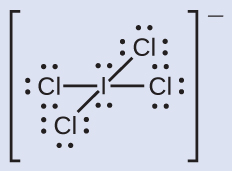
Assign formal charges to each atom in the interhalogen ion
ハロゲン間イオンの各原子に形式電荷を割り当てなさい。
Solution解答
- We divide the bonding electron pairs equally for all I–Cl bonds:すべてのI–Cl結合について、結合電子対を均等に分ける。
- We assign lone pairs of electrons to their atoms. Each Cl atom now has seven electrons assigned to it, and the I atom has eight.非共有電子対は、それをもつ原子に割り当てる。これで各Cl原子に電子7個、I原子に電子8個が割り当てられる。
- Subtract this number from the number of valence electrons for the neutral atom:
I: 7 – 8 = –1
Cl: 7 – 7 = 0
The sum of the formal charges of all the atoms equals –1, which is identical to the charge of the ion (–1).中性原子の価電子数から、この電子数を引く。I:7 − 8 = −1Cl:7 − 7 = 0全原子の形式電荷の総和は−1で、イオンの電荷(−1)と一致する。
Check Your Learning理解を確かめよう
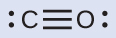
Calculate the formal charge for each atom in the carbon monoxide molecule:
一酸化炭素分子の各原子の形式電荷を計算しなさい。
Example 7.7例題 7.7
Calculating Formal Charge from Lewis Structuresルイス構造から形式電荷を計算する
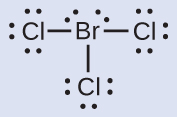
Assign formal charges to each atom in the interhalogen molecule BrCl3.
ハロゲン間分子BrCl3の各原子に形式電荷を割り当てなさい。
Solution解答
- Assign one of the electrons in each Br–Cl bond to the Br atom and one to the Cl atom in that bond:各Br–Cl結合の電子のうち、1個をBr原子に、もう1個をその結合のCl原子に割り当てる。
- Assign the lone pairs to their atom. Now each Cl atom has seven electrons and the Br atom has seven electrons.非共有電子対は、それをもつ原子に割り当てる。これで各Cl原子の電子は7個、Br原子の電子も7個となる。
- Subtract this number from the number of valence electrons for the neutral atom. This gives the formal charge:
Br: 7 – 7 = 0
Cl: 7 – 7 = 0
All atoms in BrCl3 have a formal charge of zero, and the sum of the formal charges totals zero, as it must in a neutral molecule.中性原子の価電子数から、この電子数を引くと形式電荷が得られる。Br:7 − 7 = 0Cl:7 − 7 = 0BrCl3内のすべての原子の形式電荷は0であり、その総和も0となる。これは中性分子で満たすべき条件である。
Check Your Learning理解を確かめよう
Determine the formal charge for each atom in NCl3.
NCl3の各原子の形式電荷を求めなさい。
Using Formal Charge to Predict Molecular Structure形式電荷を使って分子構造を予測する
The arrangement of atoms in a molecule or ion is called its molecular structure. In many cases, following the steps for writing Lewis structures may lead to more than one possible molecular structure—different multiple bond and lone-pair electron placements or different arrangements of atoms, for instance. A few guidelines involving formal charge can be helpful in deciding which of the possible structures is most likely for a particular molecule or ion:
英語のヒント
分子やイオン内の原子の配置を、その分子構造という。ルイス構造を書く手順に従うと、分子構造の候補が複数得られることが多い。たとえば、多重結合や非共有電子対の位置が異なったり、原子の配列が異なったりする。ある分子やイオンについて、どの構造が最もありそうかを判断する際には、形式電荷に関する次の指針が役に立つ。
- A molecular structure in which all formal charges are zero is preferable to one in which some formal charges are not zero.
英語のヒント
すべての形式電荷が0である分子構造のほうが、0でない形式電荷を含む構造より望ましい。 - If the Lewis structure must have nonzero formal charges, the arrangement with the smallest nonzero formal charges is preferable.ルイス構造に0でない形式電荷が必要な場合、その形式電荷の大きさが最小の配置が望ましい。
- Lewis structures are preferable when adjacent formal charges are zero or of the opposite sign.
英語のヒント
隣り合う形式電荷が0であるか、互いに異符号であるルイス構造が望ましい。 - When we must choose among several Lewis structures with similar distributions of formal charges, the structure with the negative formal charges on the more electronegative atoms is preferable.形式電荷の分布が似たいくつかのルイス構造から選ぶ必要があるときは、電気陰性度の大きな原子に負の形式電荷がある構造が望ましい。
To see how these guidelines apply, let us consider some possible structures for carbon dioxide, CO2. We know from our previous discussion that the less electronegative atom typically occupies the central position, but formal charges allow us to understand why this occurs. We can draw three possibilities for the structure: carbon in the center and double bonds, carbon in the center with a single and triple bond, and oxygen in the center with double bonds:
英語のヒント
これらの指針がどう適用されるかを見るため、二酸化炭素CO2に考えられるいくつかの構造を検討しよう。前の議論から、通常は電気陰性度の小さい原子が中心にくることがわかっている。形式電荷を考えると、その理由を理解できる。構造の候補は3つ書ける。炭素が中心で二重結合をもつ構造、炭素が中心で単結合と三重結合をもつ構造、そして酸素が中心で二重結合をもつ構造である。

Comparing the three formal charges, we can definitively identify the structure on the left as preferable because it has only formal charges of zero (Guideline 1).
英語のヒント
3つの形式電荷を比較すると、左の構造では形式電荷がすべて0なので、この構造が望ましいと明確に判断できる(指針1)。
As another example, the thiocyanate ion, an ion formed from a carbon atom, a nitrogen atom, and a sulfur atom, could have three different molecular structures: NCS–, CNS–, or CSN–. The formal charges present in each of these molecular structures can help us pick the most likely arrangement of atoms. Possible Lewis structures and the formal charges for each of the three possible structures for the thiocyanate ion are shown here:
別の例として、炭素原子、窒素原子、硫黄原子からなるチオシアン酸イオンには、NCS–、CNS–、CSN–という3つの異なる分子構造が考えられる。それぞれの分子構造の形式電荷は、最もありそうな原子配列を選ぶ手掛かりになる。チオシアン酸イオンの3つの構造の候補について、考えられるルイス構造と形式電荷を次に示す。

Note that the sum of the formal charges in each case is equal to the charge of the ion (–1). However, the first arrangement of atoms is preferred because it has the lowest number of atoms with nonzero formal charges (Guideline 2). Also, it places the least electronegative atom in the center, and the negative charge on the more electronegative element (Guideline 4).
いずれの場合も形式電荷の総和はイオンの電荷(−1)に等しいことに注意しよう。しかし、最初の原子配列は0でない形式電荷をもつ原子数が最小なので、最も望ましい(指針2)。また、電気陰性度が最小の原子が中心にあり、負の電荷は電気陰性度のより大きな元素にある(指針4)。
Example 7.8例題 7.8
Using Formal Charge to Determine Molecular Structure形式電荷を使って分子構造を決める
Nitrous oxide, N2O, commonly known as laughing gas, is used as an anesthetic in minor surgeries, such as the routine extraction of wisdom teeth. Which is the more likely structure for nitrous oxide?
英語のヒント
笑気として知られる亜酸化窒素N2Oは、通常の親知らずの抜歯など、小規模な手術で麻酔薬として使われる。亜酸化窒素として、よりありそうな構造はどちらか。

Solution解答
Determining formal charge yields the following:
形式電荷を求めると、次のようになる。
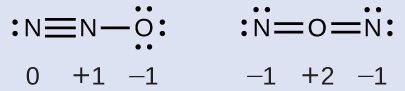
The structure with a terminal oxygen atom best satisfies the criteria for the most stable distribution of formal charge:
英語のヒント
酸素原子が末端にある構造が、最も安定な形式電荷の分布についての基準を最もよく満たす。
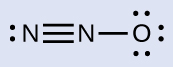
The number of atoms with formal charges are minimized (Guideline 2), there is no formal charge with a magnitude greater than one (Guideline 2), the negative formal charge is on the more electronegative element (Guideline 4), and the less electronegative atom is in the center position.
形式電荷をもつ原子数が最小であり(指針2)、大きさが1を超える形式電荷がない(指針2)。負の形式電荷は電気陰性度のより大きな元素上にあり(指針4)、電気陰性度のより小さな原子が中心に位置する。
Check Your Learning理解を確かめよう
Which is the most likely molecular structure for the nitrite ion?
亜硝酸イオンの分子構造として、最もありそうなのはどちらか。



