第7章化学結合と分子の形
7.1 Ionic Bonding7.1 イオン結合
Learning Objectives学習目標
By the end of this section, you will be able to:
この節を学ぶと、次のことができるようになる。
- Explain the formation of cations, anions, and ionic compounds陽イオン、陰イオン、イオン化合物ができる仕組みを説明する。
- Predict the charge of common metallic and nonmetallic elements, and write their electron configurations一般的な金属元素・非金属元素がもつ電荷を予測し、その電子配置を書く。
As you have learned, ions are atoms or molecules bearing an electrical charge. A cation (a positive ion) forms when a neutral atom loses one or more electrons from its valence shell, and an anion (a negative ion) forms when a neutral atom gains one or more electrons in its valence shell.
英語のヒント
すでに学んだように、イオンとは電荷を帯びた原子または分子である。中性の原子が価電子殻から1個以上の電子を失うと陽イオン(正のイオン)ができ、中性の原子が価電子殻に1個以上の電子を受け取ると陰イオン(負のイオン)ができる。
Compounds composed of ions are called ionic compounds (or salts), and their constituent ions are held together by ionic bonds: electrostatic forces of attraction between oppositely charged cations and anions. The properties of ionic compounds shed some light on the nature of ionic bonds. Ionic solids exhibit a crystalline structure and tend to be rigid and brittle; they also tend to have high melting and boiling points, which suggests that ionic bonds are very strong. Ionic solids are also poor conductors of electricity for the same reason—the strength of ionic bonds prevents ions from moving freely in the solid state. Most ionic solids, however, dissolve readily in water. Once dissolved or melted, ionic compounds are excellent conductors of electricity and heat because the ions can move about freely.
英語のヒント
イオンからなる化合物をイオン化合物(または塩)といい、構成するイオンはイオン結合によって結び付いている。イオン結合とは、逆符号の電荷をもつ陽イオンと陰イオンの間にはたらく静電引力である。イオン化合物の性質から、イオン結合の本質をある程度知ることができる。イオン性の固体は結晶構造をもち、硬くてもろい傾向がある。融点や沸点も高い傾向があり、これはイオン結合が非常に強いことを示唆する。イオン性の固体が電気を通しにくいのも、同じ理由による。強いイオン結合が、固体中でイオンが自由に動くのを妨げるためである。しかし、多くのイオン性の固体は水に容易に溶ける。溶解または融解すると、イオンが自由に動き回れるようになるため、イオン化合物は電気と熱をよく通す。
Neutral atoms and their associated ions have very different physical and chemical properties. Sodium atoms form sodium metal, a soft, silvery-white metal that burns vigorously in air and reacts explosively with water. Chlorine atoms form chlorine gas, Cl2, a yellow-green gas that is extremely corrosive to most metals and very poisonous to animals and plants. The vigorous reaction between the elements sodium and chlorine forms the white, crystalline compound sodium chloride, common table salt, which contains sodium cations and chloride anions (Figure 7.2). The compound composed of these ions exhibits properties entirely different from the properties of the elements sodium and chlorine. Chlorine is poisonous, but sodium chloride is essential to life; sodium atoms react vigorously with water, but sodium chloride simply dissolves in water.
英語のヒント
中性原子と、その原子からできるイオンとでは、物理的・化学的性質が大きく異なる。ナトリウム原子からできる金属ナトリウムは、柔らかい銀白色の金属で、空気中で激しく燃え、水と爆発的に反応する。塩素原子からできる塩素ガスCl2は黄緑色で、ほとんどの金属を強く腐食し、動植物に対して強い毒性をもつ。ナトリウムと塩素の単体どうしを激しく反応させると、白い結晶性の化合物である塩化ナトリウム、すなわち食塩ができる。食塩にはナトリウム陽イオンと塩化物陰イオンが含まれる(図7.2)。これらのイオンからなる化合物は、ナトリウムや塩素の単体とはまったく異なる性質を示す。塩素は有毒だが、塩化ナトリウムは生命に不可欠である。ナトリウム原子は水と激しく反応するが、塩化ナトリウムは単に水に溶ける。
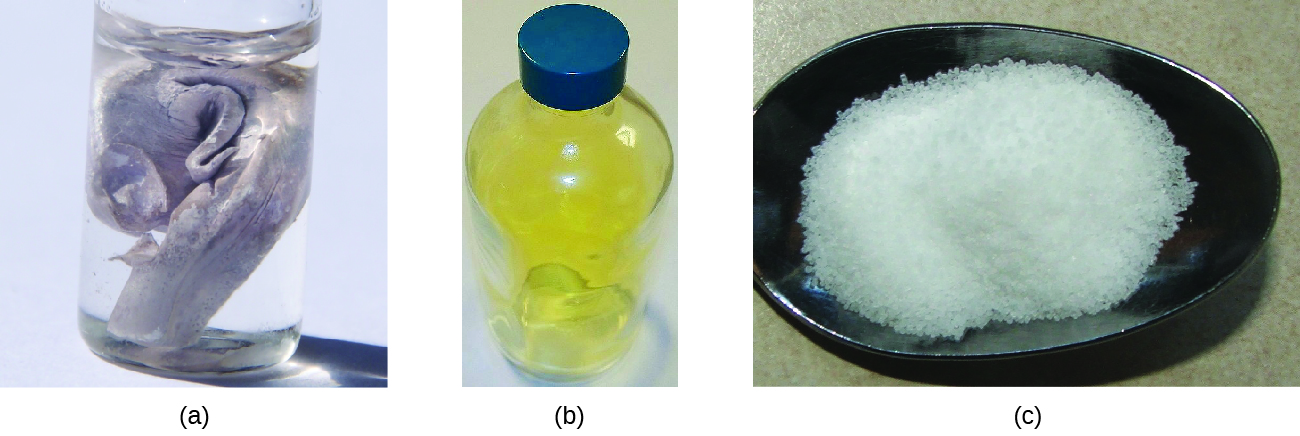
Jurii / images-of-elements.com; Chemicalinterest; modified by OpenStax. · CC BY 3.0; public-domain source photograph; CC BY 4.0 composition · Source出典
Figure 7.2図 7.2
(a) Sodium is a soft metal that must be stored in mineral oil to prevent reaction with air or water. (b) Chlorine is a pale yellow-green gas. (c) When combined, they form white crystals of sodium chloride (table salt). (credit a: modification of work by “Jurii”/Wikimedia Commons)
英語のヒント
(a)ナトリウムは柔らかい金属であり、空気や水との反応を防ぐため、鉱油中に保存しなければならない。(b)塩素は淡い黄緑色の気体である。(c)両者を結合させると、塩化ナトリウム(食塩)の白い結晶ができる。出典:aは「Jurii」/Wikimedia Commonsの作品を改変。
The Formation of Ionic Compoundsイオン化合物の生成
Binary ionic compounds are composed of just two elements: a metal (which forms the cations) and a nonmetal (which forms the anions). For example, NaCl is a binary ionic compound. We can think about the formation of such compounds in terms of the periodic properties of the elements. Many metallic elements have relatively low ionization potentials and lose electrons easily. These elements lie to the left in a period or near the bottom of a group on the periodic table. Nonmetal atoms have relatively high electron affinities and thus readily gain electrons lost by metal atoms, thereby filling their valence shells. Nonmetallic elements are found in the upper-right corner of the periodic table.
英語のヒント
二元イオン化合物は、陽イオンになる金属と、陰イオンになる非金属の、2種類の元素だけからなる。たとえば、NaClは二元イオン化合物である。このような化合物の生成は、元素の周期的な性質から考えられる。多くの金属元素はイオン化ポテンシャルが比較的低く、電子を失いやすい。こうした元素は、周期表の同じ周期の左側や、同じ族の下のほうに位置する。非金属原子は電子親和力が比較的高いため、金属原子が失った電子を容易に受け取り、価電子殻を満たす。非金属元素は周期表の右上に位置している。
As all substances must be electrically neutral, the total number of positive charges on the cations of an ionic compound must equal the total number of negative charges on its anions. The formula of an ionic compound represents the simplest ratio of the numbers of ions necessary to give identical numbers of positive and negative charges. For example, the formula for aluminum oxide, Al2O3, indicates that this ionic compound contains two aluminum cations, Al3+, for every three oxide anions, O2− [thus, (2 +3) + (3 –2) = 0].
英語のヒント
物質はすべて電気的に中性でなければならないため、イオン化合物中の陽イオンがもつ正電荷の総数は、陰イオンがもつ負電荷の総数に等しくなければならない。イオン化合物の化学式は、正負の電荷の数が同じになるために必要な、イオンの数の最も簡単な比を表す。たとえば、酸化アルミニウムの化学式Al2O3は、このイオン化合物が、酸化物陰イオンO2−3個につき、アルミニウム陽イオンAl3+を2個含むことを示す[したがって、(2 +3) + (3 –2) = 0]。
It is important to note, however, that the formula for an ionic compound does not represent the physical arrangement of its ions. It is incorrect to refer to a sodium chloride (NaCl) “molecule” because there is not a single ionic bond, per se, between any specific pair of sodium and chloride ions. The attractive forces between ions are isotropic—the same in all directions—meaning that any particular ion is equally attracted to all of the nearby ions of opposite charge. This results in the ions arranging themselves into a tightly bound, three-dimensional lattice structure. Sodium chloride, for example, consists of a regular arrangement of equal numbers of Na+ cations and Cl– anions (Figure 7.3).
英語のヒント
しかし、イオン化合物の化学式は、イオンの実際の配置を表すものではないことに注意する必要がある。塩化ナトリウム(NaCl)の「分子」と呼ぶのは正しくない。特定のナトリウムイオンと塩化物イオンの一対の間に、それだけで独立した1本のイオン結合があるわけではないからである。イオン間の引力は等方的、すなわちすべての方向で同じである。したがって、あるイオンは、周囲にある逆符号の電荷をもつすべてのイオンから、同じように引き付けられる。その結果、イオンは強く結び付いた三次元の格子構造に配列する。たとえば塩化ナトリウムは、同じ数のNa+陽イオンとCl–陰イオンが規則正しく配列したものである(図7.3)。
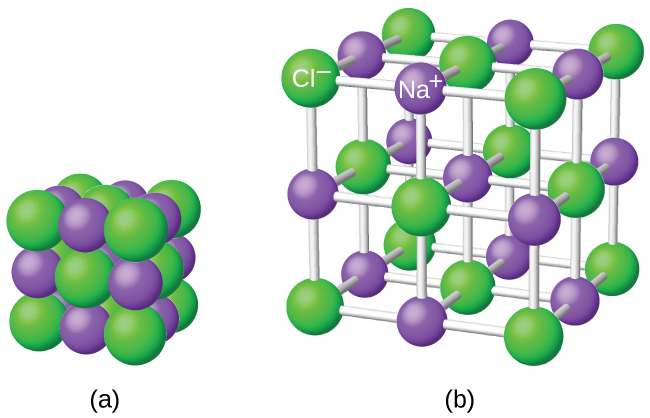


Figure 7.3図 7.3
The atoms in sodium chloride (common table salt) are arranged to (a) maximize opposite charges interacting. The smaller spheres represent sodium ions, the larger ones represent chloride ions. In the expanded view (b), the geometry can be seen more clearly. Note that each ion is “bonded” to all of the surrounding ions—six in this case.
英語のヒント
塩化ナトリウム(食塩)の原子は、逆符号の電荷の相互作用を最大にするように配列している(a)。小さい球はナトリウムイオン、大きい球は塩化物イオンを表す。間隔を広げた図(b)では、幾何学的な配置がより明瞭にわかる。各イオンは周囲のすべてのイオン、この場合は6個と「結合」していることに注意しよう。
The strong electrostatic attraction between Na+ and Cl– ions holds them tightly together in solid NaCl. It requires 769 kJ of energy to dissociate one mole of solid NaCl into separate gaseous Na+ and Cl– ions:
英語のヒント
Na+イオンとCl–イオンの間の強い静電引力が、固体NaClの中で両者を強く結び付けている。固体NaClを1モル、互いに離れた気体のNa+イオンとCl–イオンに解離させるには、769 kJのエネルギーが必要である。