第7章化学結合と分子の形
Electronegativity電気陰性度
Whether a bond is nonpolar or polar covalent is determined by a property of the bonding atoms called electronegativity. Electronegativity is a measure of the tendency of an atom to attract electrons (or electron density) towards itself. It determines how the shared electrons are distributed between the two atoms in a bond. The more strongly an atom attracts the electrons in its bonds, the larger its electronegativity. Electrons in a polar covalent bond are shifted toward the more electronegative atom; thus, the more electronegative atom is the one with the partial negative charge. The greater the difference in electronegativity, the more polarized the electron distribution and the larger the partial charges of the atoms.
英語のヒント
共有結合が無極性か極性かは、結合する原子の電気陰性度という性質で決まる。電気陰性度は、原子が電子(または電子密度)を自分のほうへ引き付ける傾向の尺度である。共有される電子が、結合する2原子間にどう分布するかを決める。原子が結合中の電子を強く引き付けるほど、電気陰性度は大きい。極性共有結合の電子は、電気陰性度の大きい原子のほうへ偏る。したがって、電気陰性度の大きい原子が、部分的な負電荷をもつ側になる。電気陰性度の差が大きいほど電子分布の偏りは大きくなり、各原子の部分電荷も大きくなる。
Figure 7.6 shows the electronegativity values of the elements as proposed by one of the most famous chemists of the twentieth century: Linus Pauling (Figure 7.7). In general, electronegativity increases from left to right across a period in the periodic table and decreases down a group. Thus, the nonmetals, which lie in the upper right, tend to have the highest electronegativities, with fluorine the most electronegative element of all (EN = 4.0). Metals tend to be less electronegative elements, and the group 1 metals have the lowest electronegativities. Note that noble gases are excluded from this figure because these atoms usually do not share electrons with others atoms since they have a full valence shell. (While noble gas compounds such as XeO2 do exist, they can only be formed under extreme conditions, and thus they do not fit neatly into the general model of electronegativity.)
英語のヒント
図7.6に、20世紀で最も著名な化学者の1人、ライナス・ポーリング(図7.7)が提案した元素の電気陰性度を示す。一般に、電気陰性度は周期表の同じ周期で左から右へ増加し、同じ族で下へ行くほど減少する。したがって、右上にある非金属は電気陰性度が高い傾向があり、フッ素が全元素中で最も高い(EN = 4.0)。金属の電気陰性度は低い傾向があり、第1族の金属は最も低い。この図から希ガスを除いてあることに注意しよう。希ガス原子は価電子殻が満たされているため、通常は他の原子と電子を共有しないからである。XeO2などの希ガス化合物は実際に存在するが、極端な条件でしか生成できず、そのため電気陰性度の一般的なモデルにはきれいに当てはまらない。
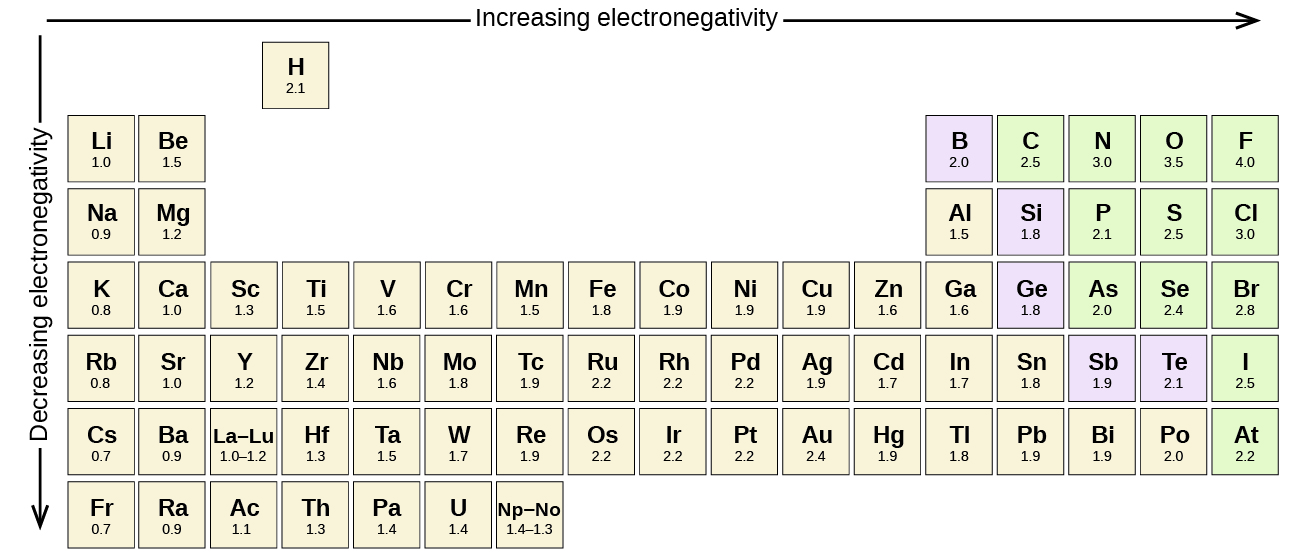
Figure 7.6図 7.6
The electronegativity values derived by Pauling follow predictable periodic trends, with the higher electronegativities toward the upper right of the periodic table.
英語のヒント
ポーリングが求めた電気陰性度は、予測可能な周期的傾向を示し、周期表の右上ほど大きくなる。
Electronegativity versus Electron Affinity電気陰性度と電子親和力
We must be careful not to confuse electronegativity and electron affinity. The electron affinity of an element is a measurable physical quantity, namely, the energy released or absorbed when an isolated gas-phase atom acquires an electron, measured in kJ/mol. Electronegativity, on the other hand, describes how tightly an atom attracts electrons in a bond. It is a dimensionless quantity that is calculated, not measured. Pauling derived the first electronegativity values by comparing the amounts of energy required to break different types of bonds. He chose an arbitrary relative scale ranging from 0 to 4.
英語のヒント
電気陰性度と電子親和力を混同しないよう注意しなければならない。ある元素の電子親和力は、測定できる物理量である。具体的には、気相で孤立した原子が電子1個を受け取るときに放出または吸収するエネルギーで、kJ/molで測定する。これに対し、電気陰性度は、原子が結合中の電子をどれだけ強く引き付けるかを示す。測定ではなく計算で求める無次元量である。ポーリングは、異なる種類の結合を切るのに必要なエネルギー量を比較して、最初の電気陰性度の値を求めた。その際、0から4までの任意の相対尺度を選んだ。
Electronegativity and Bond Type電気陰性度と結合の種類
The absolute value of the difference in electronegativity (ΔEN) of two bonded atoms provides a rough measure of the polarity to be expected in the bond and, thus, the bond type. When the difference is very small or zero, the bond is covalent and nonpolar. When it is large, the bond is polar covalent or ionic. The absolute values of the electronegativity differences between the atoms in the bonds H–H, H–Cl, and Na–Cl are 0 (nonpolar), 0.9 (polar covalent), and 2.1 (ionic), respectively. The degree to which electrons are shared between atoms varies from completely equal (pure covalent bonding) to not at all (ionic bonding). Figure 7.8 shows the relationship between electronegativity difference and bond type.
英語のヒント
結合した2原子の電気陰性度の差(ΔEN)の絶対値は、その結合に予想される極性、したがって結合の種類の、おおよその目安になる。差が非常に小さいか0なら無極性共有結合となり、差が大きいと極性共有結合またはイオン結合となる。H–H、H–Cl、Na–Clの各結合の原子間の電気陰性度差の絶対値は、それぞれ0(無極性)、0.9(極性共有結合)、2.1(イオン結合)である。原子間で電子を共有する程度は、完全に等しく共有する場合(無極性共有結合)から、まったく共有しない場合(イオン結合)まで変わる。図7.8は、電気陰性度の差と結合の種類の関係を示す。
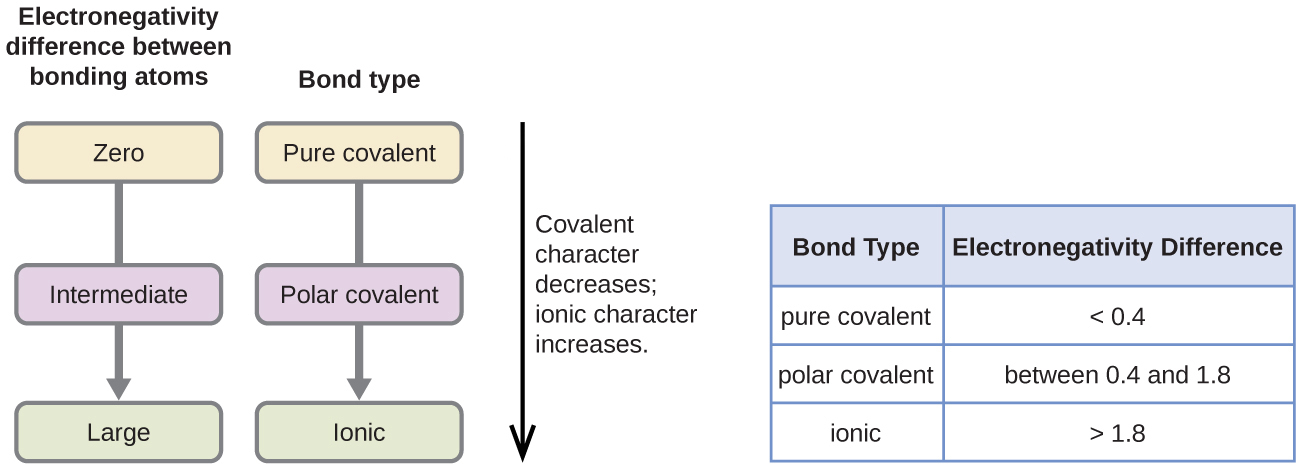


Figure 7.8図 7.8
As the electronegativity difference increases between two atoms, the bond becomes more ionic.
2原子間の電気陰性度の差が大きくなるほど、結合のイオン性が強くなる。
A rough approximation of the electronegativity differences associated with covalent, polar covalent, and ionic bonds is shown in Figure 7.8. This table is just a general guide, however, with many exceptions. For example, the H and F atoms in HF have an electronegativity difference of 1.9, and the N and H atoms in NH3 a difference of 0.9, yet both of these compounds form bonds that are considered polar covalent. Likewise, the Na and Cl atoms in NaCl have an electronegativity difference of 2.1, and the Mn and I atoms in MnI2 have a difference of 1.0, yet both of these substances form ionic compounds.
英語のヒント
共有結合、極性共有結合、イオン結合に対応する電気陰性度差のおおよその目安を、図7.8に示した。しかし、この表は一般的な指針にすぎず、例外も多い。たとえば、HFのHとFの電気陰性度差は1.9、NH3のNとHの差は0.9であるが、両化合物の結合はいずれも極性共有結合とされる。同様に、NaClのNaとClの電気陰性度差は2.1、MnI2のMnとIの差は1.0であるが、どちらの物質もイオン化合物をつくる。
The best guide to the covalent or ionic character of a bond is to consider the types of atoms involved and their relative positions in the periodic table. Bonds between two nonmetals are generally covalent; bonding between a metal and a nonmetal is often ionic.
結合が共有結合的かイオン結合的かを判断する最もよい指針は、関わる原子の種類と、周期表における相対的な位置を考えることである。2つの非金属の間の結合は一般に共有結合であり、金属と非金属の間の結合は多くの場合イオン結合となる。
Some compounds contain both covalent and ionic bonds. The atoms in polyatomic ions, such as OH–, and are held together by polar covalent bonds. However, these polyatomic ions form ionic compounds by combining with ions of opposite charge. For example, potassium nitrate, KNO3, contains the K+ cation and the polyatomic anion. Thus, bonding in potassium nitrate is ionic, resulting from the electrostatic attraction between the ions K+ and as well as covalent between the nitrogen and oxygen atoms in
英語のヒント
共有結合とイオン結合の両方を含む化合物もある。OH–、、などの多原子イオンの中では、原子は極性共有結合で結び付いている。しかし、これらの多原子イオンは、逆符号の電荷をもつイオンと結び付いてイオン化合物をつくる。たとえば硝酸カリウムKNO3は、K+陽イオンと多原子陰イオンを含む。したがって、硝酸カリウムにはK+との間の静電引力によるイオン結合があると同時に、中の窒素原子と酸素原子の間には共有結合がある。
Example 7.3例題 7.3
Electronegativity and Bond Polarity電気陰性度と結合の極性
Bond polarities play an important role in determining the structure of proteins. Using the electronegativity values in Figure 7.6, arrange the following covalent bonds—all commonly found in amino acids—in order of increasing polarity. Then designate the positive and negative atoms using the symbols δ+ and δ–:
英語のヒント
結合の極性は、タンパク質の構造を決めるうえで重要な役割を果たす。図7.6の電気陰性度を使い、次の共有結合を極性の小さい順に並べよ。いずれもアミノ酸によく見られる結合である。次に、δ+とδ–の記号で正側と負側の原子を示せ。
C–H, C–N, C–O, N–H, O–H, S–H
C–H, C–N, C–O, N–H, O–H, S–H
Solution解答
The polarity of these bonds increases as the absolute value of the electronegativity difference increases. The atom with the δ– designation is the more electronegative of the two. Table 7.1 shows these bonds in order of increasing polarity.
これらの結合の極性は、電気陰性度差の絶対値が大きくなるほど強くなる。δ–と表示するのは、2原子のうち電気陰性度が大きいほうである。表7.1に、極性が小さい順に並べた結合を示す。
Bond Polarity and Electronegativity Difference 結合の極性と電気陰性度差 |
||
|---|---|---|
Bond 結合 |
ΔEN |
Polarity 極性 |
C–H |
0.4 |
|
S–H |
0.4 |
|
C–N |
0.5 |
|
N–H |
0.9 |
|
C–O |
1.0 |
|
O–H |
1.4 |
|
Check Your Learning理解を確かめよう
Silicones are polymeric compounds containing, among others, the following types of covalent bonds: Si–O, Si–C, C–H, and C–C. Using the electronegativity values in Figure 7.6, arrange the bonds in order of increasing polarity and designate the positive and negative atoms using the symbols δ+ and δ–.
英語のヒント
シリコーンは、Si–O、Si–C、C–H、C–Cなどの共有結合を含む高分子化合物である。図7.6の電気陰性度を使い、これらの結合を極性の小さい順に並べ、δ+とδ–の記号で正側と負側の原子を示せ。