第1章化学の基本概念
1.5 Measurement Uncertainty, Accuracy, and Precision1.5 測定の不確かさ・真度・精度
Learning Objectives学習目標
By the end of this section, you will be able to:
この節を学び終えると、次のことができるようになる。
- Define accuracy and precision正確さと精度を定義する
- Distinguish exact and uncertain numbers正確な数と不確かな数を区別する
- Correctly represent uncertainty in quantities using significant figures有効数字を使って量の不確かさを正しく表す
- Apply proper rounding rules to computed quantities計算した量に適切な丸めの規則を適用する
Counting is the only type of measurement that is free from uncertainty, provided the number of objects being counted does not change while the counting process is underway. The result of such a counting measurement is an example of an exact number. By counting the eggs in a carton, one can determine exactly how many eggs the carton contains. The numbers of defined quantities are also exact. By definition, 1 foot is exactly 12 inches, 1 inch is exactly 2.54 centimeters, and 1 gram is exactly 0.001 kilogram. Quantities derived from measurements other than counting, however, are uncertain to varying extents due to practical limitations of the measurement process used.
英語のヒント
数えることは、不確かさを含まない唯一の測定である。ただし、数えている途中で対象となる物の数が変わらないことが条件になる。このように数える測定の結果は、正確な数の一例である。容器の中の卵を数えれば、容器に何個の卵が入っているかを正確に求められる。定義された量の数値も正確である。定義により、1フィートは正確に12インチ、1インチは正確に2.54センチメートル、1グラムは正確に0.001キログラムである。しかし、数える以外の測定から得られる量には、使う測定過程の実際上の限界により、さまざまな程度の不確かさがある。
Significant Figures in Measurement測定における有効数字
The numbers of measured quantities, unlike defined or directly counted quantities, are not exact. To measure the volume of liquid in a graduated cylinder, you should make a reading at the bottom of the meniscus, the lowest point on the curved surface of the liquid.
英語のヒント
測定した量の数値は、定義された量や直接数えた量とは異なり、正確ではない。メスシリンダー内の液体の体積を測るときは、湾曲した液面の最も低い位置、すなわちメニスカスの底を読み取る。
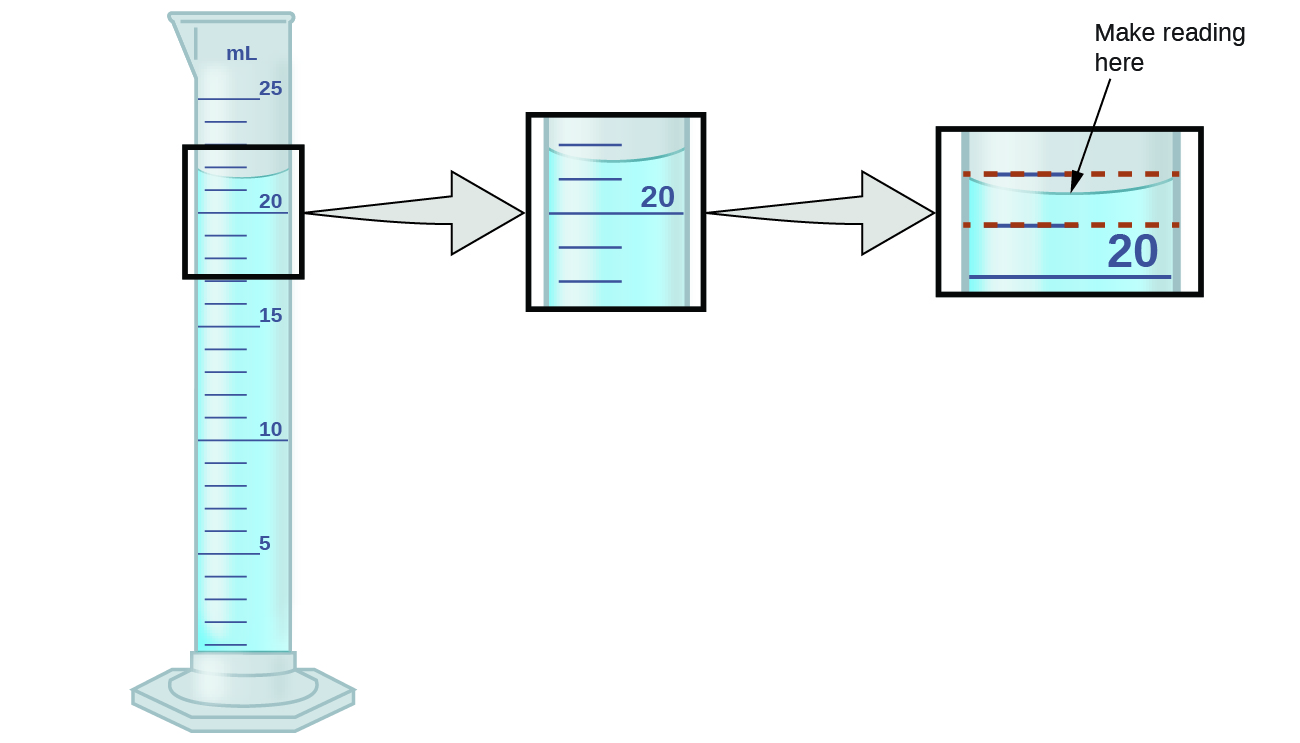
Figure 1.26図 1.26
To measure the volume of liquid in this graduated cylinder, you must mentally subdivide the distance between the 21 and 22 mL marks into tenths of a milliliter, and then make a reading (estimate) at the bottom of the meniscus.
このメスシリンダー内の液体の体積を測るには、21 mLと22 mLの目盛りの間を頭の中で0.1 mLずつに分け、メニスカスの底で読み取り(推定)を行う必要がある。
Refer to the illustration in Figure 1.26. The bottom of the meniscus in this case clearly lies between the 21 and 22 markings, meaning the liquid volume is certainly greater than 21 mL but less than 22 mL. The meniscus appears to be a bit closer to the 22-mL mark than to the 21-mL mark, and so a reasonable estimate of the liquid’s volume would be 21.6 mL. In the number 21.6, then, the digits 2 and 1 are certain, but the 6 is an estimate. Some people might estimate the meniscus position to be equally distant from each of the markings and estimate the tenth-place digit as 5, while others may think it to be even closer to the 22-mL mark and estimate this digit to be 7. Note that it would be pointless to attempt to estimate a digit for the hundredths place, given that the tenths-place digit is uncertain. In general, numerical scales such as the one on this graduated cylinder will permit measurements to one-tenth of the smallest scale division. The scale in this case has 1-mL divisions, and so volumes may be measured to the nearest 0.1 mL.
英語のヒント
図1.26を見よう。この場合、メニスカスの底は明らかに21と22の目盛りの間にあるので、液体の体積は確実に21 mLより大きく、22 mLより小さい。メニスカスは21 mLの目盛りより22 mLの目盛りに少し近く見えるので、液体の体積を21.6 mLと見積もるのが妥当だろう。したがって21.6という数値では、2と1の数字は確実だが、6は推定値である。メニスカスが両方の目盛りから等しい距離にあると判断して、小数第1位を5と見積もる人もいるかもしれない。一方、22 mLの目盛りにさらに近いと判断して、この数字を7と見積もる人もいるだろう。小数第1位が不確かなのだから、小数第2位を推定しようとしても意味がないことに注意しよう。一般に、このメスシリンダーのような数値目盛りでは、最小の目盛り間隔の10分の1まで測定できる。この場合、目盛り間隔は1 mLなので、体積を0.1 mLの位まで測定できる。
This concept holds true for all measurements, even if you do not actively make an estimate. If you place a quarter on a standard electronic balance, you may obtain a reading of 6.72 g. The digits 6 and 7 are certain, and the 2 indicates that the mass of the quarter is likely between 6.71 and 6.73 grams. The quarter weighs about 6.72 grams, with a nominal uncertainty in the measurement of ± 0.01 gram. If the coin is weighed on a more sensitive balance, the mass might be 6.723 g. This means its mass lies between 6.722 and 6.724 grams, an uncertainty of 0.001 gram. Every measurement has some uncertainty, which depends on the device used (and the user’s ability). All of the digits in a measurement, including the uncertain last digit, are called significant figures or significant digits. Note that zero may be a measured value; for example, if you stand on a scale that shows weight to the nearest pound and it shows “120,” then the 1 (hundreds), 2 (tens) and 0 (ones) are all significant (measured) values.
英語のヒント
この考え方は、意識して推定していない場合でも、すべての測定に当てはまる。標準的な電子天びんに25セント硬貨を載せると、6.72 gと表示されるかもしれない。6と7の数字は確実であり、2は硬貨の質量がおそらく6.71〜6.73グラムの間にあることを示す。硬貨の質量は約6.72グラムで、この測定の公称不確かさは±0.01グラムである。より感度の高い天びんで硬貨を量ると、質量は6.723 gかもしれない。これは質量が6.722〜6.724グラムの間にあり、不確かさが0.001グラムであることを意味する。どんな測定にもいくらかの不確かさがあり、その大きさは使う装置(と使用者の能力)に依存する。不確かな最後の桁も含め、測定値のすべての桁を有効数字という。ゼロも測定された値になり得ることに注意しよう。たとえば、1ポンドの位まで重さを示すはかりに乗って「120」と表示されたなら、1(百の位)、2(十の位)、0(一の位)はすべて有効な(測定された)値である。
A measurement result is properly reported when its significant digits accurately represent the certainty of the measurement process. But what if you were analyzing a reported value and trying to determine what is significant and what is not? Well, for starters, all nonzero digits are significant, and it is only zeros that require some thought. We will use the terms “leading,” “trailing,” and “captive” for the zeros and will consider how to deal with them.
英語のヒント
有効数字が測定過程の確かさを正しく表しているとき、測定結果は適切に報告されている。しかし、報告された値を見て、どの数字が有効で、どれが有効でないかを判断しようとする場合はどうだろうか。まず、ゼロ以外の数字はすべて有効であり、考える必要があるのはゼロだけである。ゼロについて「先頭の」「末尾の」「挟まれた」という呼び方を使い、それぞれをどう扱うか考える。
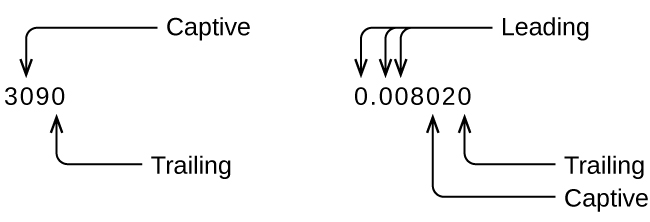
Starting with the first nonzero digit on the left, count this digit and all remaining digits to the right. This is the number of significant figures in the measurement unless the last digit is a trailing zero lying to the left of the decimal point.
英語のヒント
左から最初に現れるゼロでない数字を起点に、その数字と、その右にあるすべての数字を数える。最後の数字が小数点より左にある末尾のゼロでない限り、この数が測定値の有効数字の桁数になる。

Captive zeros result from measurement and are therefore always significant. Leading zeros, however, are never significant—they merely tell us where the decimal point is located.
英語のヒント
ほかの数字に挟まれたゼロは測定から得られたものなので、常に有効である。しかし、先頭のゼロが有効になることはなく、単に小数点の位置を示しているだけである。

The leading zeros in this example are not significant. We could use exponential notation (as described in Appendix B) and express the number as 8.32407 10−3; then the number 8.32407 contains all of the significant figures, and 10−3 locates the decimal point.
この例の先頭のゼロは有効ではない。指数表記(付録Bで説明)を使って8.32407 10−3と表せば、8.32407という数値にすべての有効数字が含まれ、10−3が小数点の位置を定める。
The number of significant figures is uncertain in a number that ends with a zero to the left of the decimal point location. The zeros in the measurement 1,300 grams could be significant or they could simply indicate where the decimal point is located. The ambiguity can be resolved with the use of exponential notation: 1.3 103 (two significant figures), 1.30 103 (three significant figures, if the tens place was measured), or 1.300 103 (four significant figures, if the ones place was also measured). In cases where only the decimal-formatted number is available, it is prudent to assume that all trailing zeros are not significant.
英語のヒント
小数点の位置より左にあるゼロで終わる数値では、有効数字の桁数は不確かである。1,300グラムという測定値のゼロは有効かもしれないし、単に小数点の位置を示しているだけかもしれない。この曖昧さは指数表記を使うと解消できる。1.3 103(有効数字2桁)、1.30 103(十の位まで測定された場合、有効数字3桁)、1.300 103(一の位も測定された場合、有効数字4桁)と表す。小数形式の数値しか示されていない場合は、末尾のゼロはすべて有効でないと考えるのが慎重な扱いである。



When determining significant figures, be sure to pay attention to reported values and think about the measurement and significant figures in terms of what is reasonable or likely when evaluating whether the value makes sense. For example, the official January 2014 census reported the resident population of the US as 317,297,725. Do you think the US population was correctly determined to the reported nine significant figures, that is, to the exact number of people? People are constantly being born, dying, or moving into or out of the country, and assumptions are made to account for the large number of people who are not actually counted. Because of these uncertainties, it might be more reasonable to expect that we know the population to within perhaps a million or so, in which case the population should be reported as 3.17 108 people.
英語のヒント
有効数字を判断するときは、報告された値に注意を払い、その値に意味があるかを確かめる際に、何が妥当か、何がありそうかという観点から測定と有効数字を考えよう。たとえば、2014年1月の公式国勢調査では、米国の居住人口が317,297,725人と報告された。米国の人口は、報告された有効数字9桁まで、つまり1人単位で正確に求められたと思うだろうか。人は絶えず生まれ、亡くなり、国の内外へ移動している。また、実際には数えられていない多くの人々を織り込むため、仮定が置かれている。こうした不確かさがあるので、人口はおそらく100万人程度の幅で把握していると考えるほうが妥当かもしれない。その場合、人口は3.17 108人と報告すべきである。