第1章化学の基本概念
1.3 Physical and Chemical Properties1.3 物理的性質と化学的性質
Learning Objectives学習目標
By the end of this section, you will be able to:
この節を学び終えると、次のことができるようになる。
- Identify properties of and changes in matter as physical or chemical物質の性質と変化を、物理的なものと化学的なものに分類する
- Identify properties of matter as extensive or intensive物質の性質を、示量性質と示強性質に分類する
The characteristics that distinguish one substance from another are called properties. A physical property is a characteristic of matter that is not associated with a change in its chemical composition. Familiar examples of physical properties include density, color, hardness, melting and boiling points, and electrical conductivity. Some physical properties, such as density and color, may be observed without changing the physical state of the matter. Other physical properties, such as the melting temperature of iron or the freezing temperature of water, can only be observed as matter undergoes a physical change. A physical change is a change in the state or properties of matter without any accompanying change in the chemical identities of the substances contained in the matter. Physical changes are observed when wax melts, when sugar dissolves in coffee, and when steam condenses into liquid water (Figure 1.18). Other examples of physical changes include magnetizing and demagnetizing metals (as is done with common antitheft security tags) and grinding solids into powders (which can sometimes yield noticeable changes in color). In each of these examples, there is a change in the physical state, form, or properties of the substance, but no change in its chemical composition.
英語のヒント
ある物質を別の物質と区別する特徴を、性質という。物理的性質とは、化学組成の変化を伴わない物質の特徴である。身近な例として、密度、色、硬さ、融点と沸点、電気伝導性が挙げられる。密度や色などの物理的性質は、物質の物理的な状態を変えずに観察できる。鉄の融解温度や水の凝固温度など、別の物理的性質は、物質に物理変化が起こるときにしか観察できない。物理変化とは、物質の状態や性質は変わるが、その中に含まれる物質の化学的な種類は変わらない変化である。ろうが融けるとき、砂糖がコーヒーに溶けるとき、水蒸気が凝縮して液体の水になるときには、物理変化が観察される(図1.18)。ほかには、一般的な盗難防止タグで行うような金属の磁化・消磁や、固体を粉末にする粉砕がある。粉砕では、ときに色の変化が目立つこともある。どの例でも、物質の物理的な状態、形、性質には変化があるが、化学組成は変わらない。
Image omitted because its reuse rights could not be verified.権利の確認ができないため画像を割愛。
Figure 1.18図 1.18
(a) Wax undergoes a physical change when solid wax is heated and forms liquid wax. (b) Steam condensing inside a cooking pot is a physical change, as water vapor is changed into liquid water. (credit a: modification of work by “95jb14”/Wikimedia Commons; credit b: modification of work by “mjneuby”/Flickr)
(a) 固体のろうを加熱して液体のろうにすると、物理変化が起こる。(b) 調理鍋の内部で水蒸気が凝縮するのは、気体の水が液体の水に変わる物理変化である。(出典:aは「95jb14」/Wikimedia Commonsの作品を改変、bは「mjneuby」/Flickrの作品を改変)
The ability to change from one type of matter into another (or the inability to change) is a chemical property. Examples of chemical properties include flammability, toxicity, acidity, and many other types of reactivity. Iron, for example, combines with oxygen in the presence of water to form rust; chromium does not oxidize (Figure 1.19). Nitroglycerin is very dangerous because it explodes easily; neon poses almost no hazard because it is very unreactive.
英語のヒント
ある種類の物質から別の種類の物質へ変わる能力(または変わらないこと)は、化学的性質である。化学的性質には、燃焼性、毒性、酸性をはじめ、さまざまな種類の反応性がある。たとえば鉄は水の存在下で酸素と結びついてさびを生じるが、クロムは酸化しない(図1.19)。ニトログリセリンは容易に爆発するため非常に危険である。一方、ネオンは反応性が非常に低いため、ほとんど危険をもたらさない。
Image omitted because its reuse rights could not be verified.権利の確認ができないため画像を割愛。
Figure 1.19図 1.19
(a) One of the chemical properties of iron is that it rusts; (b) one of the chemical properties of chromium is that it does not. (credit a: modification of work by Tony Hisgett; credit b: modification of work by “Atoma”/Wikimedia Commons)
(a) 鉄の化学的性質の一つはさびることであり、(b) クロムの化学的性質の一つはさびないことである。(出典a:Tony Hisgettの作品を改変、出典b:「Atoma」/Wikimedia Commonsの作品を改変)
A chemical change always produces one or more types of matter that differ from the matter present before the change. The formation of rust is a chemical change because rust is a different kind of matter than the iron, oxygen, and water present before the rust formed. The explosion of nitroglycerin is a chemical change because the gases produced are very different kinds of matter from the original substance. Other examples of chemical changes include reactions that are performed in a lab (such as copper reacting with nitric acid), all forms of combustion (burning), and food being cooked, digested, or rotting (Figure 1.20).
英語のヒント
化学変化では、変化前に存在していた物質とは異なる物質が、必ず1種類以上生じる。さびは、さびができる前に存在した鉄、酸素、水とは異なる種類の物質なので、さびの生成は化学変化である。ニトログリセリンの爆発は、生じる気体がもとの物質とはまったく異なる種類の物質であるため、化学変化である。化学変化の例にはほかにも、実験室で行う反応(銅と硝酸の反応など)、あらゆる形の燃焼、食品の調理、消化、腐敗がある(図1.20)。
Image omitted because its reuse rights could not be verified.権利の確認ができないため画像を割愛。
Figure 1.20図 1.20
(a) Copper and nitric acid undergo a chemical change to form copper nitrate and brown, gaseous nitrogen dioxide. (b) During the combustion of a match, cellulose in the match and oxygen from the air undergo a chemical change to form carbon dioxide and water vapor. (c) Cooking red meat causes a number of chemical changes, including the oxidation of iron in myoglobin that results in the familiar red-to-brown color change. (d) A banana turning brown is a chemical change as new, darker (and less tasty) substances form. (credit b: modification of work by Jeff Turner; credit c: modification of work by Gloria Cabada-Leman; credit d: modification of work by Roberto Verzo)
(a) 銅と硝酸は化学変化を起こし、硝酸銅と褐色の気体である二酸化窒素を生じる。(b) マッチが燃焼する際には、マッチに含まれるセルロースと空気中の酸素が化学変化を起こし、二酸化炭素と水蒸気を生じる。(c) 赤い肉の調理では多くの化学変化が起こる。その一つがミオグロビン中の鉄の酸化で、これによっておなじみの赤色から褐色への変色が生じる。(d) バナナが褐色になるのは、新たに色の濃い(そしておいしさの劣る)物質ができるためであり、化学変化である。(出典b:Jeff Turnerの作品を改変、出典c:Gloria Cabada-Lemanの作品を改変、出典d:Roberto Verzoの作品を改変)
Properties of matter fall into one of two categories. If the property depends on the amount of matter present, it is an extensive property. The mass and volume of a substance are examples of extensive properties; for instance, a gallon of milk has a larger mass than a cup of milk. The value of an extensive property is directly proportional to the amount of matter in question. If the property of a sample of matter does not depend on the amount of matter present, it is an intensive property. Temperature is an example of an intensive property. If the gallon and cup of milk are each at 20 °C (room temperature), when they are combined, the temperature remains at 20 °C. As another example, consider the distinct but related properties of heat and temperature. A drop of hot cooking oil spattered on your arm causes brief, minor discomfort, whereas a pot of hot oil yields severe burns. Both the drop and the pot of oil are at the same temperature (an intensive property), but the pot clearly contains much more heat (extensive property).
英語のヒント
物質の性質は二つのカテゴリーのいずれかに分類される。存在する物質の量に依存する性質を、示量性質という。物質の質量と体積は示量性質の例である。たとえば、1ガロンの牛乳は1カップの牛乳より質量が大きい。示量性質の値は、対象となる物質の量に正比例する。物質試料の性質が、存在する物質の量に依存しなければ、それは示強性質である。温度は示強性質の例である。1ガロンの牛乳と1カップの牛乳がどちらも20 °C(室温)なら、両者を混ぜ合わせても温度は20 °Cのままである。別の例として、互いに異なるが関係のある性質、熱と温度を考えよう。熱い食用油が1滴腕にはねると、軽い不快感がしばらく続くが、鍋いっぱいの熱い油では重いやけどを負う。1滴の油も鍋の油も同じ温度(示強性質)だが、鍋のほうがはるかに多くの熱(示量性質)を含んでいることは明らかである。
While many elements differ dramatically in their chemical and physical properties, some elements have similar properties. For example, many elements conduct heat and electricity well, whereas others are poor conductors. These properties can be used to sort the elements into three classes: metals (elements that conduct well), nonmetals (elements that conduct poorly), and metalloids (elements that have intermediate conductivities).
英語のヒント
多くの元素は化学的性質や物理的性質が大きく異なるが、似た性質をもつ元素もある。たとえば、熱や電気をよく伝える元素が多くある一方で、伝えにくい元素もある。こうした性質によって、元素を金属(よく伝える元素)、非金属(伝えにくい元素)、半金属(中間の伝導性をもつ元素)の三つに分類できる。
The periodic table is a table of elements that places elements with similar properties close together (Figure 1.22). You will learn more about the periodic table as you continue your study of chemistry.
周期表は、似た性質をもつ元素を互いに近くに配置した元素の表である(図1.22)。化学の学習を進めながら、周期表についてさらに詳しく学ぶ。
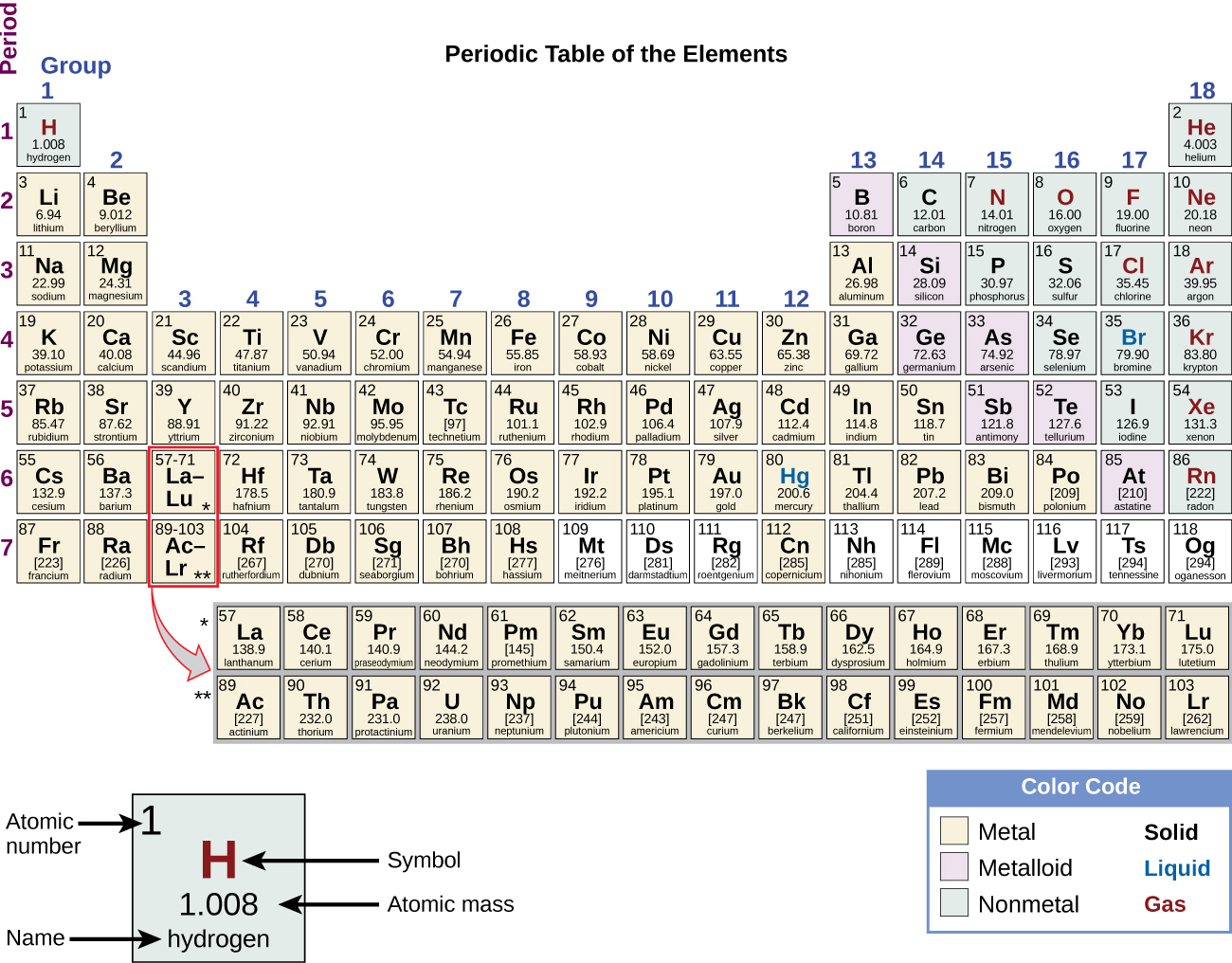

Figure 1.22図 1.22
The periodic table shows how elements may be grouped according to certain similar properties. Note the background color denotes whether an element is a metal, metalloid, or nonmetal, whereas the element symbol color indicates whether it is a solid, liquid, or gas.
周期表は、特定の似た性質に従って元素をどのように分類できるかを示す。背景の色は元素が金属、半金属、非金属のどれであるかを表し、元素記号の色は固体、液体、気体のどれであるかを表していることに注目しよう。