第1章化学の基本概念
Atoms and Molecules原子と分子
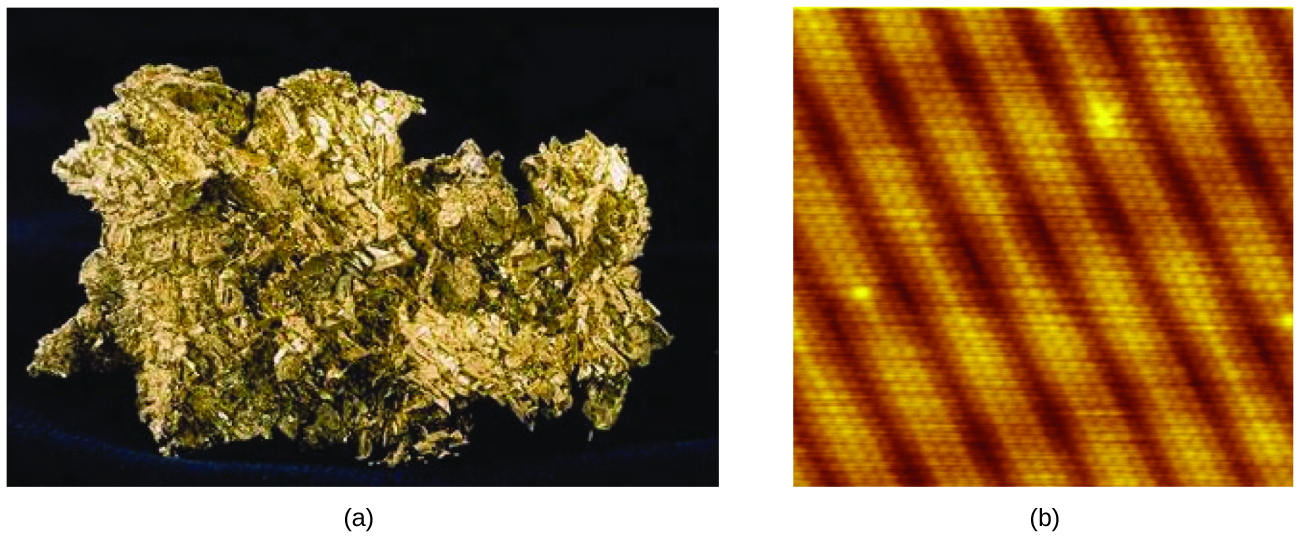
An atom is the smallest particle of an element that has the properties of that element and can enter into a chemical combination. Consider the element gold, for example. Imagine cutting a gold nugget in half, then cutting one of the halves in half, and repeating this process until a piece of gold remained that was so small that it could not be cut in half (regardless of how tiny your knife may be). This minimally sized piece of gold is an atom (from the Greek atomos, meaning “indivisible”) (Figure 1.12). This atom would no longer be gold if it were divided any further.
英語のヒント
原子とは、ある元素の性質を持ち、化学的な結合に加わることのできる、その元素の最小の粒子である。たとえば金という元素を考えてみよう。金塊を半分に切り、その片方をさらに半分に切る。この操作を繰り返して、どれほど小さなナイフを使っても半分には切れないほど小さな金のかけらが残るところを想像してほしい。この最小の金のかけらが原子である。atomという語は「分割できない」を意味するギリシャ語atomosに由来する(図1.12)。この原子をそれ以上分割すると、もはや金ではなくなる。
USGS; Erwin Rossen; modified by OpenStax. · CC BY 4.0; public-domain source photographs · Source出典
Figure 1.12図 1.12
(a) This photograph shows a gold nugget. (b) A scanning-tunneling microscope (STM) can generate views of the surfaces of solids, such as this image of a gold crystal. Each sphere represents one gold atom. (credit a: modification of work by United States Geological Survey; credit b: modification of work by “Erwinrossen”/Wikimedia Commons)
(a) 金塊の写真。(b) 走査型トンネル顕微鏡(STM)は、この金結晶の画像のように、固体の表面を画像にできる。各球は金原子一つを表す。(出典:aはUnited States Geological Surveyの作品を改変、bは「Erwinrossen」/Wikimedia Commonsの作品を改変)
The first suggestion that matter is composed of atoms is attributed to the Greek philosophers Leucippus and Democritus, who developed their ideas in the 5th century BCE. However, it was not until the early nineteenth century that John Dalton (1766–1844), a British schoolteacher with a keen interest in science, supported this hypothesis with quantitative measurements. Since that time, repeated experiments have confirmed many aspects of this hypothesis, and it has become one of the central theories of chemistry. Other aspects of Dalton’s atomic theory are still used but with minor revisions (details of Dalton’s theory are provided in the chapter on atoms and molecules).
英語のヒント
物質が原子からできているという最初の提案は、紀元前5世紀に考えを発展させたギリシャの哲学者レウキッポスとデモクリトスによるものとされる。しかし、この仮説が定量的な測定によって裏付けられたのは19世紀初めのことで、科学に強い関心を持つイギリスの教師ジョン・ドルトン(1766~1844年)がそれを行った。それ以来、繰り返された実験によって、この仮説の多くの側面が確認され、化学の中心的な理論の一つとなった。ドルトンの原子説のほかの部分も、わずかな修正を加えて現在も使われている。ドルトンの理論の詳細は、原子と分子を扱う章で説明する。
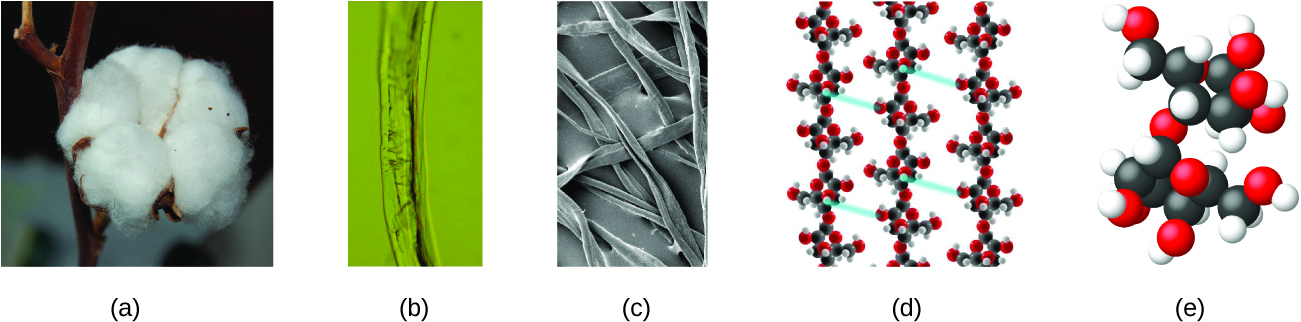
An atom is so small that its size is difficult to imagine. One of the smallest things we can see with our unaided eye is a single thread of a spider web: These strands are about 1/10,000 of a centimeter (0.0001 cm) in diameter. Although the cross-section of one strand is almost impossible to see without a microscope, it is huge on an atomic scale. A single carbon atom in the web has a diameter of about 0.000000015 centimeter, and it would take about 7000 carbon atoms to span the diameter of the strand. To put this in perspective, if a carbon atom were the size of a dime, the cross-section of one strand would be larger than a football field, which would require about 150 million carbon atom “dimes” to cover it. (Figure 1.13) shows increasingly close microscopic and atomic-level views of ordinary cotton.
英語のヒント
原子は、その大きさを想像するのが難しいほど小さい。肉眼で見える最も小さいものの一つが、クモの巣の糸一本である。その直径は約1万分の1センチメートル(0.0001 cm)である。糸一本の断面は顕微鏡なしではほとんど見えないが、原子の尺度では巨大である。その糸を構成する炭素原子一つの直径は約0.000000015センチメートルで、糸の直径を端から端まで埋めるには約7000個の炭素原子が必要になる。この大きさの関係をつかむために、炭素原子が10セント硬貨ほどの大きさになったと考えてみよう。すると糸一本の断面はフットボール場より大きくなり、そこを埋め尽くすには、炭素原子を表す「10セント硬貨」が約1億5000万枚必要になる。図1.13には、普通の綿を顕微鏡の尺度から原子の尺度へと、次第に拡大して見た様子を示す。
Featheredtar; modified by OpenStax. · CC BY 3.0; CC BY 4.0 composition · Source出典
Figure 1.13図 1.13
These images provide an increasingly closer view: (a) a cotton boll, (b) a single cotton fiber viewed under an optical microscope (magnified 40 times), (c) an image of a cotton fiber obtained with an electron microscope (much higher magnification than with the optical microscope); and (d and e) atomic-level models of the fiber (spheres of different colors represent atoms of different elements). (credit c: modification of work by “Featheredtar”/Wikimedia Commons)
これらの画像は、対象を次第に細かく見たものである。(a) 綿の実、(b) 光学顕微鏡で40倍に拡大した綿繊維一本、(c) 光学顕微鏡よりはるかに高倍率の電子顕微鏡で撮影した綿繊維、(d)と(e)は繊維の原子レベルのモデルである。色の異なる球は、異なる元素の原子を表す。(出典:cは「Featheredtar」/Wikimedia Commonsの作品を改変)
An atom is so light that its mass is also difficult to imagine. A billion lead atoms (1,000,000,000 atoms) weigh about 3 10−13 grams, a mass that is far too light to be weighed on even the world’s most sensitive balances. It would require over 300,000,000,000,000 lead atoms (300 trillion, or 3 1014) to be weighed, and they would weigh only 0.0000001 gram.
英語のヒント
原子は非常に軽く、その質量を想像するのも難しい。鉛原子10億個(1,000,000,000個)の質量は約3 10−13グラムで、世界で最も感度の高い天秤でも測れないほど軽い。測定するには300,000,000,000,000個を超える鉛原子、つまり300兆個、または3 1014個以上が必要となるが、それでも質量はわずか0.0000001グラムである。
It is rare to find collections of individual atoms. Only a few elements, such as the gases helium, neon, and argon, consist of a collection of individual atoms that move about independently of one another. Other elements, such as the gases hydrogen, nitrogen, oxygen, and chlorine, are composed of units that consist of pairs of atoms (Figure 1.14). One form of the element phosphorus consists of units composed of four phosphorus atoms. The element sulfur exists in various forms, one of which consists of units composed of eight sulfur atoms. These units are called molecules. A molecule consists of two or more atoms joined by strong forces called chemical bonds. The atoms in a molecule move around as a unit, much like the cans of soda in a six-pack or a bunch of keys joined together on a single key ring. A molecule may consist of two or more identical atoms, as in the molecules found in the elements hydrogen, oxygen, and sulfur, or it may consist of two or more different atoms, as in the molecules found in water. Each water molecule is a unit that contains two hydrogen atoms and one oxygen atom. Each glucose molecule is a unit that contains 6 carbon atoms, 12 hydrogen atoms, and 6 oxygen atoms. Like atoms, molecules are incredibly small and light. If an ordinary glass of water were enlarged to the size of the earth, the water molecules inside it would be about the size of golf balls.
英語のヒント
互いに独立した原子の集まりを見いだすことはまれである。気体のヘリウム、ネオン、アルゴンのような少数の元素だけが、互いに独立して動き回る個々の原子の集まりからできている。一方、気体の水素、窒素、酸素、塩素などの元素は、原子の対を単位として構成されている(図1.14)。リンの単体の一形態は、リン原子四つからなる単位でできている。硫黄の単体にはさまざまな形態があり、その一つは硫黄原子八つからなる単位でできている。これらの単位を分子という。分子は、化学結合と呼ばれる強い力によって結び付いた、二つ以上の原子からなる。分子内の原子は、一まとまりとして動き回る。これは、6本パックにまとめられたソーダの缶や、一つのキーリングに束ねられた鍵に似ている。分子には、水素、酸素、硫黄の単体の分子のように同じ原子が二つ以上集まったものもあれば、水の分子のように異なる原子が二つ以上集まったものもある。水分子一つは、水素原子二つと酸素原子一つを含む単位である。グルコース分子一つは、炭素原子6個、水素原子12個、酸素原子6個を含む。分子は原子と同様、信じられないほど小さく軽い。普通のコップ一杯の水を地球ほどの大きさに拡大したとしても、中の水分子はゴルフボールほどの大きさにしかならない。
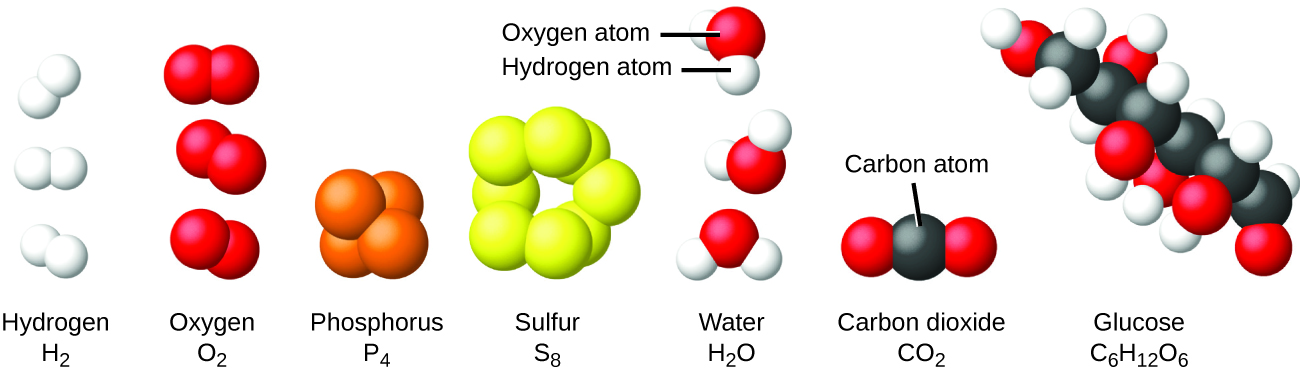


Figure 1.14図 1.14
The elements hydrogen, oxygen, phosphorus, and sulfur form molecules consisting of two or more atoms of the same element. The compounds water, carbon dioxide, and glucose consist of combinations of atoms of different elements.
水素、酸素、リン、硫黄の単体は、同じ元素の原子が二つ以上集まった分子を作る。化合物である水、二酸化炭素、グルコースは、異なる元素の原子の組合せからなる。