第1章化学の基本概念
1.2 Phases and Classification of Matter1.2 物質の状態と分類
Learning Objectives学習目標
By the end of this section, you will be able to:
この節を学び終えると、次のことができるようになる。
- Describe the basic properties of each physical state of matter: solid, liquid, and gas固体・液体・気体という、それぞれの物質の状態の基本的な性質を説明する。
- Distinguish between mass and weight質量と重さを区別する。
- Apply the law of conservation of matter物質保存の法則を適用する。
- Classify matter as an element, compound, homogeneous mixture, or heterogeneous mixture with regard to its physical state and composition物理的な状態と組成に基づいて、物質を単体、化合物、均一混合物、不均一混合物に分類する。
- Define and give examples of atoms and molecules原子と分子を定義し、例を挙げる。
Matter is defined as anything that occupies space and has mass, and it is all around us. Solids and liquids are more obviously matter: We can see that they take up space, and their weight tells us that they have mass. Gases are also matter; if gases did not take up space, a balloon would not inflate (increase its volume) when filled with gas.
英語のヒント
物質は、空間を占め、質量を持つものすべてと定義され、私たちの周囲の至る所に存在する。固体や液体が物質であることは、比較的分かりやすい。それらが空間を占めることは目で見て分かり、その重さから質量があると分かる。気体も物質である。もし気体が空間を占めないなら、風船は気体を入れても膨らまない、つまり体積が増えないはずである。
Solids, liquids, and gases are the three states of matter commonly found on earth (Figure 1.6). A solid is rigid and possesses a definite shape. A liquid flows and takes the shape of its container, except that it forms a flat or slightly curved upper surface when acted upon by gravity. (In zero gravity, liquids assume a spherical shape.) Both liquid and solid samples have volumes that are very nearly independent of pressure. A gas takes both the shape and volume of its container.
英語のヒント
固体・液体・気体は、地球上でよく見られる物質の三つの状態である(図1.6)。固体は変形しにくく、一定の形を持つ。液体は流動し、容器の形を取る。ただし、重力が作用すると、上面は平ら、またはわずかに曲がった面になる。(無重力では、液体は球形になる。)液体と固体の試料の体積は、どちらも圧力にほぼ依存しない。気体は、その容器の形と体積の両方を取る。
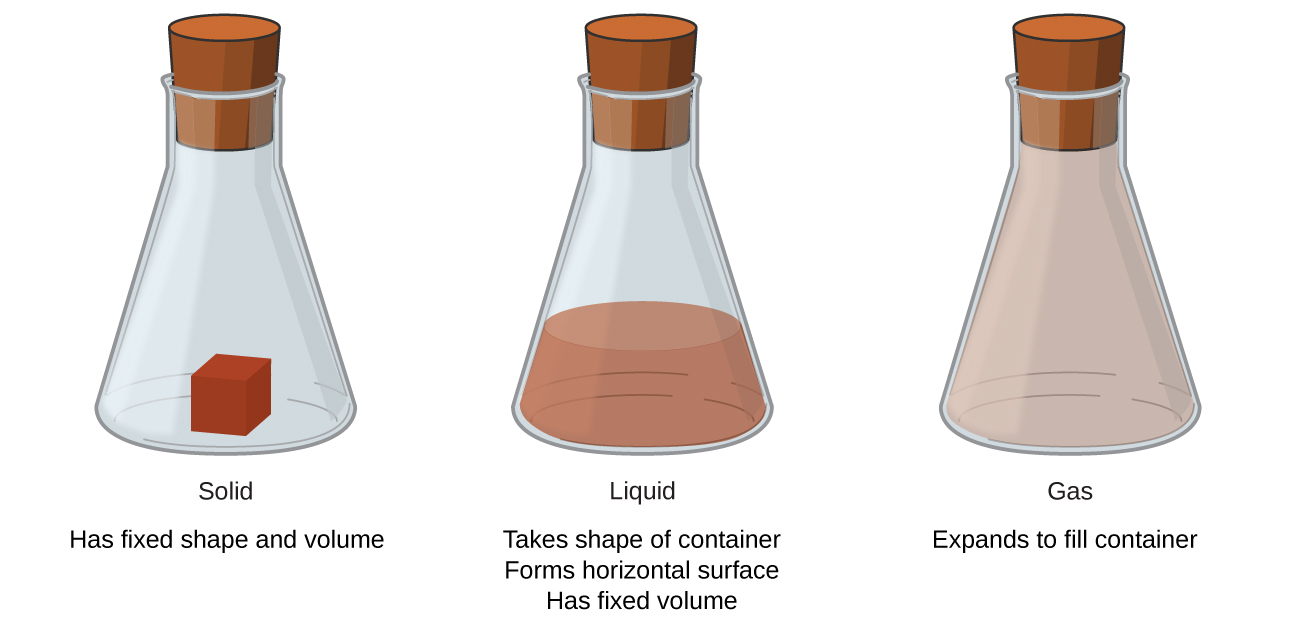
Figure 1.6図 1.6
The three most common states or phases of matter are solid, liquid, and gas.
物質の最も一般的な三つの状態、すなわち相は、固体・液体・気体である。
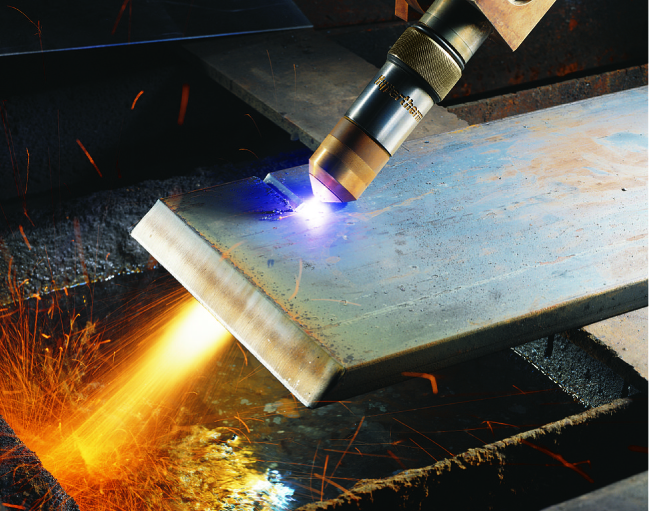
A fourth state of matter, plasma, occurs naturally in the interiors of stars. A plasma is a gaseous state of matter that contains appreciable numbers of electrically charged particles (Figure 1.7). The presence of these charged particles imparts unique properties to plasmas that justify their classification as a state of matter distinct from gases. In addition to stars, plasmas are found in some other high-temperature environments (both natural and man-made), such as lightning strikes, certain television screens, and specialized analytical instruments used to detect trace amounts of metals.
英語のヒント
物質の第四の状態であるプラズマは、恒星の内部に自然に存在する。プラズマは、電荷を持つ粒子を相当数含む、気体状の物質の状態である(図1.7)。これらの荷電粒子の存在によって、プラズマには特有の性質が生まれる。そのため、プラズマは気体とは異なる物質の状態として分類される。恒星以外にも、落雷、一部のテレビ画面、微量の金属を検出する専門的な分析装置など、自然または人工のさまざまな高温環境でプラズマが見られる。
Hypertherm; modified by OpenStax. · Copyrighted free use; CC BY 4.0 composition · Source出典
Figure 1.7図 1.7
A plasma torch can be used to cut metal. (credit: “Hypertherm”/Wikimedia Commons)
プラズマトーチは金属の切断に利用できる。(出典:「Hypertherm」/Wikimedia Commons)
Some samples of matter appear to have properties of solids, liquids, and/or gases at the same time. This can occur when the sample is composed of many small pieces. For example, we can pour sand as if it were a liquid because it is composed of many small grains of solid sand. Matter can also have properties of more than one state when it is a mixture, such as with clouds. Clouds appear to behave somewhat like gases, but they are actually mixtures of air (gas) and tiny particles of water (liquid or solid).
英語のヒント
物質の試料の中には、固体・液体・気体のうち複数の状態の性質を同時に持つように見えるものがある。これは、試料が多くの小さなかけらでできている場合に起こりうる。たとえば砂は、固体の小さな粒が多数集まったものなので、液体のように注ぐことができる。また、雲のような混合物では、物質が複数の状態の性質を持つことがある。雲は気体に多少似た振る舞いをするように見えるが、実際には空気という気体と、液体または固体の小さな水の粒子との混合物である。
The mass of an object is a measure of the amount of matter in it. One way to measure an object’s mass is to measure the force it takes to accelerate the object. It takes much more force to accelerate a car than a bicycle because the car has much more mass. A more common way to determine the mass of an object is to use a balance to compare its mass with a standard mass.
英語のヒント
物体の質量は、その中にある物質の量の尺度である。物体の質量を測る方法の一つは、その物体を加速するのに必要な力を測ることである。自動車は自転車より質量がはるかに大きいため、加速するのにはるかに大きな力を必要とする。より一般的な質量の測定方法は、天秤を用い、物体の質量を基準となる質量と比較することである。
Although weight is related to mass, it is not the same thing. Weight refers to the force that gravity exerts on an object. This force is directly proportional to the mass of the object. The weight of an object changes as the force of gravity changes, but its mass does not. An astronaut’s mass does not change just because she goes to the moon. But her weight on the moon is only one-sixth her earth-bound weight because the moon’s gravity is only one-sixth that of the earth’s. She may feel “weightless” during her trip when she experiences negligible external forces (gravitational or any other), although she is, of course, never “massless.”
英語のヒント
重さは質量に関係するが、同じものではない。重さとは、物体に重力が及ぼす力を指す。この力は物体の質量に正比例する。重力の強さが変わると物体の重さは変わるが、質量は変わらない。宇宙飛行士が月へ行ったからといって、彼女の質量は変化しない。しかし月の重力は地球の6分の1しかないため、月での彼女の重さは地球上の6分の1になる。飛行中、重力を含む外力が無視できるほど小さいときには、「無重量」だと感じるかもしれない。しかし、もちろん「質量がない」状態になることは決してない。
The law of conservation of matter summarizes many scientific observations about matter: It states that there is no detectable change in the total quantity of matter present when matter converts from one type to another (a chemical change) or changes among solid, liquid, or gaseous states (a physical change). Brewing beer and the operation of batteries provide examples of the conservation of matter (Figure 1.8). During the brewing of beer, the ingredients (water, yeast, grains, malt, hops, and sugar) are converted into beer (water, alcohol, carbonation, and flavoring substances) with no actual loss of substance. This is most clearly seen during the bottling process, when glucose turns into ethanol and carbon dioxide, and the total mass of the substances does not change. This can also be seen in a lead-acid car battery: The original substances (lead, lead oxide, and sulfuric acid), which are capable of producing electricity, are changed into other substances (lead sulfate and water) that do not produce electricity, with no change in the actual amount of matter.
英語のヒント
物質保存の法則は、物質についての多くの科学的観察をまとめたものである。物質が別の種類の物質に変わる化学変化や、固体・液体・気体の間で状態が変わる物理変化では、存在する物質の総量に検出可能な変化は生じない、という法則である。ビールの醸造や電池の作動は、物質保存の例になる(図1.8)。ビールの醸造では、水・酵母・穀物・麦芽・ホップ・糖という原料が、水・アルコール・炭酸・風味成分からなるビールへ変わるが、物質が実際に失われることはない。これは瓶詰めの過程で最もはっきり分かる。グルコースがエタノールと二酸化炭素へ変わっても、物質の総質量は変わらない。自動車の鉛蓄電池でも同じことが見られる。電気を生み出すことのできる元の物質である鉛・酸化鉛・硫酸が、電気を生み出さない別の物質である硫酸鉛と水へ変わるが、実際の物質の量には変化がない。
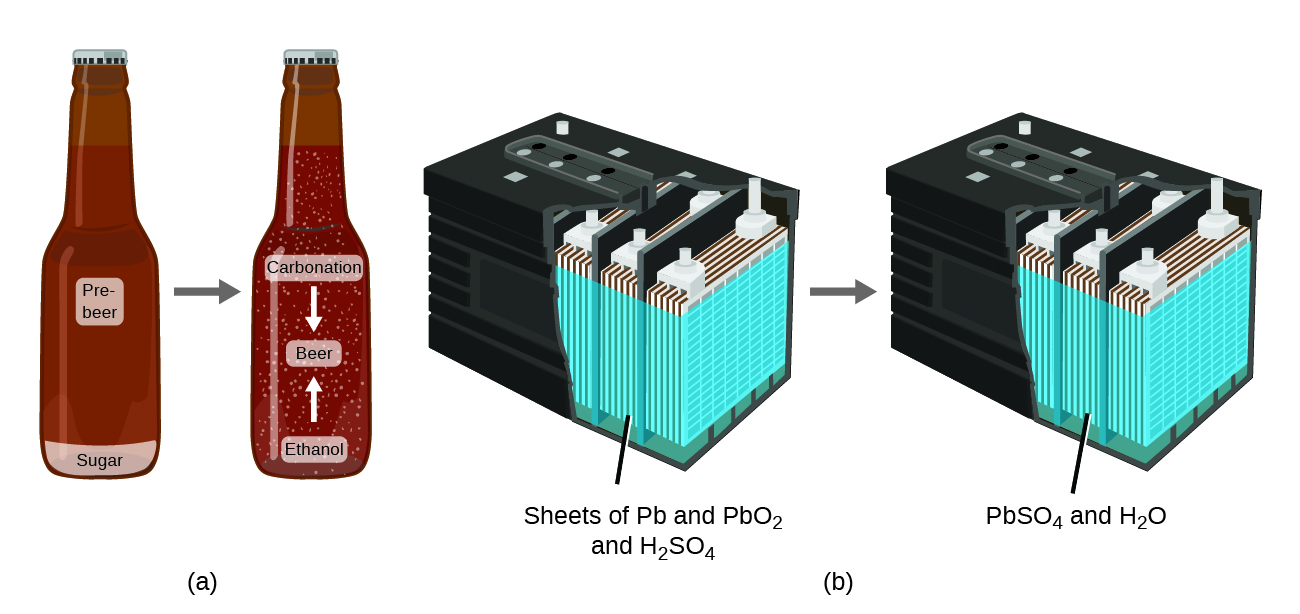


Figure 1.8図 1.8
(a) The mass of beer precursor materials is the same as the mass of beer produced: Sugar has become alcohol and carbon dioxide. (b) The mass of the lead, lead oxide, and sulfuric acid consumed by the production of electricity is exactly equal to the mass of lead sulfate and water that is formed.
(a) ビールの原料の質量は、できたビールの質量と同じである。糖がアルコールと二酸化炭素に変わっている。(b) 発電によって消費された鉛・酸化鉛・硫酸の質量は、生成した硫酸鉛と水の質量に正確に等しい。
Although this conservation law holds true for all conversions of matter, convincing examples are few and far between because, outside of the controlled conditions in a laboratory, we seldom collect all of the material that is produced during a particular conversion. For example, when you eat, digest, and assimilate food, all of the matter in the original food is preserved. But because some of the matter is incorporated into your body, and much is excreted as various types of waste, it is challenging to verify by measurement.
英語のヒント
この保存則は物質のあらゆる変換で成り立つ。しかし、納得しやすい実例はそう多くない。実験室のように管理された条件の外では、特定の変換で生じた物質をすべて集めることがめったにないからである。たとえば、食べ物を食べ、消化し、体内に取り込むとき、元の食べ物に含まれていた物質はすべて保存される。しかし一部は体内に組み込まれ、多くはさまざまな老廃物として排出されるため、測定によってこれを確かめるのは難しい。