第1章化学の基本概念
SI Base UnitsSI基本単位
The initial units of the metric system, which eventually evolved into the SI system, were established in France during the French Revolution. The original standards for the meter and the kilogram were adopted there in 1799 and eventually by other countries. This section introduces four of the SI base units commonly used in chemistry. Other SI units will be introduced in subsequent chapters.
英語のヒント
やがてSI単位系へと発展したメートル法の最初の単位は、フランス革命のさなかにフランスで制定された。メートルとキログラムの最初の基準は、1799年にフランスで採用され、その後ほかの国々でも採用された。この節では、化学でよく使う四つのSI基本単位を紹介する。ほかのSI単位は以降の章で紹介する。
Length長さ
The standard unit of length in both the SI and original metric systems is the meter (m). A meter was originally specified as 1/10,000,000 of the distance from the North Pole to the equator. It is now defined as the distance light in a vacuum travels in 1/299,792,458 of a second. A meter is about 3 inches longer than a yard (Figure 1.23); one meter is about 39.37 inches or 1.094 yards. Longer distances are often reported in kilometers (1 km = 1000 m = 103 m), whereas shorter distances can be reported in centimeters (1 cm = 0.01 m = 10−2 m) or millimeters (1 mm = 0.001 m = 10−3 m).
英語のヒント
SI単位系でも、もとのメートル法でも、長さの標準単位はメートル(m)である。1メートルは当初、北極から赤道までの距離の10,000,000分の1として定められた。現在は、真空中の光が299,792,458分の1秒の間に進む距離と定義されている。1メートルは1ヤードより約3インチ長い(図1.23)。1メートルは約39.37インチ、または1.094ヤードである。長い距離はキロメートル(1 km = 1000 m = 103 m)で表すことが多く、短い距離はセンチメートル(1 cm = 0.01 m = 10−2 m)やミリメートル(1 mm = 0.001 m = 10−3 m)で表せる。
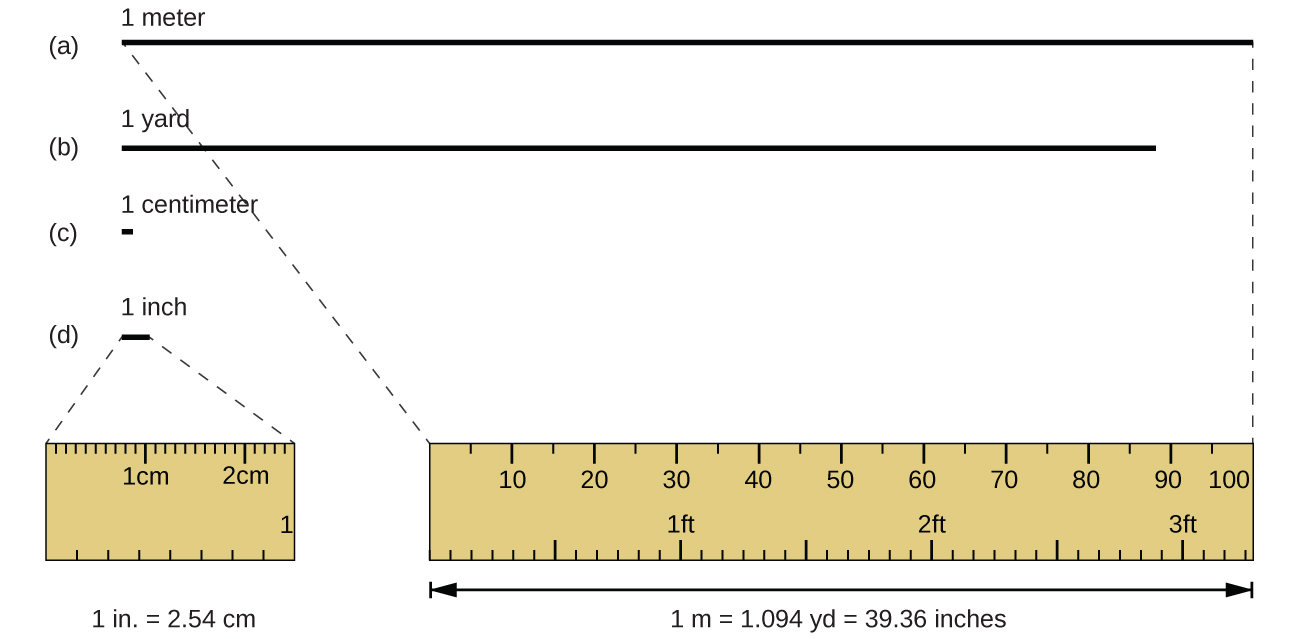
Figure 1.23図 1.23
The relative lengths of 1 m, 1 yd, 1 cm, and 1 in. are shown (not actual size), as well as comparisons of 2.54 cm and 1 in., and of 1 m and 1.094 yd.
1 m、1 yd、1 cm、1 in.の長さの関係(実物大ではない)と、2.54 cmと1 in.、1 mと1.094 ydの比較を示す。
Mass質量
The standard unit of mass in the SI system is the kilogram (kg). The kilogram was previously defined by the International Union of Pure and Applied Chemistry (IUPAC) as the mass of a specific reference object. This object was originally one liter of pure water, and more recently it was a metal cylinder made from a platinum-iridium alloy with a height and diameter of 39 mm (Figure 1.24). In May 2019, this definition was changed to one that is based instead on precisely measured values of several fundamental physical constants. For details see https://www.nist.gov/pml/weights-and-measures/si-units-mass . One kilogram is about 2.2 pounds. The gram (g) is exactly equal to 1/1000 of the mass of the kilogram (10−3 kg).
英語のヒント
SI単位系における質量の標準単位はキログラム(kg)である。キログラムは以前、国際純正・応用化学連合(IUPAC)によって、特定の基準物体の質量として定義されていた。この物体は当初、1リットルの純水であり、より最近では、白金とイリジウムの合金でできた、高さと直径が39 mmの金属製円柱であった(図1.24)。2019年5月、この定義は、いくつかの基本的な物理定数の精密な測定値に基づく定義へと変更された。詳しくはhttps://www.nist.gov/pml/weights-and-measures/si-units-massを参照。1キログラムは約2.2ポンドである。グラム(g)は、キログラムの質量の1000分の1(10−3 kg)に正確に等しい。
Image omitted because its reuse rights could not be verified.権利の確認ができないため画像を割愛。
Figure 1.24図 1.24
This replica prototype kilogram as previously defined is housed at the National Institute of Standards and Technology (NIST) in Maryland. (credit: National Institutes of Standards and Technology)
以前の定義に基づくこのキログラム原器の複製は、メリーランド州の米国国立標準技術研究所(NIST)に保管されている。(出典:米国国立標準技術研究所)
Temperature温度
Temperature is an intensive property. The SI unit of temperature is the kelvin (K). The IUPAC convention is to use kelvin (all lowercase) for the word, K (uppercase) for the unit symbol, and neither the word “degree” nor the degree symbol (°). The degree Celsius (°C) is also allowed in the SI system, with both the word “degree” and the degree symbol used for Celsius measurements. Celsius degrees are the same magnitude as those of kelvin, but the two scales place their zeros in different places. Water freezes at 273.15 K (0 °C) and boils at 373.15 K (100 °C), and normal human body temperature is approximately 310 K (37 °C). The conversion between these two units and the Fahrenheit scale will be discussed later in this chapter.
英語のヒント
温度は示強性質である。温度のSI単位はケルビン(K)である。IUPACの取り決めでは、英語の単位名にはすべて小文字のkelvinを、単位記号には大文字のKを使い、「degree」という語も度記号(°)も使わない。SI単位系ではセルシウス度(°C)の使用も認められており、セルシウス温度の測定値には「degree」という語も度記号も使う。セルシウス度とケルビンの1度分の大きさは等しいが、二つの温度目盛りではゼロの位置が異なる。水は273.15 K(0 °C)で凍り、373.15 K(100 °C)で沸騰する。人間の平常時の体温は約310 K(37 °C)である。この二つの単位とファーレンハイト温度目盛りの間の換算は、この章の後半で扱う。
Time時間
The SI base unit of time is the second (s). Small and large time intervals can be expressed with the appropriate prefixes; for example, 3 microseconds = 0.000003 s = 3 10−6 and 5 megaseconds = 5,000,000 s = 5 106 s. Alternatively, hours, days, and years can be used.
時間のSI基本単位は秒(s)である。短い時間間隔も長い時間間隔も、適切な接頭語を使って表せる。たとえば、3マイクロ秒 = 0.000003 s = 3 10−6、5メガ秒 = 5,000,000 s = 5 106 sである。時間、日、年を使って表すこともできる。
Derived SI UnitsSI組立単位
We can derive many units from the seven SI base units. For example, we can use the base unit of length to define a unit of volume, and the base units of mass and length to define a unit of density.
七つのSI基本単位から、多くの単位を導くことができる。たとえば、長さの基本単位から体積の単位を、質量と長さの基本単位から密度の単位を定義できる。
Volume体積
Volume is the measure of the amount of space occupied by an object. The standard SI unit of volume is defined by the base unit of length (Figure 1.25). The standard volume is a cubic meter (m3), a cube with an edge length of exactly one meter. To dispense a cubic meter of water, we could build a cubic box with edge lengths of exactly one meter. This box would hold a cubic meter of water or any other substance.
英語のヒント
体積は、物体が占める空間の大きさを測る量である。体積の標準的なSI単位は、長さの基本単位によって定義される(図1.25)。基準となる体積は立方メートル(m3)であり、一辺の長さが正確に1メートルの立方体の体積である。1立方メートルの水を量り取るには、各辺の長さが正確に1メートルの立方体の箱を作ればよい。この箱には、1立方メートルの水や、ほかの物質を入れることができる。
A more commonly used unit of volume is derived from the decimeter (0.1 m, or 10 cm). A cube with edge lengths of exactly one decimeter contains a volume of one cubic decimeter (dm3). A liter (L) is the more common name for the cubic decimeter. One liter is about 1.06 quarts.
よりよく使われる体積の単位は、デシメートル(0.1 m、または10 cm)から導かれる。各辺の長さが正確に1デシメートルの立方体は、1立方デシメートル(dm3)の体積をもつ。立方デシメートルの一般的な呼び名がリットル(L)である。1リットルは約1.06クォートである。
A cubic centimeter (cm3) is the volume of a cube with an edge length of exactly one centimeter. The abbreviation cc (for cubic centimeter) is often used by health professionals. A cubic centimeter is equivalent to a milliliter (mL) and is 1/1000 of a liter.
英語のヒント
立方センチメートル(cm3)は、一辺の長さが正確に1センチメートルの立方体の体積である。医療従事者は、立方センチメートルを表す略号ccをよく使う。1立方センチメートルは1ミリリットル(mL)に相当し、1リットルの1000分の1である。
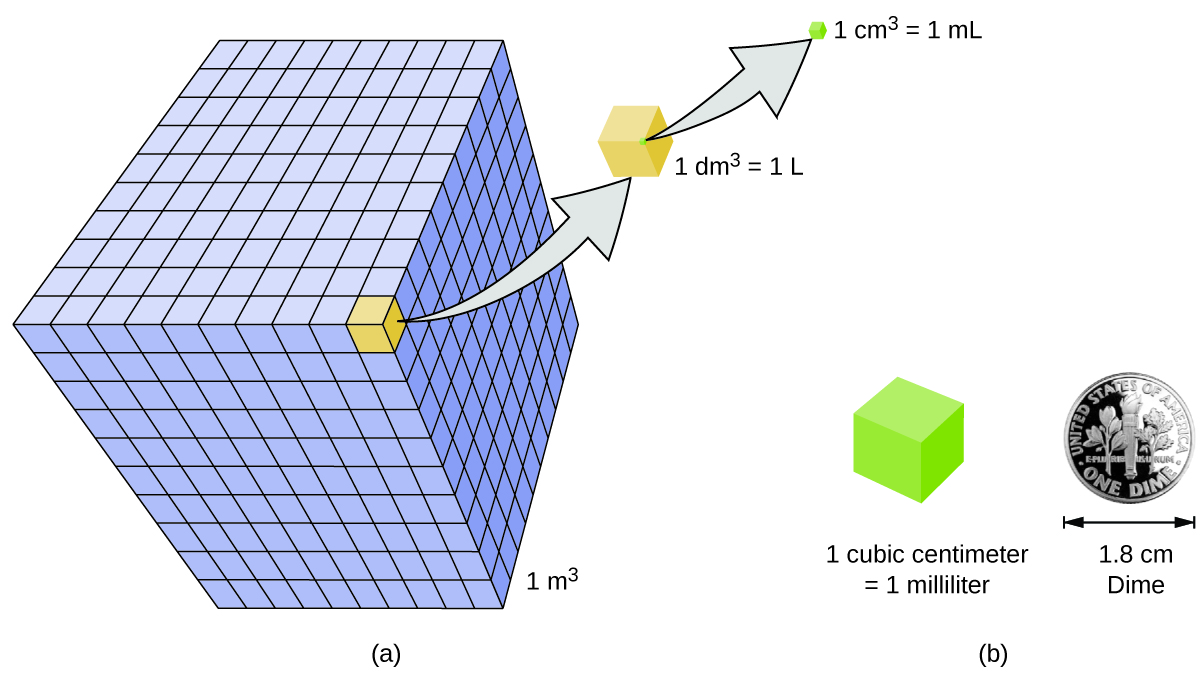


Figure 1.25図 1.25
(a) The relative volumes are shown for cubes of 1 m3, 1 dm3 (1 L), and 1 cm3 (1 mL) (not to scale). (b) The diameter of a dime is compared relative to the edge length of a 1-cm3 (1-mL) cube.
(a) 1 m3、1 dm3(1 L)、1 cm3(1 mL)の立方体の体積の関係を示す(縮尺は正確ではない)。(b) 10セント硬貨の直径と、1 cm3(1 mL)の立方体の一辺の長さを比較する。