第1章化学の基本概念
The Scientific Method科学的方法
Chemistry is a science based on observation and experimentation. Doing chemistry involves attempting to answer questions and explain observations in terms of the laws and theories of chemistry, using procedures that are accepted by the scientific community. There is no single route to answering a question or explaining an observation, but there is an aspect common to every approach: Each uses knowledge based on experiments that can be reproduced to verify the results. Some routes involve a hypothesis, a tentative explanation of observations that acts as a guide for gathering and checking information. A hypothesis is tested by experimentation, calculation, and/or comparison with the experiments of others and then refined as needed.
英語のヒント
化学は、観察と実験に基づく科学である。化学を行うとは、科学界に受け入れられた手順を用い、化学の法則や理論によって問いに答え、観察結果を説明しようとすることである。問いに答えたり観察結果を説明したりする道筋は一つではない。しかし、どの方法にも共通する点がある。結果を確かめるために再現できる実験に基づく知識を、どの方法も用いるという点である。方法によっては仮説を用いる。仮説とは、情報を集めて確かめる際の指針となる、観察結果についての暫定的な説明である。仮説は、実験、計算、他者の実験との比較のいずれか、あるいはそれらの組合せによって検証され、必要に応じて練り直される。
Some hypotheses are attempts to explain the behavior that is summarized in laws. The laws of science summarize a vast number of experimental observations, and describe or predict some facet of the natural world. If such a hypothesis turns out to be capable of explaining a large body of experimental data, it can reach the status of a theory. Scientific theories are well-substantiated, comprehensive, testable explanations of particular aspects of nature. Theories are accepted because they provide satisfactory explanations, but they can be modified if new data become available. The path of discovery that leads from question and observation to law or hypothesis to theory, combined with experimental verification of the hypothesis and any necessary modification of the theory, is called the scientific method (Figure 1.4).
英語のヒント
仮説の中には、法則にまとめられた振る舞いを説明しようとするものがある。科学の法則は、膨大な実験観察を要約し、自然界のある側面を記述したり予測したりする。こうした仮説が大量の実験データを説明できると分かれば、理論としての地位に達することがある。科学理論とは、自然の特定の側面について、十分な根拠に支えられた包括的かつ検証可能な説明である。理論は、満足できる説明を与えるために受け入れられるが、新たなデータが得られれば修正されることもある。問いと観察から法則または仮説へ、さらに理論へと進む発見の道筋に、仮説の実験的な検証と必要な理論の修正を組み合わせたものを、科学的方法という(図1.4)。
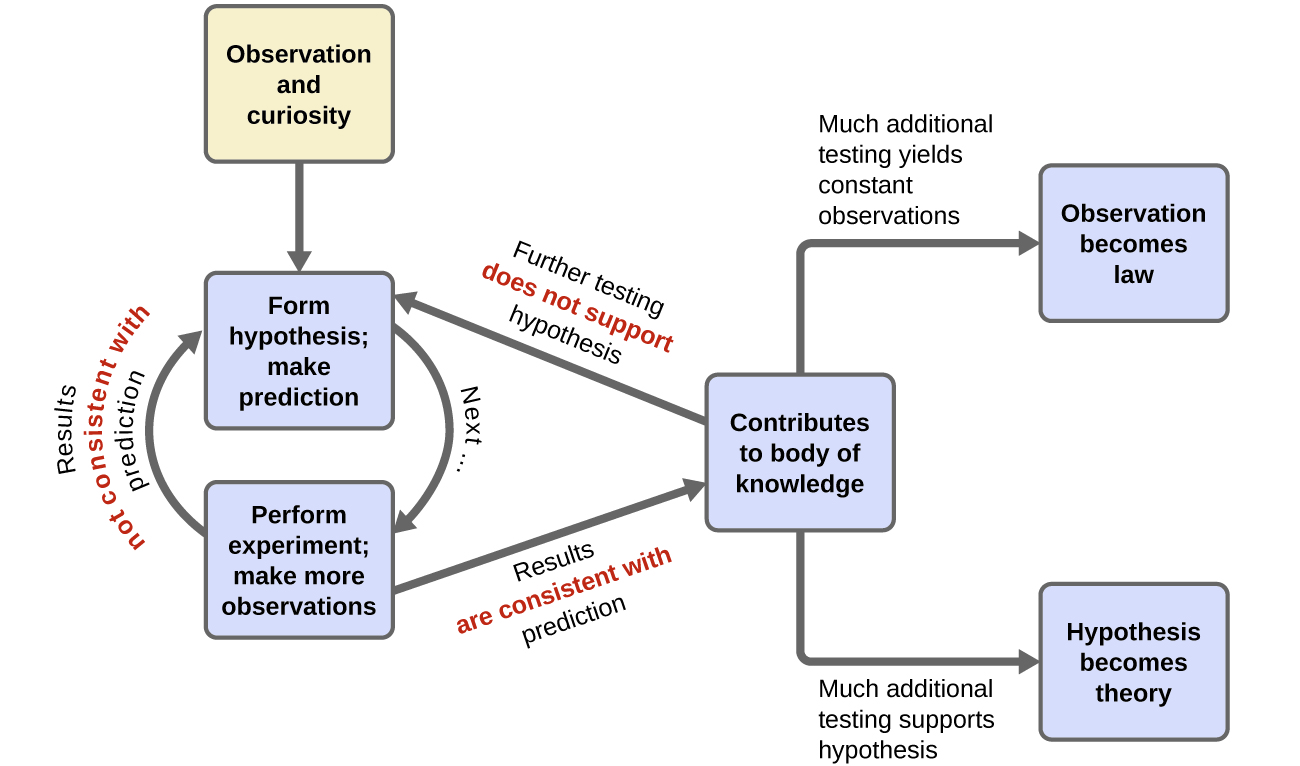

Figure 1.4図 1.4
The scientific method follows a process similar to the one shown in this diagram. All the key components are shown, in roughly the right order. Scientific progress is seldom neat and clean: It requires open inquiry and the reworking of questions and ideas in response to findings.
科学的方法は、この図と似た過程をたどる。重要な構成要素がすべて、おおよそ正しい順序で示されている。科学の進歩が整然と進むことはめったにない。開かれた探究と、得られた知見に応じて問いや考えを練り直すことが必要である。
The Domains of Chemistry化学の三つの領域
Chemists study and describe the behavior of matter and energy in three different domains: macroscopic, microscopic, and symbolic. These domains provide different ways of considering and describing chemical behavior.
英語のヒント
化学者は、巨視的・微視的・記号的という三つの異なる領域で、物質やエネルギーの振る舞いを研究し、記述する。これらの領域は、化学的な振る舞いを考え、表すための異なる方法を与える。
Macro is a Greek word that means “large.” The macroscopic domain is familiar to us: It is the realm of everyday things that are large enough to be sensed directly by human sight or touch. In daily life, this includes the food you eat and the breeze you feel on your face. The macroscopic domain includes everyday and laboratory chemistry, where we observe and measure physical and chemical properties such as density, solubility, and flammability.
英語のヒント
macroは「大きい」を意味するギリシャ語である。巨視的領域は、私たちに身近な領域である。人の視覚や触覚で直接感じ取れるほど大きな、日常の物の世界を指す。日々の生活では、食べ物や顔に感じるそよ風などがこれに当たる。巨視的領域には日常生活や実験室の化学が含まれ、そこでは密度・溶解度・燃えやすさなどの物理的性質や化学的性質を観察し、測定する。
Micro comes from Greek and means “small.” The microscopic domain of chemistry is often visited in the imagination. Some aspects of the microscopic domain are visible through standard optical microscopes, for example, many biological cells. More sophisticated instruments are capable of imaging even smaller entities such as molecules and atoms (see Figure 1.5 (b)).
英語のヒント
microもギリシャ語に由来し、「小さい」を意味する。化学の微視的領域は、しばしば想像の中で訪れる世界である。微視的領域の一部、たとえば多くの生物の細胞は、普通の光学顕微鏡で見ることができる。さらに高度な装置なら、分子や原子のようにもっと小さいものも画像にできる(図1.5(b)参照)。
However, most of the subjects in the microscopic domain of chemistry are too small to be seen even with the most advanced microscopes and may only be pictured in the mind. Other components of the microscopic domain include ions and electrons, protons and neutrons, and chemical bonds, each of which is far too small to see.
英語のヒント
しかし、化学の微視的領域に属する対象のほとんどは、最先端の顕微鏡を使っても見えないほど小さく、頭の中で思い描くしかない場合がある。この領域には、イオンや電子、陽子や中性子、化学結合なども含まれ、どれも目で見るにははるかに小さすぎる。
The symbolic domain contains the specialized language used to represent components of the macroscopic and microscopic domains. Chemical symbols (such as those used in the periodic table), chemical formulas, and chemical equations are part of the symbolic domain, as are graphs, drawings, and calculations. These symbols play an important role in chemistry because they help interpret the behavior of the macroscopic domain in terms of the components of the microscopic domain. One of the challenges for students learning chemistry is recognizing that the same symbols can represent different things in the macroscopic and microscopic domains, and one of the features that makes chemistry fascinating is the use of a domain that must be imagined to explain behavior in a domain that can be observed.
英語のヒント
記号的領域には、巨視的領域と微視的領域の構成要素を表すための専門的な言語が含まれる。周期表で用いるような元素記号、化学式、化学反応式は、この領域の一部であり、グラフ、図、計算も同様である。こうした記号は、巨視的領域の振る舞いを微視的領域の構成要素によって解釈する助けとなるため、化学で重要な役割を果たす。化学を学ぶ学生にとっての難しさの一つは、同じ記号が、巨視的領域と微視的領域で異なるものを表しうると理解することである。また、観察できる領域の振る舞いを説明するために、想像しなければならない領域を利用する点は、化学を魅力的にしている特徴の一つである。
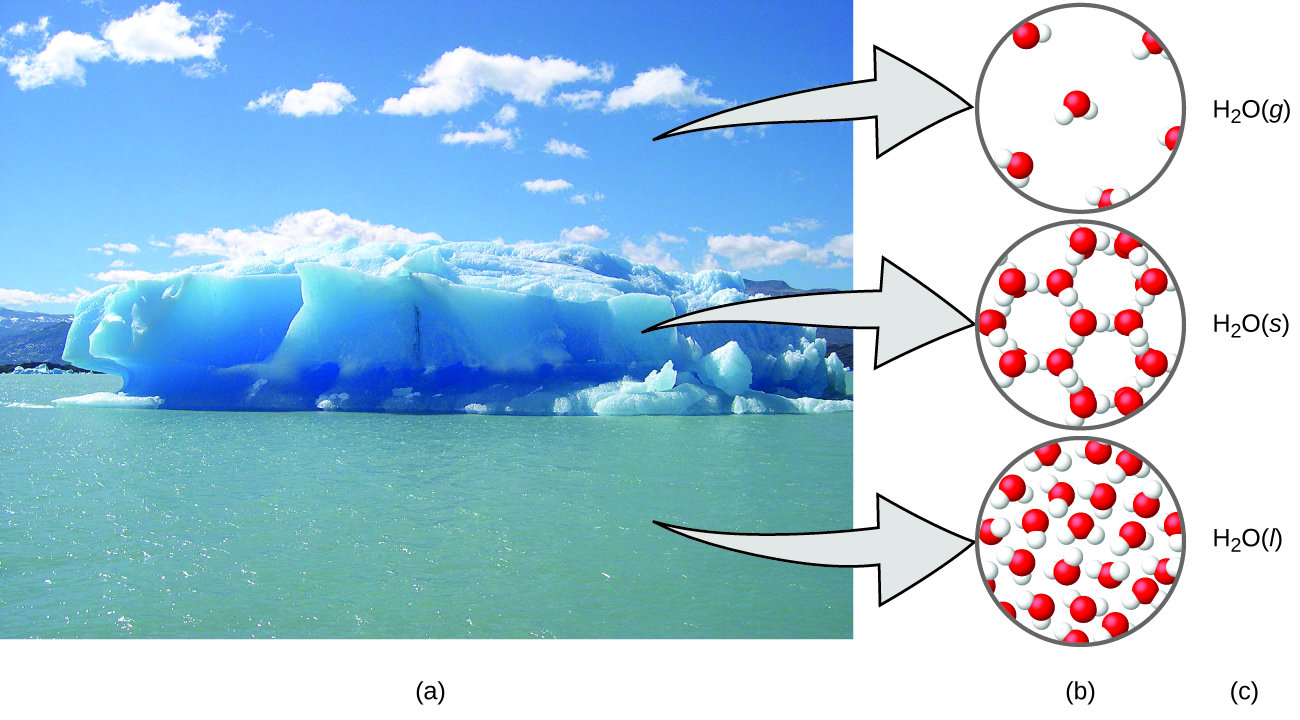
A helpful way to understand the three domains is via the essential and ubiquitous substance of water. That water is a liquid at moderate temperatures, will freeze to form a solid at lower temperatures, and boil to form a gas at higher temperatures (Figure 1.5) are macroscopic observations. But some properties of water fall into the microscopic domain—what cannot be observed with the naked eye. The description of water as comprising two hydrogen atoms and one oxygen atom, and the explanation of freezing and boiling in terms of attractions between these molecules, is within the microscopic arena. The formula H2O, which can describe water at either the macroscopic or microscopic levels, is an example of the symbolic domain. The abbreviations (g) for gas, (s) for solid, and (l) for liquid are also symbolic.
英語のヒント
この三つの領域を理解するのに役立つのが、不可欠で、どこにでもある物質である水を通じて考える方法である。水は適度な温度では液体で、低い温度では凍って固体になり、高い温度では沸騰して気体になる(図1.5)。これらは巨視的な観察である。しかし水の性質の一部は、肉眼では観察できない微視的領域に属する。水を二つの水素原子と一つの酸素原子からなるものと記述したり、分子どうしの引力によって凍結や沸騰を説明したりすることは、微視的領域の話である。化学式H2Oは、巨視的な水も微視的な水も表すことができ、記号的領域の例である。気体を表す(g)、固体を表す(s)、液体を表す(l)という略号も記号的な表現である。
Gorkaazk; modified by OpenStax. · CC BY 3.0; CC BY 4.0 composition · Source出典

Figure 1.5図 1.5
(a) Moisture in the air, icebergs, and the ocean represent water in the macroscopic domain. (b) At the molecular level (microscopic domain), gas molecules are far apart and disorganized, solid water molecules are close together and organized, and liquid molecules are close together and disorganized. (c) The formula H2O symbolizes water, and (g), (s), and (l) symbolize its phases. Note that clouds are actually comprised of either very small liquid water droplets or solid water crystals; gaseous water in our atmosphere is not visible to the naked eye, although it may be sensed as humidity. (credit a: modification of work by “Gorkaazk”/Wikimedia Commons)
(a) 空気中の水分、氷山、海は、巨視的領域の水を表している。(b) 分子の水準、すなわち微視的領域では、気体分子は互いに遠く離れて不規則に存在し、固体の水分子は近接して規則正しく並び、液体分子は近接して不規則に存在する。(c) 化学式H2Oは水を、(g)・(s)・(l)はその状態を記号で表す。雲は実際には、ごく小さな液体の水滴、または固体の水の結晶からできていることに注意しよう。大気中の気体の水は、湿気として感じられることはあるが、肉眼では見えない。(出典:aは「Gorkaazk」/Wikimedia Commonsの作品を改変)