第1章化学の基本概念
Significant Figures in Calculations計算における有効数字
A second important principle of uncertainty is that results calculated from a measurement are at least as uncertain as the measurement itself. Take the uncertainty in measurements into account to avoid misrepresenting the uncertainty in calculated results. One way to do this is to report the result of a calculation with the correct number of significant figures, which is determined by the following three rules for rounding numbers:
英語のヒント
不確かさについての第二の重要な原則は、測定値から計算した結果の不確かさが、少なくとも測定値そのものの不確かさ以上になることである。計算結果の不確かさを誤って表さないように、測定の不確かさを考慮しよう。方法の一つは、計算結果を正しい有効数字の桁数で報告することである。その桁数は、次の三つの丸めの規則によって決まる。
- When adding or subtracting numbers, round the result to the same number of decimal places as the number with the least number of decimal places (the least certain value in terms of addition and subtraction).数値を加算または減算するときは、小数点以下の桁数が最も少ない数値(加減算に関して最も確かさの低い値)と同じ小数桁数になるように、結果を丸める。
- When multiplying or dividing numbers, round the result to the same number of digits as the number with the least number of significant figures (the least certain value in terms of multiplication and division).数値を乗算または除算するときは、有効数字の桁数が最も少ない数値(乗除算に関して最も確かさの低い値)と同じ有効数字の桁数になるように、結果を丸める。
- If the digit to be dropped (the one immediately to the right of the digit to be retained) is less than 5, “round down” and leave the retained digit unchanged; if it is more than 5, “round up” and increase the retained digit by 1. If the dropped digit is 5, and it’s either the last digit in the number or it’s followed only by zeros, round up or down, whichever yields an even value for the retained digit. If any nonzero digits follow the dropped 5, round up. (The last part of this rule may strike you as a bit odd, but it’s based on reliable statistics and is aimed at avoiding any bias when dropping the digit “5,” since it is equally close to both possible values of the retained digit.)
英語のヒント
取り除く最初の数字(残す最後の数字のすぐ右の数字)が5未満なら「切り捨て」、残す数字は変えない。5より大きければ「切り上げ」、残す数字を1増やす。取り除く数字が5で、それが数値の最後の数字であるか、その後にゼロしか続かない場合は、残す数字が偶数になるように切り上げるか切り捨てる。取り除く5の後にゼロでない数字が一つでも続く場合は、切り上げる。(この規則の最後の部分は少し奇妙に思えるかもしれないが、信頼できる統計に基づいている。5は、残す数字の二つの候補のどちらからも等しい距離にあるため、「5」を取り除く際の偏りを避けることを目的としている。)
The following examples illustrate the application of this rule in rounding a few different numbers to three significant figures:
次の例では、いくつかの数値を有効数字3桁に丸める際に、この規則をどう使うかを示す。
- 0.028675 rounds “up” to 0.0287 (the dropped digit, 7, is greater than 5)0.028675は「切り上げ」て0.0287になる(取り除く数字の7が5より大きい)。
- 18.3384 rounds “down” to 18.3 (the dropped digit, 3, is less than 5)18.3384は「切り捨て」て18.3になる(取り除く数字の3が5未満である)。
- 6.8752 rounds “up” to 6.88 (the dropped digit is 5, and a nonzero digit follows it)6.8752は「切り上げ」て6.88になる(取り除く数字は5で、その後にゼロでない数字が続く)。
- 92.85 rounds “down” to 92.8 (the dropped digit is 5, and the retained digit is even)92.85は「切り捨て」て92.8になる(取り除く数字は5で、残す数字は偶数である)。
Let’s work through these rules with a few examples.
いくつかの例を使って、この規則を実際に確かめよう。
Example 1.3例題 1.3
Rounding Numbers数値の丸め
Round the following to the indicated number of significant figures:
次の数値を、指定された有効数字の桁数に丸めなさい。
(a) 31.57 (to two significant figures)
(a) 31.57(有効数字2桁)
(b) 8.1649 (to three significant figures)
(b) 8.1649(有効数字3桁)
(c) 0.051065 (to four significant figures)
(c) 0.051065(有効数字4桁)
(d) 0.90275 (to four significant figures)
(d) 0.90275(有効数字4桁)
Solution解き方
(a) 31.57 rounds “up” to 32 (the dropped digit is 5, and the retained digit is even)
(a) 31.57は「切り上げ」て32になる(取り除く数字は5で、残す数字は偶数である)。
(b) 8.1649 rounds “down” to 8.16 (the dropped digit, 4, is less than 5)
(b) 8.1649は「切り捨て」て8.16になる(取り除く数字の4が5未満である)。
(c) 0.051065 rounds “down” to 0.05106 (the dropped digit is 5, and the retained digit is even)
(c) 0.051065は「切り捨て」て0.05106になる(取り除く数字は5で、残す数字は偶数である)。
(d) 0.90275 rounds “up” to 0.9028 (the dropped digit is 5, and the retained digit is even)
(d) 0.90275は「切り上げ」て0.9028になる(取り除く数字は5で、残す数字は偶数である)。
Check Your Learning理解度の確認
Round the following to the indicated number of significant figures:
次の数値を、指定された有効数字の桁数に丸めなさい。
(a) 0.424 (to two significant figures)
(a) 0.424(有効数字2桁)
(b) 0.0038661 (to three significant figures)
(b) 0.0038661(有効数字3桁)
(c) 421.25 (to four significant figures)
(c) 421.25(有効数字4桁)
(d) 28,683.5 (to five significant figures)
(d) 28,683.5(有効数字5桁)
Example 1.4例題 1.4
Addition and Subtraction with Significant Figures有効数字を考慮した加算と減算
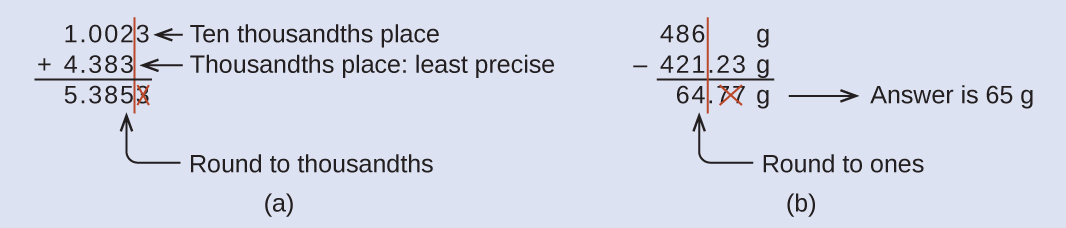
Rule: When adding or subtracting numbers, round the result to the same number of decimal places as the number with the fewest decimal places (i.e., the least certain value in terms of addition and subtraction).
規則:数値を加算または減算するときは、小数点以下の桁数が最も少ない数値(すなわち、加減算に関して最も確かさの低い値)と同じ小数桁数になるように、結果を丸める。
(a) Add 1.0023 g and 4.383 g.
(a) 1.0023 gと4.383 gを足しなさい。
(b) Subtract 421.23 g from 486 g.
(b) 486 gから421.23 gを引きなさい。
Solution解き方
(a)
(a)
Answer is 5.385 g (round to the thousandths place; three decimal places)
答えは5.385 g(小数第3位に丸める。小数点以下3桁)。
(b)
(b)
Answer is 65 g (round to the ones place; no decimal places)
答えは65 g(一の位に丸める。小数部分なし)。
Check Your Learning理解度の確認
(a) Add 2.334 mL and 0.31 mL.
(a) 2.334 mLと0.31 mLを足しなさい。
(b) Subtract 55.8752 m from 56.533 m.
(b) 56.533 mから55.8752 mを引きなさい。
Example 1.5例題 1.5
Multiplication and Division with Significant Figures有効数字を考慮した乗算と除算
Rule: When multiplying or dividing numbers, round the result to the same number of digits as the number with the fewest significant figures (the least certain value in terms of multiplication and division).
規則:数値を乗算または除算するときは、有効数字の桁数が最も少ない数値(乗除算に関して最も確かさの低い値)と同じ有効数字の桁数になるように、結果を丸める。
(a) Multiply 0.6238 cm by 6.6 cm.
(a) 0.6238 cmに6.6 cmを掛けなさい。
(b) Divide 421.23 g by 486 mL.
(b) 421.23 gを486 mLで割りなさい。
Solution解き方
(a)
(a)
(b)
(b)
Check Your Learning理解度の確認
(a) Multiply 2.334 cm and 0.320 cm.
(a) 2.334 cmと0.320 cmを掛けなさい。
(b) Divide 55.8752 m by 56.53 s.
(b) 55.8752 mを56.53 sで割りなさい。
In the midst of all these technicalities, it is important to keep in mind the reason for these rules about significant figures and rounding—to correctly represent the certainty of the values reported and to ensure that a calculated result is not represented as being more certain than the least certain value used in the calculation.
英語のヒント
こうした細かな決まりを扱う間も、有効数字や丸めの規則の目的を忘れないことが大切である。その目的は、報告する値の確かさを正しく表すこと、そして、計算結果が、計算に使った最も確かさの低い値より確かであるかのように表されないようにすることである。
Example 1.6例題 1.6
Calculation with Significant Figures有効数字を考慮した計算
One common bathtub is 13.44 dm long, 5.920 dm wide, and 2.54 dm deep. Assume that the tub is rectangular and calculate its approximate volume in liters.
ある一般的な浴槽は、長さ13.44 dm、幅5.920 dm、深さ2.54 dmである。浴槽を直方体と仮定し、およその体積をリットルで計算しなさい。
Solution解き方
Check Your Learning理解度の確認
What is the density of a liquid with a mass of 31.1415 g and a volume of 30.13 cm3?
質量31.1415 g、体積30.13 cm3の液体の密度はいくらか。
Example 1.7例題 1.7
Experimental Determination of Density Using Water Displacement水の押しのけを利用する密度の実験的測定
A piece of rebar is weighed and then submerged in a graduated cylinder partially filled with water, with results as shown.
鉄筋片の質量を量り、水を途中まで入れたメスシリンダーに沈めると、図の結果になった。
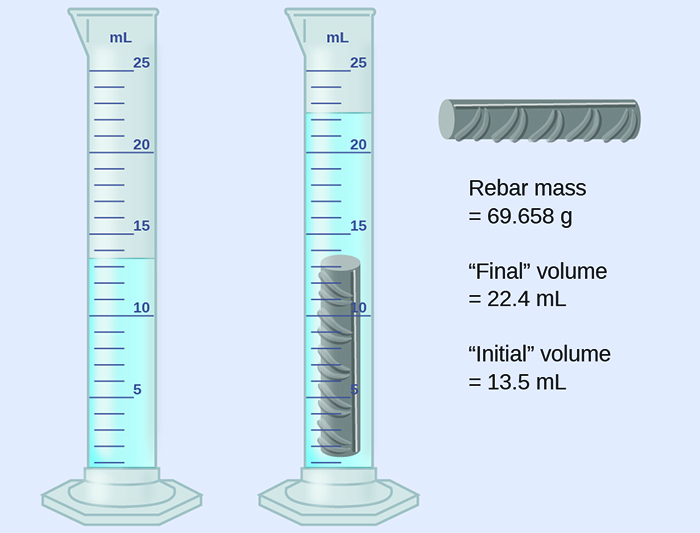
(a) Use these values to determine the density of this piece of rebar.
(a) これらの値を使って、鉄筋片の密度を求めなさい。
(b) Rebar is mostly iron. Does your result in (a) support this statement? How?
(b) 鉄筋の主成分は鉄である。(a)の結果はこの記述を裏づけるか。どのように裏づけるか。
Solution解き方
The volume of the piece of rebar is equal to the volume of the water displaced:
鉄筋片の体積は、押しのけられた水の体積に等しい。
(rounded to the nearest 0.1 mL, per the rule for addition and subtraction)
(加減算の規則に従い、0.1 mLの位に丸める。)
The density is the mass-to-volume ratio:
密度は、質量と体積の比である。
(rounded to two significant figures, per the rule for multiplication and division)
(乗除算の規則に従い、有効数字2桁に丸める。)
From Table 1.4, the density of iron is 7.9 g/cm3, very close to that of rebar, which lends some support to the fact that rebar is mostly iron.
英語のヒント
表1.4によると鉄の密度は7.9 g/cm3であり、鉄筋の密度に非常に近い。これは、鉄筋の主成分が鉄であることをある程度裏づける。
Check Your Learning理解度の確認
An irregularly shaped piece of a shiny yellowish material is weighed and then submerged in a graduated cylinder, with results as shown.
光沢のある黄色がかった物質の、不規則な形のかけらの質量を量り、メスシリンダーに沈めると、図の結果になった。
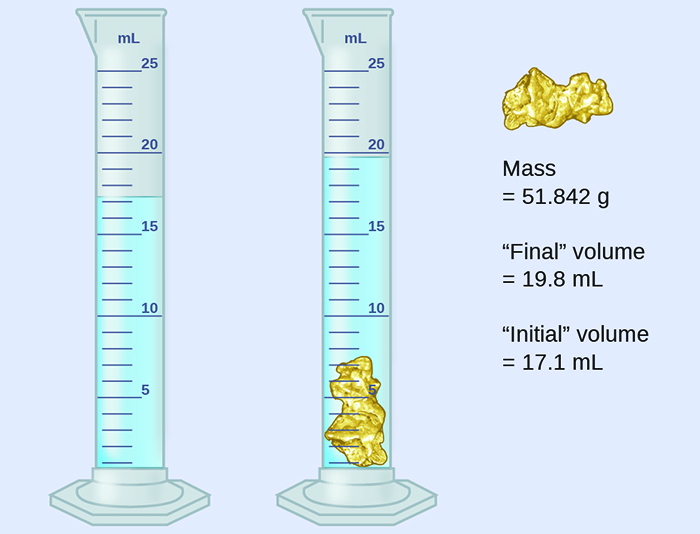


(a) Use these values to determine the density of this material.
(a) これらの値を使って、この物質の密度を求めなさい。
(b) Do you have any reasonable guesses as to the identity of this material? Explain your reasoning.
(b) この物質が何かについて、妥当な推測はできるだろうか。推論の根拠を説明しなさい。