第1章化学の基本概念
Conversion of Temperature Units温度の単位の換算
We use the word temperature to refer to the hotness or coldness of a substance. One way we measure a change in temperature is to use the fact that most substances expand when their temperature increases and contract when their temperature decreases. The liquid in a common glass thermometer changes its volume as the temperature changes, and the position of the trapped liquid's surface along a printed scale may be used as a measure of temperature.
英語のヒント
温度という語は、物質の熱さや冷たさを表すために使う。温度変化を測る方法の一つは、ほとんどの物質が温度の上昇によって膨張し、温度の低下によって収縮することを利用するものである。一般的なガラス製温度計の中の液体は、温度の変化に伴って体積が変わるため、封入された液体の表面が印刷された目盛りのどの位置にあるかを、温度の指標として使える。
Temperature scales are defined relative to selected reference temperatures: Two of the most commonly used are the freezing and boiling temperatures of water at a specified atmospheric pressure. On the Celsius scale, 0 °C is defined as the freezing temperature of water and 100 °C as the boiling temperature of water. The space between the two temperatures is divided into 100 equal intervals, which we call degrees. On the Fahrenheit scale, the freezing point of water is defined as 32 °F and the boiling temperature as 212 °F. The space between these two points on a Fahrenheit thermometer is divided into 180 equal parts (degrees).
英語のヒント
温度目盛りは、選んだ基準温度に対して定義される。よく使われる二つの基準は、指定された大気圧における水の凝固温度と沸騰温度である。セルシウス温度目盛りでは、水の凝固温度を0 °C、沸騰温度を100 °Cと定義する。この二つの温度の間を100等分し、その一区間を1度と呼ぶ。ファーレンハイト温度目盛りでは、水の凝固点を32 °F、沸騰温度を212 °Fと定義する。ファーレンハイト温度計では、この二点の間を180の等しい部分(度)に分ける。
Defining the Celsius and Fahrenheit temperature scales as described in the previous paragraph results in a slightly more complex relationship between temperature values on these two scales than for different units of measure for other properties. Most measurement units for a given property are directly proportional to one another (y = mx). Using familiar length units as one example:
前の段落のようにセルシウスとファーレンハイトの温度目盛りを定義すると、二つの目盛りの温度値の関係は、ほかの性質を測る異なる単位間の関係より少し複雑になる。ある性質を測る単位の多くは、互いに正比例の関係にある(y = mx)。身近な長さの単位を例にすると、次のようになる。
where y = length in feet, x = length in inches, and the proportionality constant, m, is the conversion factor. The Celsius and Fahrenheit temperature scales, however, do not share a common zero point, and so the relationship between these two scales is a linear one rather than a proportional one (y = mx + b). Consequently, converting a temperature from one of these scales into the other requires more than simple multiplication by a conversion factor, m; it also must take into account differences in the scales’ zero points (b).
英語のヒント
ここで、yはフィートで表した長さ、xはインチで表した長さであり、比例定数mが換算係数である。しかし、セルシウスとファーレンハイトの温度目盛りはゼロ点が共通ではないため、二つの目盛りの関係は比例関係ではなく一次関係(y = mx + b)になる。したがって、一方の目盛りの温度をもう一方に換算するには、単に換算係数mを掛けるだけでは足りず、両目盛りのゼロ点の違い(b)も考慮しなければならない。
The linear equation relating Celsius and Fahrenheit temperatures is easily derived from the two temperatures used to define each scale. Representing the Celsius temperature as x and the Fahrenheit temperature as y, the slope, m, is computed to be:
セルシウス温度とファーレンハイト温度を結ぶ一次方程式は、それぞれの目盛りの定義に使われた二つの温度から容易に導ける。セルシウス温度をx、ファーレンハイト温度をyとすると、傾きmは次のように計算できる。
The y-intercept of the equation, b, is then calculated using either of the equivalent temperature pairs, (100 °C, 212 °F) or (0 °C, 32 °F), as:
次に、同じ温度を表す組である(100 °C、212 °F)または(0 °C、32 °F)のどちらかを使い、式のy切片bを次のように計算する。
The equation relating the temperature (T) scales is then:
したがって、温度(T)目盛り間の関係式は次のようになる。
An abbreviated form of this equation that omits the measurement units is:
測定単位を省略した、この式の簡略形は次のとおりである。
Rearrangement of this equation yields the form useful for converting from Fahrenheit to Celsius:
この式を変形すると、ファーレンハイトからセルシウスへの換算に便利な形が得られる。
As mentioned earlier in this chapter, the SI unit of temperature is the kelvin (K). Unlike the Celsius and Fahrenheit scales, the kelvin scale is an absolute temperature scale in which 0 (zero) K corresponds to the lowest temperature that can theoretically be achieved. Since the kelvin temperature scale is absolute, a degree symbol is not included in the unit abbreviation, K. The early 19th-century discovery of the relationship between a gas’s volume and temperature suggested that the volume of a gas would be zero at −273.15 °C. In 1848, British physicist William Thompson, who later adopted the title of Lord Kelvin, proposed an absolute temperature scale based on this concept (further treatment of this topic is provided in this text’s chapter on gases).
英語のヒント
この章で前に述べたとおり、温度のSI単位はケルビン(K)である。セルシウスやファーレンハイトの目盛りとは異なり、ケルビン目盛りは絶対温度目盛りであり、0(ゼロ)Kは理論上到達できる最低温度に対応する。ケルビン温度目盛りは絶対的なものなので、単位の略号Kには度記号を付けない。19世紀初頭に発見された気体の体積と温度の関係は、−273.15 °Cで気体の体積がゼロになることを示唆した。1848年、後にケルビン卿の称号を名乗ることになる英国の物理学者ウィリアム・トンプソンは、この考え方に基づく絶対温度目盛りを提案した(この話題は、本書の気体の章でさらに扱う)。
The freezing temperature of water on this scale is 273.15 K and its boiling temperature is 373.15 K. Notice the numerical difference in these two reference temperatures is 100, the same as for the Celsius scale, and so the linear relation between these two temperature scales will exhibit a slope of . Following the same approach, the equations for converting between the kelvin and Celsius temperature scales are derived to be:
この目盛りでは、水の凝固温度は273.15 K、沸騰温度は373.15 Kである。この二つの基準温度の数値の差は、セルシウス目盛りと同じ100であることに注目しよう。そのため、この二つの温度目盛りの一次関係の傾きはとなる。同じ方法を使うと、ケルビンとセルシウスの温度目盛り間の換算式は次のように導かれる。
The 273.15 in these equations has been determined experimentally, so it is not exact. Figure 1.28 shows the relationship among the three temperature scales.
これらの式の273.15は実験によって決定された値なので、正確な数ではない。図1.28に、三つの温度目盛りの関係を示す。
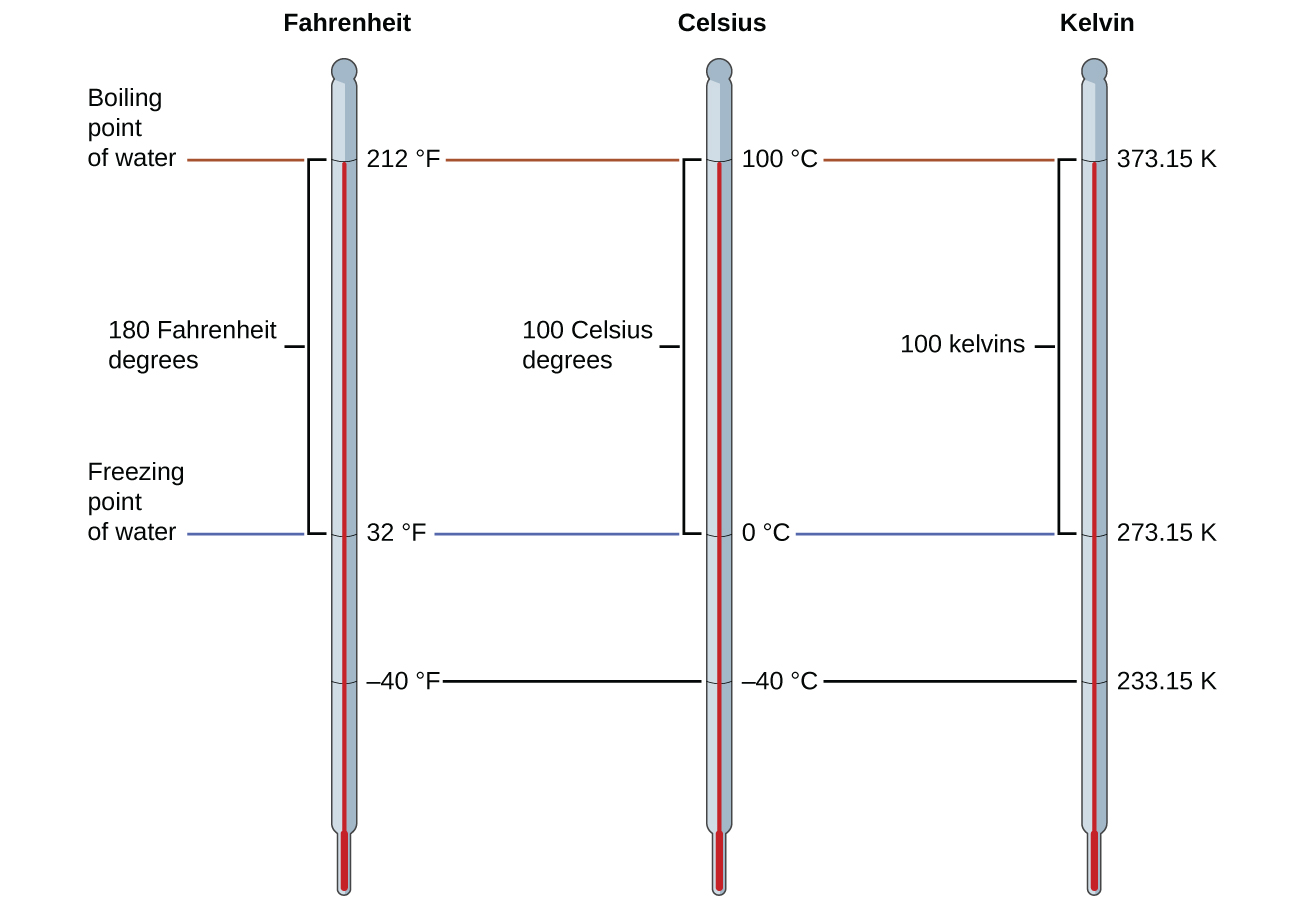

Figure 1.28図 1.28
The Fahrenheit, Celsius, and kelvin temperature scales are compared.
ファーレンハイト、セルシウス、ケルビンの温度目盛りを比較する。
Although the kelvin (absolute) temperature scale is the official SI temperature scale, Celsius is commonly used in many scientific contexts and is the scale of choice for nonscience contexts in almost all areas of the world. Very few countries (the U.S. and its territories, the Bahamas, Belize, Cayman Islands, and Palau) still use Fahrenheit for weather, medicine, and cooking.
英語のヒント
ケルビン(絶対)温度目盛りは公式なSI温度目盛りだが、科学の多くの場面ではセルシウスが一般的に使われ、科学以外でも世界のほぼすべての地域でセルシウスが選ばれている。天気、医療、料理に今もファーレンハイトを使う国・地域は、ごく少数(米国とその領土、バハマ、ベリーズ、ケイマン諸島、パラオ)である。
Example 1.11例題 1.11
Conversion from Celsiusセルシウス温度からの換算
Normal body temperature has been commonly accepted as 37.0 °C (although it varies depending on time of day and method of measurement, as well as among individuals). What is this temperature on the kelvin scale and on the Fahrenheit scale?
平常時の体温は一般に37.0 °Cとされてきた(ただし、個人差だけでなく、時刻や測定方法によっても変化する)。この温度は、ケルビン目盛りとファーレンハイト目盛りではいくらか。
Solution解き方
Check Your Learning理解度の確認
Convert 80.92 °C to K and °F.
80.92 °CをKと°Fに換算しなさい。
Example 1.12例題 1.12
Conversion from Fahrenheitファーレンハイト温度からの換算
Baking a ready-made pizza calls for an oven temperature of 450 °F. If you are in Europe, and your oven thermometer uses the Celsius scale, what is the setting? What is the kelvin temperature?
英語のヒント
市販のピザを焼くには、オーブンの温度を450 °Fにする必要がある。ヨーロッパにいて、オーブンの温度計がセルシウス目盛りを使っているなら、何度に設定すればよいか。ケルビン温度ではいくらか。
Solution解き方
Check Your Learning理解度の確認
Convert 50 °F to °C and K.
50 °Fを°CとKに換算しなさい。