第1章化学の基本概念
Classifying Matter物質の分類
Matter can be classified into several categories. Two broad categories are mixtures and pure substances. A pure substance has a constant composition. All specimens of a pure substance have exactly the same makeup and properties. Any sample of sucrose (table sugar) consists of 42.1% carbon, 6.5% hydrogen, and 51.4% oxygen by mass. Any sample of sucrose also has the same physical properties, such as melting point, color, and sweetness, regardless of the source from which it is isolated.
英語のヒント
物質は、いくつかの種類に分類できる。大きな二つの分類は、混合物と純物質である。純物質は一定の組成を持つ。純物質のどの試料も、組成と性質が正確に同じである。スクロース、すなわち食卓で使う砂糖は、どの試料も質量で42.1%の炭素、6.5%の水素、51.4%の酸素からなる。また、どこから分離されたものであっても、どのスクロース試料も融点、色、甘さなどの物理的性質が同じである。
Pure substances may be divided into two classes: elements and compounds. Pure substances that cannot be broken down into simpler substances by chemical changes are called elements. Iron, silver, gold, aluminum, sulfur, oxygen, and copper are familiar examples of the more than 100 known elements, of which about 90 occur naturally on the earth, and two dozen or so have been created in laboratories.
英語のヒント
純物質は、単体と化合物の二種類に分けられる。化学変化によって、さらに単純な物質へ分解できない純物質を単体という。鉄、銀、金、アルミニウム、硫黄、酸素、銅は、100種類以上知られている元素の身近な例である。そのうち約90種類は地球上に自然に存在し、20数種類ほどは実験室で作られた。
Pure substances that are comprised of two or more elements are called compounds. Compounds may be broken down by chemical changes to yield either elements or other compounds, or both. Mercury(II) oxide, an orange, crystalline solid, can be broken down by heat into the elements mercury and oxygen (Figure 1.9). When heated in the absence of air, the compound sucrose is broken down into the element carbon and the compound water. (The initial stage of this process, when the sugar is turning brown, is known as caramelization—this is what imparts the characteristic sweet and nutty flavor to caramel apples, caramelized onions, and caramel). Silver(I) chloride is a white solid that can be broken down into its elements, silver and chlorine, by absorption of light. This property is the basis for the use of this compound in photographic films and photochromic eyeglasses (those with lenses that darken when exposed to light).
英語のヒント
二つ以上の元素からなる純物質を化合物という。化合物は化学変化によって分解され、単体、別の化合物、またはその両方を生じることがある。橙色の結晶性固体である酸化水銀(II)は、加熱によって単体の水銀と酸素に分解できる(図1.9)。化合物のスクロースを空気のない状態で加熱すると、単体の炭素と化合物の水に分解される。この過程の初期段階で砂糖が褐色に変わる現象は、カラメル化と呼ばれる。キャラメルアップル、カラメル化させたタマネギ、キャラメルに、甘く香ばしい独特の風味を与えるのは、この現象である。塩化銀(I)は白い固体で、光を吸収することによって単体の銀と塩素に分解できる。この性質を利用して、この化合物は写真フィルムや、光に当たるとレンズが暗くなる調光眼鏡に使われている。
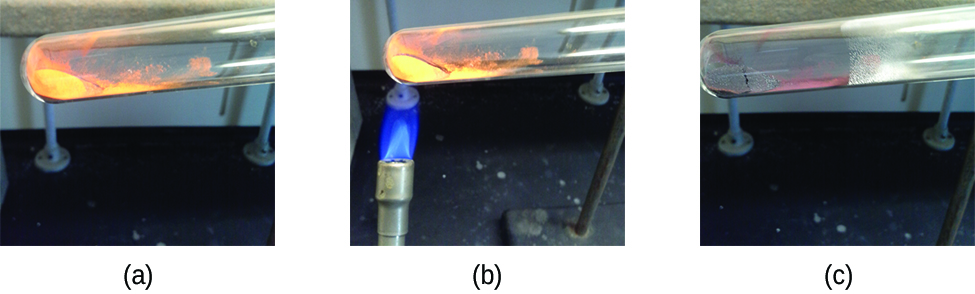
Figure 1.9図 1.9
(a) The compound mercury(II) oxide, (b) when heated, (c) decomposes into silvery droplets of liquid mercury and invisible oxygen gas. (credit: modification of work by Paul Flowers)
(a) 化合物の酸化水銀(II)は、(b) 加熱されると、(c) 銀色の液体水銀の滴と、目に見えない酸素ガスに分解する。(出典:Paul Flowersの作品を改変)
The properties of combined elements are different from those in the free, or uncombined, state. For example, white crystalline sugar (sucrose) is a compound resulting from the chemical combination of the element carbon, which is a black solid in one of its uncombined forms, and the two elements hydrogen and oxygen, which are colorless gases when uncombined. Free sodium, an element that is a soft, shiny, metallic solid, and free chlorine, an element that is a yellow-green gas, combine to form sodium chloride (table salt), a compound that is a white, crystalline solid.
英語のヒント
結合した元素の性質は、遊離した、つまり結合していない状態での性質とは異なる。たとえば、白い結晶性の砂糖であるスクロースは、単体の一形態では黒い固体である炭素と、単体では無色の気体である水素と酸素が、化学的に結び付いてできた化合物である。柔らかく光沢のある金属固体である単体のナトリウムと、黄緑色の気体である単体の塩素が結び付くと、白い結晶性固体の化合物である塩化ナトリウム、すなわち食塩ができる。
A mixture is composed of two or more types of matter that can be present in varying amounts and can be separated by physical changes, such as evaporation (you will learn more about this later). A mixture with a composition that varies from point to point is called a heterogeneous mixture. Italian dressing is an example of a heterogeneous mixture (Figure 1.10). Its composition can vary because it may be prepared from varying amounts of oil, vinegar, and herbs. It is not the same from point to point throughout the mixture—one drop may be mostly vinegar, whereas a different drop may be mostly oil or herbs because the oil and vinegar separate and the herbs settle. Other examples of heterogeneous mixtures are chocolate chip cookies (we can see the separate bits of chocolate, nuts, and cookie dough) and granite (we can see the quartz, mica, feldspar, and more).
英語のヒント
混合物は、二種類以上の物質からなり、それぞれがさまざまな割合で含まれうる。また、蒸発のような物理変化で成分を分離できる。これについては後で詳しく学ぶ。場所によって組成が異なる混合物を、不均一混合物という。イタリアンドレッシングは不均一混合物の例である(図1.10)。油、酢、ハーブの量を変えて作れるため、その組成も変わりうる。また、一つの混合物の中でも場所によって組成が異なる。油と酢が分離し、ハーブが沈むため、ある一滴はほとんど酢で、別の一滴はほとんど油やハーブかもしれない。ほかにも、チョコレート、ナッツ、クッキー生地の各部分が見えるチョコチップクッキーや、石英、雲母、長石などが見える花崗岩が、不均一混合物の例である。
A homogeneous mixture, also called a solution, exhibits a uniform composition and appears visually the same throughout. An example of a solution is a sports drink, consisting of water, sugar, coloring, flavoring, and electrolytes mixed together uniformly (Figure 1.10). Each drop of a sports drink tastes the same because each drop contains the same amounts of water, sugar, and other components. Note that the composition of a sports drink can vary—it could be made with somewhat more or less sugar, flavoring, or other components, and still be a sports drink. Other examples of homogeneous mixtures include air, maple syrup, gasoline, and a solution of salt in water.
英語のヒント
溶液とも呼ばれる均一混合物は、一様な組成を持ち、どの部分も見た目が同じである。スポーツドリンクは溶液の一例で、水、糖、着色料、香料、電解質が一様に混ざっている(図1.10)。どの一滴にも水、糖、そのほかの成分が同じ量ずつ含まれているため、どの一滴も同じ味がする。ただし、スポーツドリンクの組成自体は変えられる。糖、香料、そのほかの成分を多少多く、または少なくしても、やはりスポーツドリンクである。均一混合物には、ほかにも空気、メープルシロップ、ガソリン、食塩水などがある。
Image omitted because its reuse rights could not be verified.権利の確認ができないため画像を割愛。
Figure 1.10図 1.10
(a) Oil and vinegar salad dressing is a heterogeneous mixture because its composition is not uniform throughout. (b) A commercial sports drink is a homogeneous mixture because its composition is uniform throughout. (credit a “left”: modification of work by John Mayer; credit a “right”: modification of work by Umberto Salvagnin; credit b “left: modification of work by Jeff Bedford)
(a) 油と酢のサラダドレッシングは、全体の組成が一様でないため、不均一混合物である。(b) 市販のスポーツドリンクは、全体の組成が一様なため、均一混合物である。(出典:aの左はJohn Mayerの作品を改変、aの右はUmberto Salvagninの作品を改変、bの左はJeff Bedfordの作品を改変)
Although there are just over 100 elements, tens of millions of chemical compounds result from different combinations of these elements. Each compound has a specific composition and possesses definite chemical and physical properties that distinguish it from all other compounds. And, of course, there are innumerable ways to combine elements and compounds to form different mixtures. A summary of how to distinguish between the various major classifications of matter is shown in (Figure 1.11).
英語のヒント
元素は100種類あまりしかないが、それらの異なる組合せから何千万種類もの化合物が生まれる。それぞれの化合物は特有の組成を持ち、ほかのすべての化合物と区別できる、一定の化学的性質と物理的性質を備えている。また、元素や化合物を組み合わせて異なる混合物を作る方法は、もちろん無数にある。物質の主な分類をどのように見分けるかを、図1.11にまとめて示す。
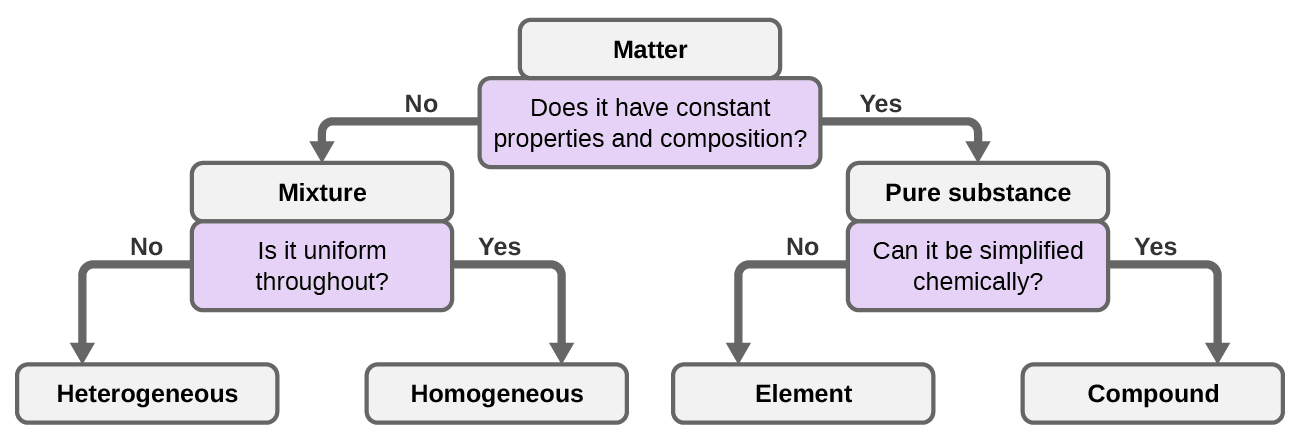

Figure 1.11図 1.11
Depending on its properties, a given substance can be classified as a homogeneous mixture, a heterogeneous mixture, a compound, or an element.
ある物質は、その性質に応じて、均一混合物、不均一混合物、化合物、単体のいずれかに分類できる。
Eleven elements make up about 99% of the earth’s crust and atmosphere (Table 1.1). Oxygen constitutes nearly one-half and silicon about one-quarter of the total quantity of these elements. A majority of elements on earth are found in chemical combinations with other elements; about one-quarter of the elements are also found in the free state.
英語のヒント
地球の地殻と大気の約99%は、11種類の元素で構成されている(表1.1)。これらの元素の総量のうち、酸素がほぼ半分を、ケイ素が約4分の1を占める。地球上の元素の大部分は、ほかの元素と化学的に結合した状態で見つかる。元素の約4分の1は、単体の状態でも見つかる。
Elemental Composition of Earth 地球を構成する元素の組成 |
|||||
|---|---|---|---|---|---|
Element 元素 |
Symbol 記号 |
Percent Mass 質量百分率 |
Element 元素 |
Symbol 記号 |
Percent Mass 質量百分率 |
oxygen 酸素 |
O |
49.20 |
chlorine 塩素 |
Cl |
0.19 |
silicon ケイ素 |
Si |
25.67 |
phosphorus リン |
P |
0.11 |
aluminum アルミニウム |
Al |
7.50 |
manganese マンガン |
Mn |
0.09 |
iron 鉄 |
Fe |
4.71 |
carbon 炭素 |
C |
0.08 |
calcium カルシウム |
Ca |
3.39 |
sulfur 硫黄 |
S |
0.06 |
sodium ナトリウム |
Na |
2.63 |
barium バリウム |
Ba |
0.04 |
potassium カリウム |
K |
2.40 |
nitrogen 窒素 |
N |
0.03 |
magnesium マグネシウム |
Mg |
1.93 |
fluorine フッ素 |
F |
0.03 |
hydrogen 水素 |
H |
0.87 |
strontium ストロンチウム |
Sr |
0.02 |
titanium チタン |
Ti |
0.58 |
all others その他すべて |
- |
0.47 |