第1章化学の基本概念
1.1 Chemistry in Context1.1 化学と私たちの世界
Learning Objectives学習目標
By the end of this section, you will be able to:
この節を学び終えると、次のことができるようになる。
- Outline the historical development of chemistry化学の歴史的な発展を概説する。
- Provide examples of the importance of chemistry in everyday life日常生活における化学の重要性を、例を挙げて示す。
- Describe the scientific method科学的方法を説明する。
- Differentiate among hypotheses, theories, and laws仮説、理論、法則を区別する。
- Provide examples illustrating macroscopic, microscopic, and symbolic domains巨視的領域、微視的領域、記号的領域を示す例を挙げる。
Throughout human history, people have tried to convert matter into more useful forms. Our Stone Age ancestors chipped pieces of flint into useful tools and carved wood into statues and toys. These endeavors involved changing the shape of a substance without changing the substance itself. But as our knowledge increased, humans began to change the composition of the substances as well—clay was converted into pottery, hides were cured to make garments, copper ores were transformed into copper tools and weapons, and grain was made into bread.
英語のヒント
人類は歴史を通じて、物質をもっと役立つ形へ変えようとしてきた。石器時代の祖先は、火打ち石のかけらを削って便利な道具にし、木を彫って像やおもちゃを作った。こうした仕事では、物質そのものは変えずに、その形を変えていた。しかし知識が増すにつれて、人間は物質の組成も変えるようになった。粘土は陶器に、獣皮はなめされて衣服に、銅鉱石は銅の道具や武器に、穀物はパンに変えられた。
Humans began to practice chemistry when they learned to control fire and use it to cook, make pottery, and smelt metals. Subsequently, they began to separate and use specific components of matter. A variety of drugs such as aloe, myrrh, and opium were isolated from plants. Dyes, such as indigo and Tyrian purple, were extracted from plant and animal matter. Metals were combined to form alloys—for example, copper and tin were mixed together to make bronze—and more elaborate smelting techniques produced iron. Alkalis were extracted from ashes, and soaps were prepared by combining these alkalis with fats. Alcohol was produced by fermentation and purified by distillation.
英語のヒント
人間が化学を実践し始めたのは、火を扱い、料理や陶器作り、金属の製錬に使うことを覚えたときである。やがて、物質の特定の成分を分離して利用するようになった。アロエ、没薬、アヘンなど、さまざまな薬が植物から取り出された。インジゴやティルス紫のような染料は、動植物由来の物質から抽出された。金属を組み合わせて合金が作られた。たとえば、銅とスズを混ぜて青銅を作り、さらに高度な製錬技術によって鉄を作った。灰からはアルカリが抽出され、それらのアルカリを脂肪と組み合わせてせっけんが作られた。アルコールは発酵によって作られ、蒸留によって精製された。
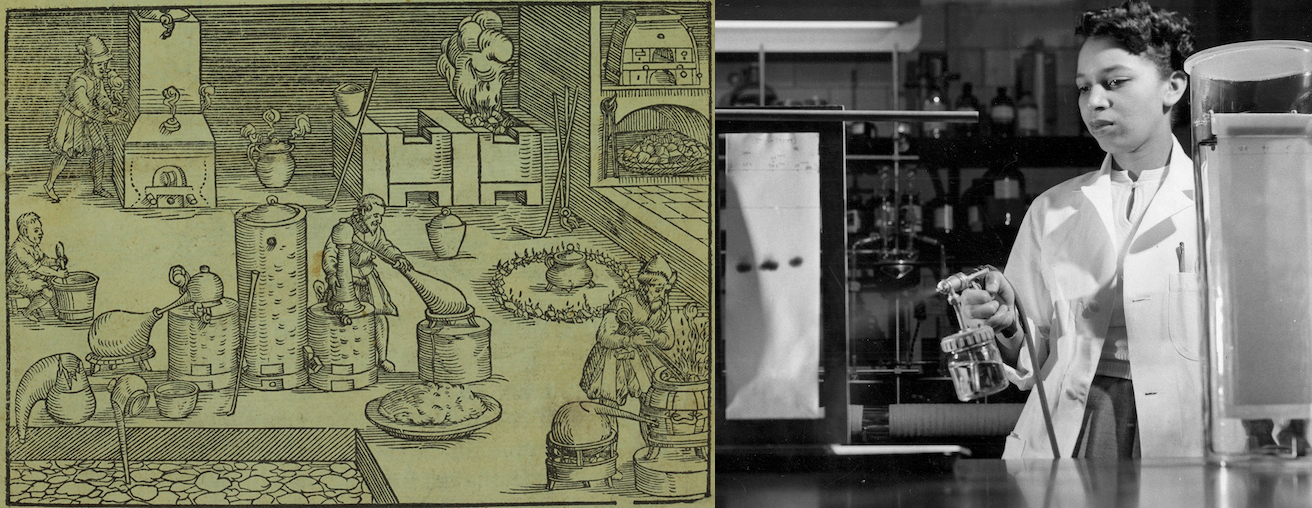
Attempts to understand the behavior of matter extend back for more than 2500 years. As early as the sixth century BC, Greek philosophers discussed a system in which water was the basis of all things. You may have heard of the Greek postulate that matter consists of four elements: earth, air, fire, and water. Subsequently, an amalgamation of chemical technologies and philosophical speculations was spread from Egypt, China, and the eastern Mediterranean by alchemists, who endeavored to transform “base metals” such as lead into “noble metals” like gold, and to create elixirs to cure disease and extend life (Figure 1.2).
英語のヒント
物質の振る舞いを理解しようとする試みは、2500年以上前にさかのぼる。早くも紀元前6世紀に、ギリシャの哲学者たちは、水が万物の基本であるという体系について論じていた。物質は土・空気・火・水という四つの元素からなる、というギリシャの仮説を聞いたことがあるかもしれない。その後、化学的な技術と哲学的な思索を混ぜ合わせたものが、錬金術師たちによってエジプト、中国、地中海東部から広められた。彼らは、鉛のような「卑金属」を金のような「貴金属」に変え、病気を治し寿命を延ばす霊薬を作ろうと努めた(図1.2)。
Lazarus Ercker / Science History Institute; NIH History Office; modified by OpenStax. · CC BY 4.0; public-domain source images · Source出典
Figure 1.2図 1.2
(a) This portrayal shows an alchemist’s workshop circa 1580. Although alchemy made some useful contributions to how to manipulate matter, it was not scientific by modern standards. (b) While the equipment used by Alma Levant Hayden in this 1952 picture might not seem as sleek as you might find in a lab today, her approach was highly methodical and carefully recorded. A department head at the FDA, Hayden is most famous for exposing an aggressively marketed anti-cancer drug as nothing more than an unhelpful solution of common substances. (credit a: Chemical Heritage Foundation; b: NIH History Office)
(a) この絵は1580年ごろの錬金術師の作業場を表している。錬金術は、物質を扱う方法にいくつかの有用な貢献をしたが、現代の基準では科学的ではなかった。(b) この1952年の写真でアルマ・レヴァント・ヘイデンが使っている装置は、今日の実験室で目にするものほど洗練されて見えないかもしれない。しかし、彼女の手法はきわめて系統的で、慎重に記録されていた。FDAの部門長であったヘイデンは、盛んに売り込まれていた抗がん剤が、一般的な物質を溶かした役に立たない溶液にすぎないと暴いたことで、最もよく知られている。(出典:aはChemical Heritage Foundation、bはNIH History Office)
From alchemy came the historical progressions that led to modern chemistry: the isolation of drugs from natural sources, such as plants and animals. But while many of the substances extracted or processed from those natural sources were critical in the treatment of diseases, many were scarce. For example, progesterone, which is critical to women's health, became available as a medicine in 1935, but its animal sources produced extremely small quantities, limiting its availability and increasing its expense. Likewise, in the 1940s, cortisone came into use to treat arthritis and other disorders and injuries, but it took a 36-step process to synthesize. Chemist Percy Lavon Julian turned to a more plentiful source: soybeans. Previously, Julian had developed a lab to isolate soy protein, which was used in firefighting among other applications. He focused on using the soy sterols—substances mostly used in plant membranes—and was able to quickly produce progesterone and later testosterone and other hormones. He later developed a process to do the same for cortisone, and laid the groundwork for modern drug design. Since soybeans and similar plant sources were extremely plentiful, the drugs soon became widely available, saving many lives.
英語のヒント
錬金術から、現代化学へとつながる歴史的な進展が生まれた。たとえば、植物や動物などの天然資源から薬を分離することである。しかし、こうした天然資源から抽出・加工された物質の多くは、病気の治療に不可欠でありながら、希少でもあった。たとえば女性の健康に重要なプロゲステロンは、1935年に薬として利用できるようになった。しかし動物から得られる量はごくわずかで、供給が限られ、価格も高くなった。同様に、1940年代には関節炎をはじめとする病気やけがの治療にコルチゾンが使われるようになったが、その合成には36段階の工程が必要だった。化学者パーシー・ラヴォン・ジュリアンは、より豊富な供給源である大豆に目を向けた。それ以前にジュリアンは、大豆タンパク質を分離する研究所を立ち上げており、そのタンパク質は消火をはじめとする用途で使われていた。彼は、主として植物の膜に使われている物質である大豆ステロールの利用に着目し、プロゲステロンを、さらに後にはテストステロンなどのホルモンも速やかに製造できるようになった。後にはコルチゾンについても同様の製法を開発し、現代の創薬の基礎を築いた。大豆やそれに類する植物資源はきわめて豊富だったため、これらの薬はまもなく広く利用できるようになり、多くの命を救った。
Chemistry: The Central Science化学――中心となる科学
Chemistry is sometimes referred to as “the central science” due to its interconnectedness with a vast array of other STEM disciplines (STEM stands for areas of study in the science, technology, engineering, and math fields). Chemistry and the language of chemists play vital roles in biology, medicine, materials science, forensics, environmental science, and many other fields (Figure 1.3). The basic principles of physics are essential for understanding many aspects of chemistry, and there is extensive overlap between many subdisciplines within the two fields, such as chemical physics and nuclear chemistry. Mathematics, computer science, and information theory provide important tools that help us calculate, interpret, describe, and generally make sense of the chemical world. Biology and chemistry converge in biochemistry, which is crucial to understanding the many complex factors and processes that keep living organisms (such as us) alive. Chemical engineering, materials science, and nanotechnology combine chemical principles and empirical findings to produce useful substances, ranging from gasoline to fabrics to electronics. Agriculture, food science, veterinary science, and brewing and wine making help provide sustenance in the form of food and drink to the world’s population. Medicine, pharmacology, biotechnology, and botany identify and produce substances that help keep us healthy. Environmental science, geology, oceanography, and atmospheric science incorporate many chemical ideas to help us better understand and protect our physical world. Chemical ideas are used to help understand the universe in astronomy and cosmology.
英語のヒント
化学は、ほかの幅広いSTEM分野と相互につながっていることから、ときに「中心となる科学」と呼ばれる。STEMは、科学・技術・工学・数学の各研究分野を表す。化学と化学者の言葉は、生物学、医学、材料科学、法科学、環境科学など、多くの分野で重要な役割を果たす(図1.3)。物理学の基本原理は、化学の多くの側面を理解するうえで不可欠である。また、化学物理学や核化学のように、両分野の下位領域の多くには大きな重なりがある。数学、コンピューター科学、情報理論は、化学の世界について計算し、解釈し、記述し、全般的に意味を理解するための重要な道具を提供する。生物学と化学は生化学で合流する。生化学は、私たちのような生物を生かし続ける、多くの複雑な要因や過程を理解するために欠かせない。化学工学、材料科学、ナノテクノロジーは、化学の原理と経験的な知見を組み合わせ、ガソリンから布地、電子機器に至るまでの有用な物質を生み出す。農業、食品科学、獣医学、ビール醸造やワイン作りは、世界の人々に飲食物という形で栄養を提供する助けとなる。医学、薬理学、バイオテクノロジー、植物学は、私たちの健康維持に役立つ物質を特定し、作り出す。環境科学、地質学、海洋学、大気科学は、多くの化学的な考えを取り入れ、物理的な世界をよりよく理解し保護する助けとする。天文学や宇宙論でも、宇宙の理解に化学的な考えが使われている。
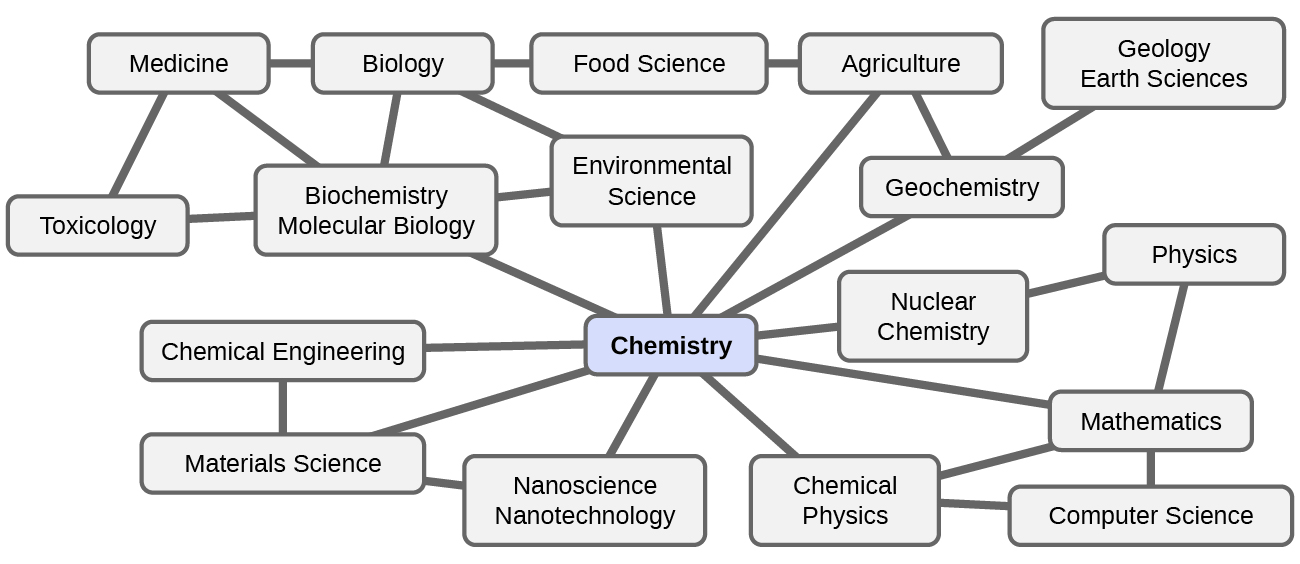

Figure 1.3図 1.3
Knowledge of chemistry is central to understanding a wide range of scientific disciplines. This diagram shows just some of the interrelationships between chemistry and other fields.
化学の知識は、幅広い科学分野を理解するうえで中心的な位置を占める。この図は、化学とほかの分野との相互関係の一部を示している。
What are some changes in matter that are essential to daily life? Digesting and assimilating food, synthesizing polymers that are used to make clothing, containers, cookware, and credit cards, and refining crude oil into gasoline and other products are just a few examples. As you proceed through this course, you will discover many different examples of changes in the composition and structure of matter, how to classify these changes and how they occurred, their causes, the changes in energy that accompany them, and the principles and laws involved. As you learn about these things, you will be learning chemistry, the study of the composition, properties, and interactions of matter. The practice of chemistry is not limited to chemistry books or laboratories: It happens whenever someone is involved in changes in matter or in conditions that may lead to such changes.
英語のヒント
日常生活に欠かせない物質の変化には、どのようなものがあるだろうか。食物を消化して体内に取り込むこと、衣服・容器・調理器具・クレジットカードの製造に使う高分子を合成すること、原油を精製してガソリンなどの製品にすることは、そのほんの一例である。この授業を進めるにつれて、物質の組成や構造が変化するさまざまな例、その変化の分類方法や起こり方、原因、伴うエネルギーの変化、関係する原理や法則を学ぶことになる。これらを学ぶことは、物質の組成・性質・相互作用を研究する学問である化学を学ぶことである。化学の実践は、化学の本や実験室に限られない。誰かが物質の変化や、その変化を引き起こしうる条件に関わるとき、そこではいつでも化学が行われている。