第2章極限
2.5 The Precise Definition of a Limit2.5 極限の厳密な定義
Learning Objectives学習目標
- Describe the epsilon-delta definition of a limit.極限のイプシロン・デルタ定義を説明する。
- Apply the epsilon-delta definition to find the limit of a function.イプシロン・デルタ定義を使って、関数の極限を求める。
- Describe the epsilon-delta definitions of one-sided limits and infinite limits.片側極限と無限大の極限の、イプシロン・デルタによる定義を説明する。
- Use the epsilon-delta definition to prove the limit laws.イプシロン・デルタ定義を使って、極限の法則を証明する。
By now you have progressed from the very informal definition of a limit in the introduction of this chapter to the intuitive understanding of a limit. At this point, you should have a very strong intuitive sense of what the limit of a function means and how you can find it. In this section, we convert this intuitive idea of a limit into a formal definition using precise mathematical language. The formal definition of a limit is quite possibly one of the most challenging definitions you will encounter early in your study of calculus; however, it is well worth any effort you make to reconcile it with your intuitive notion of a limit. Understanding this definition is the key that opens the door to a better understanding of calculus.
英語のヒント
この章の最初では極限を大まかに説明したが、ここまでの学習で、関数の極限が何を意味し、どう求められるかを直感的につかめたはずである。この節では、その直感を、正確な数学の言葉による定義に置き換える。極限の厳密な定義は、微積分を学び始める段階で出会う定義の中でも、特に難しいものかもしれない。それでも、自分の直感とこの定義がどう結びつくかを考える価値は十分にある。この定義を理解することが、微積分をさらに深く理解する鍵になる。
Quantifying Closeness「近い」を数量で表す
Before stating the formal definition of a limit, we must introduce a few preliminary ideas. Recall that the distance between two points a and b on a number line is given by
英語のヒント
極限の厳密な定義を述べる前に、準備となる考え方を確認しよう。数直線上の2点aとbの距離は、で与えられる。
- The statement may be interpreted as: The distance between and L is less than ε.は、「とLの距離がεより小さい」と読める。
- The statement may be interpreted as: and the distance between x and a is less than δ.は、「であり、xとaの距離がδより小さい」と読める。
It is also important to look at the following equivalences for absolute value:
絶対値について、次の同値な表現も重要である。
- The statement is equivalent to the statementとは同値である。
- The statement is equivalent to the statement andは、かつと同値である。
With these clarifications, we can state the formal epsilon-delta definition of the limit.
英語のヒント
これで、イプシロン・デルタを使った極限の厳密な定義を述べる準備ができた。
This definition may seem rather complex from a mathematical point of view, but it becomes easier to understand if we break it down phrase by phrase. The statement itself involves something called a universal quantifier (for every an existential quantifier (there exists a and, last, a conditional statement (if then Let’s take a look at Table 2.9, which breaks down the definition and translates each part.
英語のヒント
この定義は複雑に見えるかもしれないが、句ごとに分けると理解しやすい。定義には、全称量化子「任意の」、存在量化子「あるが存在する」、そして条件文「なら」が含まれる。表2.9では、定義を部分に分けて意味を言い換える。
Definition 定義 |
Translation 意味の言い換え |
|---|---|
1. For every 1. 任意のに対し、 |
1. For every positive distance ε from L, 1. Lからの距離として、どんな正のεを指定されても、 |
2. there exists a 2. あるが存在して、 |
2. There is a positive distance from a, 2. aからの正の距離を、次を満たすように選べる。 |
3. such that 3. 次の条件が成り立つ。 |
3. such that 3. すなわち、 |
4. if then 4. なら、。 |
4. if x is closer than to a and then is closer than ε to L. 4. xがaから未満の距離にあり、なら、はLからε未満の距離にある。 |
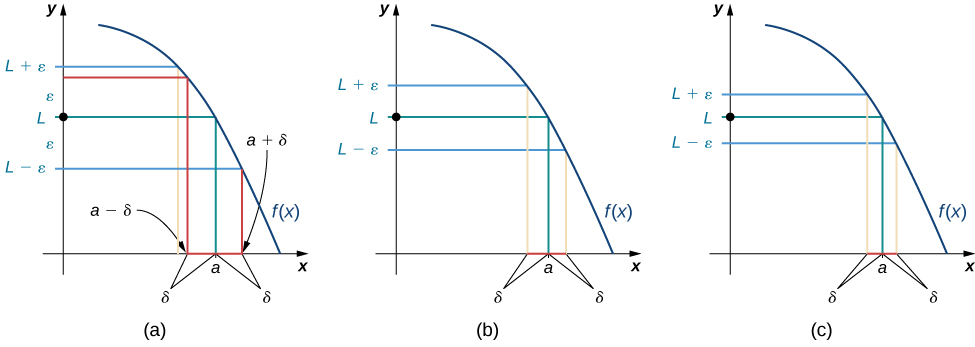
We can get a better handle on this definition by looking at the definition geometrically. Figure 2.39 shows possible values of for various choices of for a given function a number a, and a limit L at a. Notice that as we choose smaller values of ε (the distance between the function and the limit), we can always find a small enough so that if we have chosen an x value within of a, then the value of is within ε of the limit L.
英語のヒント
図で考えると、この定義をつかみやすくなる。図2.39では、関数、点a、その点での極限Lを固定し、さまざまなに対して選べるを示している。関数値と極限の間に許す距離εを小さくしても、を十分小さく選べば、aから未満の距離にあるx(ただしx≠a)について、をLからε未満の距離に収められることに注目しよう。
OpenStax, Rice University; Calculus Volume 1. · CC BY-NC-SA 4.0
Figure 2.39図 2.39
These graphs show possible values of , given successively smaller choices of ε.
εを順に小さくしても、それぞれに対応するを選べることを示す。
Example 2.39 shows how you can use this definition to prove a statement about the limit of a specific function at a specified value.
例題2.39では、この定義を使い、特定の関数が指定された点で持つ極限を証明する方法を示す。
Example 2.39例題 2.39
Proving a Statement about the Limit of a Specific Function具体的な関数の極限を証明する
Prove that
を証明せよ。
Solution解き方
Let
を任意にとる。
The first part of the definition begins “For every This means we must prove that whatever follows is true no matter what positive value of ε is chosen. By stating “Let we signal our intent to do so.
英語のヒント
定義は「任意のに対し」から始まる。これは、どんな正のεを選んでも、その後の主張が成り立つことを証明しなければならないという意味である。「を任意にとる」と書いて、その方針を示す。
Choose
と選ぶ。
The definition continues with “there exists a ” The phrase “there exists” in a mathematical statement is always a signal for a scavenger hunt. In other words, we must go and find So, where exactly did come from? There are two basic approaches to tracking down One method is purely algebraic and the other is geometric.
英語のヒント
定義は「あるが存在する」と続く。数学で「存在する」という言葉を見たら、その具体例を探すことが課題になる。ここではを見つけなければならない。では、という選び方は、どこから出てきたのだろうか。を探す基本的な方法は2つあり、1つは式による方法、もう1つは図による方法である。
We begin by tackling the problem from an algebraic point of view. Since ultimately we want we begin by manipulating this expression: is equivalent to which in turn is equivalent to Last, this is equivalent to Thus, it would seem that is appropriate.
英語のヒント
まず式で考える。最終的に示したいのはなので、これを変形する。はと同値であり、さらにと同値である。最後に、と同値になる。したがって、と選べばよさそうだ。
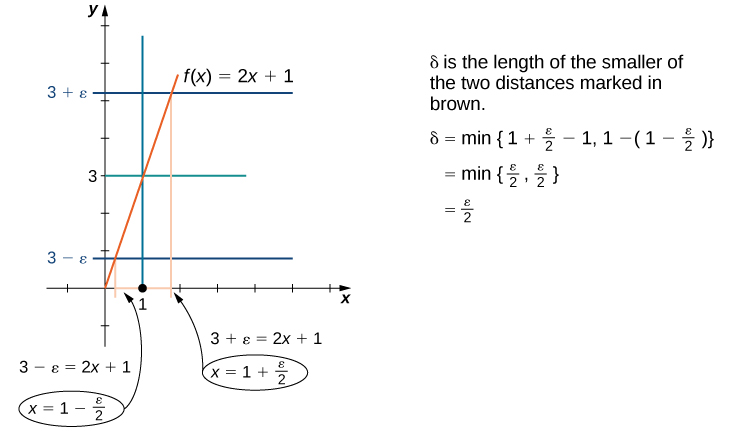
We may also find through geometric methods. Figure 2.40 demonstrates how this is done.
は、図から見つけることもできる。図2.40で、その方法を示す。
OpenStax, Rice University; Calculus Volume 1. · CC BY-NC-SA 4.0
Figure 2.40図 2.40
This graph shows how we find geometrically.
図からを選ぶ方法。
Assume When has been chosen, our goal is to show that if then To prove any statement of the form “If this, then that,” we begin by assuming “this” and trying to get “that.”
と仮定する。を選んだ後の目標は、ならとなることを示すことである。「AならB」を証明するには、まずAを仮定し、そこからBを導く。
Thus,
したがって、
The following Problem-Solving Strategy summarizes the type of proof we worked out in Example 2.39.
例題2.39で使った証明の方法を、次の手順にまとめる。
Example 2.40例題 2.40
Proving a Statement about a Limit極限に関する主張を証明する
Complete the proof that by filling in the blanks.
空欄を埋めて、の証明を完成させよ。
Let _____.
_____を任意にとる。
Choose
と選ぶ。
Assume
と仮定する。
Thus,
すると、。
Solution解き方
We begin by filling in the blanks where the choices are specified by the definition. Thus, we have
まず、定義だけで埋められる空欄を埋めよう。すると、次のようになる。
Let
を任意にとる。
Choose
と選ぶ。
Assume (or equivalently,
、同じことだがと仮定する。
Thus,
すると、。
Focusing on the final line of the proof, we see that we should choose
最後の不等式を見ると、と選べばよいことがわかる。
We now complete the final write-up of the proof:
完成した証明は、次のとおりである。
Let
を任意にとる。
Choose
と選ぶ。
Assume (or equivalently,
、同じことだがと仮定する。
Thus,
すると、。
In Example 2.39 and Example 2.40, the proofs were fairly straightforward, since the functions with which we were working were linear. In Example 2.41, we see how to modify the proof to accommodate a nonlinear function.
英語のヒント
Example 2.41例題 2.41
Proving a Statement about the Limit of a Specific Function (Geometric Approach)具体的な関数の極限を証明する(図を使う方法)
Prove that
を証明せよ。
Solution解き方
- Let The first part of the definition begins “For every so we must prove that whatever follows is true no matter what positive value of ε is chosen. By stating “Let we signal our intent to do so.を任意にとる。定義は「任意のに対し」で始まるので、どんな正のεを選んでも、その後の主張が成り立つことを示す必要がある。「を任意にとる」と書くことで、その方針を示す。
- Without loss of generality, assume Two questions present themselves: Why do we want and why is it okay to make this assumption? In answer to the first question: Later on, in the process of solving for we will discover that involves the quantity Consequently, we need In answer to the second question: If we can find that “works” for then it will “work” for any as well. Keep in mind that, although it is always okay to put an upper bound on ε, it is never okay to put a lower bound (other than zero) on ε.
英語のヒント
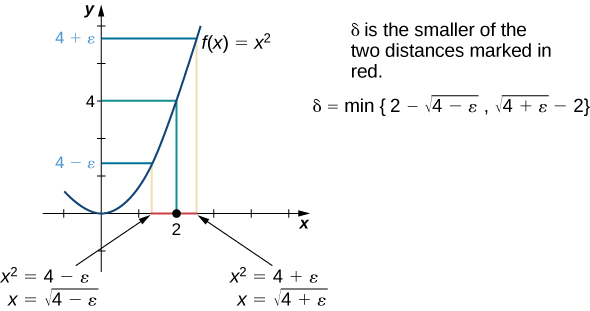
一般性を失わずに、と仮定してよい。ここで、なぜとしたいのか、なぜそう仮定してよいのかという2つの問いが生まれる。第1の理由は、後でを求めるとき、にが現れるからである。この平方根を実数として扱うため、が必要になる。第2の理由は、に対して使えるが見つかれば、それより緩い条件であるにも対応できるからである。εに上限を設けて証明することはできるが、0以外の正の下限を設けることはできない。どれほど小さい正のεにも対応する必要がある。 - Choose Figure 2.41 shows how we made this choice ofと選ぶ。図2.41に、このの選び方を示す。
OpenStax, Rice University; Calculus Volume 1. · CC BY-NC-SA 4.0
Figure 2.41図 2.41This graph shows how we find δ geometrically for a given ε for the proof in Example 2.41.例題2.41で、指定されたεに対するδを図から選ぶ方法。 - We must show: If then so we must begin by assuming示したいのは、ならということである。そこで、まず次を仮定する。
We don’t really need (in other words, for this proof. Since it is okay to dropこの証明では、、つまりという条件自体は必要ない。が成り立つので、を外して考えてよい。
Hence,したがって、
Recall that Thus, and consequently We also use here. We might ask at this point: Why did we substitute for on the left-hand side of the inequality and on the right-hand side of the inequality? If we look at Figure 2.41, we see that corresponds to the distance on the left of 2 on the x-axis and corresponds to the distance on the right. Thus,と選んだことを思い出そう。したがって、であり、符号を反転するととなる。また、も使う。なぜ不等式の左側ではをに、右側ではに置き換えるのだろうか。図2.41を見ると、はx軸上で2の左側の距離、は右側の距離に対応する。したがって、
We simplify the expression on the left:左側の式を整理する。
Then, we add 2 to all parts of the inequality:不等式の各辺に2を足す。
We square all parts of the inequality. It is okay to do so, since all parts of the inequality are positive:不等式の各辺を2乗する。各辺は非負なので、不等号の向きを保って2乗できる。
We subtract 4 from all parts of the inequality:不等式の各辺から4を引く。
Last,最後に、 - Therefore,したがって、
The geometric approach to proving that the limit of a function takes on a specific value works quite well for some functions. Also, the insight into the formal definition of the limit that this method provides is invaluable. However, we may also approach limit proofs from a purely algebraic point of view. In many cases, an algebraic approach may not only provide us with additional insight into the definition, it may prove to be simpler as well. Furthermore, an algebraic approach is the primary tool used in proofs of statements about limits. For Example 2.42, we take on a purely algebraic approach.
英語のヒント
関数の極限が指定された値になることを証明する際、図を使う方法は、ある種の関数でとてもうまく働く。極限の厳密な定義を理解するうえでも、この方法は貴重な手がかりとなる。極限の証明は、式だけで進めることもできる。多くの場合、式による方法は定義の理解を深めるだけでなく、図を使うより簡単なこともある。さらに、極限に関する一般的な主張の証明では、式による方法が中心的な道具になる。例題2.42では、この方法を使う。
Example 2.42例題 2.42
Proving a Statement about the Limit of a Specific Function (Algebraic Approach)具体的な関数の極限を証明する(式を使う方法)
Prove that
を証明せよ。
Solution解き方
Let’s use our outline from the Problem-Solving Strategy:
先ほどの証明の手順に沿って進めよう。
- Letを任意にとる。
- Choose This choice of may appear odd at first glance, but it was obtained by taking a look at our ultimate desired inequality: This inequality is equivalent to At this point, the temptation simply to choose is very strong. Unfortunately, our choice of must depend on ε only and no other variable. If we can replace by a numerical value, our problem can be resolved. This is the place where assuming comes into play. The choice of here is arbitrary. We could have just as easily used any other positive number. In some proofs, greater care in this choice may be necessary. Now, since and we are able to show that Consequently, At this point we realize that we also need Thus, we choose
英語のヒント
と選ぶ。このの選び方は一見奇妙だが、最後に示したい不等式から考えている。この不等式はと同値である。ここでと選びたくなるかもしれない。しかし、はεだけに依存するように選び、変動するxには依存させてはいけない。そこで、を一定の数で上から押さえられれば解決できる。このためにという制限を使う。ここでとしたのは任意の選択で、別の正の上限でもよい。ただし、証明によっては上限を慎重に選ぶ必要がある。かつからが示せるので、となる。さらにも必要である。この2条件を満たすように、と選ぶ。 - Assume Thus,と仮定する。すると、
Since we may conclude that Thus, by subtracting 4 from all parts of the inequality, we obtain Consequently, This gives usなので、である。各辺から4を引くととなり、したがってがわかる。これより、
Therefore,したがって、
You will find that, in general, the more complex a function, the more likely it is that the algebraic approach is the easiest to apply. The algebraic approach is also more useful in proving statements about limits.
英語のヒント
一般に、関数が複雑になるほど、式を使う方法のほうが適用しやすいことが多い。また、極限に関する一般的な主張を証明するときにも、この方法が役立つ。