第2章極限
Types of Discontinuities不連続の種類
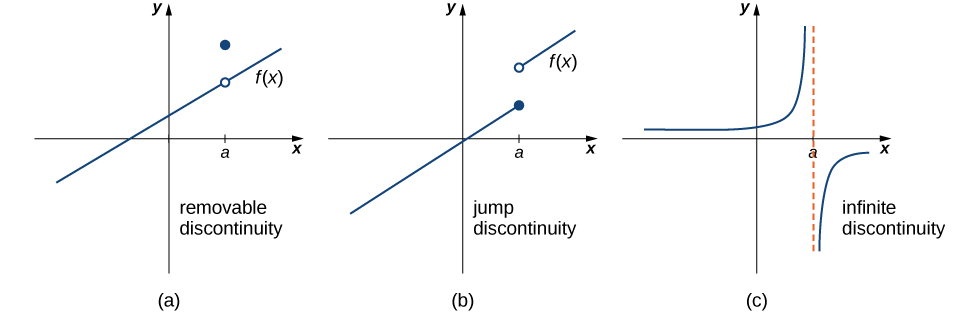
As we have seen in Example 2.26 and Example 2.27, discontinuities take on several different appearances. We classify the types of discontinuities we have seen thus far as removable discontinuities, infinite discontinuities, or jump discontinuities. Intuitively, a removable discontinuity is a discontinuity for which there is a hole in the graph, a jump discontinuity is a noninfinite discontinuity for which the sections of the function do not meet up, and an infinite discontinuity is a discontinuity located at a vertical asymptote. Figure 2.37 illustrates the differences in these types of discontinuities. Although these terms provide a handy way of describing three common types of discontinuities, keep in mind that not all discontinuities fit neatly into these categories.
英語のヒント
OpenStax, Rice University; Calculus Volume 1. · CC BY-NC-SA 4.0
Figure 2.37図 2.37
Discontinuities are classified as (a) removable, (b) jump, or (c) infinite.
不連続の例。(a)除去可能な不連続、(b)跳躍不連続、(c)無限不連続。
These three discontinuities are formally defined as follows:
この3種類を、正確には次のように定義する。
Example 2.30例題 2.30
Classifying a Discontinuity不連続を分類する
In Example 2.26, we showed that is discontinuous at Classify this discontinuity as removable, jump, or infinite.
例題2.26では、がで不連続であることを示した。この不連続を、除去可能・跳躍・無限のいずれかに分類しなさい。
Solution解き方
To classify the discontinuity at 2 we must evaluate
2での不連続を分類するには、を求める。
Since f is discontinuous at 2 and exists, f has a removable discontinuity at
fは2で不連続だがは存在するので、での不連続は除去可能である。
Example 2.31例題 2.31
Classifying a Discontinuity不連続を分類する
In Example 2.27, we showed that is discontinuous at Classify this discontinuity as removable, jump, or infinite.
例題2.27では、がで不連続であることを示した。この不連続を、除去可能・跳躍・無限のいずれかに分類しなさい。
Solution解き方
Earlier, we showed that f is discontinuous at 3 because does not exist. However, since and both exist, we conclude that the function has a jump discontinuity at 3.
すでに、が存在しないため、fは3で不連続だと分かっている。しかし、とはともに存在し、値が異なる。したがって、3での不連続は跳躍不連続である。
Example 2.32例題 2.32
Classifying a Discontinuity不連続を分類する
Determine whether is continuous at −1. If the function is discontinuous at −1, classify the discontinuity as removable, jump, or infinite.
が−1で連続かどうかを調べなさい。不連続なら、除去可能・跳躍・無限のいずれかに分類すること。
Solution解き方
The function value is undefined. Therefore, the function is not continuous at −1. To determine the type of discontinuity, we must determine the limit at −1. We see that and Therefore, the function has an infinite discontinuity at −1.
関数値は未定義なので、この関数は−1で連続ではない。不連続の種類を調べるため、−1での極限を考える。かつだから、−1では無限不連続である。
Continuity over an Interval区間上での連続性
Now that we have explored the concept of continuity at a point, we extend that idea to continuity over an interval. As we develop this idea for different types of intervals, it may be useful to keep in mind the intuitive idea that a function is continuous over an interval if we can use a pencil to trace the function between any two points in the interval without lifting the pencil from the paper. In preparation for defining continuity on an interval, we begin by looking at the definition of what it means for a function to be continuous from the right at a point and continuous from the left at a point.
英語のヒント
ある点での連続性を学んだので、これを区間上での連続性へ広げよう。さまざまな区間で考える際には、「区間内の任意の2点の間を、鉛筆を紙から離さずにグラフに沿ってなぞれる」という直感を思い出すとよい。区間上の連続性を定義する準備として、まず、ある点での右連続・左連続を定義する。
A function is continuous over an open interval if it is continuous at every point in the interval. A function is continuous over a closed interval of the form if it is continuous at every point in and is continuous from the right at a and is continuous from the left at b. Analogously, a function is continuous over an interval of the form if it is continuous over and is continuous from the left at b. Continuity over other types of intervals are defined in a similar fashion.
英語のヒント
開区間のすべての点で連続なら、関数はその開区間上で連続であるという。関数が閉区間上で連続であるとは、のすべての点で連続であり、さらにaで右連続、bで左連続であることをいう。同様に、関数が上で連続であるとは、上で連続で、bで左連続であることをいう。ほかの種類の区間でも、同じように定義する。
Requiring that and ensures that we can trace the graph of the function from the point to the point without lifting the pencil. If, for example, we would need to lift our pencil to jump from to the graph of the rest of the function over
とを要求することで、点から点まで、鉛筆を離さずにグラフをなぞれる。たとえばなら、に対応する点から上の残りのグラフへ移る際、鉛筆を持ち上げて飛び移らなければならない。
Example 2.33例題 2.33
Continuity on an Interval区間上での連続性
State the interval(s) over which the function is continuous.
関数が連続である区間をすべて挙げなさい。
Solution解き方
Since is a rational function, it is continuous at every point in its domain. The domain of is the set Thus, is continuous over each of the intervals and
は有理関数なので、定義域のすべての点で連続である。の定義域はである。したがって、は各区間およびで連続である。
Example 2.34例題 2.34
Continuity over an Interval区間上での連続性
State the interval(s) over which the function is continuous.
関数が連続である区間をすべて挙げなさい。
Solution解き方
From the limit laws, we know that for all values of a in We also know that exists and exists. Therefore, is continuous over the interval
極限の法則から、のすべてのaについてが成り立つ。また、端点ではとが成り立ち、それぞれの関数値に等しい。したがって、は区間上で連続である。
The Theorem 2.9 allows us to expand our ability to compute limits. In particular, this theorem ultimately allows us to demonstrate that trigonometric functions are continuous over their domains.
定理2.9により、求められる極限の範囲が広がる。特に、この定理を使うと、三角関数がそれぞれの定義域で連続であることを示せる。
Before we move on to Example 2.35, recall that earlier, in the section on limit laws, we showed Consequently, we know that is continuous at 0. In Example 2.35 we see how to combine this result with the composite function theorem.
Example 2.35例題 2.35
Limit of a Composite Cosine Function余弦を含む合成関数の極限
Evaluate
を求めなさい。
Solution解き方
The given function is a composite of and Since and is continuous at 0, we may apply the composite function theorem. Thus,
与えられた関数は、との合成である。であり、は0で連続なので、合成関数の定理を使える。したがって、次のようになる。
The proof of the next theorem uses the composite function theorem as well as the continuity of and at the point 0 to show that trigonometric functions are continuous over their entire domains.
次の定理の証明では、合成関数の定理と、およびの0での連続性を使い、三角関数がそれぞれの定義域全体で連続であることを示す。
Proof証明
We begin by demonstrating that is continuous at every real number. To do this, we must show that for all values of a.
まず、がすべての実数で連続であることを示す。そのためには、どのaについてもが成り立つことを示せばよい。
The proof that is continuous at every real number is analogous. Because the remaining trigonometric functions may be expressed in terms of and their continuity follows from the quotient limit law.
がすべての実数で連続であることも、同様に示せる。残りの三角関数はとを使って表せるので、商の極限の法則から、それぞれの定義域での連続性が従う。
□
□
As you can see, the composite function theorem is invaluable in demonstrating the continuity of trigonometric functions. As we continue our study of calculus, we revisit this theorem many times.
このように、合成関数の定理は三角関数の連続性を示すうえで非常に役に立つ。微積分の学習を進める中で、何度もこの定理を使うことになる。