第2章極限
The Squeeze Theoremはさみうちの定理
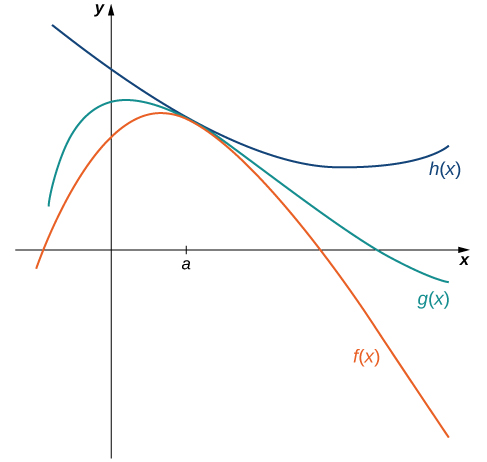
The techniques we have developed thus far work very well for algebraic functions, but we are still unable to evaluate limits of very basic trigonometric functions. The next theorem, called the squeeze theorem, proves very useful for establishing basic trigonometric limits. This theorem allows us to calculate limits by “squeezing” a function, with a limit at a point a that is unknown, between two functions having a common known limit at a. Figure 2.27 illustrates this idea.
英語のヒント
ここまでの方法は代数関数には有効だが、ごく基本的な三角関数の極限さえ、まだ求められない。次の「はさみうちの定理」は、三角関数の基本的な極限を示すうえで役に立つ。aでの極限がまだ分からない関数を、aでの極限が同じ既知の値になる2つの関数ではさむことで、その極限を計算できる。図2.27が、この考えを示している。
OpenStax, Rice University; Calculus Volume 1. · CC BY-NC-SA 4.0
Figure 2.27図 2.27
The Squeeze Theorem applies when and
かつのとき、はさみうちの定理を使える。
Example 2.24例題 2.24
Applying the Squeeze Theoremはさみうちの定理を使う
Apply the squeeze theorem to evaluate
はさみうちの定理を使って、を求めなさい。
Solution解き方
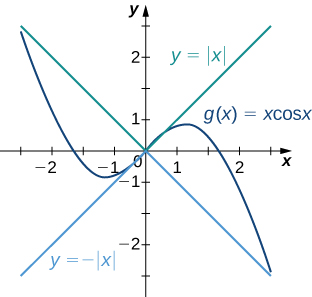
Because for all x, we have . Since from the squeeze theorem, we obtain The graphs of and are shown in Figure 2.28.
どのxについてもだから、が成り立つ。なので、はさみうちの定理からを得る。図2.28に、およびのグラフを示す。
OpenStax, Rice University; Calculus Volume 1. · CC BY-NC-SA 4.0
Figure 2.28図 2.28
The graphs of and are shown around the point
の近くでの、およびのグラフ。
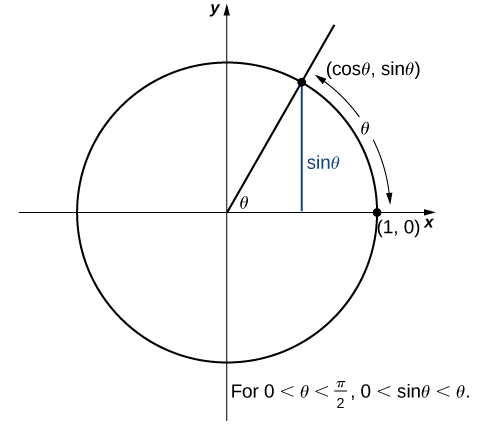
We now use the squeeze theorem to tackle several very important limits. Although this discussion is somewhat lengthy, these limits prove invaluable for the development of the material in both the next section and the next chapter. The first of these limits is Consider the unit circle shown in Figure 2.29. In the figure, we see that is the y-coordinate on the unit circle and it corresponds to the line segment shown in blue. The radian measure of angle θ is the length of the arc it subtends on the unit circle. Therefore, we see that for
英語のヒント
はさみうちの定理を使い、非常に重要ないくつかの極限を求めよう。少し長い議論になるが、これらの極限は、次の節や次の章の内容を展開するうえで欠かせない。最初はである。図2.29の単位円を考えよう。は円周上の点のy座標であり、青い線分の長さに当たる。角θのラジアン値は、単位円でその角が切り取る弧の長さである。したがって、0<θ<π/2のとき、が分かる。
OpenStax, Rice University; Calculus Volume 1. · CC BY-NC-SA 4.0
Figure 2.29図 2.29
The sine function is shown as a line on the unit circle.
単位円上で、正弦の値を線分の長さとして示している。
Because and by using the squeeze theorem we conclude that
かつなので、はさみうちの定理から次を得る。
To see that as well, observe that for and hence, Consequently, It follows that An application of the squeeze theorem produces the desired limit. Thus, since and
左側からもとなることを確かめよう。−π/2<θ<0ならなので、となる。正弦は奇関数だから、であり、したがってである。ここにはさみうちの定理を使えば、求める左側極限を得る。かつなので、次が成り立つ。
Next, using the identity for we see that
次に、で成り立つ恒等式を使うと、次を得る。
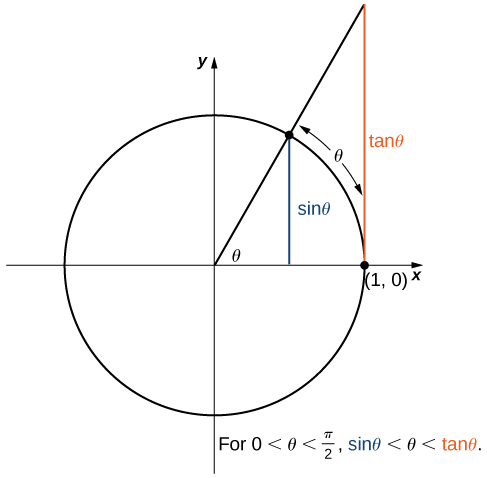
We now take a look at a limit that plays an important role in later chapters—namely, To evaluate this limit, we use the unit circle in Figure 2.30. Notice that this figure adds one additional triangle to Figure 2.30. We see that the length of the side opposite angle θ in this new triangle is Thus, we see that for
OpenStax, Rice University; Calculus Volume 1. · CC BY-NC-SA 4.0
Figure 2.30図 2.30
The sine and tangent functions are shown as lines on the unit circle.
単位円を使い、正弦と正接の値を線分の長さとして示している。
By dividing by in all parts of the inequality, we obtain
不等式の各辺をで割ると、次を得る。
Equivalently, we have
これを同値な形に書き換えると、次のようになる。
Since we conclude that By applying a manipulation similar to that used in demonstrating that we can show that Thus,
英語のヒント
なので、はさみうちの定理からと分かる。また、を示したときと同じように負の角を扱えば、も示せる。したがって、次を得る。
In Example 2.25 we use this limit to establish This limit also proves useful in later chapters.
例題2.25では、この極限を使ってを示す。この極限も、後の章で役に立つ。
Example 2.25例題 2.25
Evaluating an Important Trigonometric Limit重要な三角関数の極限を求める
Evaluate
を求めなさい。
Solution解き方
In the first step, we multiply by the conjugate so that we can use a trigonometric identity to convert the cosine in the numerator to a sine:
最初に共役な式を掛ける。すると、三角関数の恒等式を使い、分子の余弦を正弦の式に変えられる。
Therefore,
したがって、次のようになる。