第2章極限
The Intermediate Value Theorem中間値の定理
Functions that are continuous over intervals of the form where a and b are real numbers, exhibit many useful properties. Throughout our study of calculus, we will encounter many powerful theorems concerning such functions. The first of these theorems is the Intermediate Value Theorem.
英語のヒント
実数a,bについて、の形の区間で連続な関数は、有用な性質を数多く持つ。微積分では、そのような関数に関する強力な定理をいくつも学ぶ。最初に取り上げるのは、中間値の定理である。
Example 2.36例題 2.36
Application of the Intermediate Value Theorem中間値の定理の応用
Show that has at least one zero.
が少なくとも1つの零点を持つことを示しなさい。
Solution解き方
Since is continuous over it is continuous over any closed interval of the form If you can find an interval such that and have opposite signs, you can use the Intermediate Value Theorem to conclude there must be a real number c in that satisfies Note that
英語のヒント
はで連続なので、どの閉区間でも連続である。とが異なる符号になる区間を見つければ、中間値の定理により、を満たす実数cが内に存在するといえる。ここで、次に注目する。
and
また、
Using the Intermediate Value Theorem, we can see that there must be a real number c in that satisfies Therefore, has at least one zero.
中間値の定理から、を満たす実数cが内に存在する。したがって、には少なくとも1つ零点がある。
Example 2.37例題 2.37
When Can You Apply the Intermediate Value Theorem?中間値の定理はいつ使えるか
If is continuous over and can we use the Intermediate Value Theorem to conclude that has no zeros in the interval Explain.
について、で連続かつf(0)>0、さらにとする。中間値の定理を使って、は区間内に零点を持たないと結論づけられるか。説明しなさい。
Solution解き方
No. The Intermediate Value Theorem only allows us to conclude that we can find a value between and it doesn’t allow us to conclude that we can’t find other values. To see this more clearly, consider the function It satisfies and
英語のヒント
結論づけられない。中間値の定理が保証するのは、との間の値を取ることだけであり、その範囲外の値を取らないとはいっていない。たとえば、を考えると分かりやすい。この関数はを満たすが、である。
Example 2.38例題 2.38
When Can You Apply the Intermediate Value Theorem?中間値の定理はいつ使えるか
For and Can we conclude that has a zero in the interval
かつである。このことから、が区間内に零点を持つと結論づけられるか。
Solution解き方
No. The function is not continuous over The Intermediate Value Theorem does not apply here.
結論づけられない。この関数は上で連続でないため、中間値の定理は使えない。
Key Concepts重要な概念
- For a function to be continuous at a point, it must be defined at that point, its limit must exist at the point, and the value of the function at that point must equal the value of the limit at that point.関数がある点で連続であるためには、その点で定義され、極限が存在し、その関数値と極限の値が一致しなければならない。
- Discontinuities may be classified as removable, jump, or infinite.不連続には、除去可能・跳躍・無限という種類がある。
- A function is continuous over an open interval if it is continuous at every point in the interval. It is continuous over a closed interval if it is continuous at every point in its interior and is continuous at its endpoints.開区間のすべての点で連続なら、その開区間上で連続である。閉区間では、内部のすべての点で連続であり、端点では区間の内側から連続であることを要求する。
- The composite function theorem states: If is continuous at L and then合成関数の定理:がLで連続で、なら、となる。
- The Intermediate Value Theorem guarantees that if a function is continuous over a closed interval, then the function takes on every value between the values at its endpoints.中間値の定理は、閉区間で連続な関数が、両端の関数値の間にあるすべての値を取ることを保証する。
Exercises 131–138練習問題 131–138
For the following exercises, determine the point(s), if any, at which each function is discontinuous. Classify any discontinuity as jump, removable, infinite, or other.
以下の問題では、各関数が不連続になる点があれば、すべて求めなさい。不連続を、跳躍・除去可能・無限・その他に分類すること。
Exercise 131問題 131
Solution解き方
The function is defined for all x in the interval
この関数は、区間内のすべてのxで定義される。
Exercise 132問題 132
Exercise 133問題 133
Solution解き方
Removable discontinuity at infinite discontinuity at
で除去可能な不連続、で無限不連続。
Exercise 134問題 134
Exercise 135問題 135
Solution解き方
Infinite discontinuity at
で無限不連続。
Exercise 136問題 136
Exercise 137問題 137
Solution解き方
Infinite discontinuities at for
に対し、で無限不連続。
Exercise 138問題 138
Exercises 139–144練習問題 139–144
For the following exercises, decide if the function continuous at the given point. If it is discontinuous, what type of discontinuity is it?
以下の問題では、指定された点で関数が連続かどうかを調べなさい。不連続なら、その種類も答えること。
Exercise 139問題 139
at
について、で調べる。
Solution解き方
No. It is a removable discontinuity.
連続ではない。除去可能な不連続である。
Exercise 140問題 140
at
について、で調べる。
Exercise 141問題 141
at
について、で調べる。
Solution解き方
Yes. It is continuous.
連続である。
Exercise 142問題 142
at
について、で調べる。
Exercise 143問題 143
at
について、で調べる。
Solution解き方
Yes. It is continuous.
連続である。
Exercise 144問題 144
at
について、で調べる。
Exercises 145–149練習問題 145–149
In the following exercises, find the value(s) of k that makes each function continuous over the given interval.
以下の問題では、指定された区間上で各関数が連続になるようなkの値を求めなさい。
Exercise 145問題 145
Solution解き方
Exercise 146問題 146
Exercise 147問題 147
Solution解き方
Exercise 148問題 148
Exercise 149問題 149
Solution解き方
Exercises 150–158練習問題 150–158
In the following exercises, use the Intermediate Value Theorem (IVT).
以下の問題では、中間値の定理(IVT)を使いなさい。
Exercise 150問題 150
Let Over the interval there is no value of x such that although and Explain why this does not contradict the IVT.
とする。かつだが、区間にはを満たすxがない。これが中間値の定理に矛盾しない理由を説明しなさい。
Exercise 151問題 151
A particle moving along a line has at each time t a position function which is continuous. Assume and Another particle moves such that its position is given by Explain why there must be a value c for such that
直線上を動く粒子の位置を、時刻tの連続関数で表す。かつとする。別の粒子の位置はで与えられる。を満たすcがの範囲に存在する理由を説明しなさい。
Solution解き方
Since both s and are continuous everywhere, then is continuous everywhere and, in particular, it is continuous over the closed interval Also, and Therefore, by the IVT, there is a value such that
sももすべての点で連続なので、もすべての点で連続であり、特に閉区間で連続である。また、かつである。したがって、中間値の定理より、を満たす値が2と5の間に存在する。
Exercise 152問題 152
[T] Use the statement “The cosine of t is equal to t cubed.”
[T] 「tの余弦は、tの3乗に等しい」という記述を考える。
- Write a mathematical equation of the statement.この記述を方程式に表しなさい。
- Prove that the equation in part a. has at least one real solution.aの方程式が少なくとも1つの実数解を持つことを証明しなさい。
- Use a calculator to find an interval of length 0.01 that contains a solution.電卓を使い、解を含む長さ0.01の区間を求めなさい。
Exercise 153問題 153
Apply the IVT to determine whether has a solution in one of the intervals or Briefly explain your response for each interval.
中間値の定理を使い、が区間またはで解を持つか調べなさい。それぞれの区間について、理由を簡潔に説明すること。
Solution解き方
The function is continuous over the interval and has opposite signs at the endpoints.
関数は区間で連続であり、両端の値の符号が異なるため、この区間には解が存在する。
Exercise 154問題 154
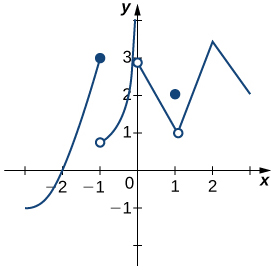
Consider the graph of the function shown in the following graph.
次に示す関数のグラフを考える。
OpenStax, Rice University; Calculus Volume 1. · CC BY-NC-SA 4.0
- Find all values for which the function is discontinuous.関数が不連続になる値をすべて求めなさい。
- For each value in part a., state why the formal definition of continuity does not apply.aで求めた各値について、連続性の定義のどの条件を満たさないか述べなさい。
- Classify each discontinuity as either jump, removable, or infinite.各不連続を、跳躍・除去可能・無限のいずれかに分類しなさい。
Exercise 155問題 155
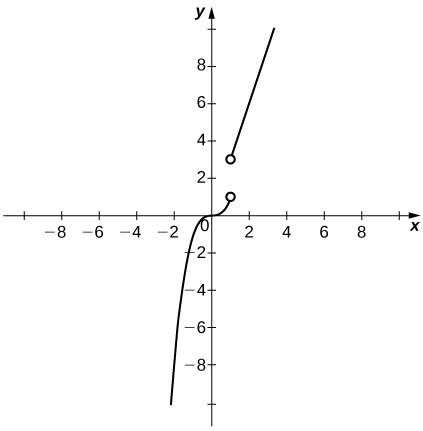
Let
とする。
- Sketch the graph of f.fのグラフを描きなさい。
- Is it possible to find a value k such that which makes continuous for all real numbers? Briefly explain.と定めることで、がすべての実数で連続になるようなkを選べるか。簡潔に説明しなさい。
Solution解き方
a.
a.
OpenStax, Rice University; Calculus Volume 1. · CC BY-NC-SA 4.0
b. It is not possible to redefine since the discontinuity is a jump discontinuity.
b. 跳躍不連続なので、の値を定め直しても連続にはできない。
Exercise 156問題 156
Let for
に対して、とする。
- Sketch the graph of f.fのグラフを描きなさい。
- Is it possible to find values and such that and and that makes continuous for all real numbers? Briefly explain.かつと定めることで、がすべての実数で連続になるようなとを選べるか。簡潔に説明しなさい。
Exercise 157問題 157
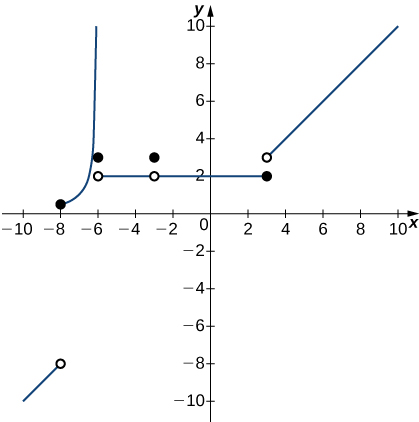
Sketch the graph of the function with properties i. through vi.
i〜viの性質を持つ関数のグラフを描きなさい。
- The domain of f isfの定義域はである。
- f has an infinite discontinuity atfはで無限不連続を持つ。
- f is left continuous but not right continuous atfはで左連続だが、右連続ではない。
Solution解き方
Answers may vary; see the following example:
解答は1通りとは限らない。次に例を示す。
OpenStax, Rice University; Calculus Volume 1. · CC BY-NC-SA 4.0
Exercise 158問題 158
Sketch the graph of the function with properties i. through iv.
i〜ivの性質を持つ関数のグラフを描きなさい。
- The domain of f isfの定義域はである。
- and exist and are equal.とが存在し、等しい。
- is left continuous but not continuous at and right continuous but not continuous atはで左連続だが連続ではなく、で右連続だが連続ではない。
- has a removable discontinuity at a jump discontinuity at and the following limits hold: andはで除去可能な不連続、で跳躍不連続を持ち、かつが成り立つ。