第2章極限
The Existence of a Limit極限が存在するかどうか
As we consider the limit in the next example, keep in mind that for the limit of a function to exist at a point, the functional values must approach a single real-number value at that point. If the functional values do not approach a single value, then the limit does not exist.
英語のヒント
次の例題では、関数の極限がある点で存在するためには、関数の値が1つの実数に近づかなければならないことを意識しよう。1つの値に近づかないなら、極限は存在しない。
Example 2.7例題 2.7
Evaluating a Limit That Fails to Exist存在しない極限を調べる
Evaluate using a table of values.
値の表を使って、を調べなさい。
Solution解き方
x |
x |
|||
|---|---|---|---|---|
−0.1 |
0.544021110889 |
0.1 |
−0.544021110889 |
|
−0.01 |
0.50636564111 |
0.01 |
−0.50636564111 |
|
−0.001 |
−0.8268795405312 |
0.001 |
0.826879540532 |
|
−0.0001 |
0.305614388888 |
0.0001 |
−0.305614388888 |
|
−0.00001 |
−0.035748797987 |
0.00001 |
0.035748797987 |
|
−0.000001 |
0.349993504187 |
0.000001 |
−0.349993504187 |
After examining the table of functional values, we can see that the y-values do not seem to approach any one single value. It appears the limit does not exist. Before drawing this conclusion, let’s take a more systematic approach. Take the following sequence of x-values approaching 0:
英語のヒント
関数の値の表を見ると、yの値は1つの値に近づいているようには見えない。極限は存在しないようだ。ただし、結論を出す前に、もう少し系統的に調べよう。0に近づく、次のようなxの値の列を取る。
The corresponding y-values are
それに対応するyの値は、次のようになる。
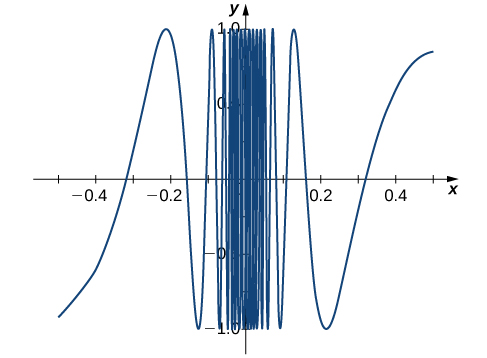
At this point we can indeed conclude that does not exist. (Mathematicians frequently abbreviate “does not exist” as DNE. Thus, we would write DNE.) The graph of is shown in Figure 2.17 and it gives a clearer picture of the behavior of as x approaches 0. You can see that oscillates ever more wildly between −1 and 1 as x approaches 0.
英語のヒント
これで、は存在しないと結論づけられる。数学では「存在しない」をDNE(does not exist)と略すことがよくある。そこで、 DNEと書く。図2.17はのグラフで、xが0に近づくときのの振る舞いを、より分かりやすく示している。xが0に近づくほど、は−1と1の間をますます激しく振動する。
OpenStax, Rice University; Calculus Volume 1. · CC BY-NC-SA 4.0
Figure 2.17図 2.17
The graph of oscillates rapidly between −1 and 1 as x approaches 0.
のグラフは、xが0に近づくと−1と1の間で急速に振動する。
One-Sided Limits片側極限
Sometimes indicating that the limit of a function fails to exist at a point does not provide us with enough information about the behavior of the function at that particular point. To see this, we now revisit the function introduced at the beginning of the section (see Figure 2.12(b)). As we pick values of x close to 2, does not approach a single value, so the limit as x approaches 2 does not exist—that is, DNE. However, this statement alone does not give us a complete picture of the behavior of the function around the x-value 2. To provide a more accurate description, we introduce the idea of a one-sided limit. For all values to the left of 2 (or the negative side of 2), Thus, as x approaches 2 from the left, approaches −1. Mathematically, we say that the limit as x approaches 2 from the left is −1. Symbolically, we express this idea as
英語のヒント
ある点で極限が存在しないと述べるだけでは、その点の周辺で関数がどう振る舞うかを十分に表せないことがある。この節の冒頭で登場した関数を、もう一度考えよう(図2.12(b))。xの値を2に近づけても、は1つの値に近づかない。したがって、xが2に近づくときの極限は存在せず、 DNEである。しかし、これだけでは2付近での関数の様子を十分に伝えられない。より正確に述べるため、片側極限を導入する。2の左側、つまり2より小さい側の値では、常にである。したがって、xが左から2に近づくとき、は−1に近づく。このとき「xが左から2に近づくときの極限は−1である」といい、次のように表す。
Similarly, as x approaches 2 from the right (or from the positive side), approaches 1. Symbolically, we express this idea as
同様に、xが2の右側、つまり2より大きい側から近づくとき、は1に近づく。これを次のように表す。
We can now present an informal definition of one-sided limits.
ここで、片側極限を直感的に定義しよう。
Example 2.8例題 2.8
Evaluating One-Sided Limits片側極限を求める
For the function evaluate each of the following limits.
関数について、次の各極限を求めなさい。
Solution解き方
We can use tables of functional values again Table 2.6. Observe that for values of x less than 2, we use and for values of x greater than 2, we use
ここでも関数の値の表を使える(表2.6)。xが2より小さいときはを使い、2より大きいときはを使う。
x |
x |
|||
|---|---|---|---|---|
1.9 |
2.9 |
2.1 |
0.41 |
|
1.99 |
2.99 |
2.01 |
0.0401 |
|
1.999 |
2.999 |
2.001 |
0.004001 |
|
1.9999 |
2.9999 |
2.0001 |
0.00040001 |
|
1.99999 |
2.99999 |
2.00001 |
0.0000400001 |
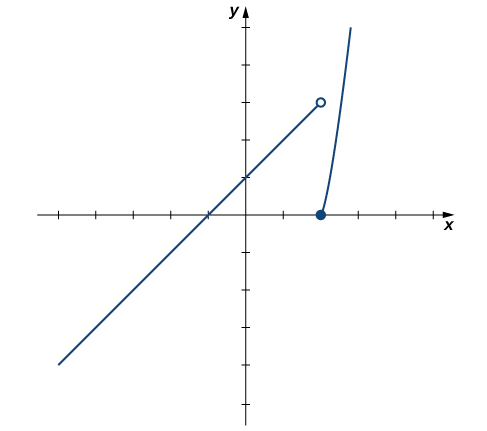
Based on this table, we can conclude that a. and b. Therefore, the (two-sided) limit of does not exist at Figure 2.18 shows a graph of and reinforces our conclusion about these limits.
英語のヒント
この表から、a. 、b. と結論づけられる。左右の極限が一致しないため、でのの両側極限は存在しない。図2.18ののグラフも、この結論を裏づけている。
OpenStax, Rice University; Calculus Volume 1. · CC BY-NC-SA 4.0
Figure 2.18図 2.18
The graph of has a break at
のグラフは、で途切れている。
Let us now consider the relationship between the limit of a function at a point and the limits from the right and left at that point. It seems clear that if the limit from the right and the limit from the left have a common value, then that common value is the limit of the function at that point. Similarly, if the limit from the left and the limit from the right take on different values, the limit of the function does not exist. These conclusions are summarized in Theorem 2.2.
英語のヒント
ある点での関数の極限と、その点での左右の極限との関係を考えよう。右側極限と左側極限が同じ値なら、その共通の値が、その点での関数の極限になる。一方、左右の極限が異なる値なら、関数の極限は存在しない。これらを定理2.2にまとめる。