第2章極限
Key Concepts重要な概念
- The limit laws allow us to evaluate limits of functions without having to go through step-by-step processes each time.極限の法則を使うと、毎回細かい定義に立ち戻って手順をたどらずに、関数の極限を求められる。
- For polynomials and rational functions,多項式関数ではが成り立つ。有理関数でも、aがその定義域に入る場合に成り立つ。
- You can evaluate the limit of a function by factoring and canceling, by multiplying by a conjugate, or by simplifying a complex fraction.因数分解と約分、共役な式を掛ける操作、繁分数の整理によって、関数の極限を求められる。
- The squeeze theorem allows you to find the limit of a function if the function is always greater than one function and less than another function with limits that are known.はさみうちの定理では、求めたい関数を上下からはさむ2つの関数が同じ既知の極限を持つとき、はさまれた関数の極限もその値になる。
Key Equations重要な式
Basic Limit Results 極限の基本的な結果 |
|
Important Limits 重要な極限 |
Exercises 83–86練習問題 83–86
In the following exercises, use the limit laws to evaluate each limit. Justify each step by indicating the appropriate limit law(s).
以下の問題では、極限の法則を使って各極限を求めなさい。各段階で適用した法則を示し、式変形の根拠を明らかにすること。
Exercise 83問題 83
Solution解き方
Use constant multiple law and difference law:
定数倍・和・差の極限の法則を使う。。
Exercise 84問題 84
Exercise 85問題 85
Solution解き方
Use root law:
累乗根の極限の法則を使う。。
Exercise 86問題 86
Exercises 87–92練習問題 87–92
In the following exercises, use direct substitution to evaluate each limit.
以下の問題では、直接代入によって各極限を求めなさい。
Exercise 87問題 87
Solution解き方
49
49
Exercise 88問題 88
Exercise 89問題 89
Solution解き方
1
1
Exercise 90問題 90
Exercise 91問題 91
Solution解き方
Exercise 92問題 92
Exercises 93–102練習問題 93–102
In the following exercises, use direct substitution to show that each limit leads to the indeterminate form Then, evaluate the limit.
以下の問題では、直接代入するとの不定形になることを示してから、極限を求めなさい。
Exercise 93問題 93
Solution解き方
then,
直接代入すると。式を変形すると。
Exercise 94問題 94
Exercise 95問題 95
Solution解き方
then,
直接代入すると。式を変形すると。
Exercise 96問題 96
Exercise 97問題 97
Solution解き方
then,
直接代入すると。式を変形すると。
Exercise 98問題 98
where a is a non-zero real-valued constant
。ここで、aは0でない実数定数とする。
Exercise 99問題 99
Solution解き方
then,
直接代入すると。式を変形すると。
Exercise 100問題 100
Exercise 101問題 101
Solution解き方
then,
直接代入すると。式を変形すると。
Exercise 102問題 102
Exercises 103–106練習問題 103–106
In the following exercises, use direct substitution to obtain an undefined expression. Then, use the method of Example 2.23 to simplify the function to help determine the limit.
以下の問題では、直接代入すると未定義の式になることを確かめなさい。その後、例題2.23の方法で関数を整理し、極限を判断しなさい。
Exercise 103問題 103
Solution解き方
−∞
−∞
Exercise 104問題 104
Exercise 105問題 105
Solution解き方
−∞
−∞
Exercise 106問題 106
Exercises 107–114練習問題 107–114
In the following exercises, assume that and Use these three facts and the limit laws to evaluate each limit.
以下の問題では、およびとする。この3つの値と極限の法則を使って、各極限を求めなさい。
Exercise 107問題 107
Solution解き方
Exercise 108問題 108
Exercise 109問題 109
Solution解き方
Exercise 110問題 110
Exercise 111問題 111
Solution解き方
Exercise 112問題 112
Exercise 113問題 113
Solution解き方
Exercise 114問題 114
Exercises 115–117練習問題 115–117
[T] In the following exercises, use a calculator to draw the graph of each piecewise-defined function and study the graph to evaluate the given limits.
[T] 以下の問題では、電卓で各区分関数のグラフを描き、それを調べて指定された極限を求めなさい。
Exercise 115問題 115
Solution解き方
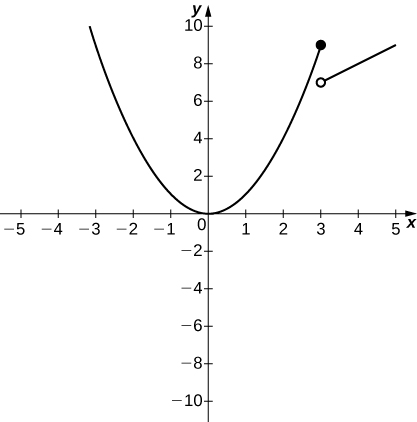
OpenStax, Rice University; Calculus Volume 1. · CC BY-NC-SA 4.0
a. 9; b. 7
a. 9 b. 7
Exercise 116問題 116
Exercise 117問題 117
Solution解き方
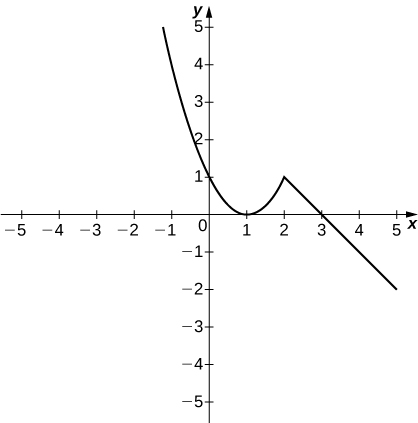
OpenStax, Rice University; Calculus Volume 1. · CC BY-NC-SA 4.0
a. 1; b. 1
a. 1 b. 1
Exercises 118–125練習問題 118–125
In the following exercises, use the following graphs and the limit laws to evaluate each limit.
以下の問題では、次のグラフと極限の法則を使って、各極限を求めなさい。
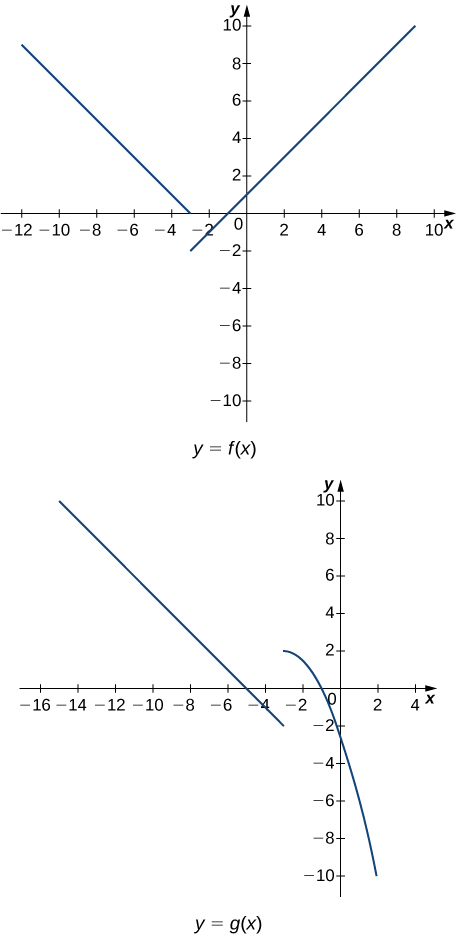
OpenStax, Rice University; Calculus Volume 1. · CC BY-NC-SA 4.0
Exercise 118問題 118
Exercise 119問題 119
Solution解き方
Exercise 120問題 120
Exercise 121問題 121
Solution解き方
Exercise 122問題 122
Exercise 123問題 123
Solution解き方
Exercise 124問題 124
Exercise 125問題 125
Solution解き方
Exercises 126–130練習問題 126–130
For the following problems, evaluate the limit using the squeeze theorem. Use a calculator to graph the functions and when possible.
以下の問題では、はさみうちの定理を使って極限を求めなさい。可能なら電卓でおよびのグラフを描くこと。
Exercise 126問題 126
[T] True or False? If then
[T] 正しいか、誤りか。ならば、である。
Exercise 127問題 127
[T]
[T]
Solution解き方
The limit is zero.
極限は0である。
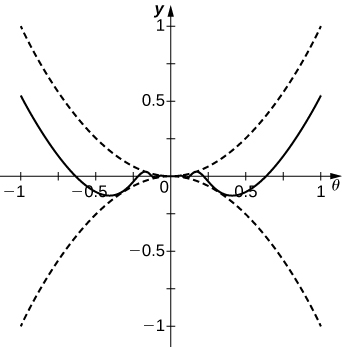
OpenStax, Rice University; Calculus Volume 1. · CC BY-NC-SA 4.0
Exercise 128問題 128
where
を求めなさい。ここで、とする。
Exercise 129問題 129
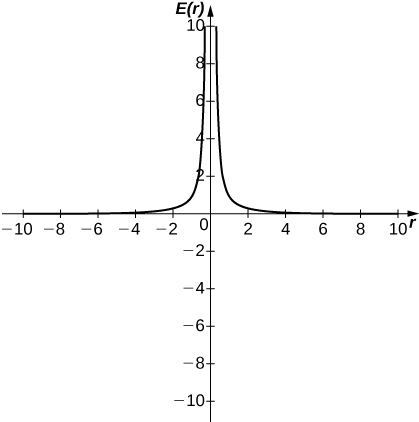
[T] In physics, the magnitude of an electric field generated by a point charge at a distance r in vacuum is governed by Coulomb’s law: where E represents the magnitude of the electric field, q is the charge of the particle, r is the distance between the particle and where the strength of the field is measured, and is Coulomb’s constant:
英語のヒント
[T] 真空中の点電荷から距離rの位置に生じる電場の大きさは、クーロンの法則で与えられる。Eは電場の大きさ、qは粒子の電荷、rは粒子から測定点までの距離である。また、はクーロン定数で、その値はである。ここでは次問のように正の電荷を考える。
- Use a graphing calculator to graph given that the charge of the particle is粒子の電荷をとして、グラフ電卓でを描きなさい。
- Evaluate What is the physical meaning of this quantity? Is it physically relevant? Why are you evaluating from the right?を求めなさい。この量の物理的な意味は何か。物理的に妥当なものだろうか。また、なぜ右側からの極限を求めるのか。
Solution解き方
a.
a.
OpenStax, Rice University; Calculus Volume 1. · CC BY-NC-SA 4.0
b. ∞. The magnitude of the electric field as you approach the particle q becomes infinite. It does not make physical sense to evaluate negative distance.
b. ∞。点電荷qへ近づくと、点電荷モデルでは電場の大きさが際限なく増加する。距離を負にすることには物理的な意味がない。
Exercise 130問題 130
[T] The density of an object is given by its mass divided by its volume:
[T] 物体の密度は、質量を体積で割って求める。。
- Use a calculator to plot the volume as a function of density assuming you are examining something of mass 8 kg (質量8 kg()の物体を考え、密度の関数として体積のグラフを電卓で描きなさい。
- Evaluate and explain the physical meaning.を求め、その物理的な意味を説明しなさい。
constant multiple law for limits
定数倍の極限の法則
the limit law
極限の法則。
difference law for limits
差の極限の法則
the limit law
極限の法則。
limit laws
極限の法則
the individual properties of limits; for each of the individual laws, let and be defined for all over some open interval containing a; assume that L and M are real numbers so that and let c be a constant
極限の個々の性質。各法則では、aを含むある開区間内のを満たすすべての値で、とが定義されているとする。また、実数LとMについて、が成り立ち、cは定数とする。
power law for limits
累乗の極限の法則
the limit law for every positive integer n
すべての正の整数nについて成り立つ、極限の法則。
product law for limits
積の極限の法則
the limit law
極限の法則。
quotient law for limits
商の極限の法則
the limit law for
のときに成り立つ、極限の法則。
root law for limits
累乗根の極限の法則
the limit law for all L if n is odd and for if n is even
極限の法則。nが奇数ならすべてのLで成り立つ。nが偶数ならとし、極限を取る範囲でf(x)≥0であることを要する。
squeeze theorem
はさみうちの定理
states that if for all over an open interval containing a and where L is a real number, then
aを含むある開区間で、を満たすすべての値についてとする。実数Lについてが成り立つなら、となる、という定理。
sum law for limits
和の極限の法則
The limit law
極限の法則。