第2章極限
Proving Limit Laws極限の法則を証明する
We now demonstrate how to use the epsilon-delta definition of a limit to construct a rigorous proof of one of the limit laws. The triangle inequality is used at a key point of the proof, so we first review this key property of absolute value.
英語のヒント
イプシロン・デルタによる定義を使い、極限の法則の1つを厳密に証明しよう。証明の重要な箇所で三角不等式を使うので、まず絶対値のこの性質を復習する。
Proof証明
We prove the following limit law: If and then
次の極限の法則を証明する。かつなら、である。
Let
を任意にとる。
Choose so that if then
ならとなるように、を選ぶ。
Choose so that if then
ならとなるように、を選ぶ。
Choose
と選ぶ。
Assume
と仮定する。
Thus,
したがって、
Hence,
よって、
□
□
We now explore what it means for a limit not to exist. The limit does not exist if there is no real number L for which Thus, for all real numbers L, To understand what this means, we look at each part of the definition of together with its opposite. A translation of the definition is given in Table 2.10.
英語のヒント
今度は、極限が存在しないとは何を意味するのかを考えよう。を満たす実数Lがないとき、極限は存在しないという。つまり、すべての実数Lについてとなる。この意味を理解するため、の定義を部分ごとに分け、それぞれの否定を考える。表2.10に、定義とその否定を対比する。
Definition 定義 |
Opposite 否定 |
|---|---|
1. For every 1. 任意のに対し、 |
1. There exists so that 1. あるが存在して、 |
2. there exists a so that 2. あるが存在して、 |
2. for every 2. どんなを選んでも、 |
3. if then 3. なら、。 |
3. There is an x satisfying so that 3. を満たし、しかもとなるxが存在する。 |
Finally, we may state what it means for a limit not to exist. The limit does not exist if for every real number L, there exists a real number so that for all there is an x satisfying so that Let’s apply this in Example 2.43 to show that a limit does not exist.
英語のヒント
これで、極限が存在しないことを正確に述べられる。どんな実数Lに対しても、ある実数が存在し、どんなに対しても、を満たしながらとなるxが見つかるなら、は存在しない。例題2.43で、この定義を使って極限が存在しないことを示そう。
Example 2.43例題 2.43
Showing That a Limit Does Not Exist極限が存在しないことを示す
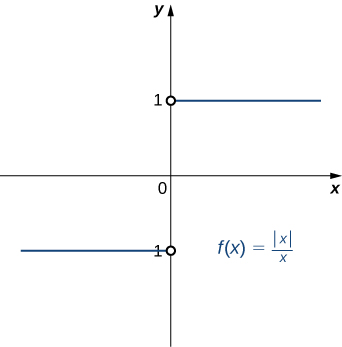
Show that does not exist. The graph of is shown here:
が存在しないことを示せ。のグラフを次に示す。
OpenStax, Rice University; Calculus Volume 1. · CC BY-NC-SA 4.0
Solution解き方
Suppose that L is a candidate for a limit. Choose
Lを極限の候補とする。と選ぶ。
Let Either or If then let Thus,
を任意にとる。かのどちらかである。なら、とおく。すると、
and
また、
On the other hand, if then let Thus,
一方、なら、とおく。すると、
and
また、
Thus, for any value of L,
したがって、Lをどのように選んでもとなる。
One-Sided and Infinite Limits片側極限と無限大の極限
Just as we first gained an intuitive understanding of limits and then moved on to a more rigorous definition of a limit, we now revisit one-sided limits. To do this, we modify the epsilon-delta definition of a limit to give formal epsilon-delta definitions for limits from the right and left at a point. These definitions only require slight modifications from the definition of the limit. In the definition of the limit from the right, the inequality replaces which ensures that we only consider values of x that are greater than (to the right of) a. Similarly, in the definition of the limit from the left, the inequality replaces which ensures that we only consider values of x that are less than (to the left of) a.
これまで、極限を直感的に理解してから厳密な定義へ進んだ。同じように、片側極限も定義し直そう。イプシロン・デルタによる極限の定義を少し変えるだけで、右側極限と左側極限を定義できる。右側極限では、をに置き換える。これによって、aより大きい、つまりaの右側にあるxだけを考える。同様に、左側極限では、をに置き換える。これによって、aより小さい、つまりaの左側にあるxだけを考える。
Example 2.44例題 2.44
Proving a Statement about a Limit From the Right右側極限を証明する
Prove that
を証明せよ。
Solution解き方
Let
を任意にとる。
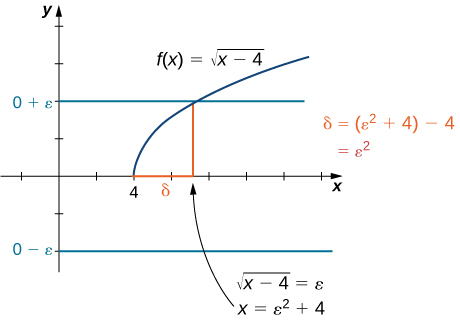
Choose Since we ultimately want we manipulate this inequality to get or, equivalently, making a clear choice. We may also determine geometrically, as shown in Figure 2.42.
と選ぶ。最後に示したいを変形すると、、つまりとなるので、という選び方が自然に得られる。図2.42のように、を図から求めることもできる。
OpenStax, Rice University; Calculus Volume 1. · CC BY-NC-SA 4.0
Figure 2.42図 2.42
This graph shows how we find δ for the proof in Example 2.44.
例題2.44の証明でδを選ぶ方法。
Assume Thus, Hence, Finally,
と仮定する。するとなので、となる。最後に、を得る。
Therefore,
したがって、である。
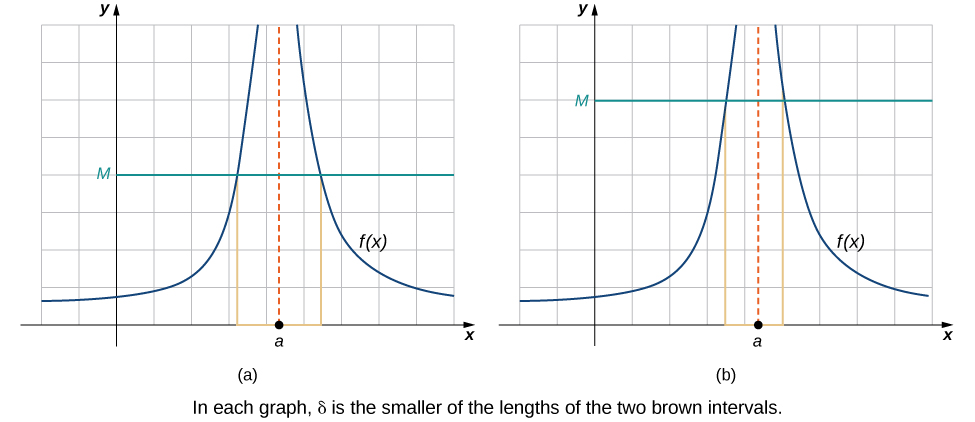
We conclude the process of converting our intuitive ideas of various types of limits to rigorous formal definitions by pursuing a formal definition of infinite limits. To have we want the values of the function to get larger and larger as x approaches a. Instead of the requirement that for arbitrarily small ε when for small enough we want for arbitrarily large positive M when for small enough Figure 2.43 illustrates this idea by showing the value of for successively larger values of M.
さまざまな極限について、直感を厳密な定義に変える作業の最後として、無限大の極限を考えよう。とは、xがaへ近づくにつれ、の値がいくらでも大きくなることである。有限の極限では、どんな小さい正のεに対しても、を十分小さく選ぶことで、ならとなることを求めた。今度は、どんな大きな正のMに対しても、を十分小さく選ぶことで、ならとなることを求める。図2.43は、Mを順に大きくしたときに選べるを示している。
OpenStax, Rice University; Calculus Volume 1. · CC BY-NC-SA 4.0
Figure 2.43図 2.43
These graphs plot values of for M to show that
Mに対するの選び方を示し、を説明している。