第4章意識の状態
4.6 Other States of Consciousness4.6 その他の意識状態
Learning Objectives学習目標
By the end of this section, you will be able to:
この節を学び終えると、次のことができるようになる。
- Define hypnosis and meditation催眠と瞑想を定義する
- Understand the similarities and differences of hypnosis and meditation催眠と瞑想の共通点と相違点を理解する
Our states of consciousness change as we move from wakefulness to sleep. We also alter our consciousness through the use of various psychoactive drugs. This final section will consider hypnotic and meditative states as additional examples of altered states of consciousness experienced by some individuals.
英語のヒント
覚醒から睡眠へと移るにつれて、私たちの意識状態は変わる。また私たちは、さまざまな精神作用薬を使うことによっても意識を変化させる。この最後の節では、一部の人が経験する変性意識状態の例として、さらに催眠状態と瞑想状態を取り上げる。
Hypnosis催眠
Hypnosis is a state of extreme self-focus and attention in which minimal attention is given to external stimuli. In the therapeutic setting, a clinician may use relaxation and suggestion in an attempt to alter the thoughts and perceptions of a patient. For individuals who are especially open to the power of suggestion, hypnosis can prove to be a very effective technique, and brain imaging studies have demonstrated that hypnotic states are associated with global changes in brain functioning (Del Casale et al., 2012; Guldenmund, Vanhaudenhuyse, Boly, Laureys, & Soddu, 2012).
英語のヒント
催眠とは、自己への極度の集中と注意の状態であり、その状態では外部の刺激にごくわずかな注意しか向けられない。治療の場では、臨床家が患者の思考や知覚を変えようとして、リラクセーションと暗示を用いることがある。暗示の力をとりわけ受け入れやすい人にとって、催眠は非常に効果的な技法となりうる。また、脳画像研究によって、催眠状態が脳機能の全般的な変化と関連していることが示されている(Del Casale et al., 2012; Guldenmund, Vanhaudenhuyse, Boly, Laureys, & Soddu, 2012)。
Historically, hypnosis has been viewed with some suspicion because of its portrayal in popular media and entertainment (Figure 4.20). Therefore, it is important to make a distinction between hypnosis as an empirically based therapeutic approach versus as a form of entertainment. Hypnosis is conducted by trained professionals, with consenting clients, often in the context of ongoing therapy. While hypnosis may be useful in enhancing memory or a skill, such enhancements are very modest in nature (Raz, 2011).
英語のヒント
歴史的に見ると、催眠は、大衆メディアや娯楽での描かれ方のために、いくらか疑いの目で見られてきた(図4.20)。したがって、実証的な根拠に基づく治療的アプローチとしての催眠と、娯楽の一形態としての催眠とを区別することが重要である。催眠は、訓練を受けた専門家が、同意したクライエントを相手に、多くの場合は継続中の治療の一環として行うものである。催眠は記憶や技能を高めるのに役立つかもしれないが、そうした向上はごくささやかなものである(Raz, 2011)。
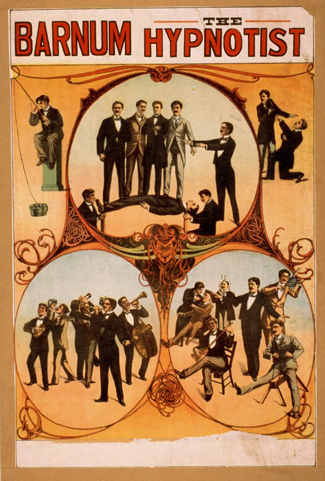

Figure 4.20図 4.20
Popular portrayals of hypnosis have led to some widely-held misconceptions.
大衆文化での催眠の描かれ方が、広く信じられているいくつかの誤解を生んできた。
How exactly does a hypnotist bring a participant to a state of hypnosis? While there are variations, there are four parts that appear consistent in bringing people into the state of suggestibility associated with hypnosis (National Research Council, 1994). These components include:
英語のヒント
催眠術師は、いったいどのようにして参加者を催眠状態に導くのだろうか。やり方にはいくつかの違いがあるものの、催眠に伴う被暗示性の状態へ人を導くうえで共通していると思われる要素が四つある(National Research Council, 1994)。その要素には次のものがある。
- The participant is guided to focus on one thing, such as the hypnotist’s words or a ticking watch.
英語のヒント
参加者は、催眠術師の言葉や時を刻む時計など、一つのものに集中するよう導かれる。 - The participant is made comfortable and is directed to be relaxed and sleepy.
英語のヒント
参加者は心地よい状態にされ、リラックスして眠くなるよう指示される。 - The participant is told to be open to the process of hypnosis, trust the hypnotist and let go.
英語のヒント
参加者は、催眠の過程を受け入れ、催眠術師を信頼して、身をゆだねるよう告げられる。 - The participant is encouraged to use their imagination.
英語のヒント
参加者は、自分の想像力を使うよう促される。
These steps are conducive to being open to the heightened suggestibility of hypnosis.
英語のヒント
これらの手順は、催眠状態で高まる被暗示性を受け入れやすくするのに役立つ。
People vary in terms of their ability to be hypnotized, but a review of available research suggests that most people are at least moderately hypnotizable (Kihlstrom, 2013). Hypnosis in conjunction with other techniques is used for a variety of therapeutic purposes and has shown to be at least somewhat effective for pain management, treatment of depression and anxiety, smoking cessation, and weight loss (Alladin, 2012; Elkins, Johnson, & Fisher, 2012; Golden, 2012; Montgomery, Schnur, & Kravits, 2012).
英語のヒント
催眠にかかる能力には個人差があるが、入手できる研究を検討したレビューからは、ほとんどの人が少なくとも中程度には催眠にかかりうることが示唆される(Kihlstrom, 2013)。催眠はほかの技法と組み合わせて、さまざまな治療目的に用いられており、痛みの管理、うつ病や不安の治療、禁煙、減量に対して、少なくともある程度の効果があることが示されている(Alladin, 2012; Elkins, Johnson, & Fisher, 2012; Golden, 2012; Montgomery, Schnur, & Kravits, 2012)。
How does hypnosis work? Two theories attempt to answer this question: One theory views hypnosis as dissociation and the other theory views it as the performance of a social role. According to the dissociation view, hypnosis is effectively a dissociated state of consciousness, much like our earlier example where you may drive to work, but you are only minimally aware of the process of driving because your attention is focused elsewhere. This theory is supported by Ernest Hilgard’s research into hypnosis and pain. In Hilgard’s experiments, he induced participants into a state of hypnosis, and placed their arms into ice water. Participants were told they would not feel pain, but they could press a button if they did; while they reported not feeling pain, they did, in fact, press the button, suggesting a dissociation of consciousness while in the hypnotic state (Hilgard & Hilgard, 1994).
英語のヒント
催眠はどのように作用するのだろうか。この問いに答えようとする理論が二つある。一つの理論は催眠を解離とみなし、もう一つの理論は催眠を社会的役割の遂行とみなす。解離説によれば、催眠とは事実上、解離した意識状態である。これは先に挙げた例とよく似ている。車で職場に向かっても、注意がほかに向いているために、運転の過程にはごくわずかしか気づいていないことがある、という例である。この理論は、アーネスト・ヒルガードによる催眠と痛みの研究によって支持されている。ヒルガードは実験で、参加者を催眠状態に導いたうえで、その腕を氷水に浸した。参加者は、痛みは感じないだろうが、もし感じたらボタンを押してよいと告げられた。参加者は痛みを感じていないと報告したが、実際にはボタンを押していた。これは、催眠状態にあるあいだ意識の解離が起きていることを示唆している(Hilgard & Hilgard, 1994)。
Taking a different approach to explain hypnosis, the social-cognitive theory of hypnosis sees people in hypnotic states as performing the social role of a hypnotized person. As you will learn when you study social roles, people’s behavior can be shaped by their expectations of how they should act in a given situation. Some view a hypnotized person’s behavior not as an altered or dissociated state of consciousness, but as their fulfillment of the social expectations for that role (Coe, 2009; Coe & Sarbin, 1966).
英語のヒント
催眠の社会的認知理論は、これとは異なるアプローチで催眠を説明しようとするもので、催眠状態にある人は、催眠にかかった人という社会的役割を演じているとみなす。社会的役割について学ぶときに分かるように、人の行動は、ある状況で自分がどうふるまうべきかについての期待によって形づくられうる。催眠にかかった人の行動を、変性した、あるいは解離した意識状態としてではなく、その役割に対する社会的な期待を本人が満たしていることとしてとらえる人もいる(Coe, 2009; Coe & Sarbin, 1966)。