第4章意識の状態
REM Sleepレム睡眠
As mentioned earlier, REM sleep is marked by rapid movements of the eyes. The brain waves associated with this stage of sleep are very similar to those observed when a person is awake, as shown in Figure 4.11, and this is the period of sleep in which dreaming occurs. It is also associated with paralysis of muscle systems in the body with the exception of those that make circulation and respiration possible. Therefore, no movement of voluntary muscles occurs during REM sleep in a normal individual; REM sleep is often referred to as paradoxical sleep because of this combination of high brain activity and lack of muscle tone. Like NREM sleep, REM has been implicated in various aspects of learning and memory (Wagner, Gais, & Born, 2001; Siegel, 2001).
英語のヒント
前に述べたように、レム睡眠は眼球のすばやい動きを特徴とする。図4.11に示すように、この睡眠段階に伴う脳波は、人が目覚めているときに観察される脳波とよく似ており、夢を見るのはこの時期である。レム睡眠はまた、体の筋肉系の麻痺とも関連している。ただし、血液循環と呼吸を可能にする筋肉系は例外である。そのため、正常な人では、レム睡眠中に随意筋の動きはまったく生じない。脳の活動が高いのに筋緊張が失われているというこの組み合わせのために、レム睡眠はしばしば逆説睡眠と呼ばれる。ノンレム睡眠と同様に、レム睡眠も、学習と記憶のさまざまな側面に関与していることが指摘されてきた(Wagner, Gais, & Born, 2001; Siegel, 2001)。
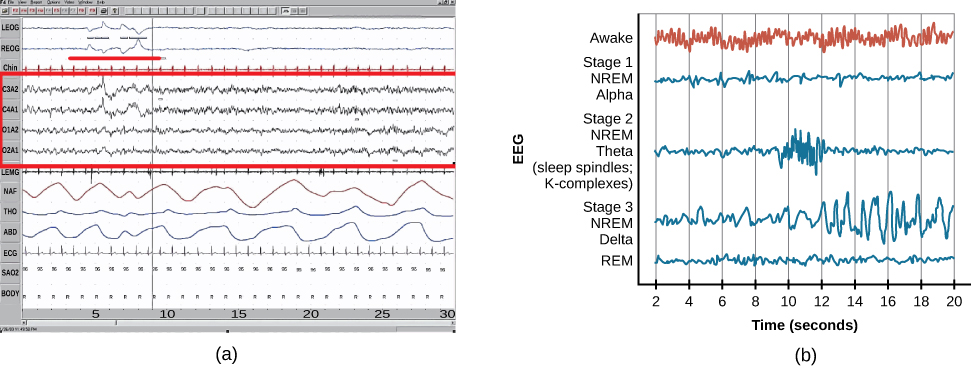
Figure 4.11図 4.11
(a) A period of rapid eye movement is marked by the short red line segment. The brain waves associated with REM sleep, outlined in the red box in (a), look very similar to those seen (b) during wakefulness.
(a)急速眼球運動の期間は、短い赤の線分で示されている。(a)で赤い枠に囲まれた、レム睡眠に伴う脳波は、(b)覚醒中に見られる脳波とよく似ている。
If people are deprived of REM sleep and then allowed to sleep without disturbance, they will spend more time in REM sleep in what would appear to be an effort to recoup the lost time in REM. This is known as the REM rebound, and it suggests that REM sleep is also homeostatically regulated. Aside from the role that REM sleep may play in processes related to learning and memory, REM sleep may also be involved in emotional processing and regulation. In such instances, REM rebound may actually represent an adaptive response to stress in nondepressed individuals by suppressing the emotional salience of aversive events that occurred in wakefulness (Suchecki, Tiba, & Machado, 2012). Sleep deprivation in general is associated with a number of negative consequences (Brown, 2012).
英語のヒント
レム睡眠を奪われた人が、その後じゃまされずに眠ることを許されると、失ったレム睡眠の時間を取り戻そうとしているかのように、レム睡眠により多くの時間を費やす。これはレム睡眠の反跳として知られ、レム睡眠もまた恒常性によって調節されていることを示唆している。レム睡眠は、学習と記憶に関係する過程で果たしうる役割のほかに、感情の処理と調節にも関与している可能性がある。そうした場合、レム睡眠の反跳は実際には、抑うつ状態にない人において、覚醒中に起きた嫌悪的な出来事の感情的な顕著さを抑えることによって、ストレスへの適応的な反応となっているのかもしれない(Suchecki, Tiba, & Machado, 2012)。睡眠不足は一般に、数多くの好ましくない結果と関連している(Brown, 2012)。
The hypnogram below (Figure 4.12) shows a person’s passage through the stages of sleep.
英語のヒント
下のヒプノグラム(図4.12)は、ある人が睡眠の各段階をたどっていく様子を示している。
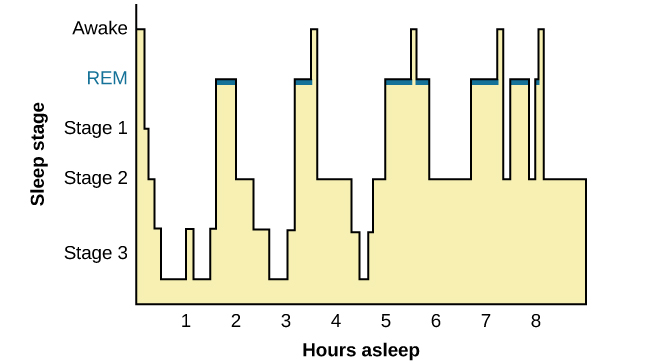


Figure 4.12図 4.12
A hypnogram is a diagram of the stages of sleep as they occur during a period of sleep. This hypnogram illustrates how an individual moves through the various stages of sleep.
ヒプノグラムとは、ひと続きの睡眠のあいだに生じる睡眠の段階を図にしたものである。このヒプノグラムは、ある人が睡眠のさまざまな段階をどのように移っていくかを示している。
Dreams夢
Dreams and their associated meanings vary across different cultures and periods of time. By the late 19th century, Austrian psychiatrist Sigmund Freud had become convinced that dreams represented an opportunity to gain access to the unconscious. By analyzing dreams, Freud thought people could increase self-awareness and gain valuable insight to help them deal with the problems they faced in their lives. Freud made distinctions between the manifest content and the latent content of dreams. Manifest content is the actual content, or storyline, of a dream. Latent content, on the other hand, refers to the hidden meaning of a dream. For instance, if a woman dreams about being chased by a snake, Freud might have argued that this represents the woman’s fear of sexual intimacy, with the snake serving as a symbol of a man’s penis.
英語のヒント
夢と、夢に結びつけられる意味は、文化や時代によって異なる。19世紀後半までに、オーストリアの精神科医ジークムント・フロイトは、夢は無意識に接近する機会になると確信するようになっていた。フロイトは、夢を分析することによって、人は自己認識を高め、人生で直面している問題に対処するのに役立つ貴重な洞察を得られると考えた。フロイトは、夢の顕在内容と潜在内容を区別した。顕在内容とは、夢の実際の内容、つまり夢の筋書きである。一方、潜在内容とは、夢の隠れた意味を指す。たとえば、ある女性がヘビに追いかけられる夢を見たとすれば、フロイトなら、これはその女性の性的な親密さへの恐れを表しており、ヘビは男性のペニスの象徴になっていると論じたかもしれない。
Freud was not the only theorist to focus on the content of dreams. The 20th century Swiss psychiatrist Carl Jung believed that dreams allowed us to tap into the collective unconscious. The collective unconscious, as described by Jung, is a theoretical repository of information he believed to be shared by everyone. According to Jung, certain symbols in dreams reflected universal archetypes with meanings that are similar for all people regardless of culture or location.
英語のヒント
夢の内容に注目した理論家は、フロイトだけではない。20世紀のスイスの精神科医カール・ユングは、夢によって私たちは集合的無意識に触れることができると考えた。ユングの説明によれば、集合的無意識とは、すべての人に共有されているとユングが考えた情報の、理論上の貯蔵庫である。ユングによれば、夢に現れる特定の象徴は、文化や地域にかかわらずすべての人にとって似た意味を持つ、普遍的な元型を反映していた。
The sleep and dreaming researcher Rosalind Cartwright, however, believes that dreams simply reflect life events that are important to the dreamer. Unlike Freud and Jung, Cartwright’s ideas about dreaming have found empirical support. For example, she and her colleagues published a study in which women going through divorce were asked several times over a five month period to report the degree to which their former spouses were on their minds. These same women were awakened during REM sleep in order to provide a detailed account of their dream content. There was a significant positive correlation between the degree to which women thought about their former spouses during waking hours and the number of times their former spouses appeared as characters in their dreams (Cartwright, Agargun, Kirkby, & Friedman, 2006). Recent research (Horikawa, Tamaki, Miyawaki, & Kamitani, 2013) has uncovered new techniques by which researchers may effectively detect and classify the visual images that occur during dreaming by using fMRI for neural measurement of brain activity patterns, opening the way for additional research in this area.
英語のヒント
しかし、睡眠と夢の研究者ロザリンド・カートライトは、夢は単に、夢を見る人にとって重要な生活上の出来事を反映しているだけだと考えている。フロイトやユングの考えとは違って、カートライトの夢についての考えは実証的な裏づけを得てきた。たとえば、カートライトと共同研究者たちが発表した研究では、離婚を経験しつつある女性たちが、5か月の期間にわたって何度か、元配偶者のことがどの程度頭にあるかを報告するよう求められた。同じ女性たちは、夢の内容を詳しく説明してもらうために、レム睡眠中に起こされた。起きているあいだに女性たちが元配偶者のことを考えていた程度と、元配偶者が夢の登場人物として現れた回数とのあいだには、有意な正の相関があった(Cartwright, Agargun, Kirkby, & Friedman, 2006)。最近の研究(Horikawa, Tamaki, Miyawaki, & Kamitani, 2013)は、fMRIで脳の活動パターンを神経レベルで測定することによって、夢を見ているあいだに生じる視覚的イメージを研究者が効果的に検出し分類できるかもしれない新しい手法を明らかにし、この領域でのさらなる研究への道を開いた。
Alan Hobson, a neuroscientist, is credited for developing activation-synthesis theory of dreaming. Early versions of this theory proposed that dreams were not the meaning-filled representations of angst proposed by Freud and others, but were rather the result of our brain attempting to make sense of ("synthesize") the neural activity ("activation") that was happening during REM sleep. Recent adaptations (e.g., Hobson, 2002) continue to update the theory based on accumulating evidence. For example, Hobson (2009) suggests that dreaming may represent a state of protoconsciousness. In other words, dreaming involves constructing a virtual reality in our heads that we might use to help us during wakefulness. Among a variety of neurobiological evidence, John Hobson cites research on lucid dreams as an opportunity to better understand dreaming in general. Lucid dreams are dreams in which certain aspects of wakefulness are maintained during a dream state. In a lucid dream, a person becomes aware of the fact that they are dreaming, and as such, they can control the dream’s content (LaBerge, 1990).
英語のヒント
神経科学者のアラン・ホブソンは、夢の活性化・合成理論を構築したとされている。この理論の初期の版は、夢とは、フロイトらが唱えたような、不安を表す意味に満ちた表象ではなく、むしろ、レム睡眠中に起きていた神経活動(「活性化」)を、脳が意味の通るものにしよう(「合成」しよう)とした結果である、と提唱した。最近の改訂版(e.g., Hobson, 2002)は、蓄積されていく証拠に基づいて理論を更新し続けている。たとえばホブソン(2009)は、夢見は原意識の状態を表しているのかもしれないと述べている。言い換えれば、夢見には、覚醒中に私たちを助けるために使うかもしれない仮想現実を、頭の中に構築することが含まれる。ホブソンは、さまざまな神経生物学的証拠の中でも、明晰夢についての研究を、夢見一般をよりよく理解する機会として挙げている。明晰夢とは、夢の状態のあいだも覚醒の特定の側面が保たれている夢である。明晰夢の中では、人は自分が夢を見ているという事実に気づき、それゆえに夢の内容をコントロールできる(LaBerge, 1990)。