第4章意識の状態
4.2 Sleep and Why We Sleep4.2 睡眠と、私たちが眠る理由
Learning Objectives学習目標
By the end of this section, you will be able to:
この節を学び終えると、次のことができるようになる。
- Describe areas of the brain involved in sleep睡眠にかかわる脳の領域を説明する
- Understand hormone secretions associated with sleep睡眠に関連するホルモンの分泌を理解する
- Describe several theories aimed at explaining the function of sleep睡眠の機能を解き明かそうとするいくつかの理論を説明する
- Name and describe three theories about why we dream私たちが夢を見る理由についての三つの理論を挙げ、説明する
We spend approximately one-third of our lives sleeping. Given the average life expectancy for U.S. citizens falls between 73 and 79 years old (Singh & Siahpush, 2006), we can expect to spend approximately 25 years of our lives sleeping. Some animals never sleep (e.g., some fish and amphibian species); other animals sleep very little without apparent negative consequences (e.g., giraffes); yet some animals (e.g., rats) die after two weeks of sleep deprivation (Siegel, 2008). Why do we devote so much time to sleeping? Is it absolutely essential that we sleep? This section will consider these questions and explore various explanations for why we sleep.
英語のヒント
私たちは人生のおよそ3分の1を眠って過ごす。アメリカ国民の平均寿命が73〜79歳のあいだにあることを考えると(Singh & Siahpush, 2006)、私たちは人生のうちおよそ25年を眠って過ごすと見込まれる。まったく眠らない動物もいれば(たとえば一部の魚類や両生類の種)、ごくわずかしか眠らなくても目に見える悪影響のない動物もいる(たとえばキリン)。ところが、ラットのように、2週間睡眠を奪われると死んでしまう動物もいる(Siegel, 2008)。私たちはなぜ、これほど多くの時間を睡眠に費やすのだろうか。眠ることは絶対に欠かせないのだろうか。この節では、こうした問いを検討し、私たちが眠る理由についてのさまざまな説明を探っていく。
What is Sleep?睡眠とは何か
You have read that sleep is distinguished by low levels of physical activity and reduced sensory awareness. As discussed by Siegel (2008), a definition of sleep must also include mention of the interplay of the circadian and homeostatic mechanisms that regulate sleep. Homeostatic regulation of sleep is evidenced by sleep rebound following sleep deprivation. Sleep rebound refers to the fact that a sleep-deprived individual will fall asleep more quickly during subsequent opportunities for sleep. Sleep is characterized by certain patterns of activity of the brain that can be visualized using electroencephalography (EEG), and different phases of sleep can be differentiated using EEG as well.
英語のヒント
すでに読んだように、睡眠の特徴は、身体活動の水準が低いことと、感覚的な気づきが低下していることにある。シーゲル(2008)が論じているように、睡眠の定義には、睡眠を調節する概日性のしくみと恒常性のしくみの相互作用への言及も含まれなければならない。睡眠が恒常性によって調節されていることは、睡眠不足の後に起こる睡眠の反跳によって裏づけられる。睡眠の反跳とは、睡眠不足の人は、その後に眠る機会があると、より速く眠りにつくという事実を指す。睡眠は、脳波検査(EEG)で可視化できる脳活動の特定のパターンによって特徴づけられ、睡眠のさまざまな段階もまたEEGを用いて区別できる。
Sleep-wake cycles seem to be controlled by multiple brain areas acting in conjunction with one another. Some of these areas include the thalamus, the hypothalamus, and the pons. As already mentioned, the hypothalamus contains the SCN—the biological clock of the body—in addition to other nuclei that, in conjunction with the thalamus, regulate slow-wave sleep. The pons is important for regulating rapid eye movement (REM) sleep (National Institutes of Health, n.d.).
英語のヒント
睡眠と覚醒の周期は、互いに連携して働く複数の脳領域によって制御されているようである。そうした領域には、視床、視床下部、橋などがある。すでに述べたように、視床下部には、身体の体内時計である視交叉上核(SCN)に加えて、視床と連携して徐波睡眠を調節するほかの神経核も含まれている。橋は、レム睡眠(REM)の調節に重要である(National Institutes of Health, n.d.)。
Sleep is also associated with the secretion and regulation of a number of hormones from several endocrine glands including: melatonin, follicle stimulating hormone (FSH), luteinizing hormone (LH), and growth hormone (National Institutes of Health, n.d.). You have read that the pineal gland releases melatonin during sleep (Figure 4.6). Melatonin is thought to be involved in the regulation of various biological rhythms and the immune system (Hardeland et al., 2006). During sleep, the pituitary gland secretes both FSH and LH which are important in regulating the reproductive system (Christensen et al., 2012; Sofikitis et al., 2008). The pituitary gland also secretes growth hormone, during sleep, which plays a role in physical growth and maturation as well as other metabolic processes (Bartke, Sun, & Longo, 2013).
英語のヒント
睡眠はまた、いくつかの内分泌腺から出る多くのホルモンの分泌と調節にも関連している。そうしたホルモンには、メラトニン、卵胞刺激ホルモン(FSH)、黄体形成ホルモン(LH)、成長ホルモンが含まれる(National Institutes of Health, n.d.)。すでに読んだように、松果体は睡眠中にメラトニンを放出する(図4.6)。メラトニンは、さまざまな生体リズムや免疫系の調節にかかわっていると考えられている(Hardeland et al., 2006)。睡眠中、下垂体はFSHとLHをともに分泌する。この二つは生殖系の調節に重要である(Christensen et al., 2012; Sofikitis et al., 2008)。下垂体はさらに、睡眠中に成長ホルモンも分泌する。成長ホルモンは、身体の成長と成熟に加えて、ほかの代謝過程にも役割を果たしている(Bartke, Sun, & Longo, 2013)。
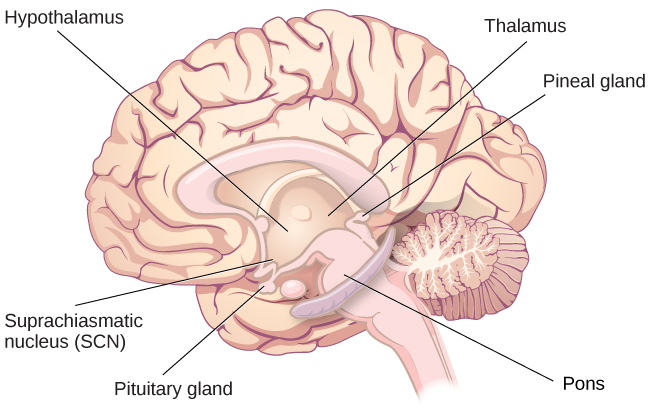

Figure 4.6図 4.6
The pineal and pituitary glands secrete a number of hormones during sleep.
松果体と下垂体は、睡眠中に多くのホルモンを分泌する。
Why Do We Sleep?私たちはなぜ眠るのか
Given the central role that sleep plays in our lives and the number of adverse consequences that have been associated with sleep deprivation, one would think that we would have a clear understanding of why it is that we sleep. Unfortunately, this is not the case; however, several hypotheses have been proposed to explain the function of sleep.
英語のヒント
睡眠が私たちの生活の中で果たしている中心的な役割と、睡眠不足と関連づけられてきた悪影響の多さを考えれば、私たちがいったいなぜ眠るのかについて、はっきりした理解が得られているはずだと、ふつうは思うだろう。残念ながら、実際はそうではない。ただし、睡眠の機能を説明するために、いくつかの仮説が提唱されてきた。
Adaptive Function of Sleep睡眠の適応的機能
One popular hypothesis of sleep incorporates the perspective of evolutionary psychology. Evolutionary psychology is a discipline that studies how universal patterns of behavior and cognitive processes have evolved over time as a result of natural selection. Variations and adaptations in cognition and behavior make individuals more or less successful in reproducing and passing their genes to their offspring. One hypothesis from this perspective might argue that sleep is essential to restore resources that are expended during the day. Just as bears hibernate in the winter when resources are scarce, perhaps people sleep at night to reduce their energy expenditures. While this is an intuitive explanation of sleep, there is little research that supports this explanation. In fact, it has been suggested that there is no reason to think that energetic demands could not be addressed with periods of rest and inactivity (Frank, 2006; Rial et al., 2007), and some research has actually found a negative correlation between energetic demands and the amount of time spent sleeping (Capellini, Barton, McNamara, Preston, & Nunn, 2008).
英語のヒント
睡眠についてよく知られた仮説の一つは、進化心理学の観点を取り入れている。進化心理学とは、行動と認知過程の普遍的なパターンが、自然選択の結果として時間とともにどのように進化してきたかを研究する学問分野である。認知と行動における変異や適応は、個体が繁殖して自分の遺伝子を子孫に伝えるうえでの成功の度合いを左右する。この観点に立つ仮説の一つは、睡眠は日中に消費された資源を回復させるために欠かせない、と主張するかもしれない。資源が乏しい冬にクマが冬眠するのと同じように、人もエネルギーの消費を減らすために夜に眠るのかもしれない。これは睡眠についての直観的に分かりやすい説明だが、この説明を支持する研究はほとんどない。実際、エネルギーの需要には休息と不活動の時間では対処できない、と考える理由はないという指摘がある(Frank, 2006; Rial et al., 2007)。さらに、エネルギーの需要と睡眠に費やされる時間の量とのあいだに、負の相関を実際に見いだした研究もある(Capellini, Barton, McNamara, Preston, & Nunn, 2008)。
Another evolutionary hypothesis of sleep holds that our sleep patterns evolved as an adaptive response to predatory risks, which increase in darkness. Thus we sleep in safe areas to reduce the chance of harm. Again, this is an intuitive and appealing explanation for why we sleep. Perhaps our ancestors spent extended periods of time asleep to reduce attention to themselves from potential predators. Comparative research indicates, however, that the relationship that exists between predatory risk and sleep is very complex and equivocal. Some research suggests that species that face higher predatory risks sleep fewer hours than other species (Capellini et al., 2008), while other researchers suggest there is no relationship between the amount of time a given species spends in deep sleep and its predation risk (Lesku, Roth, Amlaner, & Lima, 2006).
英語のヒント
睡眠についてのもう一つの進化的な仮説は、私たちの睡眠パターンは、暗闇の中で高まる捕食の危険への適応的な反応として進化した、とする。したがって私たちは、危害を受ける可能性を減らすために安全な場所で眠る。これもまた、私たちがなぜ眠るのかについての、直観的に分かりやすく魅力的な説明である。おそらく私たちの祖先は、潜在的な捕食者から向けられる注意を減らすために、長い時間を眠って過ごしたのだろう。しかし比較研究は、捕食の危険と睡眠とのあいだにある関係が、非常に複雑で、はっきりしないものであることを示している。より高い捕食の危険にさらされている種は、ほかの種よりも睡眠時間が短いことを示唆する研究がある(Capellini et al., 2008)一方で、ある種が深い睡眠に費やす時間の量と、その種が捕食される危険とのあいだには関係がないと示唆する研究者もいる(Lesku, Roth, Amlaner, & Lima, 2006)。
It is quite possible that sleep serves no single universally adaptive function, and different species have evolved different patterns of sleep in response to their unique evolutionary pressures. While we have discussed the negative outcomes associated with sleep deprivation, it should be pointed out that there are many benefits that are associated with adequate amounts of sleep. A few such benefits listed by the National Sleep Foundation (n.d.) include maintaining health, lowering stress levels, improving mood, and increasing motor coordination, as well as a number of benefits related to cognition and memory formation.
英語のヒント
睡眠には普遍的に適応的な単一の機能などなく、それぞれの種が、自らに固有の進化的な圧力に応じて異なる睡眠パターンを進化させてきた、という可能性も十分にある。ここまで睡眠不足に関連する悪い結果について論じてきたが、十分な量の睡眠に関連する利点が数多くあることも指摘しておくべきである。全米睡眠財団(n.d.)が挙げるそうした利点のいくつかには、健康の維持、ストレス水準の低下、気分の改善、運動協調の向上のほか、認知や記憶の形成にかかわる数々の利点が含まれる。