第4章意識の状態
4.1 What Is Consciousness?4.1 意識とは何か
Learning Objectives学習目標
By the end of this section, you will be able to:
この節を学び終えると、次のことができるようになる。
- Understand what is meant by consciousness意識とは何を意味するのかを理解する
- Explain how circadian rhythms are involved in regulating the sleep-wake cycle, and how circadian cycles can be disrupted概日リズムが睡眠・覚醒周期の調節にどのように関与しているか、また概日周期がどのように乱されうるかを説明する
- Discuss the concept of sleep debt睡眠負債の概念について論じる
Consciousness describes our awareness of internal and external stimuli. Awareness of internal stimuli includes feeling pain, hunger, thirst, sleepiness, and being aware of our thoughts and emotions. Awareness of external stimuli includes experiences such as seeing the light from the sun, feeling the warmth of a room, and hearing the voice of a friend.
英語のヒント
意識とは、内的および外的な刺激への気づきのことである。内的な刺激への気づきには、痛み、空腹、のどの渇き、眠気を感じることや、自分の思考や感情に気づいていることが含まれる。外的な刺激への気づきには、太陽の光を見る、部屋の暖かさを感じる、友人の声を聞くといった経験が含まれる。
We experience different states of consciousness and different levels of awareness on a regular basis. We might even describe consciousness as a continuum that ranges from full awareness to a deep sleep. Sleep is a state marked by relatively low levels of physical activity and reduced sensory awareness that is distinct from periods of rest that occur during wakefulness. Wakefulness is characterized by high levels of sensory awareness, thought, and behavior. Beyond being awake or asleep, there are many other states of consciousness people experience. These include daydreaming, intoxication, and unconsciousness due to anesthesia. Often, we are not completely aware of our surroundings, even when we are fully awake. For instance, have you ever daydreamed while driving home from work or school without really thinking about the drive itself? You were capable of engaging in all of the complex tasks involved with operating a motor vehicle even though you were not aware of doing so. Many of these processes, like much of psychological behavior, are rooted in our biology.
英語のヒント
私たちは日常的に、さまざまな意識の状態と、さまざまな水準の気づきを経験している。意識を、完全な気づきから深い睡眠にまで及ぶ連続体として記述してもよいかもしれない。睡眠とは、身体活動の水準が比較的低く、感覚的な気づきが低下していることを特徴とする状態であり、覚醒中に生じる休息の期間とは区別される。覚醒は、感覚的な気づき、思考、行動の水準が高いことを特徴とする。起きているか眠っているかのほかにも、人が経験する意識の状態は数多くある。白昼夢、酩酊、麻酔による意識の消失などである。私たちは、完全に目覚めているときでさえ、周囲に完全には気づいていないことが多い。たとえば、仕事や学校から車で帰る途中、運転そのものについてはろくに考えずに、白昼夢にふけっていたことはないだろうか。そのときあなたは、自分が運転していることに気づいていなかったにもかかわらず、自動車の運転にかかわる複雑な作業をすべてこなせていた。こうした過程の多くは、心理的な行動の多くと同じく、私たちの生物学的なしくみに根ざしている。
Biological Rhythms生体リズム
Biological rhythms are internal rhythms of biological activity. A woman’s menstrual cycle is an example of a biological rhythm—a recurring, cyclical pattern of bodily changes. One complete menstrual cycle takes about 28 days—a lunar month—but many biological cycles are much shorter. For example, body temperature fluctuates cyclically over a 24-hour period (Figure 4.2). Alertness is associated with higher body temperatures, and sleepiness with lower body temperatures.
英語のヒント
生体リズムとは、生物学的な活動の内的なリズムである。女性の月経周期は生体リズムの一例であり、身体の変化が周期的に繰り返されるパターンである。1回の月経周期には約28日、つまり1太陰月かかるが、多くの生物学的な周期はそれよりはるかに短い。たとえば、体温は24時間のあいだに周期的に変動する(図4.2)。覚醒度の高さは体温の高さと関連し、眠気は体温の低さと関連している。
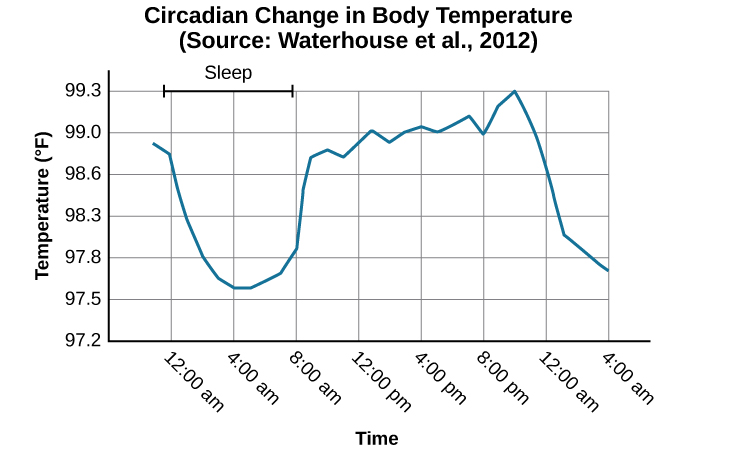
Figure 4.2図 4.2
This chart illustrates the circadian change in body temperature over 28 hours in a group of eight young men. Body temperature rises throughout the waking day, peaking in the afternoon, and falls during sleep with the lowest point occurring during the very early morning hours.
このグラフは、8人の若い男性の集団における、28時間にわたる体温の概日変化を示している。体温は目覚めている日中を通して上昇し、午後に最も高くなる。睡眠中には下がり、明け方のごく早い時間帯に最も低くなる。
This pattern of temperature fluctuation, which repeats every day, is one example of a circadian rhythm. A circadian rhythm is a biological rhythm that takes place over a period of about 24 hours. Our sleep-wake cycle, which is linked to our environment’s natural light-dark cycle, is perhaps the most obvious example of a circadian rhythm, but we also have daily fluctuations in heart rate, blood pressure, blood sugar, and body temperature. Some circadian rhythms play a role in changes in our state of consciousness.
英語のヒント
毎日繰り返されるこの体温変動のパターンは、概日リズムの一例である。概日リズムとは、約24時間の周期で生じる生体リズムである。私たちの睡眠・覚醒周期は、環境の自然な明暗周期と結びついており、おそらく概日リズムの最も分かりやすい例だろう。しかし私たちには、心拍数、血圧、血糖値、体温にも日々の変動がある。概日リズムの中には、意識の状態の変化に関与するものもある。
If we have biological rhythms, then is there some sort of biological clock? In the brain, the hypothalamus, which lies above the pituitary gland, is a main center of homeostasis. Homeostasis is the tendency to maintain a balance, or optimal level, within a biological system.
英語のヒント
私たちに生体リズムがあるのなら、何らかの体内時計のようなものがあるのだろうか。脳の中では、下垂体の上に位置する視床下部が、恒常性の主要な中枢である。恒常性とは、生物学的なシステムの中で均衡、すなわち最適な水準を保とうとする傾向である。
The brain’s clock mechanism is located in an area of the hypothalamus known as the suprachiasmatic nucleus (SCN). The axons of light-sensitive neurons in the retina provide information to the SCN based on the amount of light present, allowing this internal clock to be synchronized with the outside world (Klein, Moore, & Reppert, 1991; Welsh, Takahashi, & Kay, 2010) (Figure 4.3).
英語のヒント
脳の時計のしくみは、視床下部の中の、視交叉上核(SCN)として知られる領域にある。網膜にある光に反応するニューロンの軸索が、そこにある光の量に基づいてSCNに情報を送り、それによってこの体内時計は外界と同期できる(Klein, Moore, & Reppert, 1991; Welsh, Takahashi, & Kay, 2010)(図4.3)。
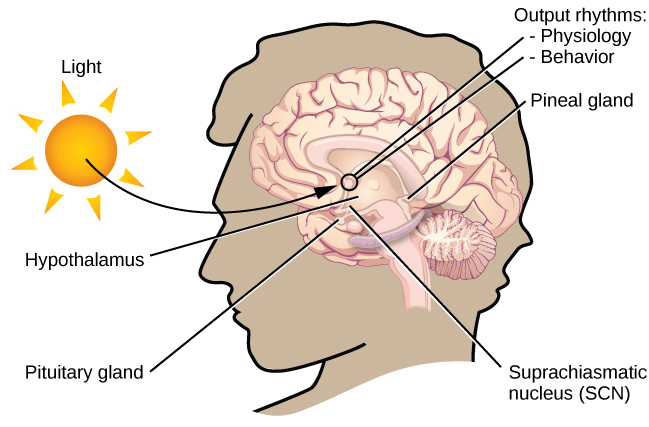


Figure 4.3図 4.3
The suprachiasmatic nucleus (SCN) serves as the brain’s clock mechanism. The clock sets itself with light information received through projections from the retina.
視交叉上核(SCN)は、脳の時計のしくみとして働く。この時計は、網膜からの投射を通して受け取る光の情報によって、自らを合わせている。
Problems With Circadian Rhythms概日リズムの問題
Generally, and for most people, our circadian cycles are aligned with the outside world. For example, most people sleep during the night and are awake during the day. One important regulator of sleep-wake cycles is the hormone melatonin. The pineal gland, an endocrine structure located inside the brain that releases melatonin, is thought to be involved in the regulation of various biological rhythms and of the immune system during sleep (Hardeland, Pandi-Perumal, & Cardinali, 2006). Melatonin release is stimulated by darkness and inhibited by light.
英語のヒント
一般に、そしてほとんどの人にとって、概日周期は外界とそろっている。たとえば、ほとんどの人は夜のあいだに眠り、日中は目覚めている。睡眠・覚醒周期の重要な調節因子の一つが、メラトニンというホルモンである。松果体は、脳の内部にあってメラトニンを放出する内分泌の構造であり、さまざまな生体リズムの調節と、睡眠中の免疫系の調節に関与していると考えられている(Hardeland, Pandi-Perumal, & Cardinali, 2006)。メラトニンの放出は、暗さによって促され、光によって抑えられる。
There are individual differences in regard to our sleep-wake cycle. For instance, some people would say they are morning people, while others would consider themselves to be night owls. These individual differences in circadian patterns of activity are known as a person’s chronotype, and research demonstrates that morning larks and night owls differ with regard to sleep regulation (Taillard, Philip, Coste, Sagaspe, & Bioulac, 2003). Sleep regulation refers to the brain’s control of switching between sleep and wakefulness as well as coordinating this cycle with the outside world.
英語のヒント
睡眠・覚醒周期には個人差がある。たとえば、自分は朝型人間だと言う人もいれば、自分を夜型の「フクロウ」だと考える人もいる。活動の概日パターンにおけるこうした個人差は、その人のクロノタイプとして知られており、研究によって、朝型の「ヒバリ」と夜型の「フクロウ」とでは睡眠調節に違いがあることが示されている(Taillard, Philip, Coste, Sagaspe, & Bioulac, 2003)。睡眠調節とは、睡眠と覚醒の切り替えや、この周期を外界に合わせることを、脳が制御することを指す。