第4章意識の状態
Disruptions of Normal Sleep正常な睡眠の乱れ
Whether lark, owl, or somewhere in between, there are situations in which a person’s circadian clock gets out of synchrony with the external environment. One way that this happens involves traveling across multiple time zones. When we do this, we often experience jet lag. Jet lag is a collection of symptoms that results from the mismatch between our internal circadian cycles and our environment. These symptoms include fatigue, sluggishness, irritability, and insomnia (i.e., a consistent difficulty in falling or staying asleep for at least three nights a week over a month’s time) (Roth, 2007).
英語のヒント
ヒバリ型であれフクロウ型であれ、その中間であれ、人の概日時計が外部環境と同期しなくなる状況がある。そうなる場合の一つが、複数のタイムゾーンをまたいで移動することである。そうすると、私たちはしばしば時差ぼけを経験する。時差ぼけとは、体内の概日周期と環境とのずれから生じる一連の症状である。こうした症状には、疲労、だるさ、いらだちやすさ、不眠症(すなわち、1か月にわたって少なくとも週に3晩、寝つくことや眠り続けることが一貫して難しい状態)などがある(Roth, 2007)。
Individuals who do rotating shift work are also likely to experience disruptions in circadian cycles. Rotating shift work refers to a work schedule that changes from early to late on a daily or weekly basis. For example, a person may work from 7:00 a.m. to 3:00 p.m. on Monday, 3:00 a.m. to 11:00 a.m. on Tuesday, and 11:00 a.m. to 7:00 p.m. on Wednesday. In such instances, the individual’s schedule changes so frequently that it becomes difficult for a normal circadian rhythm to be maintained. This often results in sleeping problems, and it can lead to signs of depression and anxiety. These kinds of schedules are common for individuals working in health care professions and service industries, and they are associated with persistent feelings of exhaustion and agitation that can make someone more prone to making mistakes on the job (Gold et al., 1992; Presser, 1995).
英語のヒント
交代制勤務をしている人も、概日周期の乱れを経験する可能性が高い。交代制勤務とは、日ごと、あるいは週ごとに、早い時間帯から遅い時間帯へと変わっていく勤務スケジュールを指す。たとえば、ある人が月曜日は午前7時から午後3時まで、火曜日は午前3時から午前11時まで、水曜日は午前11時から午後7時まで働くことがある。このような場合、その人のスケジュールはあまりにも頻繁に変わるので、正常な概日リズムを保つことが難しくなる。その結果、睡眠の問題が生じることが多く、抑うつや不安の兆候につながることもある。この種のスケジュールは医療職やサービス業で働く人々によく見られ、持続的な疲労感や焦燥感と関連している。そうした感覚は、仕事でミスをいっそう犯しやすくすることがある(Gold et al., 1992; Presser, 1995)。
Rotating shift work has pervasive effects on the lives and experiences of individuals engaged in that kind of work, which is clearly illustrated in stories reported in a qualitative study that researched the experiences of middle-aged nurses who worked rotating shifts (West, Boughton & Byrnes, 2009). Several of the nurses interviewed commented that their work schedules affected their relationships with their family. One of the nurses said,
英語のヒント
交代制勤務は、その種の仕事に従事する人々の生活と経験に広く影響を及ぼす。このことは、交代制で働く中年の看護師の経験を調べた質的研究で報告された話に、はっきりと表れている(West, Boughton & Byrnes, 2009)。インタビューを受けた看護師の何人かは、勤務スケジュールが家族との関係に影響したと述べた。看護師の一人は次のように語った。
If you’ve had a partner who does work regular job 9 to 5 office hours . . . the ability to spend time, good time with them when you’re not feeling absolutely exhausted . . . that would be one of the problems that I’ve encountered. (West et al., 2009, p. 114)英語のヒント
9時から5時までの普通の勤務時間で働いているパートナーがいたら……へとへとに疲れていないときに、一緒に時間を、いい時間を過ごせるかどうか……それが、私がぶつかってきた問題の一つでしょうね。(West et al., 2009, p. 114)
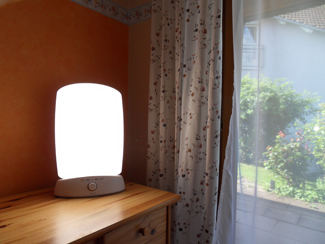
While disruptions in circadian rhythms can have negative consequences, there are things we can do to help us realign our biological clocks with the external environment. Some of these approaches, such as using a bright light as shown in Figure 4.4, have been shown to alleviate some of the problems experienced by individuals suffering from jet lag or from the consequences of rotating shift work. Because the biological clock is driven by light, exposure to bright light during working shifts and dark exposure when not working can help combat insomnia and symptoms of anxiety and depression (Huang, Tsai, Chen, & Hsu, 2013).
英語のヒント
概日リズムの乱れは悪い結果をもたらしうるが、体内時計を外部環境に合わせ直すために、私たちにできることもある。そうした方法のいくつか、たとえば図4.4に示すような明るい光を使う方法は、時差ぼけに苦しむ人や、交代制勤務がもたらす影響に苦しむ人が経験する問題の一部を和らげることが示されている。体内時計は光によって動かされているので、勤務中に明るい光を浴び、勤務していないときには暗さに身を置くことは、不眠症や、不安・抑うつの症状に対処する助けになりうる(Huang, Tsai, Chen, & Hsu, 2013)。
Copyright Rice University, OpenStax, under CC BY 4.0 license. Embedded rights notice: COPYRIGHT, 2007 · CC BY 4.0 · Source出典

Figure 4.4図 4.4
Devices like this are designed to provide exposure to bright light to help people maintain a regular circadian cycle. They can be helpful for people working night shifts or for people affected by seasonal variations in light.
このような装置は、明るい光を浴びられるようにして、人が規則的な概日周期を保てるよう助けることを目的に作られている。夜勤をしている人や、季節による日照の変化の影響を受けている人に役立つことがある。
Insufficient Sleep睡眠不足
When people have difficulty getting sleep due to their work or the demands of day-to-day life, they accumulate a sleep debt. A person with a sleep debt does not get sufficient sleep on a chronic basis. The consequences of sleep debt include decreased levels of alertness and mental efficiency. Interestingly, since the advent of electric light, the amount of sleep that people get has declined. While we certainly welcome the convenience of having the darkness lit up, we also suffer the consequences of reduced amounts of sleep because we are more active during the nighttime hours than our ancestors were. As a result, many of us sleep less than 7–8 hours a night and accrue a sleep debt. While there is tremendous variation in any given individual’s sleep needs, the National Sleep Foundation (n.d.) cites research to estimate that newborns require the most sleep (between 12 and 18 hours a night) and that this amount declines to just 7–9 hours by the time we are adults.
英語のヒント
仕事や日々の生活の要求のために睡眠をとるのが難しいと、人は睡眠負債をためていく。睡眠負債を抱えた人は、慢性的に十分な睡眠をとれていない。睡眠負債の結果には、覚醒度と精神的な効率の低下が含まれる。興味深いことに、電灯が登場して以来、人々がとる睡眠の量は減ってきた。私たちは暗闇が明るく照らされる便利さをたしかに歓迎しているが、同時に、祖先よりも夜の時間帯に活発に活動しているために、睡眠量の減少がもたらす影響も被っている。その結果、私たちの多くは一晩に7〜8時間未満しか眠らず、睡眠負債をためている。睡眠の必要量は人によって非常に大きく異なるが、全米睡眠財団(n.d.)は研究を引用して、新生児が最も多くの睡眠を必要とし(一晩に12〜18時間)、この量は大人になるころには7〜9時間にまで減ると見積もっている。
If you lie down to take a nap and fall asleep very easily, chances are you may have sleep debt. Given that college students are notorious for suffering from significant sleep debt (Hicks, Fernandez, & Pellegrini, 2001; Hicks, Johnson, & Pellegrini, 1992; Miller, Shattuck, & Matsangas, 2010), chances are you and your classmates deal with sleep debt-related issues on a regular basis. In 2015, the National Sleep Foundation updated their sleep duration hours, to better accommodate individual differences. Table 4.1 shows the new recommendations, which describe sleep durations that are “recommended”, “may be appropriate”, and “not recommended”.
英語のヒント
昼寝をしようと横になって、とても簡単に眠りに落ちるなら、おそらく睡眠負債があるのかもしれない。大学生はかなりの睡眠負債を抱えていることで悪名高いので(Hicks, Fernandez, & Pellegrini, 2001; Hicks, Johnson, & Pellegrini, 1992; Miller, Shattuck, & Matsangas, 2010)、あなたやクラスメートもおそらく、睡眠負債にかかわる問題に日常的に対処しているだろう。2015年、全米睡眠財団は、個人差によりよく対応するために、推奨する睡眠時間を改訂した。表4.1はその新しい推奨を示しており、睡眠時間を「推奨」「適切な場合もある」「推奨されない」に分けて記している。
Sleep Needs at Different Ages 年齢ごとの必要睡眠時間 |
|||
|---|---|---|---|
Age 年齢 |
Recommended 推奨 |
May be appropriate 適切な場合もある |
Not recommended 推奨されない |
0–3 months 0〜3か月 |
14–17 hours 14〜17時間 |
11–13 hours 18–19 hours 11〜13時間18〜19時間 |
Fewer than 11 hours More than 19 hours 11時間未満19時間超 |
4–11 months 4〜11か月 |
12–15 hours 12〜15時間 |
10–11 hours 16–18 hours 10〜11時間16〜18時間 |
Fewer than 10 hours More than 18 hours 10時間未満18時間超 |
1–2 years 1〜2歳 |
11–14 hours 11〜14時間 |
9–10 hours 15–16 hours 9〜10時間15〜16時間 |
Fewer than 9 hours More than 16 hours 9時間未満16時間超 |
3–5 years 3〜5歳 |
10–13 hours 10〜13時間 |
8–9 hours 14 hours 8〜9時間14時間 |
Fewer than 8 hours More than 14 hours 8時間未満14時間超 |
6–13 years 6〜13歳 |
9–11 hours 9〜11時間 |
7–8 hours 12 hours 7〜8時間12時間 |
Fewer than 7 hours More than 12 hours 7時間未満12時間超 |
14–17 years 14〜17歳 |
8–10 hours 8〜10時間 |
7 hours 11 hours 7時間11時間 |
Fewer than 7 hours More than 11 hours 7時間未満11時間超 |
18–25 years 18〜25歳 |
7–9 hours 7〜9時間 |
6 hours 10–11 hours 6時間10〜11時間 |
Fewer than 6 hours More than 11 hours 6時間未満11時間超 |
26–64 years 26〜64歳 |
7–9 hours 7〜9時間 |
6 hours 10 hours 6時間10時間 |
Fewer than 6 hours More than 10 hours 6時間未満10時間超 |
≥65 years 65歳以上 |
7–8 hours 7〜8時間 |
5–6 hours 9 hours 5〜6時間9時間 |
Fewer than 5 hours More than 9 hours 5時間未満9時間超 |
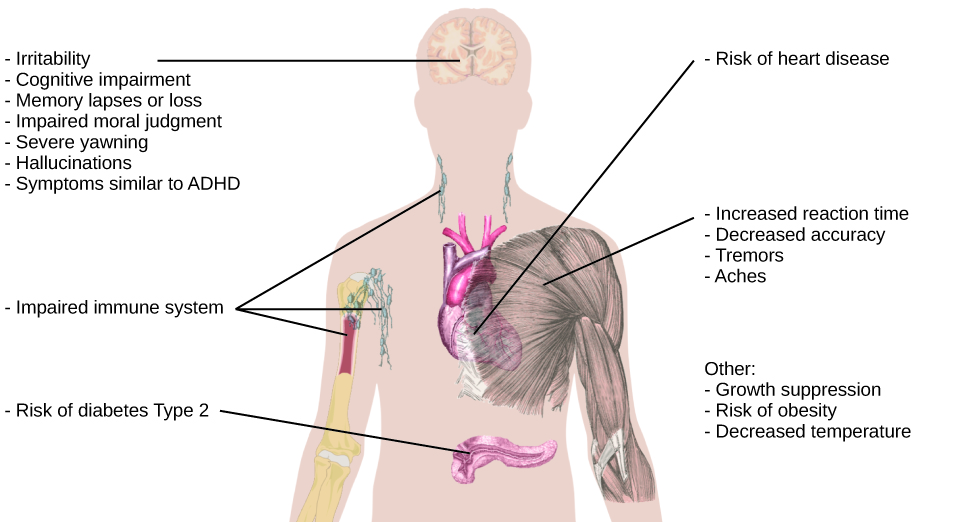
Sleep debt and sleep deprivation have significant negative psychological and physiological consequences Figure 4.5. As mentioned earlier, lack of sleep can result in decreased mental alertness and cognitive function. In addition, sleep deprivation often results in depression-like symptoms. These effects can occur as a function of accumulated sleep debt or in response to more acute periods of sleep deprivation. It may surprise you to know that sleep deprivation is associated with obesity, increased blood pressure, increased levels of stress hormones, and reduced immune functioning (Banks & Dinges, 2007). A sleep deprived individual generally will fall asleep more quickly than if they were not sleep deprived. Some sleep-deprived individuals have difficulty staying awake when they stop moving (example sitting and watching television or driving a car). That is why individuals suffering from sleep deprivation can also put themselves and others at risk when they put themselves behind the wheel of a car or work with dangerous machinery. Some research suggests that sleep deprivation affects cognitive and motor function as much as, if not more than, alcohol intoxication (Williamson & Feyer, 2000). Research shows that the most severe effects of sleep deprivation occur when a person stays awake for more than 24 hours (Killgore & Weber, 2014; Killgore et al., 2007), or following repeated nights with fewer than four hours in bed (Wickens, Hutchins, Lauk, Seebook, 2015). For example, irritability, distractibility, and impairments in cognitive and moral judgment can occur with fewer than four hours of sleep. If someone stays awake for 48 consecutive hours, they could start to hallucinate.
英語のヒント
睡眠負債と睡眠剥奪は、心理的にも生理的にも重大な悪影響をもたらす(図4.5)。前に述べたように、睡眠の不足は精神的な覚醒度と認知機能の低下を招きうる。さらに、睡眠剥奪はしばしば抑うつに似た症状をもたらす。こうした影響は、蓄積した睡眠負債に応じて生じることもあれば、より急性の睡眠剥奪の期間への反応として生じることもある。意外に思うかもしれないが、睡眠剥奪は、肥満、血圧の上昇、ストレスホルモンの水準の上昇、免疫機能の低下と関連している(Banks & Dinges, 2007)。睡眠を奪われた人は一般に、睡眠を奪われていない場合よりも早く眠りに落ちる。睡眠を奪われた人の中には、動くのをやめると(たとえば、座ってテレビを見ているときや車を運転しているとき)、起きているのが難しくなる人もいる。だからこそ、睡眠剥奪に苦しむ人は、車のハンドルを握ったり危険な機械を扱ったりするときに、自分自身と他人を危険にさらすことにもなりうる。ある研究は、睡眠剥奪が認知機能と運動機能に及ぼす影響は、アルコールによる酩酊と同じくらい、あるいはそれ以上であることを示唆している(Williamson & Feyer, 2000)。研究によれば、睡眠剥奪の最も深刻な影響が生じるのは、24時間を超えて起きていたとき(Killgore & Weber, 2014; Killgore et al., 2007)、あるいは床にいる時間が4時間未満の夜が繰り返されたあと(Wickens, Hutchins, Lauk, Seebook, 2015)である。たとえば、睡眠が4時間未満だと、いらだちやすさ、注意の散りやすさ、認知的判断や道徳的判断の低下が生じうる。48時間続けて起きていると、幻覚を見はじめる可能性がある。
OpenStax, Rice University; Psychology 2e. (credit: modification of work by Mikael Häggström) · CC BY 4.0 · Source出典

Figure 4.5図 4.5
This figure illustrates some of the negative consequences of sleep deprivation. While cognitive deficits may be the most obvious, many body systems are negatively impacted by lack of sleep. (credit: modification of work by Mikael Häggström)
この図は、睡眠剥奪がもたらす悪影響の一部を示している。認知機能の欠損が最も目立つかもしれないが、睡眠の不足によって体の多くの器官系が悪影響を受ける。(出典:Mikael Häggströmの作品を改変)
The amount of sleep we get varies across the lifespan. When we are very young, we spend up to 16 hours a day sleeping. As we grow older, we sleep less. In fact, a meta-analysis, which is a study that combines the results of many related studies, conducted within the last decade indicates that by the time we are 65 years old, we average fewer than 7 hours of sleep per day (Ohayon, Carskadon, Guilleminault, & Vitiello, 2004).
英語のヒント
私たちがとる睡眠の量は、生涯を通じて変化する。ごく幼いころは、1日に最大16時間を眠って過ごす。年をとるにつれて、眠る時間は短くなる。実際、過去10年以内に行われたメタ分析(多くの関連する研究の結果を統合する研究)は、65歳になるころには、1日の睡眠が平均して7時間未満になることを示している(Ohayon, Carskadon, Guilleminault, & Vitiello, 2004)。