第4章意識の状態
4.3 Stages of Sleep4.3 睡眠の段階
Learning Objectives学習目標
By the end of this section, you will be able to:
この節を学び終えると、次のことができるようになる。
- Differentiate between REM and non-REM sleepレム睡眠とノンレム睡眠を区別する
- Describe the differences between the three stages of non-REM sleepノンレム睡眠の三つの段階の違いを説明する
- Understand the role that REM and non-REM sleep play in learning and memory学習と記憶においてレム睡眠とノンレム睡眠が果たす役割を理解する
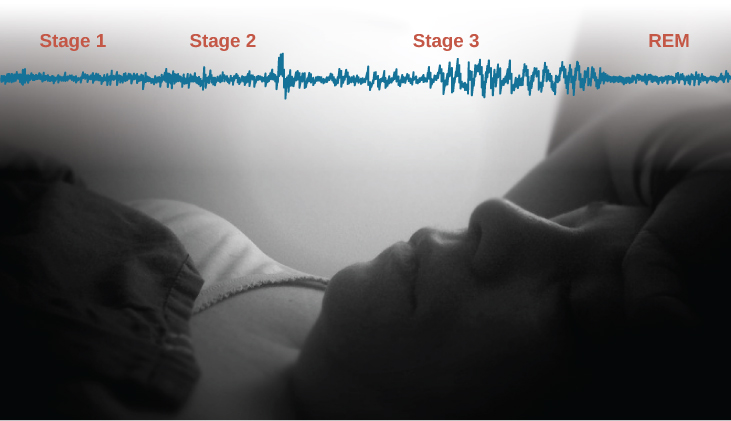
Sleep is not a uniform state of being. Instead, sleep is composed of several different stages that can be differentiated from one another by the patterns of brain wave activity that occur during each stage. While awake, our brain wave activity is dominated by beta waves. As compared to the brain wave patterns while asleep, beta waves have the highest frequency (13–30 Hz) and lowest amplitude, and they tend to show more variability. As we begin to fall asleep, our brain wave activity changes. These changes can be visualized using an EEG and are distinguished from one another by both the frequency and amplitude of the brain wave. The frequency of a brain wave is how many brain waves occur in a second, and frequency is measured in Hertz (Hz). Amplitude is the height of the brain wave (Figure 4.7). Sleep can be divided into two different general phases: REM sleep and non-REM (NREM) sleep. Rapid eye movement (REM) sleep is characterized by darting movements of the eyes under closed eyelids. Brain waves during REM sleep appear very similar to brain waves during wakefulness. In contrast, non-REM (NREM) sleep is subdivided into three stages distinguished from each other and from wakefulness by characteristic patterns of brain waves. The first three stages of sleep are NREM sleep, typically followed by REM sleep. In this section, we will discuss each of these stages of sleep and their associated patterns of brain wave activity.
英語のヒント
睡眠は一様な状態ではない。むしろ睡眠はいくつかの異なる段階から成り、それらの段階は、各段階で生じる脳波活動のパターンによって互いに区別できる。目覚めているとき、私たちの脳波活動ではベータ波が優勢である。眠っているときの脳波パターンと比べると、ベータ波は周波数が最も高く(13〜30 Hz)、振幅が最も小さい。また、ばらつきが大きい傾向がある。眠りに落ちはじめると、脳波活動は変化する。こうした変化は脳波検査(EEG)を使って目に見える形にでき、脳波の周波数と振幅の両方によって互いに区別される。脳波の周波数とは1秒間に生じる脳波の数のことで、ヘルツ(Hz)という単位で測られる。振幅とは脳波の高さのことである(図4.7)。睡眠は大きく、レム睡眠とノンレム睡眠(NREM)という二つの異なる相に分けられる。急速眼球運動(REM)睡眠、すなわちレム睡眠は、閉じたまぶたの下で眼球がすばやく動くことを特徴とする。レム睡眠中の脳波は、覚醒時の脳波とよく似ている。これに対してノンレム睡眠は、さらに三つの段階に分けられる。これらの段階は、特徴的な脳波のパターンによって互いに区別され、覚醒とも区別される。睡眠の最初の三つの段階がノンレム睡眠で、通常はその後にレム睡眠が続く。この節では、睡眠のこれらの各段階と、それぞれに伴う脳波活動のパターンを論じる。
OpenStax, Rice University; Psychology 2e. (credit "sleeping": modification of work by Ryan Vaarsi) · CC BY 4.0 · Source出典
Figure 4.7図 4.7
Brainwave activity changes dramatically across the different stages of sleep. (credit "sleeping": modification of work by Ryan Vaarsi)
脳波活動は、睡眠の段階によって大きく変化する。(出典「眠る人」:Ryan Vaarsiの作品を改変)
NREM Stages of Sleepノンレム睡眠の段階
As we begin to fall asleep, we enter NREM sleep, and brain wave patterns decrease in frequency and increase in amplitude. The first stage of NREM sleep is known as stage 1 sleep. Stage 1 sleep is a transitional phase that occurs between wakefulness and sleep, the period during which we drift off to sleep. During this time, there is a slowdown in both the rates of respiration and heartbeat. In addition, stage 1 sleep involves a marked decrease in both overall muscle tension and core body temperature.
英語のヒント
眠りに落ちはじめると、私たちはノンレム睡眠に入り、脳波パターンは周波数が低下し、振幅が大きくなる。ノンレム睡眠の最初の段階は、睡眠段階1として知られている。睡眠段階1は、覚醒と睡眠のあいだに生じる移行期であり、私たちがいつの間にか眠りに落ちていく時期である。この間、呼吸と心拍の速さはどちらも落ちる。さらに睡眠段階1では、全身の筋緊張と深部体温がともに著しく低下する。
In terms of brain wave activity, stage 1 sleep is associated with both alpha and theta waves. The early portion of stage 1 sleep produces alpha waves. These patterns of electrical activity (waves) resemble that of someone who is very relaxed, yet awake, but they have less variability (are more synchronized) and are relatively lower in frequency (8–12 Hz) and higher in amplitude than beta waves (Figure 4.8). As an individual continues through stage 1 sleep, there is an increase in theta wave activity. Theta waves are even lower frequency (4–7 Hz), and higher in amplitude, than the alpha wave patterns. It is relatively easy to wake someone from stage 1 sleep; in fact, people often report that they have not been asleep if they are awoken during stage 1 sleep.
英語のヒント
脳波活動の点から見ると、睡眠段階1はアルファ波とシータ波の両方と関連している。睡眠段階1の初めの部分ではアルファ波が生じる。この電気的活動のパターン(波)は、とてもリラックスしているがまだ目覚めている人のパターンに似ている。しかし、ベータ波と比べると、ばらつきが小さく(より同期しており)、周波数は比較的低く(8〜12 Hz)、振幅は大きい(図4.8)。睡眠段階1が進むにつれて、シータ波の活動が増えていく。シータ波は、アルファ波のパターンよりもさらに周波数が低く(4〜7 Hz)、振幅が大きい。睡眠段階1の人を起こすのは比較的たやすい。実際、睡眠段階1のあいだに起こされた人は、眠っていなかったと報告することが多い。
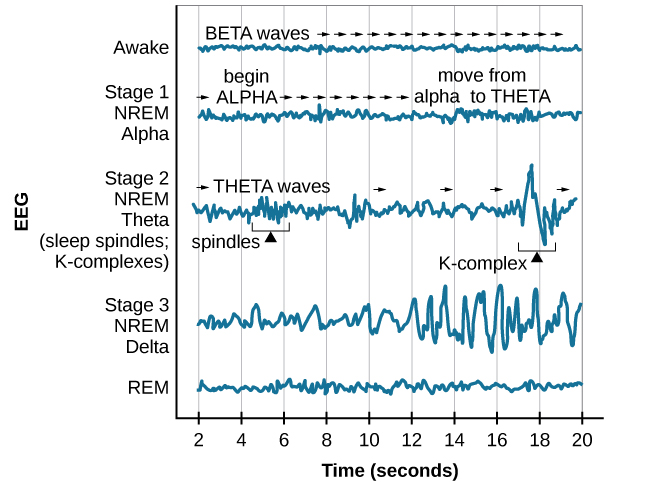
Figure 4.8図 4.8
Brainwave activity changes dramatically across the different stages of sleep.
脳波活動は、睡眠の段階によって大きく変化する。
As we move into stage 2 sleep, the body goes into a state of deep relaxation. Theta waves still dominate the activity of the brain, but they are interrupted by brief bursts of activity known as sleep spindles (Figure 4.9). A sleep spindle is a rapid burst of higher frequency brain waves that may be important for learning and memory (Fogel & Smith, 2011; Poe, Walsh, & Bjorness, 2010). In addition, the appearance of K-complexes is often associated with stage 2 sleep. A K-complex is a very high amplitude pattern of brain activity that may in some cases occur in response to environmental stimuli. Thus, K-complexes might serve as a bridge to higher levels of arousal in response to what is going on in our environments (Halász, 1993; Steriade & Amzica, 1998).
英語のヒント
睡眠段階2に移ると、体は深くリラックスした状態に入る。脳の活動では依然としてシータ波が優勢だが、そこに睡眠紡錘波と呼ばれる短い突発的な活動が割り込む(図4.9)。睡眠紡錘波とは、周波数のより高い脳波が急速に群発するもので、学習と記憶にとって重要である可能性がある(Fogel & Smith, 2011; Poe, Walsh, & Bjorness, 2010)。さらに、K複合の出現も、睡眠段階2と関連していることが多い。K複合とは振幅が非常に大きい脳活動のパターンで、場合によっては環境の刺激への反応として生じることがある。したがってK複合は、周囲の環境で起きていることに反応して、より高い覚醒水準へと移るための橋渡しの役割を果たしているのかもしれない(Halász, 1993; Steriade & Amzica, 1998)。
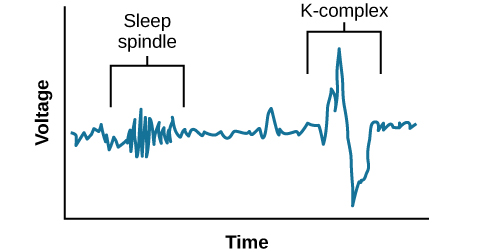
Figure 4.9図 4.9
Stage 2 sleep is characterized by the appearance of both sleep spindles and K-complexes.
睡眠段階2は、睡眠紡錘波とK複合の両方が現れることを特徴とする。
NREM stage 3 sleep is often referred to as deep sleep or slow-wave sleep because this stage is characterized by low frequency (less than 3 Hz), high amplitude delta waves (Figure 4.10). These delta waves have the lowest frequency and highest amplitude of our sleeping brain wave patterns. During this time, an individual’s heart rate and respiration slow dramatically, and it is much more difficult to awaken someone from sleep during stage 3 than during earlier stages. Interestingly, individuals who have increased levels of alpha brain wave activity (more often associated with wakefulness and transition into stage 1 sleep) during stage 3 often report that they do not feel refreshed upon waking, regardless of how long they slept (Stone, Taylor, McCrae, Kalsekar, & Lichstein, 2008).
英語のヒント
ノンレム睡眠段階3は、しばしば深い睡眠あるいは徐波睡眠と呼ばれる。この段階が、周波数が低く(3 Hz未満)振幅の大きいデルタ波を特徴とするためである(図4.10)。このデルタ波は、睡眠中の私たちの脳波パターンの中で、周波数が最も低く、振幅が最も大きい。この間、心拍と呼吸は大きく遅くなり、睡眠段階3の人を眠りから起こすのは、それより前の段階に比べてはるかに難しい。興味深いことに、睡眠段階3のあいだにアルファ波の活動水準が高まっている人(アルファ波の活動は、覚醒や睡眠段階1への移行と関連していることのほうが多い)は、どれだけ長く眠ったかにかかわらず、目覚めたときにすっきりしないと報告することが多い(Stone, Taylor, McCrae, Kalsekar, & Lichstein, 2008)。
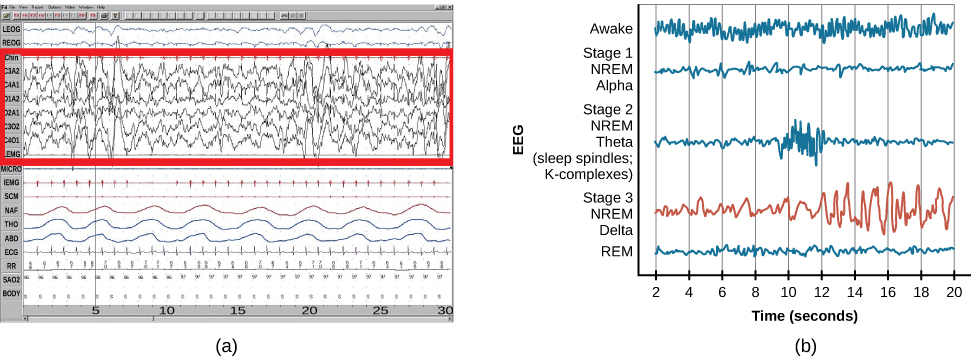


Figure 4.10図 4.10
(a) Delta waves, which are low frequency and high amplitude, characterize (b) slow-wave stage 3 and REM sleep.
(a)周波数が低く振幅の大きいデルタ波は、(b)徐波睡眠である段階3とレム睡眠を特徴づける。