第3章世界各地における哲学の起源The Early History of Philosophy around the World
Classical Indian Darshanas古典インドのダルシャナ
The word darshana derives from a Sanskrit word meaning “to view.” In Hindu philosophy, darshana refers to the beholding of a god, a holy person, or a sacred object. This experience is reciprocal: the religious believer beholds the deity and is beheld by the deity in turn. Those who behold the sacred are blessed by this encounter. The term darshana is also used to refer to six classical schools of thought based on views or manifestations of the divine—six ways of seeing and being seen by the divine. The six principal orthodox Hindu darshanas are Samkhya, Yoga, Nyaya, Vaisheshika, Mimamsa, and Vedanta. Non-Hindu or heterodox darshanas include Buddhism and Jainism.
英語のヒント
ダルシャナという語は、「見る」を意味するサンスクリット語に由来する。ヒンドゥー哲学では、ダルシャナは、神、聖なる人物、聖なる物を拝見することを指す。この経験は相互的である。信者が神を見つめると同時に、今度は神から見つめられる。聖なるものを見る人は、この出会いによって祝福される。ダルシャナという語は、神的なものの見方や現れに基づく六つの古典的な思想学派、すなわち、神的なものを見て、それに見られる六つの道を指すためにも用いられる。ヒンドゥー教の主要な六つの正統ダルシャナは、サーンキヤ、ヨーガ、ニヤーヤ、ヴァイシェーシカ、ミーマーンサー、ヴェーダーンタである。非ヒンドゥー教または異端のダルシャナには、仏教とジャイナ教がある。
Samkhyaサーンキヤ学派
Samkhya is a dualistic school of philosophy that holds that everything is composed of purusha (pure, absolute consciousness) and prakriti (matter). An evolutionary process gets underway when purusha comes into contact with prakriti. These admixtures of mind and matter produce more or less pure things such as the human mind, the five senses, the intellect, and the ego as well as various manifestations of material things. Living beings occur when purusha and prakriti bond together. Liberation finally occurs when mind is freed from the bondage of matter.
英語のヒント
サーンキヤは、すべてはプルシャ(純粋で絶対的な意識)とプラクリティ(物質)から成るとする、二元論的な哲学の学派である。プルシャがプラクリティと接触すると、展開の過程が始まる。これらの精神と物質の混合は、人間の心、五感、知性、自我といった、さまざまな程度に純粋なものと、物質的なものの多様な現れを生み出す。プルシャとプラクリティが結び付くと、生きた存在が生まれる。精神が物質の束縛から解放されたとき、最終的な解脱が生じる。
Western readers should take care not to reduce Samkhya’s metaphysics and epistemology to the various dualistic systems seen in, for example, the account of the soul in Plato’s Phaedo or in Christian metaphysics more generally. The metaphysical system of creation in Samkhya is much more complex than either of these Western examples.
英語のヒント
西洋の読者は、サーンキヤの形而上学と認識論を、たとえばプラトンの『パイドン』における魂の説明や、より一般的なキリスト教の形而上学に見られる、さまざまな二元論の体系に還元しないよう注意するべきである。サーンキヤにおける創造の形而上学的な体系は、これら西洋のどちらの例よりもはるかに複雑である。
When purusha first focuses on prakriti, buddhi, or spiritual awareness, results. Spiritual awareness gives rise to the individualized ego or I-consciousness that creates five gross elements (space, air, earth, fire, water) and then five fine elements (sight, sound, touch, smell, and taste). These in turn give rise to the five sense organs, the five organs of activity (used to speak, grasp, move, procreate, and evacuate), and the mind that coordinates them.
英語のヒント
プルシャが初めてプラクリティに意識を向けると、ブッディ、すなわち精神的な気づきが生じる。精神的な気づきは、個別化された自我、あるいは「私」という意識を生み出す。この意識は、五つの粗大元素(空間、空気、地、火、水)を生み、次いで五つの微細元素(視覚、音、触覚、匂い、味)を生み出す。これらはさらに、五つの感覚器官、五つの活動器官(話す、つかむ、動く、生殖する、排泄するために使われる)、そして、それらを調整する心を生み出す。
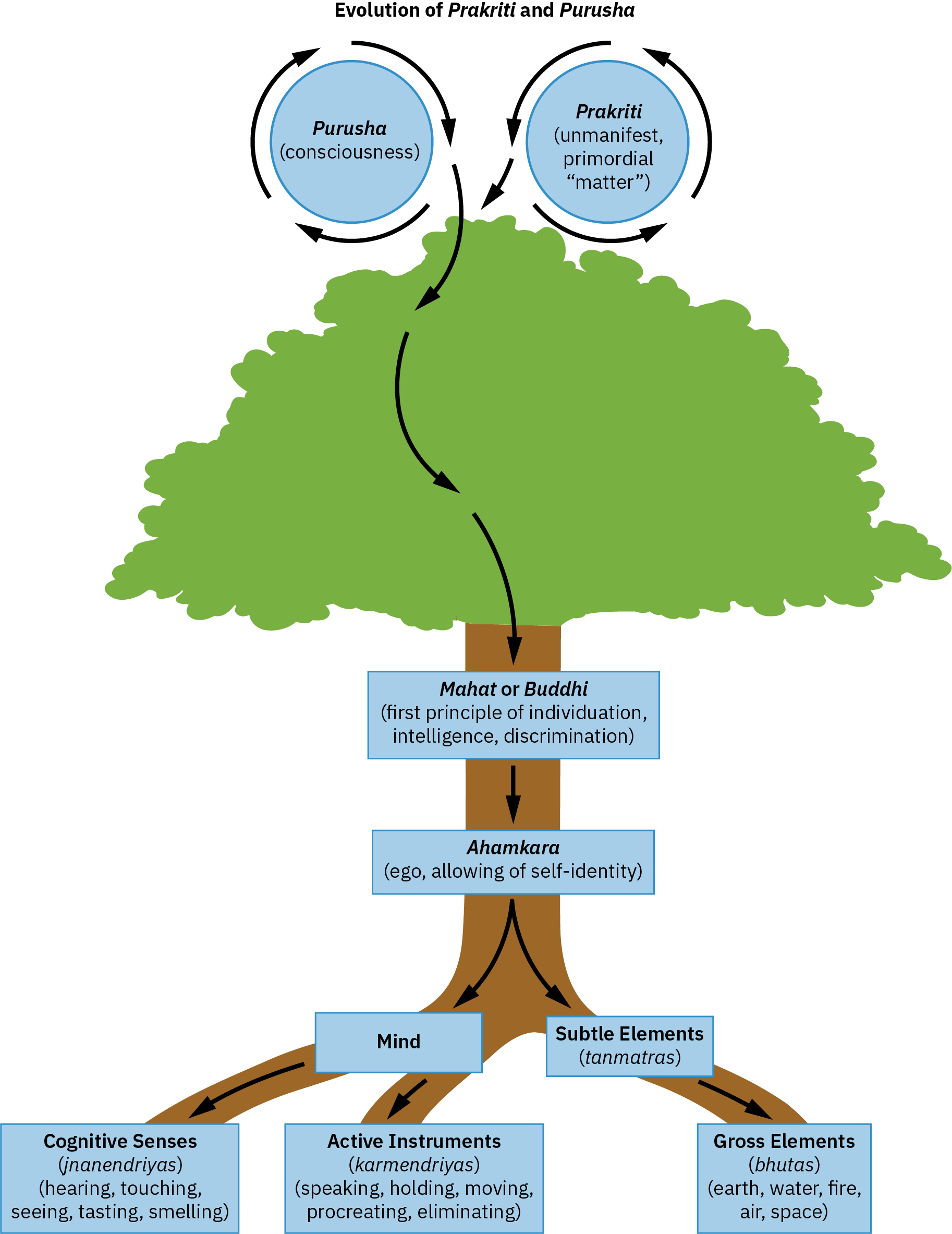
Figure 3.7 In Hinduism, the interaction between purusha (pure, absolute consciousness) and prakriti (matter) is understood to result in many elements of existence. (attribution: Copyright Rice University, OpenStax, under CC BY 4.0 license)
図3.7 ヒンドゥー教では、プルシャ(純粋で絶対的な意識)とプラクリティ(物質)の相互作用から、存在の多くの要素が生じると理解されている。(帰属表示:Copyright Rice University, OpenStax, under CC BY 4.0 license)
Yogaヨーガ学派
Yoga has become popularized as a fitness practice throughout the world, but the Westernization of this concept has emptied it of much of its original content. Although yoga instructors will still sometimes use Sanskrit terms for various poses, the movement has largely lost its cultural and spiritual vitality as it has become popular in the West. It originally developed during the Vedic period and influenced Buddhist meditation practices.
英語のヒント
ヨーガは、体力づくりの実践として世界中に広まった。しかし、この概念の西洋化は、その本来の内容の多くを空洞化させた。ヨーガの指導者は今も、さまざまな姿勢にサンスクリット語の名称を使うことがあるものの、西洋で人気が高まるにつれ、この運動は文化的・精神的な活力の大部分を失ってきた。ヨーガは、もともとヴェーダ時代に発展し、仏教の瞑想の実践に影響を与えた。
First mentioned in the Rigveda, Yoga is the mental process through which an individual’s soul joins with the supreme soul. Originally a part of the Samkhya school, it emerged as a practice during the first millennium BCE. The teachings of the sage Patanjali, who lived circa 400 BCE, regarding ancient Yoga traditions and beliefs were compiled into approximately 200 Yoga sutras. The purpose of Yoga is the stopping of the movement of thought. Only then do individuals encounter their true selves, and only then is the distinction between the observer and that which is being observed overcome (Rodrigues 2018).
英語のヒント
リグ・ヴェーダに初めて言及されるヨーガは、個人の魂が至高の魂と一つになる精神的な過程である。もともとはサーンキヤ学派の一部であり、紀元前1千年紀に一つの実践として現れた。紀元前400年ごろに生きた賢者パタンジャリが、古代のヨーガの伝統と信念について説いた教えは、約200のヨーガ・スートラにまとめられた。ヨーガの目的は、思考の動きを止めることである。そのとき初めて、人は真の自己に出会い、観察する者と観察されるものとの区別も、そのとき初めて乗り越えられる(Rodrigues 2018)。
Yoga involves eight limbs. The first involves the observance of the yamas, moral restraints that keep individuals from being violent, lying, stealing, hoarding, and squandering vital energies (often interpreted as a practice of celibacy). The second limb consists of personal codes of conduct, known as the niyamas—purity, discipline, self-study, contentment (gratitude and nonattachment), and surrender to the higher being. The third and fourth limbs, familiar to Western practitioners, are the postures, asana, and breath control, pranayama. The fifth and sixth limbs involve the mastering of the senses needed to achieve a peaceful mind and focus, the ability to concentrate deeply on one thing—a mental image, a word, or a spot on the wall (Showkeir and Showkeir 2013). The seventh limb involves meditation, which allows one to reach the eight limb, samadhi, the oneness of the self and true reality, the supreme soul.
英語のヒント
ヨーガは八つの段階から成る。第一はヤマ(禁戒)の遵守であり、暴力を振るうこと、嘘をつくこと、盗むこと、ため込むこと、生命エネルギーを浪費すること(しばしば禁欲・独身の実践と解される)を防ぐ道徳的な制約である。第二はニヤマ(勧戒)と呼ばれる個人的な行動規範であり、清浄、鍛錬、自己学習、満足(感謝と執着しないこと)、そして上位の存在への献身から成る。西洋の実践者にもなじみのある第三と第四は、アーサナ(姿勢)とプラーナーヤーマ(呼吸の制御)である。第五と第六には、穏やかな心を得るために必要な感覚の制御と、集中が含まれる。集中とは、心に浮かべた像、一つの言葉、壁の一点など、一つのものに深く意識を集中できる力である(Showkeir and Showkeir 2013)。第七は瞑想であり、それによって第八の段階、サマーディに至ることができる。サマーディとは、自己と真の現実である至高の魂との一体性である。
During the Upanishadic period (900–200 BCE), Yoga was incorporated into the new philosophic traditions that gave rise to Jainism and Buddhism. Yoga influenced the emergence of Bhakti and Sufism within Islamic culture in the 15th century CE following the conquest of India by Islamic leaders. New schools and theories of Yoga evolved. Swami Vivekananda’s translations of scriptures into English facilitated the spread of Yoga in the West in the 19th century. Today, Yoga is practiced as a form of spirituality across the globe (Pradhan 2015).
英語のヒント
ウパニシャッド時代(紀元前900〜200年)には、ヨーガは、ジャイナ教や仏教を生み出した新しい哲学的伝統に組み込まれた。イスラムの指導者たちによるインド征服後、紀元後15世紀のイスラム文化の内部で、バクティとスーフィズムが現れる際にも、ヨーガは影響を与えた。ヨーガの新たな学派や理論が発展した。19世紀には、スワーミー・ヴィヴェーカーナンダによる聖典の英訳が、西洋へのヨーガの普及を促した。今日、ヨーガは精神的な営みの一形態として世界中で実践されている(Pradhan 2015)。
Nyayaニヤーヤ学派
Nyaya, which can be translated as “method” or “rule,” focuses on logic and epistemology. Scholars seek to develop four of the Hindu pramanas, or proofs, as reliable ways of gaining knowledge: perception, inference, comparison, and testimony. Practitioners seek liberation from suffering through right knowledge. They believe that everything that exists could be directly perceived and understood if only one had the proper method for doing so. False knowledge is delusion that precludes purification and enlightenment.
英語のヒント
「方法」または「規則」と訳せるニヤーヤは、論理学と認識論に重点を置く。研究者たちは、知識を得る信頼できる方法として、ヒンドゥー教のプラマーナ、すなわち知の根拠のうち、知覚、推論、比較、証言という四つを発展させようとする。実践者は、正しい知識によって苦しみから解放されることを求める。彼らは、適切な方法さえ持っていれば、存在するすべてのものを直接知覚し理解できると信じている。誤った知識は、浄化と悟りを妨げる迷妄である。
Vaisheshikaヴァイシェーシカ学派
The Vaisheshika system developed independently of Nyaya but gradually came to share many of its core ideas. Its epistemology is simpler, allowing for only perception and inference as forms of reliable knowledge. It is known for its naturalism, and scholars of the Vaisheshika school developed a form of atomism. The atoms themselves are understood to be indestructible in their pure state, but as they enter into combinations with one another, these mixtures can be decomposed. Members of the Vaisheshika school believe that only complete knowledge can lead to purification and liberation.
英語のヒント
ヴァイシェーシカの体系は、ニヤーヤとは独立に発展したが、次第にその中核的な考えの多くを共有するようになった。その認識論はより単純で、信頼できる知識の形として認めるのは、知覚と推論だけである。ヴァイシェーシカは自然主義で知られ、この学派の研究者たちは一種の原子論を発展させた。原子そのものは、純粋な状態では破壊できないと理解される。しかし、原子同士が結合してできた混合物は分解できる。この学派の人々は、完全な知識だけが、浄化と解脱へ導きうると信じている。