第3章世界各地における哲学の起源The Early History of Philosophy around the World
3.1 Indigenous Philosophy3.1 先住民の哲学
Learning Objectives学習目標
By the end of this section, you will be able to:
この節を学ぶと、次のことができるようになる。
Identify challenges in the study of Indigenous philosophies.
先住民の哲学を研究する際の課題を挙げる。
Describe metaphysical and epistemological ideas explored by Indigenous African philosophies.
アフリカの先住民の哲学が探究してきた形而上学的・認識論的な考え方を説明する。
Describe metaphysical and epistemological ideas explored by Indigenous Native American philosophies.
アメリカ先住民の哲学が探究してきた形而上学的・認識論的な考え方を説明する。
Describe metaphysical and epistemological ideas explored by Mesoamerican philosophies.
メソアメリカの哲学が探究してきた形而上学的・認識論的な考え方を説明する。
Some of the best-known ancient texts, connected to many of the great civilizations around the world, are religious or mythological in nature. Examples include the Vedas of India, the earliest literature of China, and the Jewish Talmud. These texts introduce aspects of philosophical inquiry—such as questions concerning the origins of the cosmos and the nature and purpose of human life, morality, justice, human excellence, knowledge, and so forth—in terms of stories and explanations that rely on the supernatural. These stories provide context, meaning, and direction for human life within a framework that assumes that the natural world is infused with supernatural importance. Such texts are a testament to the fundamental and binding nature of religion in human societies.
英語のヒント
世界各地の多くの偉大な文明と結び付いた、特によく知られる古代の文献の中には、宗教的・神話的な性格のものがある。インドのヴェーダ、中国の最初期の文献、ユダヤ教のタルムードなどがその例である。これらの文献は、宇宙の起源、人間の生の性質と目的、道徳、正義、人間の卓越性、知識などに関する問いという哲学的探究の諸側面を、超自然的なものに依拠した物語や説明によって提示する。それらの物語は、自然界には超自然的な重要性が浸透していると想定する枠組みの中で、人間の生に文脈、意味、方向を与える。こうした文献は、人間社会における宗教の根本的な性格と、人々を結び付ける性格を証し立てている。
When humans shift from religious answers to questions about purpose and meaning to more naturalistic and logical answers, they move from the realm of myth to the realm of reason. In Greek, this movement is described as a move from mythos to logos, where mythos signifies the supernatural stories people tell, while logos signifies the rational, logical, and scientific stories they tell. This distinction may lead one to believe that there is a clear transition from religious thought to philosophical or scientific thought, but this is not the case. The earliest philosophers in Greece, Rome, India, China, and North Africa all used mythological and analogical (analogy-based) stories to explain their rational systems, while religious texts from the same period often engage in serious, logical argumentation. Rather than seeing a decisive break between mythological thinking and rational thinking, one should understand the transition from mythos to logos as a gradual, uneven, and zig-zagging progression. This progression teaches that there are close connections between religion, philosophy, and science in terms of the desire to understand, explain, and find purpose for human existence.
英語のヒント
目的や意味についての問いに対し、人々が宗教的な答えから、より自然主義的で論理的な答えへと移るとき、神話の領域から理性の領域へと移行する。ギリシア語では、この動きはミュトスからロゴスへの移行として表される。ここでミュトスは、人々が語る超自然的な物語を指し、ロゴスは、人々が語る理性的、論理的、科学的な物語を指す。この区別から、宗教的思考から哲学的・科学的思考への明確な切り替わりがあったと思うかもしれないが、実際にはそうではない。ギリシア、ローマ、インド、中国、北アフリカの最初期の哲学者たちは皆、自分たちの理性的な体系を説明するために、神話的な物語や類比に基づく物語を用いていた。同時代の宗教文献も、しばしば本格的な論理的論証を行っている。神話的思考と理性的思考の間に決定的な断絶を見るのではなく、ミュトスからロゴスへの移行を、緩やかで、不均一で、行きつ戻りつする進展として理解するべきである。この進展から、人間の存在を理解し、説明し、その目的を見いだそうとする欲求において、宗教、哲学、科学が密接につながっていることがわかる。
Challenges in Researching Indigenous Philosophy先住民の哲学を研究する際の課題
There is growing interest in Indigenous philosophy in contemporary academic philosophy, as a way of engaging with both the historical and present-day thought of Indigenous peoples around the world. Indigenous philosophy broadly refers to the ideas of Indigenous peoples pertaining to the nature of the world, human existence, ethics, ideal social and political structures, and other topics also considered by traditional academic philosophy. Unlike the philosophies of ancient Greece, India, and China, Indigenous philosophies did not spread across vast territorial empires or feature centers of formal learning that documented and developed philosophical ideas over hundreds or thousands of years. The study of Indigenous philosophies, or ethnophilosophy, often must rely on different methods than typical academic philosophy. Indigenous philosophy is not usually recorded in texts that can be read and analyzed. Instead, those seeking to understand Indigenous philosophical thinking must engage in the kind of research often used in ethnographic and sociological study, including identifying individuals who hold and transmit cultural knowledge about philosophical thought and recording interviews and conversations with them. Most of the philosophy of Indigenous peoples has been passed down through oral traditions, in much the same way that prehistoric thought was transmitted.
英語のヒント
現代の学問としての哲学では、世界各地の先住民の歴史的な思想と現在の思想の双方に向き合う方法として、先住民の哲学への関心が高まっている。先住民の哲学とは広くいえば、世界の本性、人間の存在、倫理、理想的な社会・政治の構造など、従来の学問としての哲学も扱う主題に関する、先住民の考え方を指す。古代ギリシア、インド、中国の哲学とは異なり、先住民の哲学は、広大な領域を持つ帝国全体へと広まったわけではない。また、数百年、数千年にわたって哲学的な考えを記録し発展させる、制度化された学問の中心地を備えていたわけでもない。先住民の哲学の研究、すなわち民族哲学は、多くの場合、通常の学問としての哲学とは異なる方法に頼らざるを得ない。先住民の哲学は通常、読んで分析できる文書の形では記録されていない。そのため、その哲学的思考を理解しようとする人は、民族誌や社会学の研究でよく用いられる調査を行う必要がある。たとえば、哲学的思考に関する文化的知識を保持し伝える人物を探し、その人々との面接や会話を記録する。先住民の哲学の大部分は、先史時代の思考が伝えられたのとよく似た仕方で、口承の伝統を通して受け継がれてきた。
There are additional challenges to studying Indigenous philosophy. The discipline of academic philosophy has traditionally dismissed or ignored the philosophical thought of Indigenous peoples, considering it to lie outside the realm of logos. The long history of erasure of Indigenous philosophical thought in academic philosophy makes it difficult to engage in academic discussion with it. There is an absence of past scholarship in this field in the West. Indigenous peoples have also been subjected to racist practices, such as forced education in languages other than their own, that make it difficult for them to retain a lively philosophical tradition. Furthermore, many Indigenous customs have been lost because of the loss of life and cultural heritage among Indigenous peoples following colonization by Europeans and Americans.
英語のヒント
先住民の哲学の研究には、さらに課題がある。学問としての哲学という分野は、先住民の哲学的思考をロゴスの領域外にあるとみなし、従来それを退けたり無視したりしてきた。学問としての哲学が先住民の哲学的思考を消し去ってきた長い歴史が、それとの学問的な対話を難しくしている。西洋には、この分野に関する過去の研究の蓄積がない。先住民は、自分たちの言語とは異なる言語による教育の強制など、人種差別的な措置の対象にもされてきた。これらは、生きた哲学の伝統を保持することを難しくしている。さらに、ヨーロッパ人とアメリカ人による植民地化の後、先住民の生命と文化遺産が失われたため、多くの先住民の慣習が消失した。
Indigenous African Philosophyアフリカの先住民の哲学
If the transition from mythos to logos is predicated on the development of written language, then this transition may have first occurred in Africa. Africa was home to the development of many ancient writing systems, including the system of ancient Egyptian hieroglyphics that developed during the fourth millennium BCE. The modern Western understanding of the deep history of philosophy is severely hampered by the lack of scholarship in English and other European languages, the loss of collective cultural knowledge exacerbated by colonialism, and the sometimes deliberate destruction of historical records, such as the burning of the Library of Alexandria. As a result, research has relied heavily on oral traditions or the rediscovery and translation of written evidence. The philosophical legacy of ancient Egypt is discussed in the chapter on classical philosophy. This chapter will examine research into ethnophilosophy from other regions of Africa.
英語のヒント
ミュトスからロゴスへの移行が書き言葉の発達を前提とするのなら、その移行はアフリカで最初に起こった可能性がある。アフリカでは、紀元前4千年紀に発達した古代エジプトのヒエログリフをはじめ、多くの古代の文字体系が生まれた。哲学の遠い過去に関する現代西洋の理解は、英語その他のヨーロッパ言語による研究の不足、植民地主義によってさらに悪化した集団的な文化知識の喪失、そしてアレクサンドリア図書館の焼失のような、ときには意図的に行われた歴史記録の破壊によって、深刻に妨げられている。そのため研究は、口承の伝統、あるいは文献上の証拠の再発見と翻訳に大きく依存してきた。古代エジプトの哲学的遺産は、古典哲学の章で論じる。本章では、アフリカの他の地域における民族哲学の研究を検討する。
The seizure of the city of Ceuta, bordering present-day Morocco, by the Portuguese in 1415 marks the first attempts by Europeans to colonize Africa. By the late 19th and early 20th centuries, European nations were engaging in what is called the “scramble for Africa.” Prior to this period, European settlement in Africa had been limited by the mosquito-borne disease malaria, the inappropriateness of African terrain to equine (horse-based) conquest, and the power of strong coastal states. European nations now gained access to the interior of Africa with the help of the discovery of quinine to treat malaria and the development of mechanized vehicles and advanced weaponry. During the colonial era, young Africans identified as having intellectual promise were sent to study at European universities, where they read Plato, Aristotle, Kant, Hegel, and other Western philosophers. Whether the intent was to help these communities enter the modern age or to create local administrations that would further the interests of Western parties—or both—the result was the failure to preserve knowledge about the history and thought of localities and regions.
英語のヒント
1415年、ポルトガル人が現在のモロッコに接するセウタの町を占領したことが、ヨーロッパ人によるアフリカ植民地化の最初の試みを画する。19世紀末から20世紀初頭になると、ヨーロッパ諸国は「アフリカ分割」と呼ばれる争奪戦に乗り出していた。それ以前、ヨーロッパ人のアフリカへの入植は、蚊が媒介するマラリア、馬を用いた征服に適さないアフリカの地形、沿岸部の強力な国家の力によって制限されていた。しかし、マラリア治療に用いるキニーネの発見、動力車両や高度な兵器の開発に助けられ、ヨーロッパ諸国はアフリカ内陸部へ進出できるようになった。植民地時代には、知的な将来性があると見込まれたアフリカの若者たちがヨーロッパの大学へ留学に送られ、プラトン、アリストテレス、カント、ヘーゲルなど、西洋の哲学者の著作を読んだ。その目的が、これらの共同体の近代への移行を支援することにあったにせよ、西洋側の利益を促進する現地行政組織を作ることにあったにせよ、あるいはその両方だったにせよ、結果として各地方や地域の歴史と思想に関する知識は保存されなかった。
In later decades, some Western-educated Africans began to engage directly with African philosophies. In 1910, Congolese philosopher Stefano Kaoze (c. 1885–1951) described the thought of the Bantu people pertaining to moral values, knowledge, and God in an essay entitled “The Psychology of the Bantus” (Dübgen and Skupien, 2019). Bantu is a blanket term for hundreds of different ethnic groups in Central and Southern African that speak what are referred to as Bantu languages and share many cultural features (see Figure 3.2). In later writings, Kaoze explored other African thought systems, arguing that these systems had much to teach Western thought systems grounded in Christianity (Nkulu Kabamba and Mpala Mbabula 2017).
英語のヒント
その後の数十年間に、西洋の教育を受けたアフリカ人の中から、アフリカの哲学に直接取り組む人々が現れた。1910年、コンゴの哲学者ステファノ・カオゼ(1885年ごろ〜1951年)は、「バントゥー人の心理学」と題する論文で、道徳的価値、知識、神に関するバントゥーの人々の思想を述べた(Dübgen and Skupien 2019)。バントゥーとは、いわゆるバントゥー諸語を話し、多くの文化的特徴を共有する、中央・南部アフリカの数百もの異なる民族集団をまとめた呼び名である(図3.2参照)。その後の著作でカオゼは、アフリカの他の思想体系を探究し、それらには、キリスト教を基盤とする西洋の思想体系に教えられることが数多くあると論じた(Nkulu Kabamba and Mpala Mbabula 2017)。
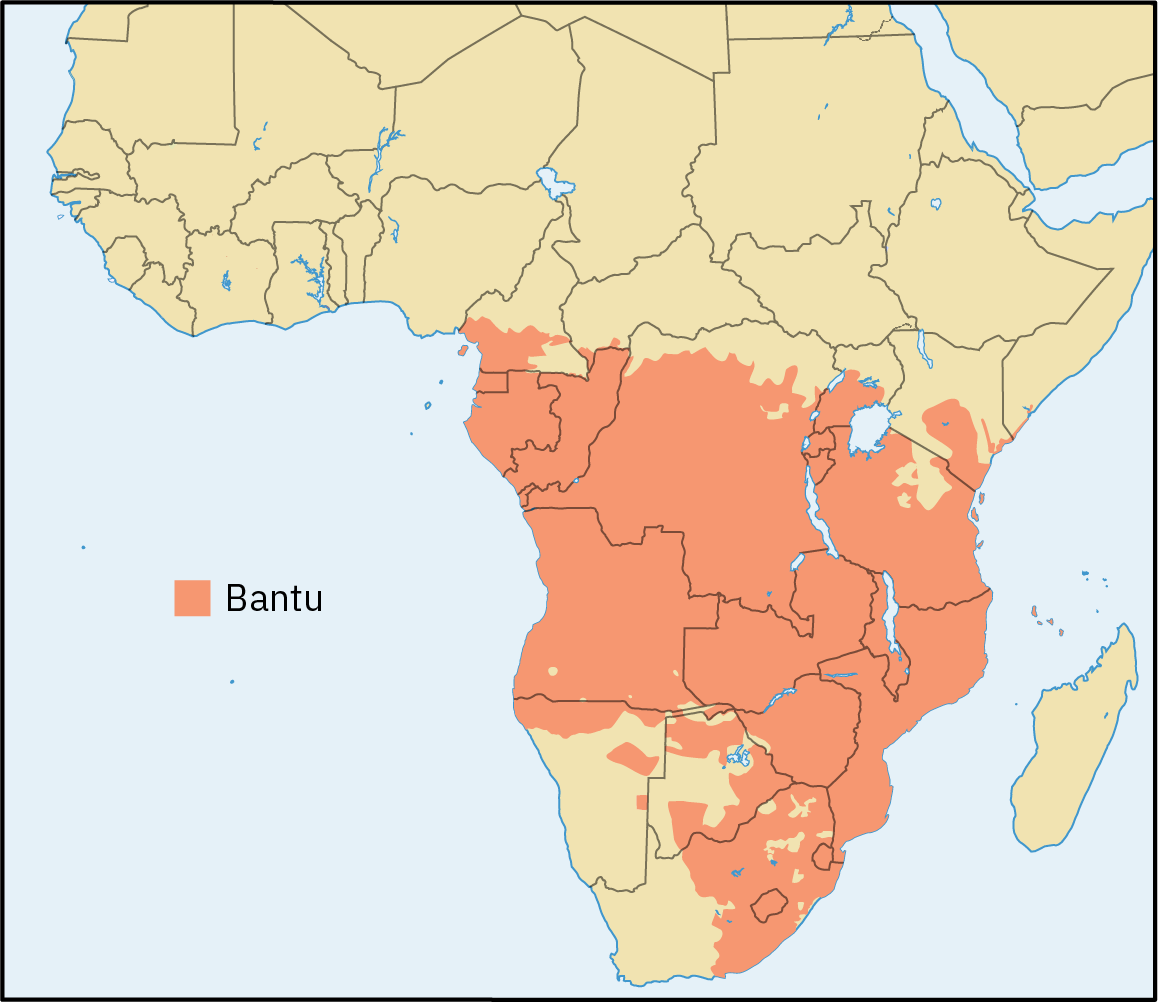
Figure 3.2 Approximate territory of Bantu peoples. Bantu is a blanket term for hundreds of different ethnic groups that speak what are referred to as Bantu languages and share many cultural features. (attribution: Copyright Rice University, OpenStax, under CC BY 4.0 license)
図3.2 バントゥー諸民族のおおよその居住域。バントゥーとは、いわゆるバントゥー諸語を話し、多くの文化的特徴を共有する数百の異なる民族集団をまとめた呼び名である。(帰属表示:Copyright Rice University, OpenStax, under CC BY 4.0 license)
It was not until 1945, when Belgian missionary Placide Tempels (1906–1977) published Bantu Philosophy, that the topic of African philosophy gained significant attention in the West. Tempels rejected the characterization of African philosophy and theology as consisting of magic, animism, and ancestor worship, instead exploring the richness of Bantu thought pertaining to individuals, society, and the divine. Tempels described Bantu peoples as believing in a “vital force,” the source of which is God. He observed that what Western thinkers envisioned as a divine being, the Bantu understood as various forces, including human forces, animal forces, and mineral forces. They viewed the universe as comprising all of these forces, and these forces could directly impact the “life force” of an individual (Okafor 1982, 84).
英語のヒント
アフリカの哲学という主題が西洋で大きな注目を集めるようになったのは、ベルギーの宣教師プラシド・タンペルス(1906〜1977年)が1945年に『バントゥー哲学』を刊行してからのことであった。タンペルスは、アフリカの哲学と神学を呪術、アニミズム、祖先崇拝から成るものとする捉え方を退け、個人、社会、神的なものに関するバントゥー思想の豊かさを探究した。タンペルスによれば、バントゥーの人々は、神を源泉とする「生命的な力」を信じていた。西洋の思想家が神的な存在として思い描くものを、バントゥーの人々は、人間の力、動物の力、鉱物の力など、さまざまな力として理解していると、彼は述べた。彼らは、宇宙はこれらすべての力から成り、それらの力は個人の「生命力」に直接影響しうると考えていた(Okafor 1982, 84)。
Later African scholars and theologians, such John Mbiti (1931–2019) and Alexis Kagame (1912–1981), indicated that Tempels was somewhat inventive in his descriptions and interpretations. They engaged in a more authentic study of Bantu philosophy, recording and analyzing African proverbs, stories, art, and music to illuminate what they presented as a shared worldview. One example of this shared worldview is the Zulu term ubuntu, which can be translated as “humanity.” Variations on the term appear in many other Bantu languages, all referring to a similar concept, expressed through maxims such as “I am because we are.” The concept of ubuntu holds that human beings have a deep natural interdependence, to the point that we are mutually dependent on one another even for our existence. The notion of ubuntu has inspired a uniquely African approach to communitarian philosophy, which refers to ideas about politics and society that privilege the community over the individual.
英語のヒント
その後、ジョン・ムビティ(1931〜2019年)やアレクシス・カガメ(1912〜1981年)など、アフリカの研究者や神学者は、タンペルスの記述と解釈には、やや創作的なところがあると指摘した。彼らは、アフリカのことわざ、物語、美術、音楽を記録・分析し、自分たちが共通の世界観として提示するものを明らかにすることで、バントゥー哲学をより忠実に研究した。こうした共通の世界観の一例が、「人間性」と訳せるズールー語のウブントゥである。同系の表現は他の多くのバントゥー諸語にも見られ、いずれも「私が存在するのは、私たちが存在するからだ」といった格言で表される、類似した概念を指している。ウブントゥの概念によれば、人間は生来、深く相互依存しており、自分が存在することすら互いに依存している。この観念は、共同体を個人より優先する政治・社会についての考え方、すなわち共同体主義の哲学に、アフリカ独自のアプローチをもたらした。
Nigerian philosopher Sophie Olúwọlé (1935–2018) was a practitioner and scholar of Yoruba philosophy. The Yoruba are a prominent ethnic group in Nigeria and other locations in sub-Saharan Africa. Among other accomplishments, Olúwọlé translated the Odu Ifá, the oral history concerning the pantheon and divination system of Ifá, the religion of the Yoruba peoples. Olúwọlé proposed that Ọ̀rúnmìlà, the high priest featured in the Odu Ifá, was a historical figure and the first Yoruba philosopher. She argued that Ọ̀rúnmìlà had an equal claim to that of Socrates as the founder of philosophy. In Socrates and Ọ̀rúnmìlà: Two Patron Saints of Classical Philosophy (2015), Olúwọlé compares the two philosophers and finds many similarities. Both are considered founders of philosophical traditions. Neither wrote anything down during their lifetimes. They both placed a primacy on the concepts of virtue and learning to live in keeping with virtue. Surprisingly, they shared cosmological views, such as a belief in reincarnation and predestination. Olúwọlé compiled quotes from each philosopher on specific topics, some of which are listed in Table 3.1. Olúwọlé argues that Yoruba ideas as conveyed through the Odu Ifá should be given full standing as a philosophy.
英語のヒント
ナイジェリアの哲学者ソフィー・オルウォレ(1935〜2018年)は、ヨルバの哲学の実践者であり研究者であった。ヨルバは、ナイジェリアやサハラ以南アフリカの他の地域に暮らす主要な民族集団である。オルウォレの業績の一つは、ヨルバの人々の宗教であるイファの神々と占いの体系についての口承史、『オドゥ・イファ』の翻訳である。オルウォレは、『オドゥ・イファ』に登場する高位の祭司オルンミラは実在の人物であり、最初のヨルバの哲学者だったと提唱した。彼女は、哲学の創始者という地位に対して、オルンミラにもソクラテスと同等の資格があると論じた。『ソクラテスとオルンミラ――古典哲学の二人の守護聖人』(2015年)で、オルウォレは二人を比較し、多くの類似点を見いだしている。どちらも哲学の伝統の創始者と考えられている。二人とも、生前に何も書き残さなかった。ともに徳という概念と、徳に従って生きることを学ぶことを重視した。驚くべきことに、輪廻転生や予定説への信念といった宇宙論的な見解も共有していた。オルウォレは、個別の主題についてそれぞれの哲学者の言葉を集めた。その一部を表3.1に示す。彼女は、『オドゥ・イファ』を通じて伝わるヨルバの思想には、哲学としての十全な地位が与えられるべきだと論じている。
Topic 主題 |
Socrates’s Quote ソクラテスの言葉 |
Ọ̀rúnmìlà’s Quote オルンミラの言葉 |
|---|---|---|
The nature of truth 真理の本性 |
“But the highest truth is that which is eternal and unchangeable.” 「しかし、最高の真理とは、永遠で変わることのないものである。」 |
“Truth is what the Great Invisible God uses in organizing the world. . . . Truth is the Word that can never be corrupted.” 「真理とは、偉大なる不可視の神が世界を秩序付ける際に用いるものである。……真理とは、決して損なわれることのない言葉である。」 |
The limits of human knowledge 人間の知識の限界 |
“And I am called wise for my hearers always imagine that I myself possess the wisdom which I find wanting in others. But the truth is, O men of Athens, that God only is wise. . . . And so I go about the world, obedient to the God.” 「そして私は賢いと呼ばれる。聞き手はいつも、私が他人に欠けていると指摘するその知恵を、私自身は持っていると思うからである。しかし、アテナイの人々よ、真実には、神だけが賢いのだ。……それゆえ私は、神に従って世を歩き回るのである。」 |
“When they turned to me and said: ‘Bàbá, we now accept that you are the only one who knows the end of everything,’ I retorted, ‘I myself do not know these things.’ For instruction on this matter, you have to go to God through divination, for He alone is the possessor of that sort of wisdom.” 「人々が私に向かって、『ババ、私たちはいま、万事の行く末を知っているのはあなただけだと認めます』と言ったとき、私は『私自身にも、そんなことはわからない』と答え返した。このことについて教えを得るには、占いを通じて神のもとへ行かなければならない。その種の知恵を持つのは、神おひとりだからである。」 |
Good and bad 善と悪 |
“And are not all things either good or evil, or intermediate and indifferent?” 「あらゆるものは、善か悪か、あるいはその中間の、どちらでもないものなのではないか。」 |
“Tribulation does not come without its good aspects. The positive and the negative constitute an inseparable pair.” 「苦難が、よい面を伴わずに訪れることはない。肯定的なものと否定的なものは、切り離せない一対を成す。」 |
Human nature 人間の本性 |
“No man voluntarily pursues evil, or that which he thinks to be evil. To prefer evil to good is not in human nature.” 「悪を、あるいは悪だと考えるものを、進んで追い求める人はいない。善よりも悪を好むことは、人間の本性にはない。」 |
“No one who knows that the result of honesty is always positive would choose wickedness when s/he is aware that it has a negative reward.” 「正直であることの結果が常によいものだと知っている人なら、悪事には悪い報いがあるとわかっていながら、悪事を選ぶことはない。」 |
Olúwọlé does identify one important distinction between the ideas of Socrates and Ọ̀rúnmìlà. Socrates held a binary metaphysical theory of matter and ideas, contrasting the unchanging eternal with the forms in which the eternal manifests itself in the physical world. By contrast, Ọ̀rúnmìlà taught that matter and ideas are inseparable. Similarly, while Socrates distinguished the concepts of good and bad, Ọ̀rúnmìlà held that they are “an inseparable pair” (Olúwọlé 2015, 64). The strict binary of the Greeks and of the West, Olúwọlé concludes, leads to an either-or perspective on truth and debate. The Yoruba, she contends, maintain a complementary dualist view of reality.
英語のヒント
オルウォレは、ソクラテスとオルンミラの思想の間に、一つの重要な違いがあることを確かに認めている。ソクラテスは、物質と観念を二つに分ける形而上学的理論を唱え、変わることのない永遠なるものと、その永遠なるものが物理的世界に現れる諸形態とを対比した。これに対してオルンミラは、物質と観念は切り離せないと教えた。同様に、ソクラテスは善と悪という概念を区別したが、オルンミラは、それらは「切り離せない一対」であるとした(Olúwọlé 2015, 64)。ギリシアや西洋の厳格な二分法は、真理や議論を「あれか、これか」で捉える見方につながる、とオルウォレは結論する。彼女によれば、ヨルバの人々は、現実について相補的な二元論的見方を保っている。
In the 1970s, Kenyan philosopher Henry Odera Oruka (1944–1995) launched a field study to record the philosophical thoughts of sages in modern-day Kenya. Researchers interviewed individual thinkers from various ethnic groups and questioned them about their views on central concepts in Western philosophy and issues related to applied ethics. Among other aims, this project was intended to demonstrate that philosophy is not an undertaking that is unique to the literate world. Odera Oruka’s findings were published in 1990, but no systematic attempt has been made to analyze them (Presbey 2017).
英語のヒント
1970年代、ケニアの哲学者ヘンリー・オデラ・オルカ(1944〜1995年)は、現代のケニアの賢者たちの哲学的思考を記録するため、現地調査を始めた。研究者たちは、さまざまな民族集団に属する個々の思想家に面接し、西洋哲学の中心的な概念や応用倫理学に関わる問題についての見解を尋ねた。この計画には、哲学は文字を使う世界だけに特有の営みではないことを示す、という目的もあった。オデラ・オルカの調査結果は1990年に刊行されたが、それらを分析する体系的な試みは行われていない(Presbey 2017)。
As these philosophers and their work demonstrate, African philosophy has emerged as a body of thought that stands on its own. The philosophy of African peoples, both those living on the African continent and those elsewhere in the world, is rooted in and developed out of concepts that both complement and challenge the Western tradition.
英語のヒント
これらの哲学者とその仕事が示すように、アフリカの哲学は、自立した思想の総体として姿を現してきた。アフリカ大陸に暮らす人々と世界の他の地域に暮らす人々の双方を含め、アフリカの人々の哲学は、西洋の伝統を補うと同時にそれに挑む概念に根ざし、そこから発展している。