第3章世界各地における哲学の起源The Early History of Philosophy around the World
Indigenous North American Philosophical Thought北アメリカ先住民の哲学的思考
Work on Native American philosophy has expanded in recent years, as philosophers, many of them Native American themselves, have engaged in collective research on Native American thought. This work has included the development of academic societies and journals devoted to the topic. Like many Indigenous African peoples, Native American peoples did not rely on written documents to preserve their history and culture but instead preserved knowledge through oral tradition. These oral traditions included rituals, ceremonies, songs, stories, and dance. What is known about Native American philosophy comes from this oral tradition as well as the experiences and thoughts of contemporary Native American people.
英語のヒント
近年、アメリカ先住民の哲学に関する研究が広がっている。哲学者たちが、アメリカ先住民の思想について共同研究を進めてきたためであり、その哲学者たちの多く自身もアメリカ先住民である。この取り組みには、この主題を専門とする学会や学術誌の創設も含まれる。多くのアフリカの先住民と同様、アメリカ先住民の人々は、歴史と文化の保存を文書に頼らず、口承の伝統を通じて知識を保存した。これらの口承の伝統には、儀礼、式典、歌、物語、踊りが含まれる。アメリカ先住民の哲学について知られていることは、この口承の伝統と、現代のアメリカ先住民の経験や思考から得られる。
Any attempt to define Indigenous North American philosophical thought is further complicated by the fact that thousands of distinct societies have existed on the continent, each with their own ideas about how the world was created, what are the basic elements of reality, what constitutes the self, and other metaphysical issues. There is a rich expanse of philosophical views to synthesize—and for every possible generalization, there are exceptions. Still, some generalizations of Indigenous North American philosophy are true more often than not. One such generalization is the perception that the creative process of the universe is akin to the thought process. Another is that more than one being is responsible for the creation of the universe—and that these beings do not take on anthropomorphic forms (Forbes 2001).
英語のヒント
北アメリカ先住民の哲学的思考を定義する試みは、この大陸に何千もの別個の社会が存在し、それぞれが、世界はどのように創られたか、現実の基本的要素とは何か、何が自己を構成するのかといった形而上学的問題について、独自の考えを持ってきたという事実によって、いっそう複雑になる。統合すべき哲学的な見解は豊かで広大であり、どのような一般化を試みても、例外がある。それでも、北アメリカ先住民の哲学について、多くの場合に当てはまる一般化はいくつかある。一つは、宇宙の創造過程は思考過程に似ているという見方である。もう一つは、宇宙の創造には複数の存在が関与し、それらの存在は人間の姿を取らないという見方である(Forbes 2001)。
Additionally, there are a number of characteristics common to Indigenous North American metaphysical concepts. Many Native American peoples, for example, emphasize balance, complementarity, and exchange between the different entities that make up the world. For instance, the Diné see breath as a fundamental force in nature, with the exchange of the internal and the external passing through all natural processes. Similarly, the Zuni note that twins, such as the twin Evening Star and the Morning Star—both of which are actually Venus – share a complementary and mirrored existence, serving as a reminder that there can be multiple manifestations of the same thing in nature. Additionally, concepts such as gender identity are understood as animated, nonbinary, and non-discrete, such that gender may develop and change over time (Waters 2004, 107). These generalizations point to a Native American metaphysics that is based on animate processes that are complementary, interactive, and integrated.
英語のヒント
さらに、北アメリカ先住民の形而上学的概念には、いくつかの共通する特徴がある。たとえば、多くのアメリカ先住民は、世界を構成する異なる存在の間の均衡、相補性、交換を重視する。ディネの人々は、呼吸を自然の根本的な力とみなし、内と外との交換が自然のあらゆる過程を貫いていると考える。同様に、ズニの人々は、宵の明星と明けの明星という双子――実際にはどちらも金星である――のような対になったものが、互いを補い鏡に映したような存在のあり方を共有すると指摘する。これは、自然には同じものの複数の現れがありうることを思い起こさせる。また、ジェンダー・アイデンティティのような概念は、生きて動き、二分的でなく、はっきり切り分けられないものとして理解される。そのためジェンダーは、時間とともに発展し変わりうる(Waters 2004, 107)。こうした一般化が指し示すのは、相補的で、相互に作用し、統合された、生きて動く過程に基づくアメリカ先住民の形而上学である。
North American Indigenous peoples also have views of the self that differ from the European tradition. The Pueblo possess a sense of personal and community identity shaped by both place and time. Known as a transformative model of identity, this social identity is understood to spiral both outward and inward through expanding and retracting influences over a certain area of land (Jojola 2004). Extant petroglyphic spirals show the migration of a clan outward to the boundaries of its physical and spiritual territory as well as the inward journey homeward. These journeys also reflect a temporal component, as they were coordinated with the cycles of the solstice calendar. Such metaphysical understandings are reflected in the tendency of many Native American cultures to build moral and ethical concepts on the idea that human beings are fundamentally social rather than individual—a “we,” not an “I.”
英語のヒント
北アメリカの先住民は、ヨーロッパの伝統とは異なる自己についての見方も持っている。プエブロの人々は、場所と時間の双方によって形作られる、個人および共同体のアイデンティティの感覚を持つ。「変容するアイデンティティのモデル」として知られるこの社会的アイデンティティは、一定の土地の範囲で影響が広がったり縮まったりすることを通じ、外向きにも内向きにも螺旋を描くものとして理解される(Jojola 2004)。現存する岩面刻画の螺旋は、氏族が自らの物理的・精神的領域の境界へと外向きに移動することと、故郷へと内向きに戻る旅の双方を示している。これらの旅は、夏至と冬至を基準とする暦の周期に合わせて行われたので、時間的な要素も反映している。こうした形而上学的な理解は、多くのアメリカ先住民の文化が、人間は根本的に個人的というより社会的な存在であり、「私」ではなく「私たち」であるという考えに、道徳や倫理の概念を基礎付ける傾向に表れている。
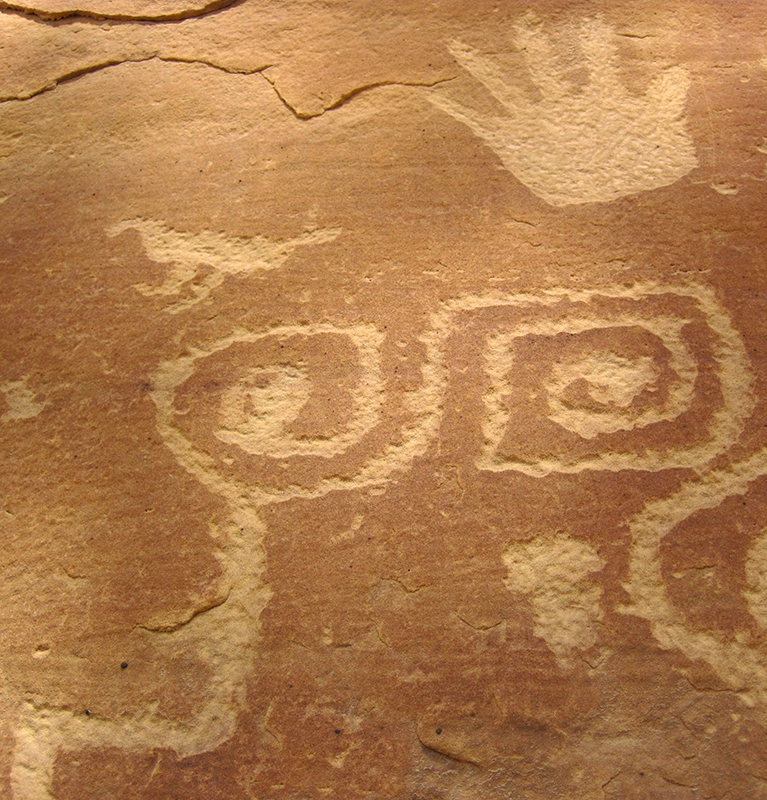
Figure 3.3 These petroglyphic spirals created by the Ancestral Pueblo represent both physical and spiritual journeys. The boxy spiral shown here likely represents the path that many Southwestern tribes believe they took when they emerged from the earth. Many contemporary scholars identify this with the geographic feature of the Grand Canyon. (credit: “Anasazi Indian Petroglyphs (~600 to 1300 A.D.) (Mesa Verde National Park, Colorado, USA) 1” by James St. John/Flickr, CC BY 2.0)
図3.3 プエブロの祖先が刻んだこの螺旋の岩面刻画は、物理的な旅と精神的な旅の双方を表している。ここに見られる角張った螺旋は、南西部の多くの部族が、自分たちが大地から現れたときに通ったと信じる道を表している可能性が高い。現代の研究者の多くは、これをグランドキャニオンという地形に対応するものとみなしている。(クレジット:「Anasazi Indian Petroglyphs (~600 to 1300 A.D.) (Mesa Verde National Park, Colorado, USA) 1」、James St. John/Flickr、CC BY 2.0)
Mesoamerican Philosophyメソアメリカの哲学
Mesoamerican peoples include an array of tribes and cultures, speaking multiple languages, that developed several sophisticated civilizations between 2000 BCE and the arrival of European colonialists in the 1500s CE. This area of the world developed both pictographic/hieroglyphic and alphabetic/phonetic forms of writing that allowed them to record thoughts and ideas, providing modern scholars access to some of the philosophical reflection that occurred within these societies. This section will examine some examples of the thought of Mesoamerican peoples by looking at the preserved writings of the Maya and the Aztec. Though the philosophical thought of each civilization is examined as if it were uniform, note that each encompassed many diverse tribes and cultures with a variety of languages, cultural practices, and religious beliefs.
英語のヒント
メソアメリカの人々には、多様な部族と文化が含まれる。彼らは複数の言語を話し、紀元前2000年から紀元後1500年代にヨーロッパの植民者が到来するまでの間に、いくつもの高度な文明を発展させた。この地域では、絵や象形記号を用いる文字と、アルファベットなど音を表す文字の両方が発達した。それらによって思考や考えを記録できたため、現代の研究者は、これらの社会の内部で行われた哲学的省察の一部を知ることができる。この節では、マヤとアステカが残した文書を取り上げ、メソアメリカの人々の思考の例を検討する。それぞれの文明の哲学的思考を、あたかも均一なもののように扱うが、いずれの文明も、さまざまな言語、文化的実践、宗教的信念を持つ、多様な部族と文化を含んでいたことに注意しよう。
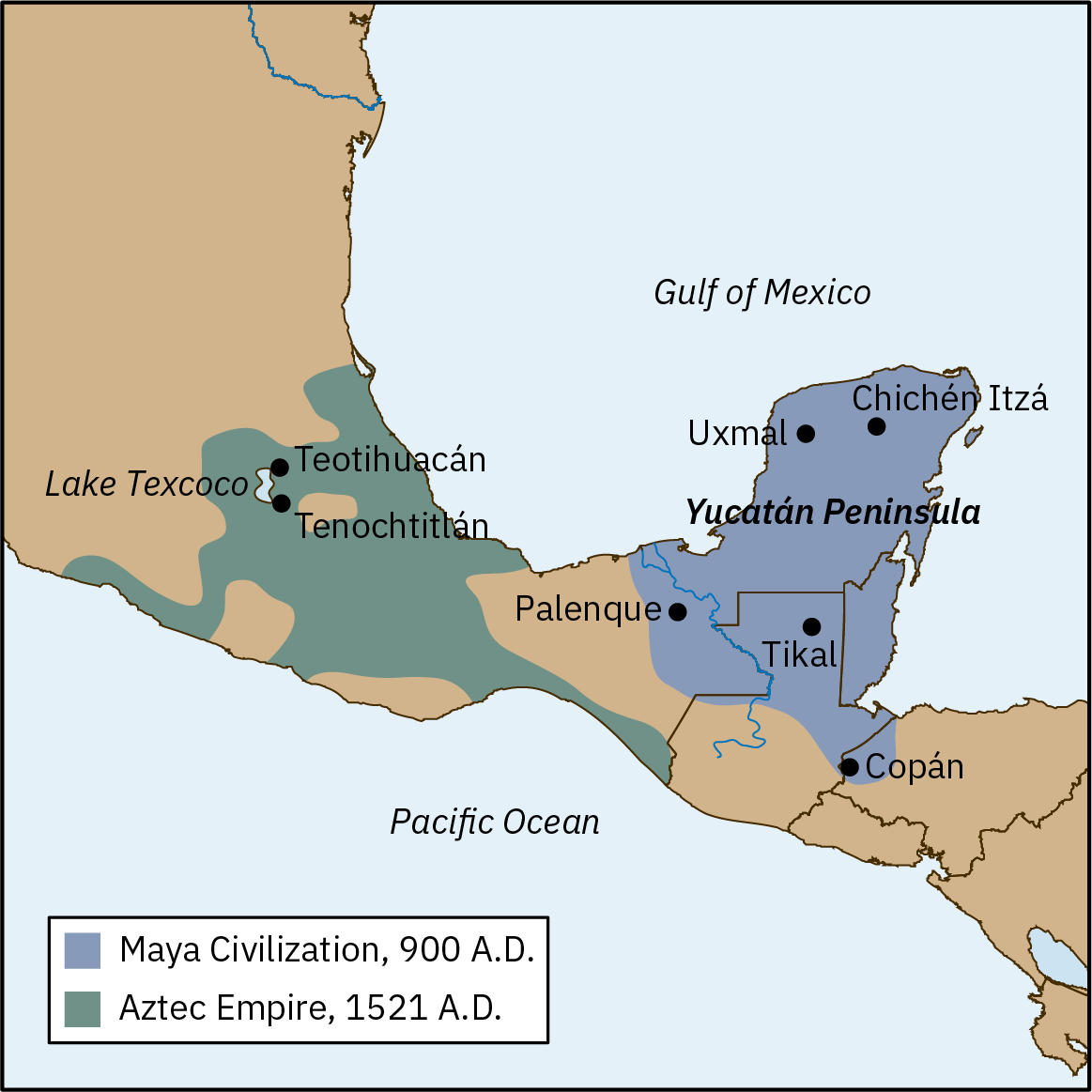
Figure 3.4 The Maya and Aztec were powerful civilizations for centuries. The existence of written records from each of these peoples has given contemporary scholars access to their philosophy, spirituality, and scientific advances. (attribution: Copyright Rice University, OpenStax, under CC BY 4.0 license)
図3.4 マヤとアステカは、何世紀にもわたって強力な文明であった。それぞれの人々が残した文書記録があるため、現代の研究者は、彼らの哲学、精神的な営み、科学の進歩を知ることができる。(帰属表示:Copyright Rice University, OpenStax, under CC BY 4.0 license)
Mayan Writingsマヤの文書
The Maya first settled in villages in the area that runs from southern Mexico through Guatemala and northern Belize around 1500 BCE. Between 750 and 500 BCE, large city-states arose and established a trading network. At the height of their civilization, between approximately 250 CE and 900 CE, the Maya possessed a written language that appears to have been a combination of an alphabetic/phonetic language and a pictographic/hieroglyphic language, used not only by the priesthood but also by the urban elite. This writing appears on stone slabs, pottery, and sculptures as well as in books called codices (plural of codex), written on a paper made from tree bark.
英語のヒント
マヤの人々が最初に村落へ定住したのは紀元前1500年ごろで、場所はメキシコ南部からグアテマラ、ベリーズ北部にかけての地域であった。紀元前750〜500年には、大きな都市国家が出現し、交易網を築いた。文明が最盛期を迎えた、およそ紀元後250〜900年のマヤには、アルファベットのように音を表す文字と、絵や象形記号を用いる文字を組み合わせたと思われる書記言語があった。これを使ったのは祭司階級だけでなく、都市の上層階級でもあった。この文字は、石板、土器、彫刻のほか、樹皮から作った紙に記した「コデックス」(複数形はコディシーズ)と呼ばれる書物にも見られる。
The Maya possessed advanced knowledge of mathematics and natural philosophy. However, following the Spanish conquest of this territory, Catholic priests burned almost all of the Maya codices as well as their scientific and technical manuals (Yucatan Times 2019). In the years that followed the conquest, the Maya lost their written language. However, some writings in clay did survive, providing scholars a glimpse into Maya thought. They implemented a numerical system using symbols that allowed for representation of very large numbers, and they may have been the first to use the number 0 in mathematics. This numerical system enabled the Maya to gain insights into arithmetic and geometry that surpassed those of the Egyptians. Their knowledge of astronomy was so advanced that they could correctly predict the timing of solar eclipses. Unlike other early civilizations, the Maya had a highly sophisticated calendar and a unique conception of time.
英語のヒント
マヤの人々は、数学と自然哲学について高度な知識を持っていた。しかし、スペインがこの地域を征服した後、カトリックの司祭たちは、マヤの書物のほぼすべてを、科学や技術の手引書とともに焼却した(Yucatan Times 2019)。征服後の年月の中で、マヤの人々は自らの書記言語を失った。それでも、粘土に記された文字の一部は生き残り、研究者がマヤの思想を垣間見る手掛かりとなっている。マヤは、非常に大きな数を表せる記号を用いた数体系を実用化しており、数学で0を最初に使った人々であった可能性もある。この数体系によって、マヤは算術や幾何学について、エジプト人を上回る理解に達することができた。天文学の知識は非常に進んでおり、日食の時期を正しく予測できた。初期の他の文明とは異なり、マヤは高度に発達した暦と、独自の時間概念を持っていた。
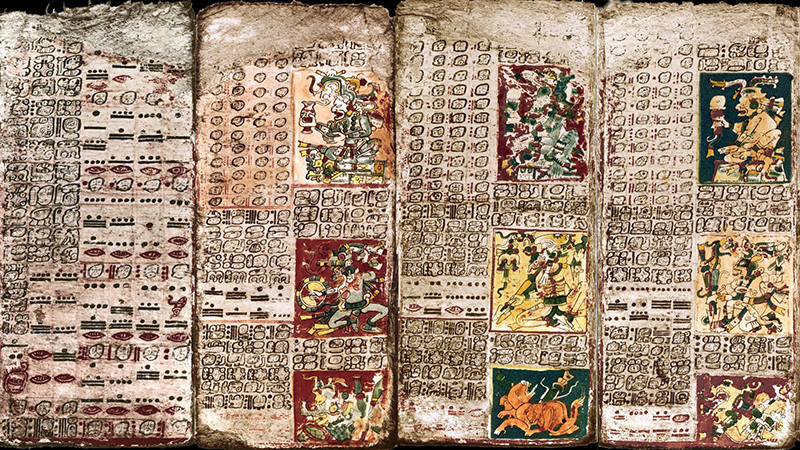
Figure 3.5 This piece of Mayan writing, known as the Dresden Codex because it was found in the city of Dresden, Germany, in the 1700s, is one of the oldest known examples of writing from the Americas. It has been dated to the 11th or 12th century. (credit: “Dresden Codex” by Chris Protopapas/Flickr, Public Domain)
図3.5 このマヤの文書は、1700年代にドイツのドレスデンで発見されたため「ドレスデン絵文書」と呼ばれ、南北アメリカにおける現存最古級の文字資料の一つである。11世紀または12世紀のものとされる。(クレジット:「Dresden Codex」、Chris Protopapas/Flickr、パブリックドメイン)