第2章心理学の研究
Independent and Dependent Variables独立変数と従属変数
In a research experiment, we strive to study whether changes in one thing cause changes in another. To achieve this, we must pay attention to two important variables, or things that can be changed, in any experimental study: the independent variable and the dependent variable. An independent variable is manipulated or controlled by the experimenter. In a well-designed experimental study, the independent variable is the only important difference between the experimental and control groups. In our example of how technology use in the classroom affects learning, the independent variable is the type of learning by participants in the study (Figure 2.17). A dependent variable is what the researcher measures to see how much effect the independent variable had. In our example, the dependent variable is the learning exhibited by our participants.
英語のヒント
研究のための実験では、ある事柄の変化が別の事柄の変化を引き起こすかどうかを調べようと努める。そのためには、どんな実験研究においても、二つの重要な変数、つまり変化しうるものに注意を払わなければならない。独立変数と従属変数である。独立変数は、実験者によって操作され、あるいは統制される。よく計画された実験研究では、独立変数が、実験群と統制群のあいだの唯一の重要な違いである。教室でのテクノロジーの使用が学習にどう影響するかという私たちの例では、独立変数は、研究の参加者による学習の種類である(図2.17)。従属変数とは、独立変数がどれだけの効果を持ったかを見るために研究者が測定するものである。私たちの例では、従属変数は参加者が示した学習である。
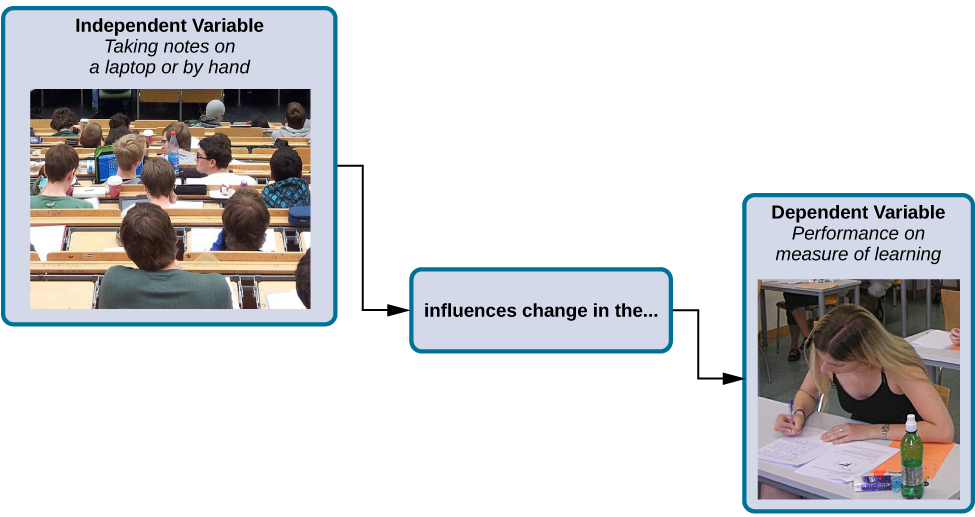
OpenStax, Rice University; Psychology 2e. (credit: “classroom” modification of work by Nikolay Georgiev/Pixabay; credit “note taking”: modification of work by KF/Wikimedia) · CC BY 4.0 · Source出典

Figure 2.17図 2.17
In an experiment, manipulations of the independent variable are expected to result in changes in the dependent variable. (credit: “classroom” modification of work by Nikolay Georgiev/Pixabay; credit “note taking”: modification of work by KF/Wikimedia)
実験では、独立変数を操作することで、従属変数に変化が生じると予想される。(出典「教室」:Nikolay Georgiev/Pixabayの作品を改変、出典「ノートを取る」:KF/Wikimediaの作品を改変)
We expect that the dependent variable will change as a function of the independent variable. In other words, the dependent variable depends on the independent variable. A good way to think about the relationship between the independent and dependent variables is with this question: What effect does the independent variable have on the dependent variable? Returning to our example, what is the effect of being taught a lesson through a computer program versus through an in-person instructor?
英語のヒント
従属変数は、独立変数に応じて変化すると予想される。言い換えれば、従属変数は独立変数に依存する。独立変数と従属変数の関係を考えるよい方法は、次の問いを立てることである。独立変数は従属変数にどのような効果を与えるのか。私たちの例に戻れば、コンピューター・プログラムを通して授業を教わることには、対面の講師から教わることと比べて、どのような効果があるのだろうか。
Selecting and Assigning Experimental Participants実験参加者を選び、割り当てる
Now that our study is designed, we need to obtain a sample of individuals to include in our experiment. Our study involves human participants so we need to determine whom to include. Participants are the subjects of psychological research, and as the name implies, individuals who are involved in psychological research actively participate in the process. Often, psychological research projects rely on college students to serve as participants. In fact, the vast majority of research in psychology subfields has historically involved students as research participants (Sears, 1986; Arnett, 2008). But are college students truly representative of the general population? College students tend to be younger, more educated, more liberal, and less diverse than the general population. Although using students as test subjects is an accepted practice, relying on such a limited pool of research participants can be problematic because it is difficult to generalize findings to the larger population.
英語のヒント
研究が計画できたので、次は実験に含める人々の標本を手に入れる必要がある。私たちの研究は人間の参加者を対象とするので、誰を含めるかを決めなければならない。参加者とは心理学研究の対象者であり、その名が示すとおり、心理学研究にかかわる人々は、その過程に能動的に参加する。心理学の研究プロジェクトは、大学生に参加者になってもらうことが多い。実際、心理学の下位分野の研究の大多数は、これまで学生を研究参加者としてきた(Sears, 1986; Arnett, 2008)。しかし、大学生は本当に一般の人々を代表しているのだろうか。大学生は一般の人々よりも、若く、教育程度が高く、リベラルで、多様性に乏しい傾向がある。学生を研究の対象者として用いることは受け入れられている慣行だが、これほど限られた研究参加者の集団に頼ることには問題がありうる。研究結果をより大きな母集団へ一般化するのが難しいからである。
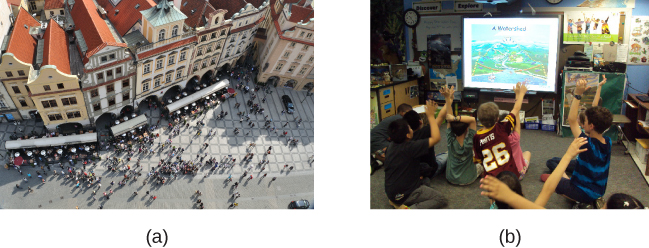
Our hypothetical experiment involves high school students, and we must first generate a sample of students. Samples are used because populations are usually too large to reasonably involve every member in our particular experiment (Figure 2.18). If possible, we should use a random sample (there are other types of samples, but for the purposes of this chapter, we will focus on random samples). A random sample is a subset of a larger population in which every member of the population has an equal chance of being selected. Random samples are preferred because if the sample is large enough we can be reasonably sure that the participating individuals are representative of the larger population. This means that the percentages of characteristics in the sample—sex, ethnicity, socioeconomic level, and any other characteristics that might affect the results—are close to those percentages in the larger population.
英語のヒント
私たちの仮想の実験は高校生を対象としており、まず生徒の標本をつくらなければならない。標本が用いられるのは、母集団がふつう大きすぎて、その全員を特定の実験に参加させるのは現実的でないからである(図2.18)。可能であれば、無作為標本を用いるべきである(標本にはほかの種類もあるが、この章では無作為標本に焦点を当てる)。無作為標本とは、より大きな母集団の部分集合であって、母集団のどの成員も選ばれる確率が等しいものをいう。無作為標本が好まれるのは、標本が十分に大きければ、参加する人々がより大きな母集団を代表していると、かなりの程度確信できるからである。これは、標本における特性の割合、つまり性別、民族、社会経済的な水準、そのほか結果に影響しうるあらゆる特性の割合が、より大きな母集団におけるそれらの割合に近いということを意味する。
In our example, let’s say we decide our population of interest is algebra students. But all algebra students is a very large population, so we need to be more specific; instead we might say our population of interest is all algebra students in a particular city. We should include students from various income brackets, family situations, races, ethnicities, religions, and geographic areas of town. With this more manageable population, we can work with the local schools in selecting a random sample of around 200 algebra students who we want to participate in our experiment.
英語のヒント
私たちの例で、関心のある母集団を代数を学ぶ生徒に決めたとしよう。しかし、代数を学ぶ生徒全員というのは非常に大きな母集団なので、もっと絞り込む必要がある。そこで代わりに、関心のある母集団を、ある特定の都市で代数を学ぶすべての生徒としてもよい。さまざまな所得層、家庭環境、人種、民族、宗教、そして町のさまざまな地域の生徒を含めるべきである。このように扱いやすくなった母集団であれば、地元の学校と協力して、実験に参加してほしい約200人の代数の生徒からなる無作為標本を選ぶことができる。
In summary, because we cannot test all of the algebra students in a city, we want to find a group of about 200 that reflects the composition of that city. With a representative group, we can generalize our findings to the larger population without fear of our sample being biased in some way.
英語のヒント
まとめると、ある都市で代数を学ぶ生徒全員をテストすることはできないので、その都市の構成を反映した約200人の集団を見つけたいのである。代表性のある集団であれば、標本が何らかの形で偏っているのではないかと心配することなく、研究結果をより大きな母集団へ一般化できる。
OpenStax, Rice University; Psychology 2e. (credit “crowd”: modification of work by James Cridland; credit “students”: modification of work by Laurie Sullivan) · CC BY 4.0 · Source出典

Figure 2.18図 2.18
Researchers may work with (a) a large population or (b) a sample group that is a subset of the larger population. (credit “crowd”: modification of work by James Cridland; credit “students”: modification of work by Laurie Sullivan)
研究者は、(a)大きな母集団を扱うこともあれば、(b)より大きな母集団の部分集合である標本の集団を扱うこともある。(出典「群衆」:James Cridlandの作品を改変、出典「生徒」:Laurie Sullivanの作品を改変)
Now that we have a sample, the next step of the experimental process is to split the participants into experimental and control groups through random assignment. With random assignment, all participants have an equal chance of being assigned to either group. There is statistical software that will randomly assign each of the algebra students in the sample to either the experimental or the control group.
英語のヒント
標本が得られたので、実験過程の次の段階は、無作為割り当てによって参加者を実験群と統制群に分けることである。無作為割り当てでは、すべての参加者が、どちらの群にも等しい確率で割り当てられる。標本に含まれる代数の生徒一人ひとりを、実験群か統制群のどちらかに無作為に割り当ててくれる統計ソフトウェアもある。
Random assignment is critical for sound experimental design. With sufficiently large samples, random assignment makes it unlikely that there are systematic differences between the groups. So, for instance, it would be very unlikely that we would get one group composed entirely of males, a given ethnic identity, or a given religious ideology. This is important because if the groups were systematically different before the experiment began, we would not know the origin of any differences we find between the groups: Were the differences preexisting, or were they caused by manipulation of the independent variable? Random assignment allows us to assume that any differences observed between experimental and control groups result from the manipulation of the independent variable.
英語のヒント
無作為割り当ては、しっかりした実験計画に欠かせない。標本が十分に大きければ、無作為割り当てによって、群のあいだに系統的な違いが生じる可能性は低くなる。そのため、たとえば、一方の群が男性だけ、特定の民族的アイデンティティの人だけ、あるいは特定の宗教的イデオロギーを持つ人だけで構成される、といったことはまず起こらない。これが重要なのは、もし実験を始める前から群どうしが系統的に異なっていたら、群のあいだに見つかった違いがどこから来たのかが分からなくなるからである。その違いはもともと存在していたのか、それとも独立変数の操作によって引き起こされたのか。無作為割り当てによって、実験群と統制群のあいだに観察された違いは、どんなものであれ独立変数の操作から生じたものだと想定できるようになる。