第2章心理学の研究
Surveys調査
Often, psychologists develop surveys as a means of gathering data. Surveys are lists of questions to be answered by research participants, and can be delivered as paper-and-pencil questionnaires, administered electronically, or conducted verbally (Figure 2.9). Generally, the survey itself can be completed in a short time, and the ease of administering a survey makes it easy to collect data from a large number of people.
英語のヒント
心理学者は、データを集める手段として調査を作成することが多い。調査とは、研究参加者に答えてもらう質問を並べたものであり、紙と鉛筆で答える質問紙として配布することも、電子的に実施することも、口頭で行うこともできる(図2.9)。一般に、調査そのものは短時間で終えることができ、実施が容易なので、多くの人からデータを集めやすい。
Surveys allow researchers to gather data from larger samples than may be afforded by other research methods. A sample is a subset of individuals selected from a population, which is the overall group of individuals that the researchers are interested in. Researchers study the sample and seek to generalize their findings to the population. Generally, researchers will begin this process by calculating various measures of central tendency from the data they have collected. These measures provide an overall summary of what a typical response looks like. There are three measures of central tendency: mode, median, and mean. The mode is the most frequently occurring response, the median lies at the middle of a given data set, and the mean is the arithmetic average of all data points. Means tend to be most useful in conducting additional analyses like those described below; however, means are very sensitive to the effects of outliers, and so one must be aware of those effects when making assessments of what measures of central tendency tell us about a data set in question.
英語のヒント
調査を使うと、研究者は、ほかの研究方法で得られるよりも大きな標本からデータを集められる。標本とは、母集団から選ばれた個人の部分集合である。母集団とは、研究者が関心を持っている個人の集団全体のことである。研究者は標本を研究し、その結果を母集団へ一般化しようとする。一般に研究者は、この過程を、集めたデータからさまざまな中心傾向の指標を計算することから始める。これらの指標は、典型的な回答がどのようなものかを全体として要約してくれる。中心傾向の指標には、最頻値、中央値、平均値の三つがある。最頻値は最も頻繁に現れる回答、中央値はあるデータセットの真ん中に位置する値、平均値はすべてのデータ点の算術平均である。平均値は、以下で述べるような追加の分析を行う際に最も役立つことが多い。しかし、平均値は外れ値の影響を非常に受けやすい。そのため、問題となっているデータセットについて中心傾向の指標から何が分かるのかを判断する際には、その影響に注意しなければならない。
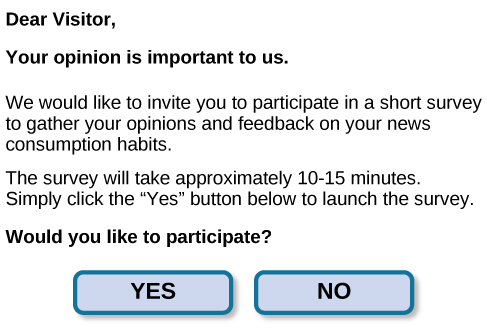

Figure 2.9図 2.9
Surveys can be administered in a number of ways, including electronically administered research, like the survey shown here. (credit: Robert Nyman)
調査はさまざまな方法で実施できる。ここに示した調査のように、電子的に実施する研究もその一つである。(出典:Robert Nyman)
There is both strength and weakness of the survey in comparison to case studies. By using surveys, we can collect information from a larger sample of people. A larger sample is better able to reflect the actual diversity of the population, thus allowing better generalizability. Therefore, if our sample is sufficiently large and diverse, we can assume that the data we collect from the survey can be generalized to the larger population with more certainty than the information collected through a case study. However, given the greater number of people involved, we are not able to collect the same depth of information on each person that would be collected in a case study.
英語のヒント
事例研究と比べると、調査には長所と短所の両方がある。調査によって、より大きな標本の人々から情報を集められる。標本が大きいほど、母集団の実際の多様性をよりよく反映でき、そのため一般化可能性が高まる。したがって、標本が十分に大きく多様であれば、調査で集めたデータは、事例研究で集めた情報よりも確かな形で、より大きな母集団に一般化できると考えてよい。しかし、関わる人数が多い分、事例研究でなら集められるのと同じ深さの情報を、一人ひとりについて集めることはできない。
Another potential weakness of surveys is something we touched on earlier in this chapter: People don't always give accurate responses. They may lie, misremember, or answer questions in a way that they think makes them look good. For example, people may report drinking less alcohol than is actually the case.
英語のヒント
調査のもう一つの潜在的な弱点は、この章の前の方で触れたことである。人はいつも正確に答えるとは限らない。うそをついたり、記憶違いをしたり、自分がよく見えると思う形で質問に答えたりすることがある。たとえば、実際よりも少ない飲酒量を報告することがある。
Any number of research questions can be answered through the use of surveys. One real-world example is the research conducted by Jenkins, Ruppel, Kizer, Yehl, and Griffin (2012) about the backlash against the US Arab-American community following the terrorist attacks of September 11, 2001. Jenkins and colleagues wanted to determine to what extent these negative attitudes toward Arab-Americans still existed nearly a decade after the attacks occurred. In one study, 140 research participants filled out a survey with 10 questions, including questions asking directly about the participant’s overt prejudicial attitudes toward people of various ethnicities. The survey also asked indirect questions about how likely the participant would be to interact with a person of a given ethnicity in a variety of settings (such as, “How likely do you think it is that you would introduce yourself to a person of Arab-American descent?”). The results of the research suggested that participants were unwilling to report prejudicial attitudes toward any ethnic group. However, there were significant differences between their pattern of responses to questions about social interaction with Arab-Americans compared to other ethnic groups: they indicated less willingness for social interaction with Arab-Americans compared to the other ethnic groups. This suggested that the participants harbored subtle forms of prejudice against Arab-Americans, despite their assertions that this was not the case (Jenkins et al., 2012).
英語のヒント
調査を用いれば、実にさまざまな研究課題に答えられる。現実世界の一例として、ジェンキンス、ルッペル、カイザー、イェール、グリフィン(2012)が行った、2001年9月11日のテロ攻撃のあとにアメリカのアラブ系アメリカ人コミュニティへ向けられた反発についての研究がある。ジェンキンスらは、アラブ系アメリカ人に対するこうした否定的な態度が、テロから10年近くたってもどの程度残っているのかを明らかにしようとした。ある研究では、140人の研究参加者が10問から成る調査に回答した。その中には、さまざまな民族の人々に対する参加者のあからさまな偏見的態度を直接たずねる質問が含まれていた。この調査ではまた、さまざまな場面で、ある民族の人と関わる可能性がどのくらいあるかを間接的にたずねる質問もした(たとえば「アラブ系アメリカ人の家系の人に、自分から自己紹介する可能性はどのくらいあると思いますか」)。研究の結果からは、参加者がどの民族集団に対しても偏見的態度を報告しようとしなかったことがうかがえた。しかし、アラブ系アメリカ人との社会的な関わりについての質問への回答パターンは、ほかの民族集団についての回答と比べて有意に異なっていた。参加者は、ほかの民族集団と比べて、アラブ系アメリカ人と社会的に関わることに消極的な姿勢を示したのである。このことから、参加者は、そうではないと主張しながらも、アラブ系アメリカ人に対してかすかな形の偏見を抱いていたことが示唆された(Jenkins et al., 2012)。
Archival Researchアーカイブ研究
Some researchers gain access to large amounts of data without interacting with a single research participant. Instead, they use existing records to answer various research questions. This type of research approach is known as archival research. Archival research relies on looking at past records or data sets to look for interesting patterns or relationships.
英語のヒント
研究参加者と一人も関わることなく、大量のデータを手に入れる研究者もいる。彼らは代わりに、既存の記録を使ってさまざまな研究課題に答える。この種の研究アプローチはアーカイブ研究として知られる。アーカイブ研究は、過去の記録やデータセットを調べて、興味深いパターンや関係を探すことに頼る。
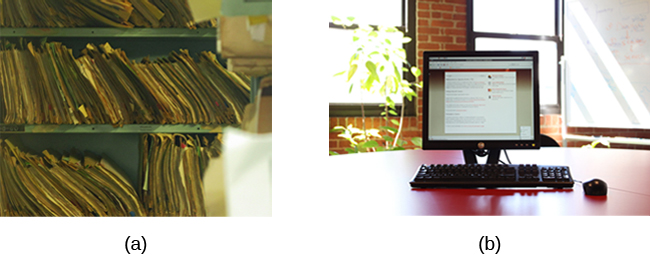
For example, a researcher might access the academic records of all individuals who enrolled in college within the past ten years and calculate how long it took them to complete their degrees, as well as course loads, grades, and extracurricular involvement. Archival research could provide important information about who is most likely to complete their education, and it could help identify important risk factors for struggling students (Figure 2.10).
英語のヒント
たとえば、研究者が、過去10年以内に大学に入学したすべての人の学業記録にアクセスし、学位の取得までにかかった期間や、履修量、成績、課外活動への参加状況を算出することが考えられる。アーカイブ研究は、誰が最も教育を修了しやすいかについて重要な情報をもたらしうるし、苦労している学生にとっての重要な危険因子を特定する助けにもなりうる(図2.10)。
OpenStax, Rice University; Psychology 2e. (credit “paper files”: modification of work by “Newtown graffiti”/Flickr; “computer”: modification of work by INPIVIC Family/Flickr) · CC BY 4.0 · Source出典

Figure 2.10図 2.10
A researcher doing archival research examines records, whether archived as a (a) hardcopy or (b) electronically. (credit “paper files”: modification of work by “Newtown graffiti”/Flickr; “computer”: modification of work by INPIVIC Family/Flickr)
アーカイブ研究を行う研究者は、(a)紙の形で保存されたものであれ、(b)電子的に保存されたものであれ、記録を調べる。(出典「紙のファイル」:“Newtown graffiti”/Flickrの作品を改変、出典「コンピューター」:INPIVIC Family/Flickrの作品を改変)
In comparing archival research to other research methods, there are several important distinctions. For one, the researcher employing archival research never directly interacts with research participants. Therefore, the investment of time and money to collect data is considerably less with archival research. Additionally, researchers have no control over what information was originally collected. Therefore, research questions have to be tailored so they can be answered within the structure of the existing data sets. There is also no guarantee of consistency between the records from one source to another, which might make comparing and contrasting different data sets problematic.
英語のヒント
アーカイブ研究をほかの研究方法と比べると、いくつか重要な違いがある。一つには、アーカイブ研究を用いる研究者は、研究参加者と直接関わることがない。そのため、データを集めるのに費やす時間と費用は、アーカイブ研究の方がかなり少ない。また研究者は、もともとどのような情報が集められたかをまったく制御できない。そのため、研究課題は、既存のデータセットの構造の中で答えられるように調整しなければならない。さらに、情報源ごとの記録のあいだに一貫性がある保証もなく、そのせいで、異なるデータセットを比較・対照するのが難しくなるおそれがある。