第2章心理学の研究
Naturalistic Observation自然観察
If you want to understand how behavior occurs, one of the best ways to gain information is to simply observe the behavior in its natural context. However, people might change their behavior in unexpected ways if they know they are being observed. How do researchers obtain accurate information when people tend to hide their natural behavior? As an example, imagine that your professor asks everyone in your class to raise their hand if they always wash their hands after using the restroom. Chances are that almost everyone in the classroom will raise their hand, but do you think hand washing after every trip to the restroom is really that universal?
英語のヒント
行動がどのように生じるのかを理解したいなら、情報を得る最良の方法の一つは、その行動を自然な文脈の中でただ観察することである。しかし、人は観察されていると知ると、予想外の形で行動を変えるかもしれない。人が自然な行動を隠しがちなとき、研究者はどうやって正確な情報を得るのだろうか。たとえば、教授がクラスの全員に、トイレを使ったあと必ず手を洗う人は手を挙げるように言ったと想像してみよう。おそらく教室のほぼ全員が手を挙げるだろう。しかし、トイレに行くたびに手を洗うことが、本当にそれほど誰にでも当てはまると思うだろうか。
This is very similar to the phenomenon mentioned earlier in this chapter: many individuals do not feel comfortable answering a question honestly. But if we are committed to finding out the facts about hand washing, we have other options available to us.
英語のヒント
これは、この章の前の方で触れた現象とよく似ている。多くの人は、質問に正直に答えることに居心地の悪さを感じるのである。しかし、手洗いについての事実を本気で突き止めようとするなら、私たちが使える選択肢はほかにもある。
Suppose we send a classmate into the restroom to actually watch whether everyone washes their hands after using the restroom. Will our observer blend into the restroom environment by wearing a white lab coat, sitting with a clipboard, and staring at the sinks? We want our researcher to be inconspicuous—perhaps standing at one of the sinks pretending to put in contact lenses while secretly recording the relevant information. This type of observational study is called naturalistic observation: observing behavior in its natural setting. To better understand peer exclusion, Suzanne Fanger collaborated with colleagues at the University of Texas to observe the behavior of preschool children on a playground. How did the observers remain inconspicuous over the duration of the study? They equipped a few of the children with wireless microphones (which the children quickly forgot about) and observed while taking notes from a distance. Also, the children in that particular preschool (a “laboratory preschool”) were accustomed to having observers on the playground (Fanger, Frankel, & Hazen, 2012).
英語のヒント
クラスメートを一人トイレに送り込み、全員がトイレを使ったあとに手を洗うかどうかを実際に見てもらうとしよう。白衣を着て、クリップボードを持って座り、洗面台をじっと見つめていたら、この観察者はトイレの環境に溶け込めるだろうか。私たちは、この研究者に目立たないでいてほしい。たとえば、洗面台の一つの前に立ってコンタクトレンズを入れるふりをしながら、関係する情報をひそかに記録する、といった具合である。この種の観察研究は自然観察と呼ばれる。自然観察とは、行動をその自然な状況の中で観察することである。スザンヌ・ファンガーは、仲間はずれについての理解を深めるために、テキサス大学の同僚と協力して、遊び場での就学前の子どもたちの行動を観察した。観察者たちは、研究期間を通じてどのようにして目立たないままでいたのだろうか。彼らは数人の子どもにワイヤレスマイクを付け(子どもたちはすぐにその存在を忘れた)、離れた場所からメモを取りながら観察した。また、その幼稚園(「実験幼稚園」)の子どもたちは、遊び場に観察者がいることに慣れていた(Fanger, Frankel, & Hazen, 2012)。
It is critical that the observer be as unobtrusive and as inconspicuous as possible: when people know they are being watched, they are less likely to behave naturally. If you have any doubt about this, ask yourself how your driving behavior might differ in two situations: In the first situation, you are driving down a deserted highway during the middle of the day; in the second situation, you are being followed by a police car down the same deserted highway (Figure 2.7).
英語のヒント
観察者ができるかぎり邪魔にならず、目立たないようにすることが決定的に重要である。人は見られていると知ると、自然にふるまう可能性が低くなるからだ。これを疑うなら、二つの状況で自分の運転のしかたがどう違うかを自問してみるとよい。一つ目の状況では、あなたは真昼に人けのない幹線道路を走っている。二つ目の状況では、同じ人けのない幹線道路で、パトカーに後ろからついて来られている(図2.7)。


Figure 2.7図 2.7
Seeing a police car behind you would probably affect your driving behavior. (credit: Michael Gil)
後ろにパトカーが見えれば、おそらく運転のしかたに影響が出るだろう。(出典:Michael Gil)
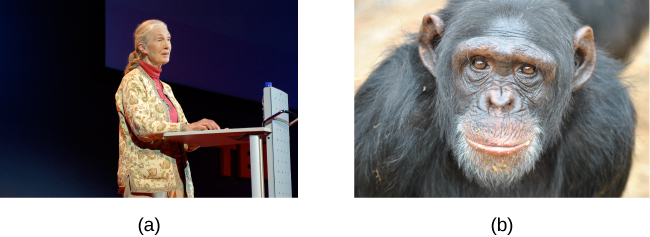
It should be pointed out that naturalistic observation is not limited to research involving humans. Indeed, some of the best-known examples of naturalistic observation involve researchers going into the field to observe various kinds of animals in their own environments. As with human studies, the researchers maintain their distance and avoid interfering with the animal subjects so as not to influence their natural behaviors. Scientists have used this technique to study social hierarchies and interactions among animals ranging from ground squirrels to gorillas. The information provided by these studies is invaluable in understanding how those animals organize socially and communicate with one another. The anthropologist Jane Goodall, for example, spent nearly five decades observing the behavior of chimpanzees in Africa (Figure 2.8). As an illustration of the types of concerns that a researcher might encounter in naturalistic observation, some scientists criticized Goodall for giving the chimps names instead of referring to them by numbers—using names was thought to undermine the emotional detachment required for the objectivity of the study (McKie, 2010).
英語のヒント
自然観察は、人間を対象とする研究に限られないことを指摘しておくべきだろう。実際、自然観察の最もよく知られた例のいくつかは、研究者が野外に出て、さまざまな種類の動物をその動物自身の環境の中で観察するものである。人間の研究と同じように、研究者は距離を保ち、対象の動物の自然な行動に影響を与えないよう、干渉を避ける。科学者たちはこの手法を用いて、ジリスからゴリラに至るさまざまな動物の社会的な階層や相互作用を研究してきた。こうした研究から得られる情報は、それらの動物がどのように社会を組織し、互いに意思を伝え合っているのかを理解するうえで、きわめて貴重である。たとえば人類学者のジェーン・グドールは、アフリカで50年近くチンパンジーの行動を観察した(図2.8)。自然観察において研究者が直面しうる懸念の種類を示す一例として、グドールがチンパンジーを番号で呼ばずに名前を付けたことを批判した科学者もいた。名前を使うことは、研究の客観性に必要な感情的な距離を損なうと考えられたのである(McKie, 2010)。
OpenStax, Rice University; Psychology 2e. (credit “Jane Goodall”: modification of work by Erik Hersman; “chimpanzee”: modification of work by “Afrika Force”/Flickr.com) · CC BY 4.0 · Source出典

Figure 2.8図 2.8
(a) Jane Goodall made a career of conducting naturalistic observations of (b) chimpanzee behavior. (credit “Jane Goodall”: modification of work by Erik Hersman; “chimpanzee”: modification of work by “Afrika Force”/Flickr.com)
(a)ジェーン・グドールは、(b)チンパンジーの行動を自然観察することを生涯の仕事とした。(出典「ジェーン・グドール」:Erik Hersmanの作品を改変、出典「チンパンジー」:“Afrika Force”/Flickr.comの作品を改変)
The greatest benefit of naturalistic observation is the validity, or accuracy, of information collected unobtrusively in a natural setting. Having individuals behave as they normally would in a given situation means that we have a higher degree of ecological validity, or realism, than we might achieve with other research approaches. Therefore, our ability to generalize the findings of the research to real-world situations is enhanced. If done correctly, we need not worry about people or animals modifying their behavior simply because they are being observed. Sometimes, people may assume that reality programs give us a glimpse into authentic human behavior. However, the principle of inconspicuous observation is violated as reality stars are followed by camera crews and are interviewed on camera for personal confessionals. Given that environment, we must doubt how natural and realistic their behaviors are.
英語のヒント
自然観察の最大の利点は、自然な状況の中で邪魔をせずに集めた情報の妥当性、つまり正確さである。ある状況で人々にふだんどおりにふるまってもらえるということは、ほかの研究アプローチで達成できるよりも高い生態学的妥当性、つまり現実性が得られるということである。そのため、研究結果を現実世界の状況へ一般化する力が高まる。正しく行えば、観察されているというだけの理由で人や動物が行動を変えてしまうことを心配する必要はない。リアリティ番組は本物の人間の行動を垣間見せてくれる、と思われることもあるだろう。しかし、リアリティ番組の出演者はカメラクルーに追いかけられ、個人的な告白のためにカメラの前でインタビューを受けるので、目立たない観察という原則は破られている。そうした環境を考えれば、彼らの行動がどれほど自然で現実的なのかは疑ってかからなければならない。
The major downside of naturalistic observation is that they are often difficult to set up and control. In our restroom study, what if you stood in the restroom all day prepared to record people’s hand washing behavior and no one came in? Or, what if you have been closely observing a troop of gorillas for weeks only to find that they migrated to a new place while you were sleeping in your tent? The benefit of realistic data comes at a cost. As a researcher you have no control of when (or if) you have behavior to observe. In addition, this type of observational research often requires significant investments of time, money, and a good dose of luck.
英語のヒント
自然観察の大きな欠点は、準備や統制が難しい場合が多いことである。先のトイレの研究で、人々の手洗い行動を記録しようと一日中トイレに立っていたのに、誰も入ってこなかったらどうだろうか。あるいは、何週間もゴリラの群れを綿密に観察してきたのに、テントで寝ているあいだに群れが新しい場所へ移動してしまったと分かったらどうだろうか。現実に即したデータという利点には、代償が伴う。研究者は、観察すべき行動がいつ現れるのか(そもそも現れるのかどうか)を制御できない。さらに、この種の観察研究には、多くの時間と費用、そしてかなりの運が必要になることが多い。
Sometimes studies involve structured observation. In these cases, people are observed while engaging in set, specific tasks. An excellent example of structured observation comes from Strange Situation by Mary Ainsworth (you will read more about this in the chapter on lifespan development). The Strange Situation is a procedure used to evaluate attachment styles that exist between an infant and caregiver. In this scenario, caregivers bring their infants into a room filled with toys. The Strange Situation involves a number of phases, including a stranger coming into the room, the caregiver leaving the room, and the caregiver’s return to the room. The infant’s behavior is closely monitored at each phase, but it is the behavior of the infant upon being reunited with the caregiver that is most telling in terms of characterizing the infant’s attachment style with the caregiver.
英語のヒント
研究には構造化観察を含むものもある。その場合、人々は、あらかじめ決められた特定の課題に取り組んでいるあいだに観察される。構造化観察の優れた例に、メアリー・エインズワースのストレンジ・シチュエーションがある(これについては「生涯発達」の章でさらに詳しく読む)。ストレンジ・シチュエーションは、乳児と養育者のあいだにある愛着スタイルを評価するために用いられる手続きである。この場面では、養育者が乳児をおもちゃでいっぱいの部屋に連れてくる。ストレンジ・シチュエーションにはいくつかの段階があり、見知らぬ人が部屋に入ってくる段階、養育者が部屋を出ていく段階、養育者が部屋に戻ってくる段階などが含まれる。乳児の行動は各段階で綿密に観察されるが、乳児と養育者との愛着スタイルを特徴づけるうえで最も多くを物語るのは、養育者と再会したときの乳児の行動である。
Another potential problem in observational research is observer bias. Generally, people who act as observers are closely involved in the research project and may unconsciously skew their observations to fit their research goals or expectations. To protect against this type of bias, researchers should have clear criteria established for the types of behaviors recorded and how those behaviors should be classified. In addition, researchers often compare observations of the same event by multiple observers, in order to test inter-rater reliability: a measure of reliability that assesses the consistency of observations by different observers.
英語のヒント
観察研究で起こりうるもう一つの問題は、観察者バイアスである。一般に、観察者の役を務める人は研究プロジェクトに深く関わっており、研究の目標や期待に合うように、無意識のうちに観察をゆがめてしまうことがある。この種のバイアスを防ぐために、研究者は、記録する行動の種類と、それらの行動をどう分類すべきかについて、明確な基準を定めておくべきである。さらに研究者は、評定者間信頼性を調べるために、同じ出来事についての複数の観察者の観察を比べることが多い。評定者間信頼性とは、異なる観察者による観察の一貫性を評価する、信頼性の指標である。