第2章心理学の研究
Correlation Does Not Indicate Causation相関は因果を示さない
Correlational research is useful because it allows us to discover the strength and direction of relationships that exist between two variables. However, correlation is limited because establishing the existence of a relationship tells us little about cause and effect. While variables are sometimes correlated because one does cause the other, it could also be that some other factor, a confounding variable, is actually causing the systematic movement in our variables of interest. In the ice cream/crime rate example mentioned earlier, temperature is a confounding variable that could account for the relationship between the two variables.
英語のヒント
相関研究が有用なのは、二つの変数のあいだに存在する関係の強さと向きを明らかにできるからである。しかし、相関には限界がある。関係が存在することを確かめても、原因と結果についてはほとんど何も分からないからである。変数どうしが相関するのは、一方が実際にもう一方を引き起こしているからという場合もあるが、何か別の要因、すなわち交絡変数が、関心のある変数の系統的な動きを実際には引き起こしている可能性もある。先に挙げたアイスクリームと犯罪率の例では、気温が交絡変数であり、二つの変数のあいだの関係を説明しうる。
Even when we cannot point to clear confounding variables, we should not assume that a correlation between two variables implies that one variable causes changes in another. This can be frustrating when a cause-and-effect relationship seems clear and intuitive. Think back to our discussion of the research done by the American Cancer Society and how their research projects were some of the first demonstrations of the link between smoking and cancer. It seems reasonable to assume that smoking causes cancer, but if we were limited to correlational research, we would be overstepping our bounds by making this assumption.
英語のヒント
はっきりした交絡変数を指摘できない場合でも、二つの変数のあいだの相関が、一方の変数がもう一方の変化を引き起こしていることを意味する、と思い込んではならない。因果関係が明白で直観的に思えるときには、これはもどかしく感じられるかもしれない。アメリカがん協会が行った研究についての先の議論と、その研究プロジェクトが喫煙とがんの結びつきを示した最初期の例の一つだったことを思い出してほしい。喫煙ががんを引き起こすと想定するのは妥当に思える。しかし、もし相関研究しか使えないのであれば、そう想定することは、自分たちに許された範囲を踏み越えることになるだろう。
Unfortunately, people mistakenly make claims of causation as a function of correlations all the time. Such claims are especially common in advertisements and news stories. For example, research found that people who eat certain breakfast cereal may have a reduced risk of heart disease (Anderson, Hanna, Peng, & Kryscio, 2000). Cereal companies are likely to share this information in a way that maximizes and perhaps overstates the positive aspects of eating cereal. But does cereal really cause better health, or are there other possible explanations for the health of those who eat cereal? While correlational research is invaluable in identifying relationships among variables, a major limitation is the inability to establish causality. Psychologists want to make statements about cause and effect, but the only way to do that is to conduct an experiment to answer a research question. The next section describes how scientific experiments incorporate methods that eliminate, or control for, alternative explanations, which allow researchers to explore how changes in one variable cause changes in another variable.
英語のヒント
残念なことに、人々は相関をもとに因果を主張するという誤りを、しょっちゅう犯している。こうした主張は、広告やニュース記事でとくによく見られる。たとえば、ある研究は、特定の朝食用シリアルを食べる人は心臓病のリスクが低い可能性があることを見いだした(Anderson, Hanna, Peng, & Kryscio, 2000)。シリアル会社は、シリアルを食べることの利点を最大限に、そしておそらくは誇張して伝えるやり方で、この情報を広めがちである。しかし、シリアルは本当に健康を向上させるのだろうか。それとも、シリアルを食べる人の健康には、ほかの説明がありうるのだろうか。相関研究は変数間の関係を見つけるうえでこの上なく貴重だが、その大きな限界は、因果関係を確立できないことである。心理学者は原因と結果について述べたいと考えるが、そのための唯一の方法は、研究上の問いに答えるための実験を行うことである。次の節では、科学的な実験が、ほかの説明を排除したり統制したりする方法をどのように組み込んでいるかを説明する。そうした方法によって、研究者は、一方の変数の変化がもう一方の変数の変化をどのように引き起こすのかを探ることができる。

Figure 2.13図 2.13
Does eating cereal really cause someone to be healthier? (credit: Tim Skillern)
シリアルを食べると、本当に健康になるのだろうか。(出典:Tim Skillern)
Illusory Correlations錯誤相関
The temptation to make erroneous cause-and-effect statements based on correlational research is not the only way we tend to misinterpret data. We also tend to make the mistake of illusory correlations, especially with unsystematic observations. Illusory correlations, or false correlations, occur when people believe that relationships exist between two things when no such relationship exists. One well-known illusory correlation is the supposed effect that the moon’s phases have on human behavior. Many people passionately assert that human behavior is affected by the phase of the moon, and specifically, that people act strangely when the moon is full (Figure 2.14).
英語のヒント
相関研究に基づいて誤った因果の主張をしたくなる誘惑は、私たちがデータを誤って解釈しがちな唯一の道筋ではない。私たちは、とくに系統的でない観察をもとにするときに、錯誤相関という誤りも犯しやすい。錯誤相関、すなわち誤った相関は、実際にはそのような関係が存在しないのに、二つの事柄のあいだに関係が存在すると人々が信じるときに生じる。よく知られた錯誤相関の一つは、月の満ち欠けが人間の行動に与えるとされる影響である。多くの人が、人間の行動は月の満ち欠けに影響される、具体的には満月のときに人は奇妙な振る舞いをする、と熱心に主張する(図2.14)。
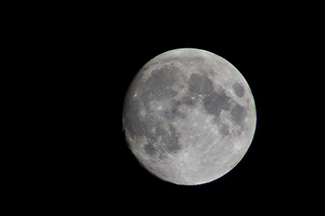


Figure 2.14図 2.14
Many people believe that a full moon makes people behave oddly. (credit: Cory Zanker)
満月は人を奇妙に振る舞わせる、と多くの人が信じている。(出典:Cory Zanker)
There is no denying that the moon exerts a powerful influence on our planet. The ebb and flow of the ocean’s tides are tightly tied to the gravitational forces of the moon. Many people believe, therefore, that it is logical that we are affected by the moon as well. After all, our bodies are largely made up of water. A meta-analysis of nearly 40 studies consistently demonstrated, however, that the relationship between the moon and our behavior does not exist (Rotton & Kelly, 1985). While we may pay more attention to odd behavior during the full phase of the moon, the rates of odd behavior remain constant throughout the lunar cycle.
英語のヒント
月が地球に強い影響を及ぼしていることは否定できない。海の潮の満ち引きは、月の引力と密接に結びついている。そのため多くの人は、私たちもまた月の影響を受けていると考えるのは筋が通っている、と信じている。なにしろ、私たちの体の大部分は水でできているのだから。しかし、40近い研究のメタ分析は、月と私たちの行動のあいだに関係が存在しないことを一貫して示した(Rotton & Kelly, 1985)。満月の時期には奇妙な行動により注意を向けるかもしれないが、奇妙な行動の発生率は、月の周期を通じて一定のままである。
Why are we so apt to believe in illusory correlations like this? Often we read or hear about them and simply accept the information as valid. Or, we have a hunch about how something works and then look for evidence to support that hunch, ignoring evidence that would tell us our hunch is false; this is known as confirmation bias. Other times, we find illusory correlations based on the information that comes most easily to mind, even if that information is severely limited. And while we may feel confident that we can use these relationships to better understand and predict the world around us, illusory correlations can have significant drawbacks. For example, research suggests that illusory correlations—in which certain behaviors are inaccurately attributed to certain groups—are involved in the formation of prejudicial attitudes that can ultimately lead to discriminatory behavior (Fiedler, 2004).
英語のヒント
私たちはなぜ、このような錯誤相関をこれほど信じやすいのだろうか。多くの場合、私たちはそれについて読んだり聞いたりして、その情報を正しいものとしてそのまま受け入れてしまう。あるいは、物事の仕組みについて何となくの勘を持ち、その勘を裏づける証拠を探す一方で、勘が誤りだと教えてくれるはずの証拠は無視する。これは確証バイアスとして知られている。また別のときには、最も思い浮かびやすい情報に基づいて錯誤相関を見いだしてしまう。その情報がひどく限られたものであってもである。そして、こうした関係を使えば身の回りの世界をよりよく理解し予測できると自信を持つかもしれないが、錯誤相関には重大な欠点がありうる。たとえば研究によれば、特定の行動が特定の集団のものだと不正確に結びつけられる錯誤相関が、偏見に基づく態度の形成にかかわっており、その態度は最終的に差別的な行動につながりうる(Fiedler, 2004)。