第21章核化学
21.6 Biological Effects of Radiation21.6 放射線の生物への影響
Learning Objectives学習目標
By the end of this section, you will be able to:
この節を終えると、次のことができるようになる。
- Describe the biological impact of ionizing radiation電離放射線の生物への影響を説明する
- Define units for measuring radiation exposure放射線被ばくの測定単位を定義する
- Explain the operation of common tools for detecting radioactivity放射能検出に使う代表的な装置の働きを説明する
- List common sources of radiation exposure in the US米国での主な放射線被ばく源を挙げる
The increased use of radioisotopes has led to increased concerns over the effects of these materials on biological systems (such as humans). All radioactive nuclides emit high-energy particles or electromagnetic waves. When this radiation encounters living cells, it can cause heating, break chemical bonds, or ionize molecules. The most serious biological damage results when these radioactive emissions fragment or ionize molecules. For example, alpha and beta particles emitted from nuclear decay reactions possess much higher energies than ordinary chemical bond energies. When these particles strike and penetrate matter, they produce ions and molecular fragments that are extremely reactive. The damage this does to biomolecules in living organisms can cause serious malfunctions in normal cell processes, taxing the organism’s repair mechanisms and possibly causing illness or even death (Figure 21.30).
英語のヒント
放射性同位体の利用が増えるにつれ、人体などの生物系への影響についての懸念も増えている。放射性核種はすべて、高エネルギーの粒子や電磁波を放出する。放射線が生きた細胞に当たると、加熱、化学結合の切断、分子の電離を起こすことがある。最も深刻な生物学的損傷は、放射線が分子を分解・電離するときに生じる。たとえば、核崩壊で放出されるα粒子やβ粒子は、通常の化学結合のエネルギーよりはるかに高いエネルギーをもつ。粒子が物質に衝突して入り込むと、極めて反応性の高いイオンや分子断片を生じる。それによる生体分子の損傷は、正常な細胞内過程に重大な異常を起こし、生体の修復機構に負担をかけ、病気や死に至ることさえある(図21.30)。
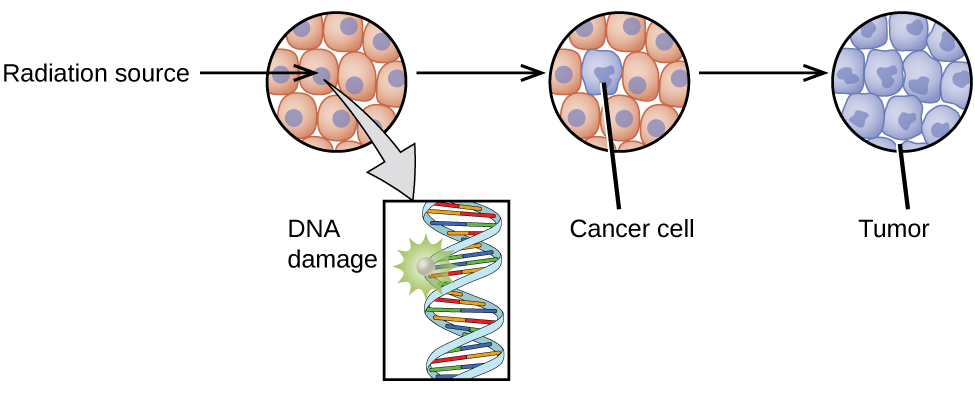
Figure 21.30図 21.30
Radiation can harm biological systems by damaging the DNA of cells. If this damage is not properly repaired, the cells may divide in an uncontrolled manner and cause cancer.
放射線は、細胞のDNAを傷つけて生物系に害を及ぼすことがある。損傷が適切に修復されないと、細胞が制御されずに分裂し、がんを生じることがある。
Ionizing and Nonionizing Radiation電離放射線と非電離放射線
There is a large difference in the magnitude of the biological effects of nonionizing radiation (for example, light and microwaves) and ionizing radiation, emissions energetic enough to knock electrons out of molecules (for example, α and β particles, γ rays, X-rays, and high-energy ultraviolet radiation) (Figure 21.31).
英語のヒント
非電離放射線(光やマイクロ波など)と電離放射線では、生物への影響の大きさが大きく異なる。電離放射線は、分子から電子をたたき出せるだけのエネルギーをもつ放射線で、α粒子、β粒子、γ線、X線、高エネルギー紫外線などが該当する(図21.31)。
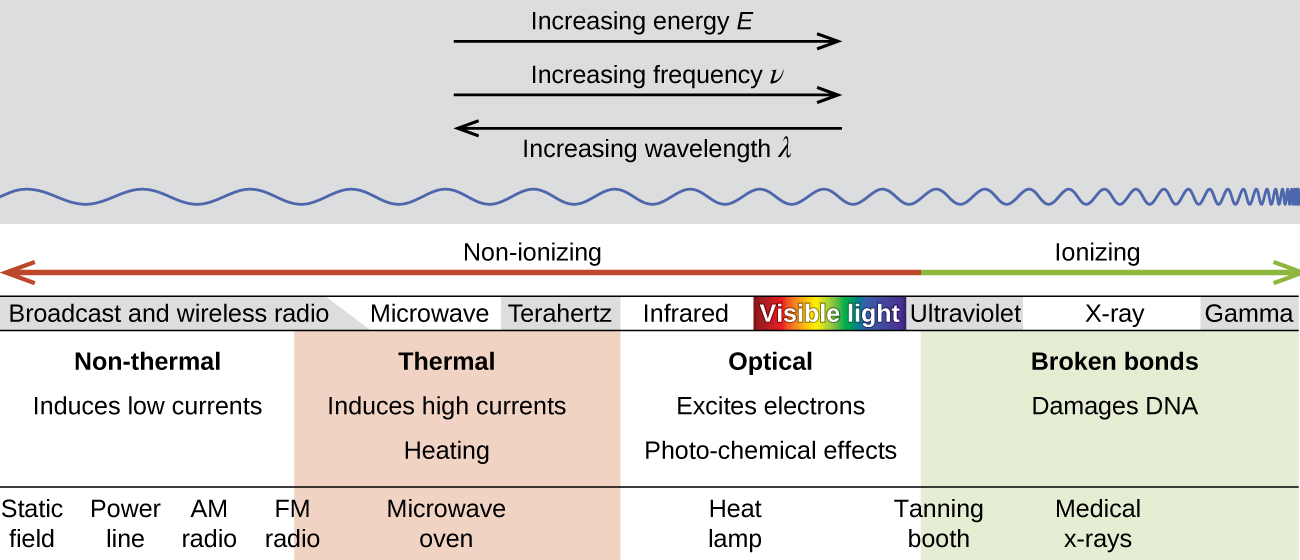
Figure 21.31図 21.31
Lower frequency, lower-energy electromagnetic radiation is nonionizing, and higher frequency, higher-energy electromagnetic radiation is ionizing.
振動数が低くエネルギーの低い電磁波は非電離放射線で、振動数が高くエネルギーの高い電磁波は電離放射線である。
Energy absorbed from nonionizing radiation speeds up the movement of atoms and molecules, which is equivalent to heating the sample. Although biological systems are sensitive to heat (as we might know from touching a hot stove or spending a day at the beach in the sun), a large amount of nonionizing radiation is necessary before dangerous levels are reached. Ionizing radiation, however, may cause much more severe damage by breaking bonds or removing electrons in biological molecules, disrupting their structure and function. The damage can also be done indirectly, by first ionizing H2O (the most abundant molecule in living organisms), which forms a H2O+ ion that reacts with water, forming a hydronium ion and a hydroxyl radical:
英語のヒント
非電離放射線から吸収したエネルギーは、原子や分子の運動を速める。これは試料を加熱することに相当する。熱いコンロに触れたり、日なたの海岸で1日過ごしたりすると分かるように、生物系は熱の影響を受けやすい。それでも、危険な水準に達するには、多量の非電離放射線が必要である。一方、電離放射線は、生体分子の結合を切ったり電子を取り去ったりして、構造や機能を乱し、はるかに深刻な損傷を与えることがある。損傷は間接的にも起こる。まず、生体内で最も豊富な分子H2Oを電離し、生じたH2O+イオンが水と反応して、ヒドロニウムイオンとヒドロキシルラジカルを作る。

Because the hydroxyl radical has an unpaired electron, it is highly reactive. (This is true of any substance with unpaired electrons, known as a free radical.) This hydroxyl radical can react with all kinds of biological molecules (DNA, proteins, enzymes, and so on), causing damage to the molecules and disrupting physiological processes. Examples of direct and indirect damage are shown in Figure 21.32.
英語のヒント
ヒドロキシルラジカルは不対電子をもつため、反応性が非常に高い。これは、不対電子をもつ「フリーラジカル」と呼ばれる物質に共通する。ヒドロキシルラジカルは、DNA、タンパク質、酵素など、あらゆる種類の生体分子と反応し、分子を傷つけて生理的な過程を乱す。直接的・間接的な損傷の例を、図21.32に示す。
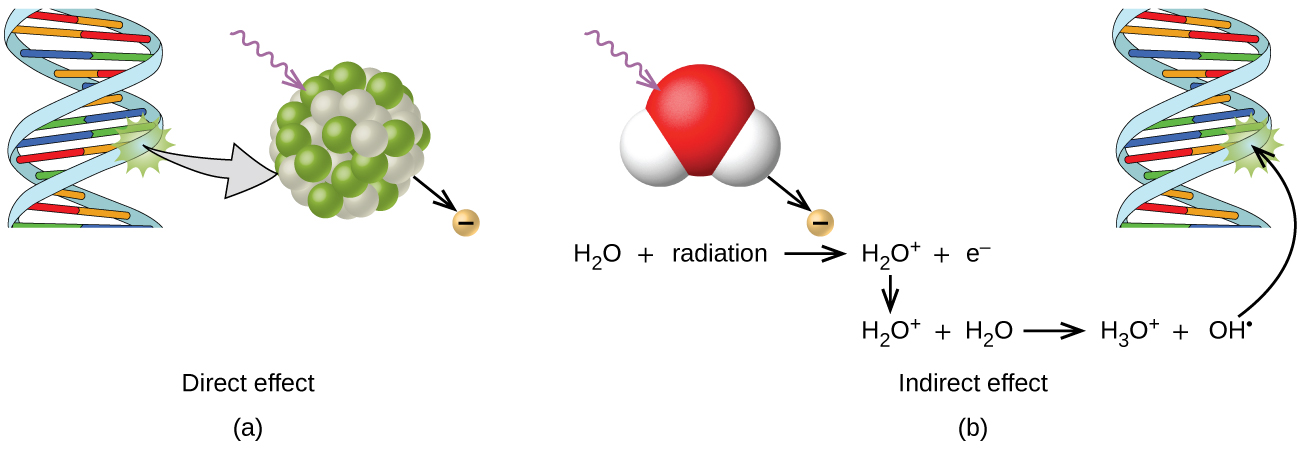
Figure 21.32図 21.32
Ionizing radiation can (a) directly damage a biomolecule by ionizing it or breaking its bonds, or (b) create an H2O+ ion, which reacts with H2O to form a hydroxyl radical, which in turn reacts with the biomolecule, causing damage indirectly.
電離放射線は、(a)生体分子を電離するか、結合を切ることで直接傷つける。または、(b)H2O+イオンを作り、それがH2Oと反応してヒドロキシルラジカルを生む。そのラジカルが生体分子と反応し、間接的に損傷を与える。
Biological Effects of Exposure to Radiation放射線被ばくによる生物への影響
Radiation can harm either the whole body (somatic damage) or eggs and sperm (genetic damage). Its effects are more pronounced in cells that reproduce rapidly, such as the stomach lining, hair follicles, bone marrow, and embryos. This is why patients undergoing radiation therapy often feel nauseous or sick to their stomach, lose hair, have bone aches, and so on, and why particular care must be taken when undergoing radiation therapy during pregnancy.
英語のヒント
放射線は、体全体(身体的障害)にも、卵子や精子(遺伝的障害)にも害を与えうる。影響は、胃の内壁、毛包、骨髄、胚など、増殖の速い細胞で特に強い。このため、放射線療法中の患者は、吐き気や胃の不快感、脱毛、骨の痛みなどを経験することが多い。また、妊娠中の放射線療法では特に注意が必要になる。
Different types of radiation have differing abilities to pass through material (Figure 21.33). A very thin barrier, such as a sheet or two of paper, or the top layer of skin cells, usually stops alpha particles. Because of this, alpha particle sources are usually not dangerous if outside the body, but are quite hazardous if ingested or inhaled (see the Chemistry in Everyday Life feature on Radon Exposure). Beta particles will pass through a hand, or a thin layer of material like paper or wood, but are stopped by a thin layer of metal. Gamma radiation is very penetrating and can pass through a thick layer of most materials. Some high-energy gamma radiation is able to pass through a few feet of concrete. Certain dense, high atomic number elements (such as lead) can effectively attenuate gamma radiation with thinner material and are used for shielding. The ability of various kinds of emissions to cause ionization varies greatly, and some particles have almost no tendency to produce ionization. Alpha particles have about twice the ionizing power of fast-moving neutrons, about 10 times that of β particles, and about 20 times that of γ rays and X-rays.
英語のヒント
放射線の種類によって、物質を透過する能力は異なる(図21.33)。α粒子は、紙1〜2枚や皮膚の表面の細胞層など、ごく薄い障壁で通常止まる。そのため、α線源は体外にある限り通常は危険ではないが、飲み込んだり吸い込んだりすると非常に危険である(「暮らしの中の化学」のラドン被曝を参照)。β粒子は、手や紙・木材の薄い層を通るが、薄い金属層で止まる。γ線は透過力が非常に強く、ほとんどの物質の厚い層を通過する。一部の高エネルギーγ線は、数フィートのコンクリートも通り抜ける。鉛などの密度が高く原子番号の大きい元素は、より薄くてもγ線を効果的に減衰させられるため、遮蔽に使われる。電離を起こす能力も放射線の種類によって大きく異なり、ほとんど電離を起こさない粒子もある。α粒子の電離能力は、高速中性子の約2倍、β粒子の約10倍、γ線やX線の約20倍である。
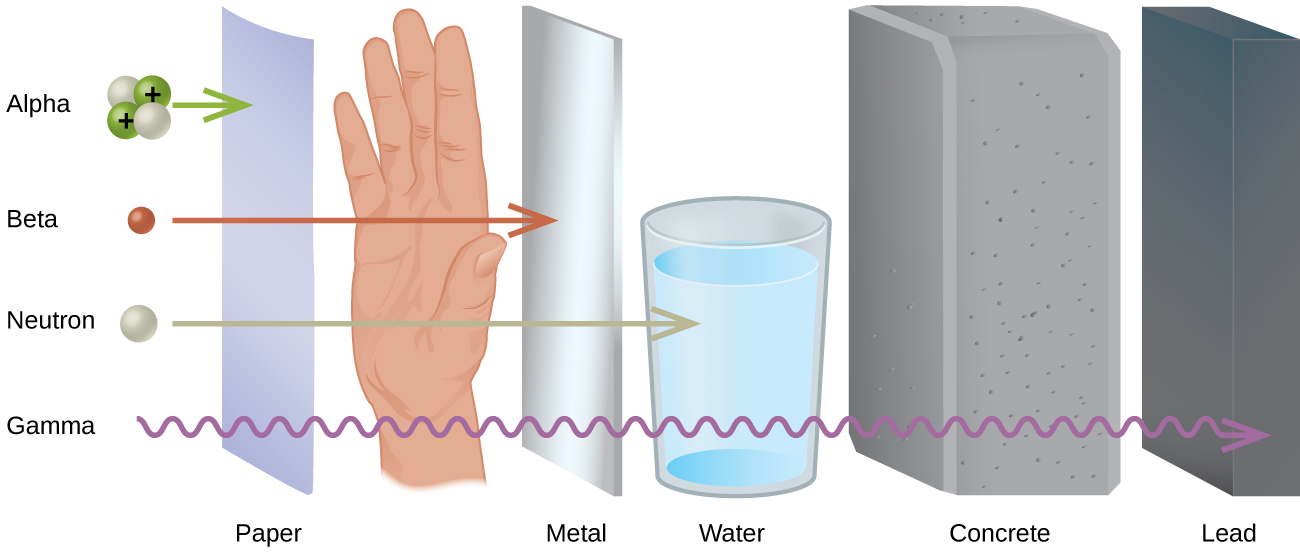


Figure 21.33図 21.33
The ability of different types of radiation to pass through material is shown. From least to most penetrating, they are alpha < beta < neutron < gamma.
各種の放射線が物質を透過する能力。透過力が弱い順に、α粒子 < β粒子 < 中性子 < γ線となる。