第21章核化学
Nuclear Fission核分裂
Many heavier elements with smaller binding energies per nucleon can decompose into more stable elements that have intermediate mass numbers and larger binding energies per nucleon—that is, mass numbers and binding energies per nucleon that are closer to the “peak” of the binding energy graph near 56 (see Figure 21.3). Sometimes neutrons are also produced. This decomposition is called fission, the breaking of a large nucleus into smaller pieces. The breaking is rather random with the formation of a large number of different products. Fission usually does not occur naturally, but is induced by bombardment with neutrons. The first reported nuclear fission occurred in 1939 when three German scientists, Lise Meitner, Otto Hahn, and Fritz Strassman, bombarded uranium-235 atoms with slow-moving neutrons that split the U-238 nuclei into smaller fragments that consisted of several neutrons and elements near the middle of the periodic table. Since then, fission has been observed in many other isotopes, including most actinide isotopes that have an odd number of neutrons. A typical nuclear fission reaction is shown in Figure 21.14.
英語のヒント
核子1個あたりの結合エネルギーが小さい重元素の多くは、質量数が中程度で、核子1個あたりの結合エネルギーがより大きい、安定な元素へ分解できる。これは、質量数56付近にある結合エネルギー曲線の頂点へ近づく変化である(図21.3)。中性子を生じることもある。大きい原子核が小さく分かれるこの分解を、核分裂という。分かれ方にはかなりの偶然性があり、多数の異なる生成物ができる。通常は自然に起こらず、中性子の衝突で誘起される。初めて核分裂が報告されたのは1939年である。ドイツの3人の科学者、リーゼ・マイトナー、オットー・ハーン、フリッツ・シュトラスマンがU-235原子へ遅い中性子を当て、U-238核を、いくつかの中性子と周期表の中央付近の元素からなる小さな断片へ分けた。以来、中性子数が奇数のアクチノイド同位体の多くを含め、さまざまな同位体で核分裂が観察されている。図21.14に典型的な核分裂反応を示す。
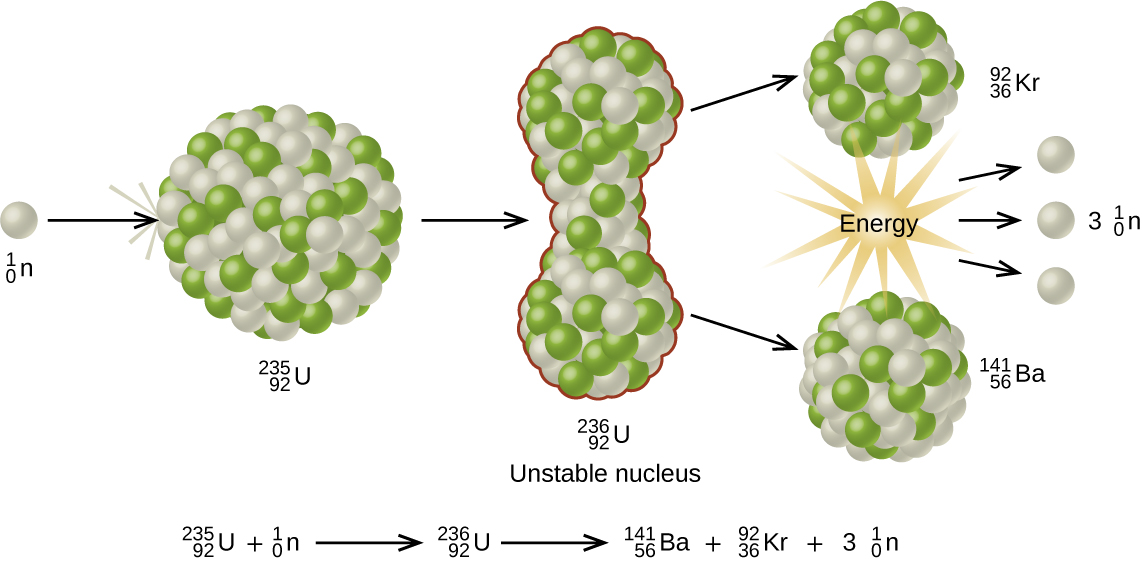
Figure 21.14図 21.14
When a slow neutron hits a fissionable U-235 nucleus, it is absorbed and forms an unstable U-236 nucleus. The U-236 nucleus then rapidly breaks apart into two smaller nuclei (in this case, Ba-141 and Kr-92) along with several neutrons (usually two or three), and releases a very large amount of energy.
遅い中性子が核分裂性のU-235核へ当たると吸収され、不安定なU-236核になる。U-236はすぐに2つの小さい核、この例ではBa-141とKr-92へ分かれ、通常2〜3個の中性子と非常に多くのエネルギーを放出する。
Among the products of Meitner, Hahn, and Strassman’s fission reaction were barium, krypton, lanthanum, and cerium, all of which have nuclei that are more stable than uranium-235. Since then, hundreds of different isotopes have been observed among the products of fissionable substances. A few of the many reactions that occur for U-235, and a graph showing the distribution of its fission products and their yields, are shown in Figure 21.15. Similar fission reactions have been observed with other uranium isotopes, as well as with a variety of other isotopes such as those of plutonium.
マイトナー、ハーン、シュトラスマンの核分裂反応では、U-235より安定な核をもつバリウム、クリプトン、ランタン、セリウムなどが生じた。以来、核分裂性物質の生成物から数百種類の同位体が見つかっている。図21.15には、U-235で起こる多くの反応の一部と、核分裂生成物の分布・収率を示す。ほかのウラン同位体や、プルトニウムなどの同位体でも、同様の核分裂が観察されている。
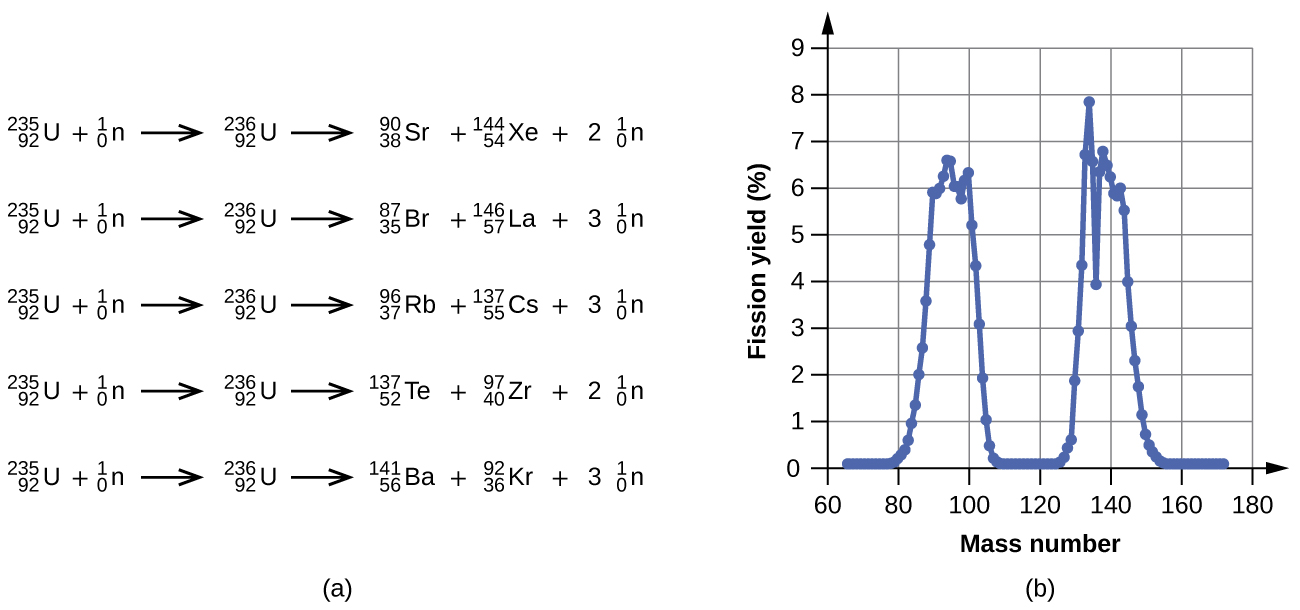
Figure 21.15図 21.15
(a) Nuclear fission of U-235 produces a range of fission products. (b) The larger fission products of U-235 are typically one isotope with a mass number around 85–105, and another isotope with a mass number that is about 50% larger, that is, about 130–150.
(a) U-235の核分裂では、さまざまな生成物ができる。(b) 大きな生成物は通常、質量数85〜105程度の同位体1つと、それより約50%重い、質量数130〜150程度の同位体1つである。
A tremendous amount of energy is produced by the fission of heavy elements. For instance, when one mole of U-235 undergoes fission, the products weigh about 0.2 grams less than the reactants; this “lost” mass is converted into a very large amount of energy, about 1.8 1010 kJ per mole of U-235. Nuclear fission reactions produce incredibly large amounts of energy compared to chemical reactions. The fission of 1 kilogram of uranium-235, for example, produces about 2.5 million times as much energy as is produced by burning 1 kilogram of coal.
重元素の核分裂は、莫大なエネルギーを生む。たとえばU-235が1 mol核分裂すると、生成物の質量は反応物より約0.2 g小さくなる。この「失われた」質量が、U-235 1 molあたり約1.8 1010 kJという非常に大きなエネルギーへ変わる。核分裂のエネルギーは化学反応に比べて桁違いに大きい。U-235 1 kgの核分裂では、石炭1 kgの燃焼の約250万倍のエネルギーが生じる。
As described earlier, when undergoing fission U-235 produces two “medium-sized” nuclei, and two or three neutrons. These neutrons may then cause the fission of other uranium-235 atoms, which in turn provide more neutrons that can cause fission of even more nuclei, and so on. If this occurs, we have a nuclear chain reaction (see Figure 21.16). On the other hand, if too many neutrons escape the bulk material without interacting with a nucleus, then no chain reaction will occur.
英語のヒント
すでに述べたように、U-235が核分裂すると、中程度の大きさの核2つと中性子2〜3個ができる。この中性子が別のU-235原子を核分裂させ、そこで生じるさらに多くの中性子が、さらに多くの核分裂を引き起こすことがある。これが続くと核連鎖反応となる(図21.16)。逆に、原子核と相互作用せずに物質の外へ逃げる中性子が多すぎれば、連鎖反応は起こらない。
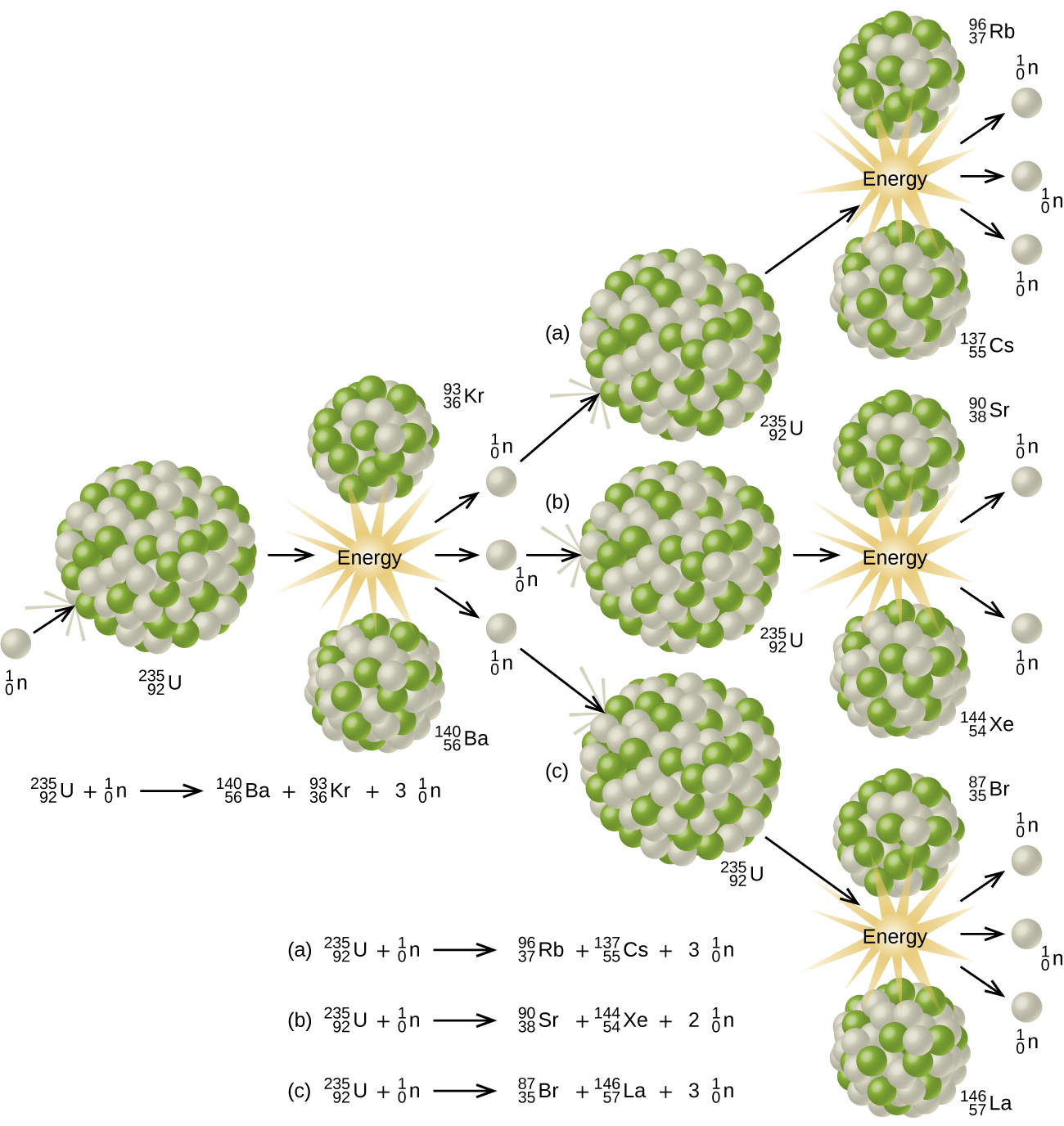
Figure 21.16図 21.16
The fission of a large nucleus, such as U-235, produces two or three neutrons, each of which is capable of causing fission of another nucleus by the reactions shown. If this process continues, a nuclear chain reaction occurs.
U-235のような大きい原子核が分裂すると、中性子が2〜3個生じる。それぞれが、図示した反応で別の原子核を分裂させることができる。過程が続けば核連鎖反応となる。
Material that can sustain a nuclear fission chain reaction is said to be fissile or fissionable. (Technically, fissile material can undergo fission with neutrons of any energy, whereas fissionable material requires high-energy neutrons.) Nuclear fission becomes self-sustaining when the number of neutrons produced by fission equals or exceeds the number of neutrons absorbed by splitting nuclei plus the number that escape into the surroundings. The amount of a fissionable material that will support a self-sustaining chain reaction is a critical mass. An amount of fissionable material that cannot sustain a chain reaction is a subcritical mass. An amount of material in which there is an increasing rate of fission is known as a supercritical mass. The critical mass depends on the type of material: its purity, the temperature, the shape of the sample, and how the neutron reactions are controlled (Figure 21.17).
英語のヒント
核分裂連鎖反応を維持できる物質を、核分裂性の物質という。英語ではfissileまたはfissionableと呼ぶ。厳密には、fissileな物質はどのエネルギーの中性子でも核分裂するが、fissionableな物質には高エネルギーの中性子が必要である。核分裂で生じる中性子数が、核分裂する核に吸収される数と外へ逃げる数の合計以上になると、核分裂は自ら持続する。自ら持続する連鎖反応を維持できる核分裂性物質の量を臨界質量、維持できない量を未臨界質量、核分裂速度が増加する状態の量を超臨界質量という。臨界質量は、物質の種類、純度、温度、試料の形、中性子反応の制御の仕方に依存する(図21.17)。
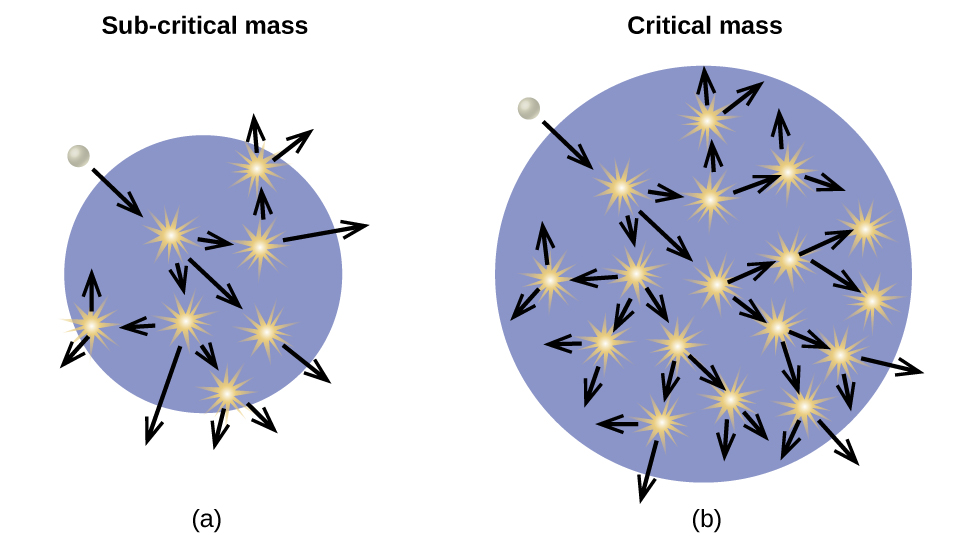
Figure 21.17図 21.17
(a) In a subcritical mass, the fissile material is too small and allows too many neutrons to escape the material, so a chain reaction does not occur. (b) In a critical mass, a large enough number of neutrons in the fissile material induce fission to create a chain reaction.
(a) 未臨界質量では核分裂性物質が小さすぎ、多くの中性子が外へ逃げるため、連鎖反応は起こらない。(b) 臨界質量では、物質内の十分な数の中性子が核分裂を誘起し、連鎖反応を起こす。
An atomic bomb (Figure 21.18) contains several pounds of fissionable material, or a source of neutrons, and an explosive device for compressing it quickly into a small volume. When fissionable material is in small pieces, the proportion of neutrons that escape through the relatively large surface area is great, and a chain reaction does not take place. When the small pieces of fissionable material are brought together quickly to form a body with a mass larger than the critical mass, the relative number of escaping neutrons decreases, and a chain reaction and explosion result.
原子爆弾(図21.18)は、数ポンドの核分裂性物質または、中性子源、物質を急速に小さい体積へ圧縮する爆発装置を含む。核分裂性物質が小片に分かれていると、相対的に大きな表面から逃げる中性子の割合が大きく、連鎖反応は起こらない。小片を急速に合わせて臨界質量を超えるかたまりにすると、逃げる中性子の相対的な数が減り、連鎖反応と爆発が起こる。
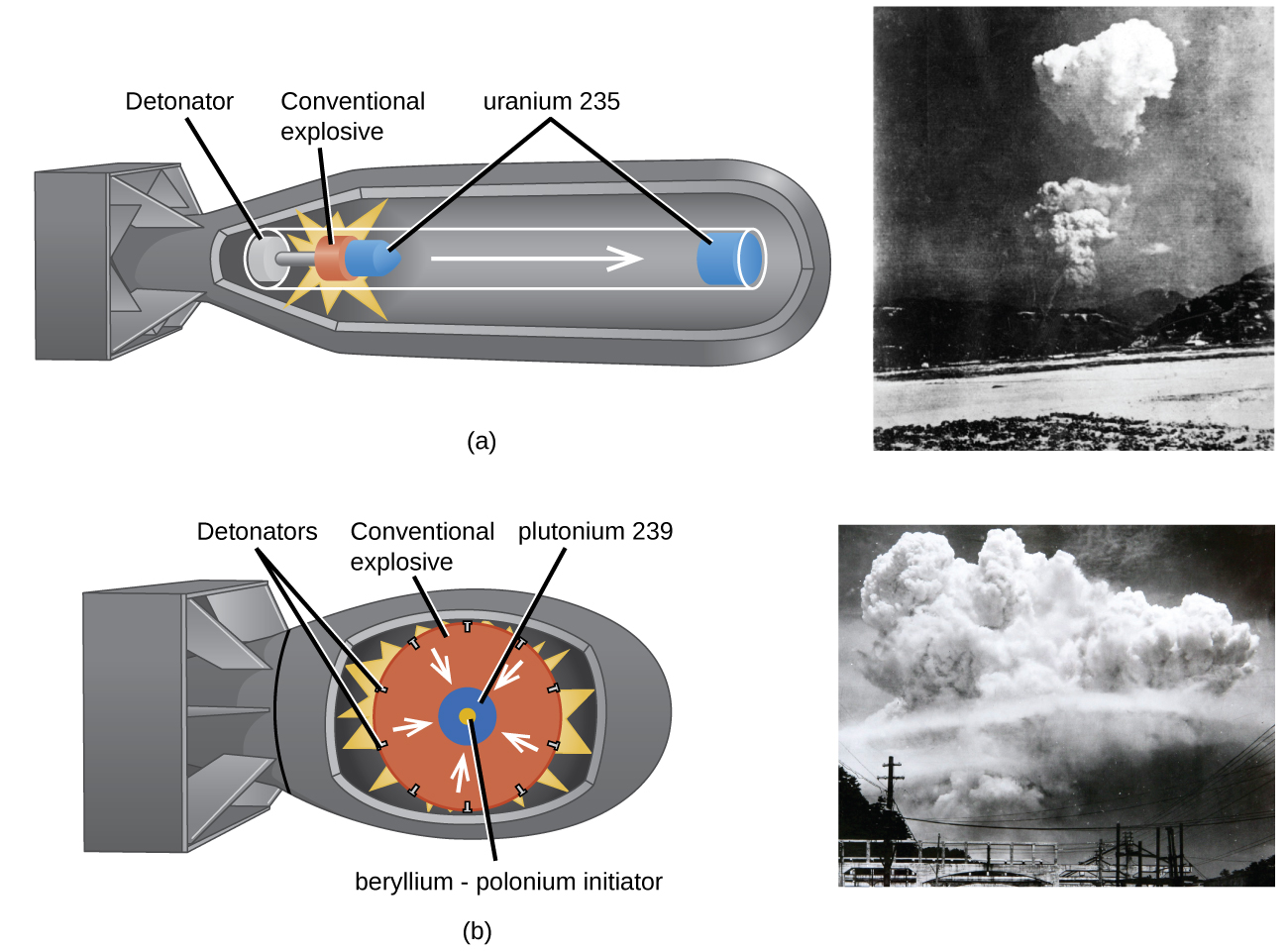


Figure 21.18図 21.18
(a) The nuclear fission bomb that destroyed Hiroshima on August 6, 1945, consisted of two subcritical masses of U-235, where conventional explosives were used to fire one of the subcritical masses into the other, creating the critical mass for the nuclear explosion. (b) The plutonium bomb that destroyed Nagasaki on August 9, 1945, consisted of a hollow sphere of plutonium that was rapidly compressed by conventional explosives. This led to a concentration of plutonium in the center that was greater than the critical mass necessary for the nuclear explosion.
(a) 1945年8月6日に広島を破壊した核分裂爆弾は、未臨界のU-235のかたまり2つからなり、通常爆薬で一方を他方へ打ち込み、核爆発に必要な臨界質量を作った。(b) 8月9日に長崎を破壊したプルトニウム爆弾は、プルトニウムの中空球を通常爆薬で急速に圧縮し、中心で核爆発に必要な臨界質量を超える集中を生じさせた。