第21章核化学
Effects of Long-term Radiation Exposure on the Human Body長期の放射線被ばくが人体に与える影響
The effects of radiation depend on the type, energy, and location of the radiation source, and the length of exposure. As shown in Figure 21.37, the average person is exposed to background radiation, including cosmic rays from the sun and radon from uranium in the ground (see the Chemistry in Everyday Life feature on Radon Exposure); radiation from medical exposure, including CAT scans, radioisotope tests, X-rays, and so on; and small amounts of radiation from other human activities, such as airplane flights (which are bombarded by increased numbers of cosmic rays in the upper atmosphere), radioactivity from consumer products, and a variety of radionuclides that enter our bodies when we breathe (for example, carbon-14) or through the food chain (for example, potassium-40, strontium-90, and iodine-131).
英語のヒント
放射線の影響は、線源の種類・エネルギー・位置と、被曝時間に依存する。図21.37に示すように、一般の人は、太陽からの宇宙線や地中のウランから生じるラドンなどの自然放射線を受ける(「暮らしの中の化学」のラドン被曝を参照)。また、CT、放射性同位体検査、X線などによる医療被曝や、そのほかの人間活動に伴う少量の放射線もある。飛行機の搭乗では上空でより多くの宇宙線を浴び、消費者向け製品にも放射能がある。さらに、呼吸によって炭素14などが、食物連鎖を通じてカリウム40、ストロンチウム90、ヨウ素131などが体内へ入る。
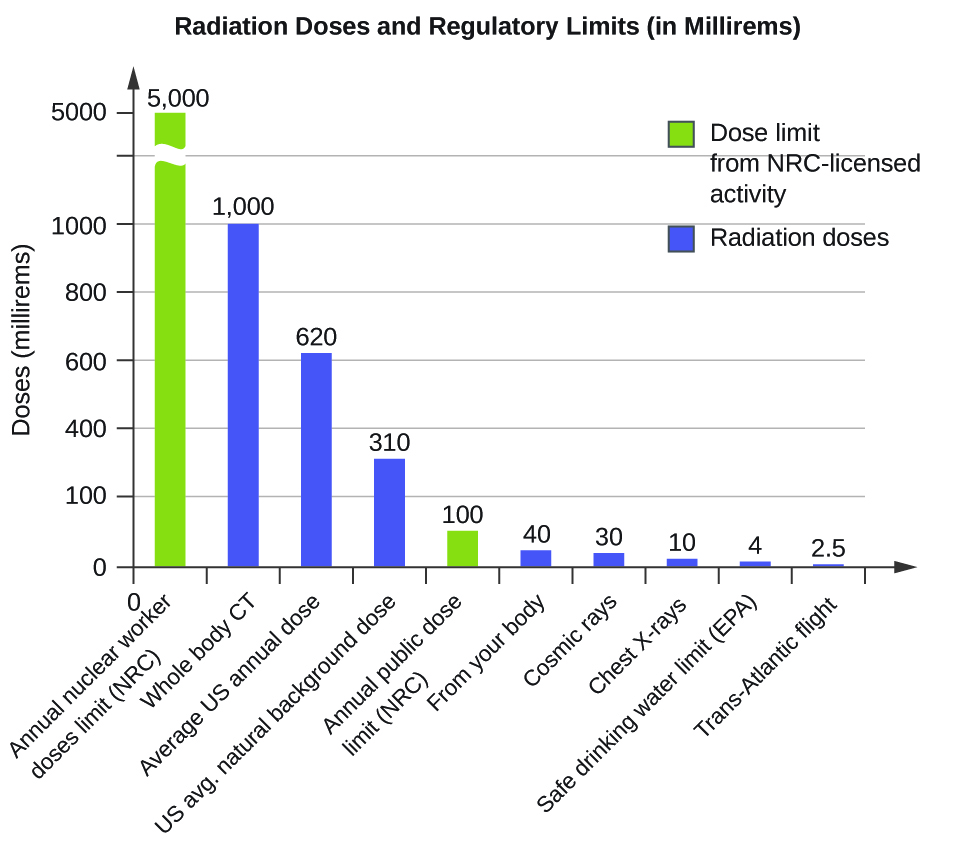

Figure 21.37図 21.37
The total annual radiation exposure for a person in the US is about 620 mrem. The various sources and their relative amounts are shown in this bar graph. (source: U.S. Nuclear Regulatory Commission)
米国の1人あたり年間総被曝量は約620 mremである。各種の被曝源と、その相対的な量を棒グラフに示す。(資料:米原子力規制委員会)
A short-term, sudden dose of a large amount of radiation can cause a wide range of health effects, from changes in blood chemistry to death. Short-term exposure to tens of rems of radiation will likely cause very noticeable symptoms or illness; a dose of about 500 rems is estimated to have a 50% probability of causing the death of the victim within 30 days of exposure. Exposure to radioactive emissions has a cumulative effect on the body during a person’s lifetime, which is another reason why it is important to avoid any unnecessary exposure to radiation. Health effects of short-term exposure to radiation are shown in Table 21.5.
英語のヒント
短時間に突然大量の放射線を受けると、血液の化学的変化から死亡まで、幅広い健康影響が起こりうる。短時間で数十remを受けると、明らかな症状や病気が生じる可能性が高い。約500 remでは、被曝後30日以内に死亡する確率が50%と推定されている。放射線被曝は生涯にわたって体へ累積的な影響を及ぼす。このことも、不必要な被曝を避けることが重要な理由である。短期間の被曝による健康影響を、表21.5に示す。
Health Effects of Radiation Source: US Environmental Protection Agency 放射線の健康への影響(出典:米国環境保護庁) |
||
|---|---|---|
Exposure (rem) 被ばく量(rem) |
Health Effect 健康への影響 |
Time to Onset (without treatment) 発症までの時間(無治療の場合) |
5–10 |
changes in blood chemistry 血液の化学成分の変化 |
— |
50 |
nausea 吐き気 |
hours 数時間 |
55 |
fatigue 疲労 |
— |
70 |
vomiting 嘔吐 |
— |
75 |
hair loss 脱毛 |
2–3 weeks 2〜3週間 |
90 |
diarrhea 下痢 |
— |
100 |
hemorrhage 出血 |
— |
400 |
possible death 死亡の可能性 |
within 2 months 2か月以内 |
1000 |
destruction of intestinal lining 腸粘膜の破壊 |
— |
internal bleeding 体内出血 |
— |
|
death 死亡 |
1–2 weeks 1〜2週間 |
|
2000 |
damage to central nervous system 中枢神経系の損傷 |
— |
loss of consciousness; 意識消失 |
minutes 数分 |
|
death 死亡 |
hours to days 数時間〜数日 |
|
It is impossible to avoid some exposure to ionizing radiation. We are constantly exposed to background radiation from a variety of natural sources, including cosmic radiation, rocks, medical procedures, consumer products, and even our own atoms. We can minimize our exposure by blocking or shielding the radiation, moving farther from the source, and limiting the time of exposure.
英語のヒント
電離放射線への被曝を完全に避けることはできない。宇宙放射線、岩石、医療処置、消費者向け製品、さらに自分自身の原子など、さまざまな線源からの環境放射線に、常にさらされている。放射線を遮断・遮蔽する、線源から離れる、被曝時間を短くすることで、被曝を最小限にできる。
Key Concepts and Summary重要な概念とまとめ
We are constantly exposed to radiation from a variety of naturally occurring and human-produced sources. This radiation can affect living organisms. Ionizing radiation is the most harmful because it can ionize molecules or break chemical bonds, which damages the molecule and causes malfunctions in cell processes. It can also create reactive hydroxyl radicals that damage biological molecules and disrupt physiological processes. Radiation can cause somatic or genetic damage, and is most harmful to rapidly reproducing cells. Types of radiation differ in their ability to penetrate material and damage tissue, with alpha particles the least penetrating but potentially most damaging and gamma rays the most penetrating.
私たちは、天然と人工のさまざまな線源からの放射線に、常にさらされている。放射線は生体に影響を与えうる。電離放射線は、分子を電離したり化学結合を切ったりして、分子を傷つけ、細胞の過程に異常を起こすため、最も有害である。また、反応性の高いヒドロキシルラジカルを生み、生体分子を傷つけて生理的過程を乱すこともある。放射線は身体的・遺伝的障害を起こし、増殖の速い細胞に最も有害である。物質を透過する能力と組織を傷つける能力は、種類によって異なる。α粒子は最も透過しにくいが、最も大きな損傷を与えうる。γ線は最も透過しやすい。
Various devices, including Geiger counters, scintillators, and dosimeters, are used to detect and measure radiation, and monitor radiation exposure. We use several units to measure radiation: becquerels or curies for rates of radioactive decay; gray or rads for energy absorbed; and rems or sieverts for biological effects of radiation. Exposure to radiation can cause a wide range of health effects, from minor to severe, and including death. We can minimize the effects of radiation by shielding with dense materials such as lead, moving away from the source, and limiting time of exposure.
ガイガー計数管、シンチレーター、線量計などの装置で、放射線を検出・測定し、被曝を監視する。放射線の測定には複数の単位を使う。放射性崩壊の速さにはベクレルやキュリー、吸収したエネルギーにはグレイやラド、生物学的影響にはレムやシーベルトを使う。被曝は、軽度から重度、さらには死亡まで、さまざまな健康影響を起こしうる。鉛などの密度の高い物質で遮蔽する、線源から離れる、被曝時間を短くすることで、影響を最小限にできる。
Key Equations重要な式
rem = RBE rad |
Sv = RBE Gy |
Chemistry End of Chapter Exercises章末問題
Exercises 58–62練習問題 58–62
Exercise 58問題 58
If a hospital were storing radioisotopes, what is the minimum containment needed to protect against:
病院で放射性同位体を保管するとき、次のものから保護するために最低限必要な格納・遮蔽は何か。
(a) cobalt-60 (a strong γ emitter used for irradiation)
(a) コバルト60(照射に使う強いγ線源)
(b) molybdenum-99 (a beta emitter used to produce technetium-99 for imaging)
(b) モリブデン99(画像診断用のテクネチウム99を作るβ線源)
Exercise 59問題 59
Based on what is known about Radon-222’s primary decay method, why is inhalation so dangerous?
ラドン222の主な崩壊様式から考えて、吸入が非常に危険なのはなぜか。
Solution解き方
Alpha particles can be stopped by very thin shielding but have much stronger ionizing potential than beta particles, X-rays, and γ-rays. When inhaled, there is no protective skin covering the cells of the lungs, making it possible to damage the DNA in those cells and cause cancer.
α粒子は非常に薄い遮蔽で止まるが、β粒子、X線、γ線よりはるかに強い電離能力をもつ。吸入した場合、肺の細胞を覆う保護用の皮膚がないため、そのDNAを傷つけ、がんを起こす可能性がある。
Exercise 60問題 60
Given specimens uranium-232 (t1/2 = 68.9 y) and uranium-233 (t1/2 = 159,200 y) of equal mass, which one would have greater activity and why?
同じ質量のウラン232(t1/2 = 68.9年)とウラン233(t1/2 = 159,200年)の試料がある。放射能が大きいのはどちらか。理由も答えなさい。
Exercise 61問題 61
A scientist is studying a 2.234 g sample of thorium-229 (t1/2 = 7340 y) in a laboratory.
ある科学者が、実験室で2.234 gのトリウム229(t1/2 = 7340年)試料を研究している。
(a) What is its activity in Bq?
(a) 放射能は何Bqか。
(b) What is its activity in Ci?
(b) 放射能は何Ciか。
Solution解き方
(a) 7.64 109 Bq; (b) 2.06 10−2 Ci
(a) 7.64 109 Bq、(b) 2.06 10−2 Ci
Exercise 62問題 62
Given specimens neon-24 (t1/2 = 3.38 min) and bismuth-211 (t1/2 = 2.14 min) of equal mass, which one would have greater activity and why?
同じ質量のネオン24(t1/2 = 3.38分)とビスマス211(t1/2 = 2.14分)の試料がある。放射能が大きいのはどちらか。理由も答えなさい。
becquerel (Bq)
ベクレル(Bq)
SI unit for rate of radioactive decay; 1 Bq = 1 disintegration/s
放射性崩壊の速度を表すSI単位。1 Bq = 毎秒1回の崩壊。
curie (Ci)
キュリー(Ci)
larger unit for rate of radioactive decay frequently used in medicine; 1 Ci = 3.7 1010 disintegrations/s
医療でよく使われる、放射性崩壊の速度を表す大きな単位。1 Ci = 毎秒3.7 1010回の崩壊。
Geiger counter
ガイガーカウンター
instrument that detects and measures radiation via the ionization produced in a Geiger-Müller tube
ガイガー・ミュラー管内で起こる電離を利用し、放射線を検出・測定する装置。
gray (Gy)
グレイ(Gy)
SI unit for measuring radiation dose; 1 Gy = 1 J absorbed/kg tissue
放射線量を測るSI単位。1 Gy = 組織1 kgあたり1 Jの吸収エネルギー。
ionizing radiation
電離放射線
radiation that can cause a molecule to lose an electron and form an ion
分子から電子を失わせ、イオンを作ることのできる放射線。
millicurie (mCi)
ミリキュリー(mCi)
larger unit for rate of radioactive decay frequently used in medicine; 1 Ci = 3.7 1010 disintegrations/s
医療でよく使われる、放射性崩壊の速度を表す大きな単位。1 Ci = 毎秒3.7 1010回の崩壊。
nonionizing radiation
非電離放射線
radiation that speeds up the movement of atoms and molecules; it is equivalent to heating a sample, but is not energetic enough to cause the ionization of molecules
原子や分子の運動を速める放射線。試料を加熱することに相当するが、分子を電離するほどのエネルギーはない。
radiation absorbed dose (rad)
吸収線量の単位ラド(rad)
SI unit for measuring radiation dose, frequently used in medical applications; 1 rad = 0.01 Gy
放射線量を測るSI単位で、医療でよく使われる。1 rad = 0.01 Gy。
radiation dosimeter
放射線線量計
device that measures ionizing radiation and is used to determine personal radiation exposure
電離放射線を測り、個人の放射線被ばく量を求めるための装置。
relative biological effectiveness (RBE)
生物学的効果比(RBE)
measure of the relative damage done by radiation
放射線による損傷の相対的な大きさを表す尺度。
roentgen equivalent man (rem)
レム(rem)
unit for radiation damage, frequently used in medicine; 100 rem = 1 Sv
医療でよく使われる、放射線による損傷を表す単位。100 rem = 1 Sv。
scintillation counter
シンチレーションカウンター
instrument that uses a scintillator—a material that emits light when excited by ionizing radiation—to detect and measure radiation
電離放射線で励起されると光を出す物質、シンチレーターを使い、放射線を検出・測定する装置。
sievert (Sv)
シーベルト(Sv)
SI unit measuring tissue damage caused by radiation; takes into account energy and biological effects of radiation
放射線による組織損傷を測るSI単位。放射線のエネルギーと生物への影響を考慮する。