第21章核化学
21.5 Uses of Radioisotopes21.5 放射性同位体の利用
Learning Objectives学習目標
By the end of this section, you will be able to:
この節を終えると、次のことができるようになる。
- List common applications of radioactive isotopes放射性同位体の代表的な用途を挙げる
Radioactive isotopes have the same chemical properties as stable isotopes of the same element, but they emit radiation, which can be detected. If we replace one (or more) atom(s) with radioisotope(s) in a compound, we can track them by monitoring their radioactive emissions. This type of compound is called a radioactive tracer (or radioactive label). Radioisotopes are used to follow the paths of biochemical reactions or to determine how a substance is distributed within an organism. Radioactive tracers are also used in many medical applications, including both diagnosis and treatment. They are used to measure engine wear, analyze the geological formation around oil wells, and much more.
英語のヒント
放射性同位体は、同じ元素の安定同位体と同じ化学的性質をもつが、検出可能な放射線を出す。化合物中の1個以上の原子を放射性同位体で置き換えると、その放射線を測定して行方を追える。このような化合物を放射性トレーサー、または放射性標識という。放射性同位体は、生化学反応の経路を追ったり、生体内に物質がどう分布するかを調べたりするために使う。放射性トレーサーは、診断と治療を含む多くの医療用途にも使われる。エンジンの摩耗の測定、油井周辺の地層の分析など、用途はさらに広い。
Radioimmunossays (RIA), for example, rely on radioisotopes to detect the presence and/or concentration of certain antigens. Developed by Rosalyn Sussman Yalow and Solomon Berson in the 1950s, the technique is known for extreme sensitivity, meaning that it can detect and measure very small quantities of a substance. Prior to its discovery, most similar detection relied on large enough quantities to produce visible outcomes. RIA revolutionized and expanded entire fields of study, most notably endocrinology, and is commonly used in narcotics detection, blood bank screening, early cancer screening, hormone measurement, and allergy diagnosis. Based on her significant contribution to medicine, Yalow received a Nobel Prize, making her the second woman to be awarded the prize for medicine.
英語のヒント
たとえば放射免疫測定法(RIA)は、放射性同位体を利用して、特定の抗原の有無や濃度を調べる。1950年代にロザリン・サスマン・ヤローとソロモン・バーソンが開発したこの方法は、感度が極めて高く、ごく微量の物質を検出・定量できることで知られる。それ以前の同様の検出法では、ほとんどの場合、目に見える結果が生じるだけの量が必要だった。RIAは、とりわけ内分泌学など、研究分野全体を変革し、その範囲を広げた。麻薬の検出、血液銀行でのスクリーニング、がんの早期検診、ホルモン測定、アレルギー診断に広く使われる。医学への大きな貢献により、ヤローはノーベル賞を受賞し、医学分野で同賞を受けた2人目の女性となった。
Radioisotopes have revolutionized medical practice (see Appendix M), where they are used extensively. Over 10 million nuclear medicine procedures and more than 100 million nuclear medicine tests are performed annually in the United States. Four typical examples of radioactive tracers used in medicine are technetium-99 , thallium-201 , iodine-131 , and sodium-24 . Damaged tissues in the heart, liver, and lungs absorb certain compounds of technetium-99 preferentially. After it is injected, the location of the technetium compound, and hence the damaged tissue, can be determined by detecting the γ rays emitted by the Tc-99 isotope. Thallium-201 (Figure 21.24) becomes concentrated in healthy heart tissue, so the two isotopes, Tc-99 and Tl-201, are used together to study heart tissue. Iodine-131 concentrates in the thyroid gland, the liver, and some parts of the brain. It can therefore be used to monitor goiter and treat thyroid conditions, such as Grave’s disease, as well as liver and brain tumors. Salt solutions containing compounds of sodium-24 are injected into the bloodstream to help locate obstructions to the flow of blood.
英語のヒント
放射性同位体は医療を変革し、広く利用されている(付録M参照)。米国では年間1000万件を超える核医学処置と、1億件を超える核医学検査が行われる。医学で使う代表的な放射性トレーサーは、テクネチウム99 、タリウム201 、ヨウ素131 、ナトリウム24 である。心臓、肝臓、肺の損傷組織は、テクネチウム99の特定の化合物を優先的に吸収する。注射後、Tc-99が出すγ線を検出すれば、テクネチウム化合物、ひいては損傷組織の位置が分かる。タリウム201(図21.24)は健康な心臓組織に集まるので、Tc-99とTl-201を組み合わせて心臓組織を調べる。ヨウ素131は甲状腺、肝臓、脳の一部に集まる。そのため、甲状腺腫の経過観察、バセドウ病などの甲状腺疾患や、肝臓・脳の腫瘍の治療に使える。ナトリウム24の化合物を含む塩溶液は、血流の障害箇所を見つけるために血管内へ注射する。
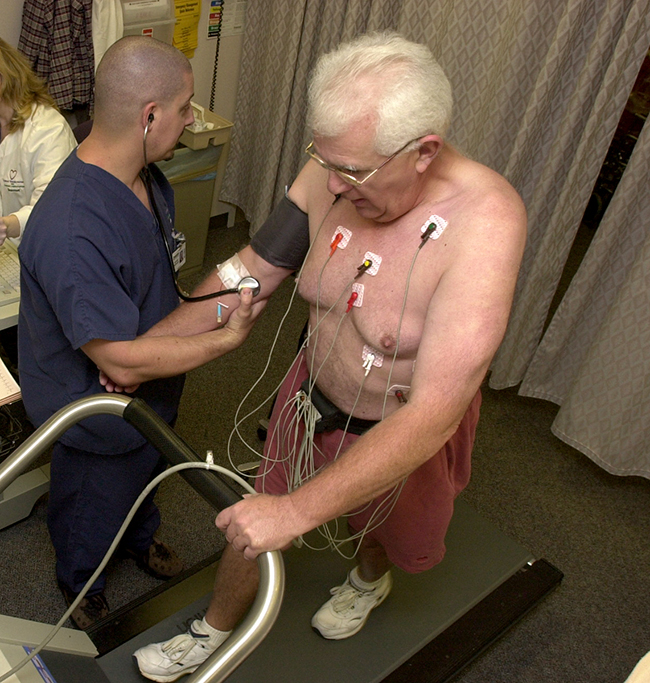
OpenStax, Rice University, Chemistry 2e. Original caption credit: (credit: modification of work by “Blue0ctane”/Wikimedia Commons) Source work: Stress test.jpg · Public domain; OpenStax adaptation CC BY 4.0 · Source出典
Figure 21.24図 21.24
Administering thallium-201 to a patient and subsequently performing a stress test offer medical professionals an opportunity to visually analyze heart function and blood flow. (credit: modification of work by “Blue0ctane”/Wikimedia Commons)
患者にタリウム201を投与してから負荷試験を行うと、医療従事者は心機能と血流を視覚的に分析できる。(出典:「Blue0ctane」/Wikimedia Commonsの作品を改変)
Radioisotopes used in medicine typically have short half-lives—for example, the ubiquitous Tc-99m has a half-life of 6.01 hours. This makes Tc-99m essentially impossible to store and prohibitively expensive to transport, so it is made on-site instead. Hospitals and other medical facilities use Mo-99 (which is primarily extracted from U-235 fission products) to generate Tc-99. Mo-99 undergoes β decay with a half-life of 66 hours, and the Tc-99 is then chemically extracted (Figure 21.25). The parent nuclide Mo-99 is part of a molybdate ion, when it decays, it forms the pertechnetate ion, These two water-soluble ions are separated by column chromatography, with the higher charge molybdate ion adsorbing onto the alumina in the column, and the lower charge pertechnetate ion passing through the column in the solution. A few micrograms of Mo-99 can produce enough Tc-99 to perform as many as 10,000 tests.
英語のヒント
医学で使う放射性同位体は、通常、半減期が短い。たとえば広く使われるTc-99mの半減期は6.01時間である。そのため、Tc-99mは実質的に保管できず、輸送費も高くなりすぎるので、使用場所で作る。病院などの医療施設では、主にU-235の核分裂生成物から抽出したMo-99を使ってTc-99を作る。Mo-99は半減期66時間でβ崩壊し、その後Tc-99を化学的に抽出する(図21.25)。親核種Mo-99はモリブデン酸イオンの一部であり、崩壊すると過テクネチウム酸イオンになる。この2種の水溶性イオンを、カラムクロマトグラフィーで分離する。電荷の大きいモリブデン酸イオンはカラム内のアルミナに吸着し、電荷の小さい過テクネチウム酸イオンは溶液とともにカラムを通過する。数μgのMo-99から、最大1万回の検査に十分なTc-99を作れる。
Image omitted because its reuse rights could not be verified.権利の確認ができないため画像を割愛。
Figure 21.25図 21.25
(a) The first Tc-99m generator (circa 1958) is used to separate Tc-99 from Mo-99. The is retained by the matrix in the column, whereas the passes through and is collected. (b) Tc-99 was used in this scan of the neck of a patient with Grave’s disease. The scan shows the location of high concentrations of Tc-99. (credit a: modification of work by the Department of Energy; credit b: modification of work by “MBq”/Wikimedia Commons)
(a) 最初期のTc-99mジェネレーター(1958年ごろ)は、Mo-99からTc-99を分離するために使われた。はカラムの充填材に保持され、は通過して回収される。(b) バセドウ病患者の首を撮影するために、Tc-99を使用した。画像はTc-99が高濃度に集まる位置を示す。(出典:aは米エネルギー省、bは「MBq」/Wikimedia Commonsの作品を改変)
Radioisotopes can also be used, typically in higher doses than as a tracer, as treatment. Radiation therapy is the use of high-energy radiation to damage the DNA of cancer cells, which kills them or keeps them from dividing (Figure 21.26). A cancer patient may receive external beam radiation therapy delivered by a machine outside the body, or internal radiation therapy (brachytherapy) from a radioactive substance that has been introduced into the body. Note that chemotherapy is similar to internal radiation therapy in that the cancer treatment is injected into the body, but differs in that chemotherapy uses chemical rather than radioactive substances to kill the cancer cells.
英語のヒント
放射性同位体は、通常トレーサーより高い線量で、治療にも使う。放射線療法は、高エネルギー放射線でがん細胞のDNAを傷つけ、細胞を殺すか、分裂できなくする治療である(図21.26)。がん患者は、体外の装置から照射する外部放射線療法、または体内に入れた放射性物質による内部放射線療法(小線源治療)を受けることがある。化学療法は、がん治療に使う物質を体内に注入する点で内部放射線療法に似ているが、放射性物質ではなく化学物質でがん細胞を殺す点が異なる。
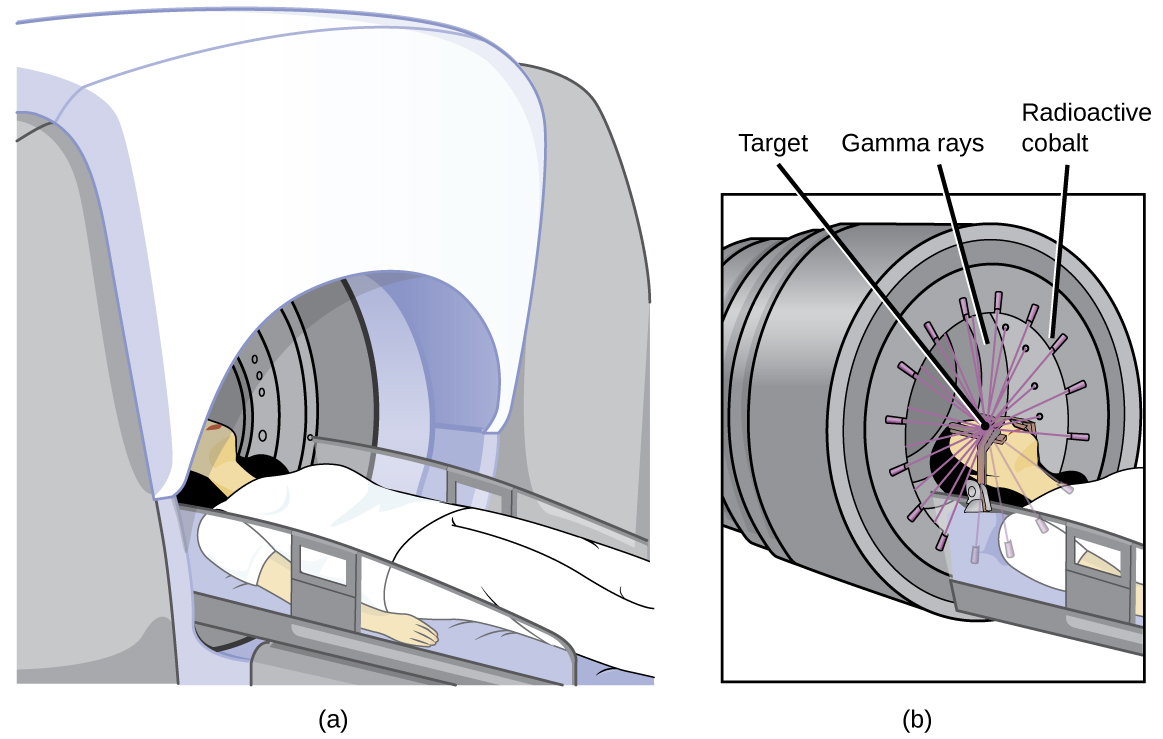
Figure 21.26図 21.26
The cartoon in (a) shows a cobalt-60 machine used in the treatment of cancer. The diagram in (b) shows how the gantry of the Co-60 machine swings through an arc, focusing radiation on the targeted region (tumor) and minimizing the amount of radiation that passes through nearby regions.
(a)は、がん治療に使うコバルト60装置の模式図。(b)はCo-60装置のガントリーが円弧状に動き、標的領域(腫瘍)へ放射線を集中させながら、近隣の領域を通る放射線量を最小限にする様子を示す。
Cobalt-60 is a synthetic radioisotope produced by the neutron activation of Co-59, which then undergoes β decay to form Ni-60, along with the emission of γ radiation. The overall process is:
コバルト60は、Co-59の中性子放射化で作る人工の放射性同位体である。その後β崩壊してNi-60になり、γ線も放出する。全体の過程は次のようになる。
The overall decay scheme for this is shown graphically in Figure 21.27.
この全体の崩壊過程を、図21.27に模式的に示す。
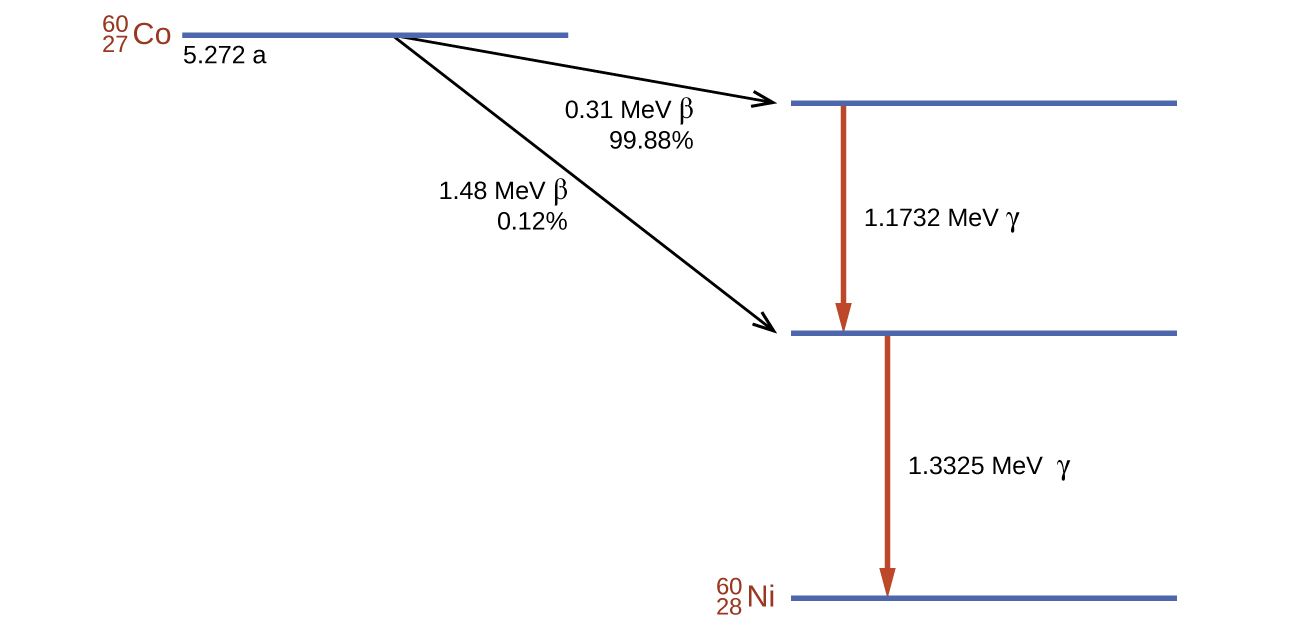


Figure 21.27図 21.27
Co-60 undergoes a series of radioactive decays. The γ emissions are used for radiation therapy.
Co-60は一連の放射性崩壊を起こす。放出されるγ線は、放射線療法に使われる。
Radioisotopes are used in diverse ways to study the mechanisms of chemical reactions in plants and animals. These include labeling fertilizers in studies of nutrient uptake by plants and crop growth, investigations of digestive and milk-producing processes in cows, and studies on the growth and metabolism of animals and plants.
英語のヒント
放射性同位体は、動植物の化学反応の仕組みを調べるために、さまざまに使われる。たとえば、植物の養分吸収と作物の成長を調べるための肥料の標識、ウシの消化や乳の生成過程の調査、動植物の成長と代謝の研究などである。
For example, the radioisotope C-14 was used to elucidate the details of how photosynthesis occurs. The overall reaction is:
英語のヒント
たとえば、光合成がどのように起こるかを詳しく解明するために、放射性同位体C-14が使われた。全体の反応は次の通りである。
but the process is much more complex, proceeding through a series of steps in which various organic compounds are produced. In studies of the pathway of this reaction, plants were exposed to CO2 containing a high concentration of . At regular intervals, the plants were analyzed to determine which organic compounds contained carbon-14 and how much of each compound was present. From the time sequence in which the compounds appeared and the amount of each present at given time intervals, scientists learned more about the pathway of the reaction.
英語のヒント
しかし、実際の過程ははるかに複雑で、さまざまな有機化合物が生じる一連の段階を経て進む。反応経路の研究では、高濃度のを含むCO2に植物をさらした。一定時間ごとに植物を分析し、どの有機化合物が炭素14を含むか、それぞれがどれだけ存在するかを調べた。化合物が現れる時間的な順序と、各時点に存在する量から、科学者は反応経路についてさらに知ることができた。
Commercial applications of radioactive materials are equally diverse (Figure 21.28). They include determining the thickness of films and thin metal sheets by exploiting the penetration power of various types of radiation. Flaws in metals used for structural purposes can be detected using high-energy gamma rays from cobalt-60 in a fashion similar to the way X-rays are used to examine the human body. In one form of pest control, flies are controlled by sterilizing male flies with γ radiation so that females breeding with them do not produce offspring. Many foods are preserved by radiation that kills microorganisms that cause the foods to spoil.
英語のヒント
放射性物質の商業利用も、同じように多様である(図21.28)。各種の放射線の透過力を利用して、フィルムや薄い金属板の厚さを測る。構造材料用金属の欠陥は、X線で人体を調べるのと似た方法で、コバルト60からの高エネルギーγ線を使って検出できる。害虫防除の一方法では、雄のハエをγ線で不妊化し、交尾した雌が子を残せないようにして、ハエを抑える。また、多くの食品は、腐敗の原因となる微生物を放射線で殺して保存する。
Image omitted because its reuse rights could not be verified.権利の確認ができないため画像を割愛。
Figure 21.28図 21.28
Common commercial uses of radiation include (a) X-ray examination of luggage at an airport and (b) preservation of food. (credit a: modification of work by the Department of the Navy; credit b: modification of work by the US Department of Agriculture)
一般的な放射線の商業利用には、(a)空港での手荷物のX線検査、(b)食品の保存などがある。(出典:aは米海軍省、bは米農務省の作品を改変)
Americium-241, an α emitter with a half-life of 458 years, is used in tiny amounts in ionization-type smoke detectors (Figure 21.29). The α emissions from Am-241 ionize the air between two electrode plates in the ionizing chamber. A battery supplies a potential that causes movement of the ions, thus creating a small electric current. When smoke enters the chamber, the movement of the ions is impeded, reducing the conductivity of the air. This causes a marked drop in the current, triggering an alarm.
英語のヒント
半減期458年のα線放出核種、アメリシウム241は、電離式煙感知器に微量使われる(図21.29)。Am-241のα線は、電離室の2枚の電極板の間の空気を電離する。電池が与える電位差でイオンが動き、小さな電流が生じる。煙が電離室へ入ると、イオンの動きが妨げられ、空気の電気伝導度が下がる。その結果、電流が大きく減少し、警報が作動する。
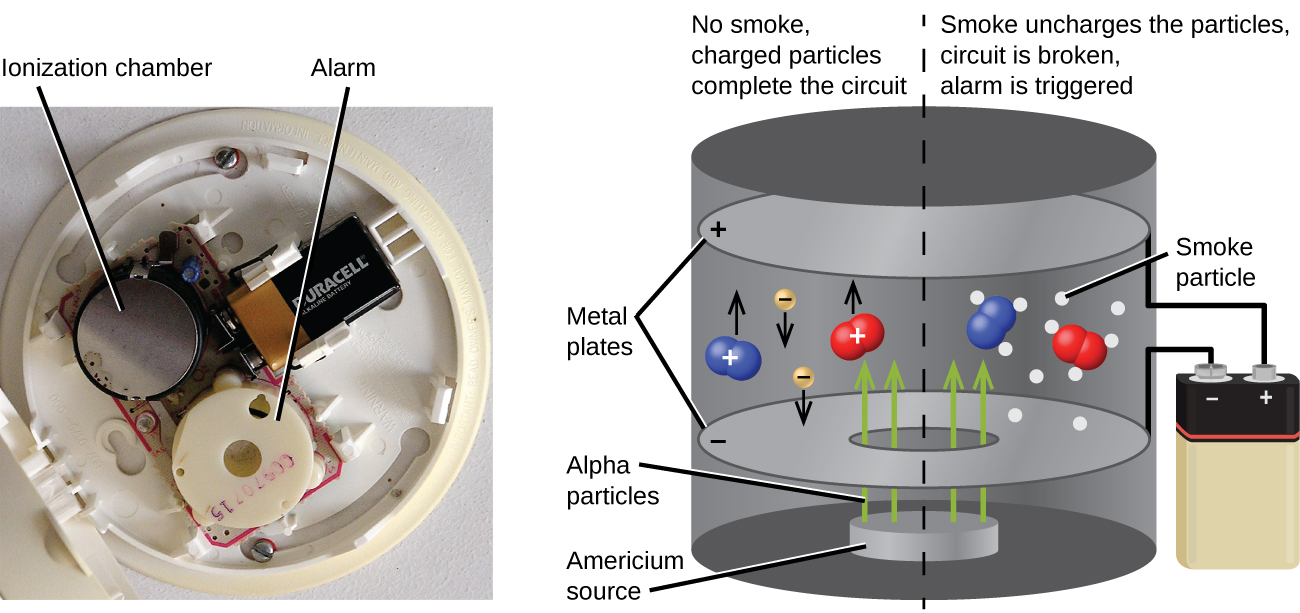
OpenStax, Rice University, Chemistry 2e. Original caption credit: (credit a: modification of work by “Muffet”/Wikimedia Commons) Source work: Smoke detector squircle.jpg · CC BY 2.0; OpenStax diagram CC BY 4.0 · Source出典

Figure 21.29図 21.29
Inside a smoke detector, Am-241 emits α particles that ionize the air, creating a small electric current. During a fire, smoke particles impede the flow of ions, reducing the current and triggering an alarm. (credit a: modification of work by “Muffet”/Wikimedia Commons)
煙感知器の中では、Am-241がα粒子を放出して空気を電離し、小さな電流を生む。火災時には、煙粒子がイオンの流れを妨げ、電流が減少して警報が作動する。(出典:aは「Muffet」/Wikimedia Commonsの作品を改変)