第21章核化学
Nuclear Stability原子核の安定性
A nucleus is stable if it cannot be transformed into another configuration without adding energy from the outside. Of the thousands of nuclides that exist, about 250 are stable. A plot of the number of neutrons versus the number of protons for stable nuclei reveals that the stable isotopes fall into a narrow band. This region is known as the band of stability (also called the belt, zone, or valley of stability). The straight line in Figure 21.2 represents nuclei that have a 1:1 ratio of protons to neutrons (n:p ratio). Note that the lighter stable nuclei, in general, have equal numbers of protons and neutrons. For example, nitrogen-14 has seven protons and seven neutrons. Heavier stable nuclei, however, have increasingly more neutrons than protons. For example: iron-56 has 30 neutrons and 26 protons, an n:p ratio of 1.15, whereas the stable nuclide lead-207 has 125 neutrons and 82 protons, an n:p ratio equal to 1.52. This is because larger nuclei have more proton-proton repulsions, and require larger numbers of neutrons to provide compensating strong forces to overcome these electrostatic repulsions and hold the nucleus together.
英語のヒント
外からエネルギーを加えなければ別の配置に変わらない原子核は、安定である。存在する数千種類の核種のうち、約250種類が安定である。安定な原子核について中性子数と陽子数をグラフにすると、安定同位体が狭い帯の中に収まる。この領域を安定帯、安定領域、安定の谷などと呼ぶ。図21.2の直線は、陽子と中性子の比が1:1の原子核を表す。軽い安定核は、一般に陽子数と中性子数が等しい。たとえば窒素14は、陽子7個と中性子7個をもつ。しかし、重い安定核ほど、陽子に対する中性子の割合が大きくなる。鉄56は中性子30個、陽子26個で、中性子と陽子の比n:pは1.15。安定核種の鉛207は中性子125個、陽子82個で、n:p比は1.52である。大きい原子核には陽子間の反発が多くある。その静電反発に打ち勝って核を結びつけておくには、強い力で補うための中性子がより多く必要になる。
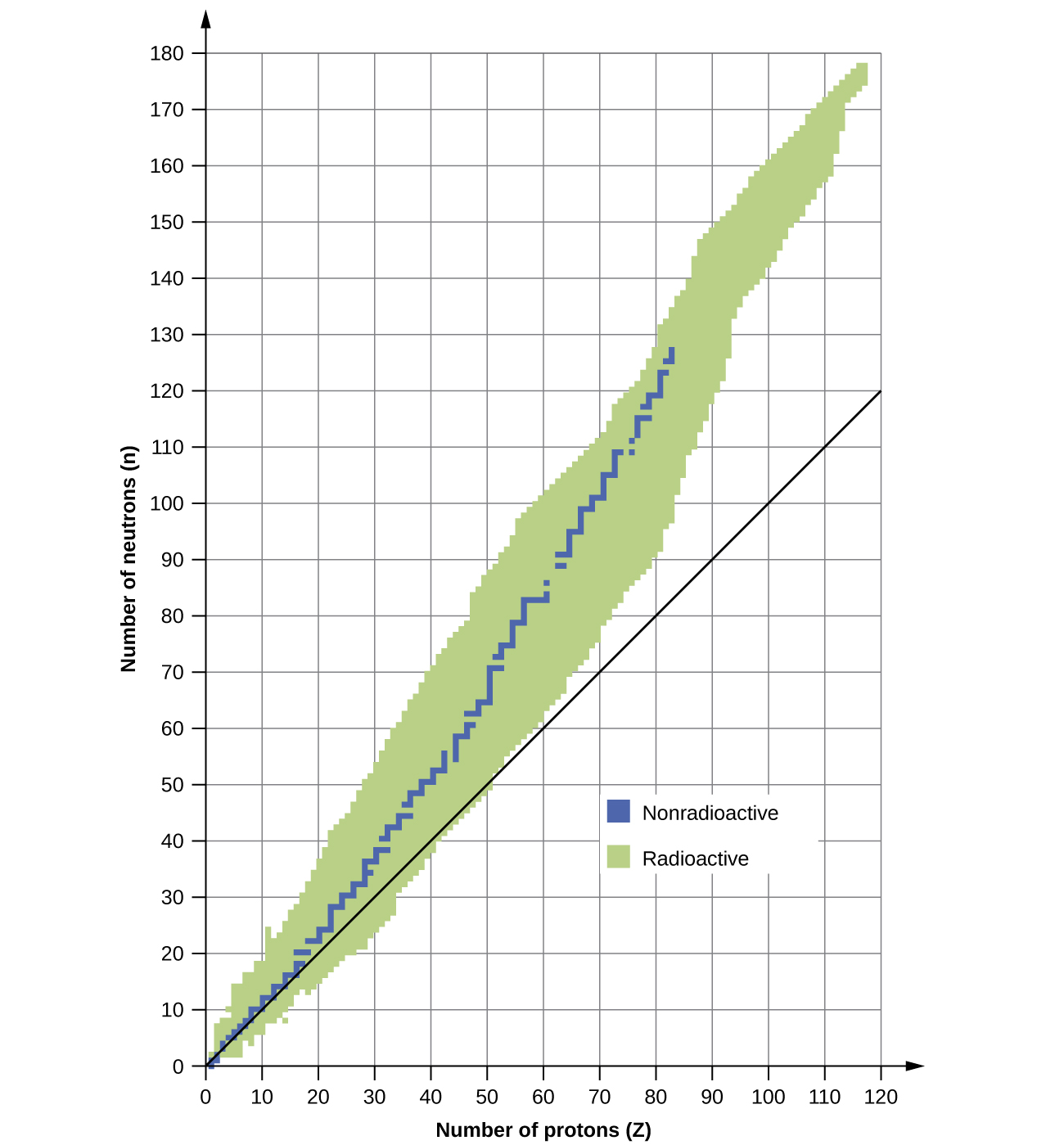
Figure 21.2図 21.2
This plot shows the nuclides that are known to exist and those that are stable. The stable nuclides are indicated in blue, and the unstable nuclides are indicated in green. Note that all isotopes of elements with atomic numbers greater than 83 are unstable. The solid line is the line where n = Z.
存在が知られている核種と、そのうち安定な核種を示すグラフ。安定核種は青、不安定核種は緑で示す。原子番号が83より大きい元素の同位体は、すべて不安定であることに注意しよう。実線はn = Zを表す。
The nuclei that are to the left or to the right of the band of stability are unstable and exhibit radioactivity. They change spontaneously (decay) into other nuclei that are either in, or closer to, the band of stability. These nuclear decay reactions convert one unstable isotope (or radioisotope) into another, more stable, isotope. We will discuss the nature and products of this radioactive decay in subsequent sections of this chapter.
英語のヒント
安定帯の左や右にある原子核は不安定で、放射能を示す。安定帯の中、またはそれに近い別の原子核へ、自発的に変化する。この変化を崩壊という。核崩壊反応は、不安定な同位体、すなわち放射性同位体を、より安定な別の同位体へ変える。この放射性崩壊の性質と生成物は、後の節で扱う。
Several observations may be made regarding the relationship between the stability of a nucleus and its structure. Nuclei with even numbers of protons, neutrons, or both are more likely to be stable (see Table 21.1). Nuclei with certain numbers of nucleons, known as magic numbers, are stable against nuclear decay. These numbers of protons or neutrons (2, 8, 20, 28, 50, 82, and 126) make complete shells in the nucleus. These are similar in concept to the stable electron shells observed for the noble gases. Nuclei that have magic numbers of both protons and neutrons, such as and are called “double magic” and are particularly stable. These trends in nuclear stability may be rationalized by considering a quantum mechanical model of nuclear energy states analogous to that used to describe electronic states earlier in this textbook. The details of this model are beyond the scope of this chapter.
英語のヒント
原子核の安定性と構造の関係には、いくつかの傾向が見られる。陽子数、中性子数、またはその両方が偶数の原子核は、安定であることが多い(表21.1)。また、魔法数と呼ばれる特定の核子数をもつ原子核は、核崩壊に対して安定である。陽子数または中性子数が2、8、20、28、50、82、126のとき、原子核の殻が満たされる。これは、希ガスの安定な電子殻と似た考え方である。、、、のように、陽子数と中性子数の両方が魔法数の核を二重魔法核と呼び、特に安定である。これらの傾向は、前に電子状態を説明したモデルに似た、核のエネルギー状態の量子力学的モデルで説明できる。このモデルの詳細は、この章の範囲を超える。
Stable Nuclear Isotopes 安定同位体 |
||
|---|---|---|
Number of Stable Isotopes 安定同位体の数 |
Proton Number 陽子数 |
Neutron Number 中性子数 |
157 |
even 偶数 |
even 偶数 |
53 |
even 偶数 |
odd 奇数 |
50 |
odd 奇数 |
even 偶数 |
5 |
odd 奇数 |
odd 奇数 |
The relative stability of a nucleus is correlated with its binding energy per nucleon, the total binding energy for the nucleus divided by the number or nucleons in the nucleus. For instance, we saw in Example 21.2 that the binding energy for a nucleus is 28.4 MeV. The binding energy per nucleon for a nucleus is therefore:
原子核の相対的な安定性は、核子1個あたりの結合エネルギーと相関する。これは、核全体の結合エネルギーを核子数で割った値である。たとえば、例題21.2ではの原子核の結合エネルギーが28.4 MeVであることを見た。したがって、の核子1個あたりの結合エネルギーは、
In Example 21.3, we learn how to calculate the binding energy per nucleon of a nuclide on the curve shown in Figure 21.3.
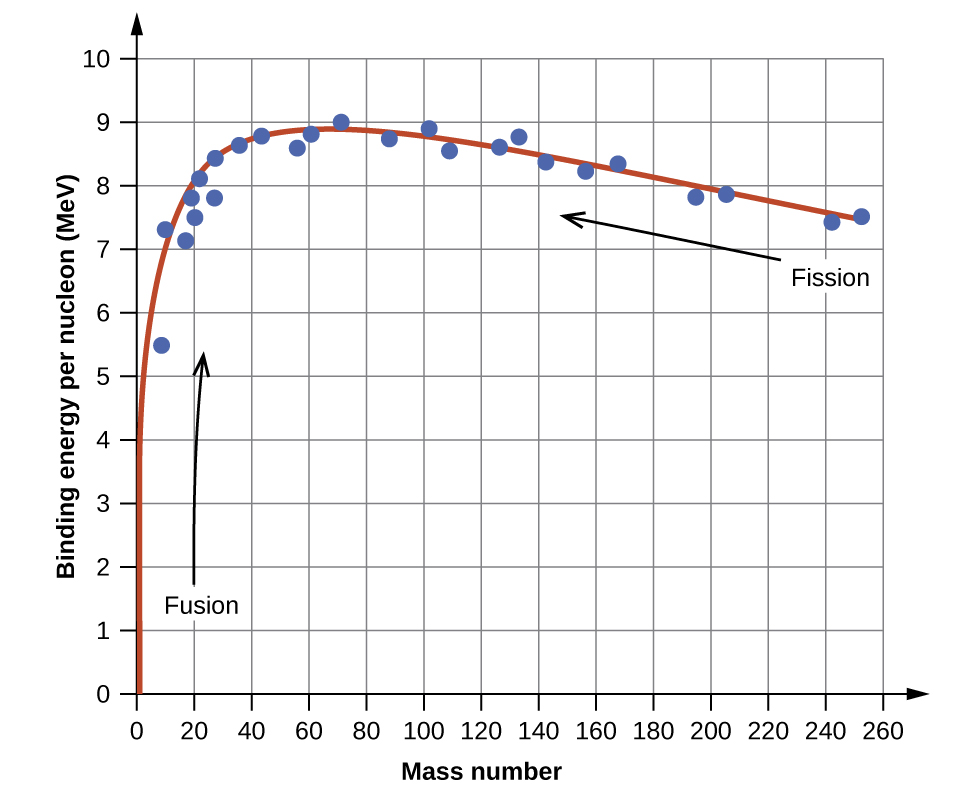


Figure 21.3図 21.3
The binding energy per nucleon is largest for nuclides with mass number of approximately 56.
核子1個あたりの結合エネルギーは、質量数がおよそ56の核種で最大になる。
Example 21.3例題 21.3
Calculation of Binding Energy per Nucleon核子1個あたりの結合エネルギーの計算
The iron nuclide lies near the top of the binding energy curve (Figure 21.3) and is one of the most stable nuclides. What is the binding energy per nucleon (in MeV) for the nuclide (atomic mass of 55.9349 amu)?
鉄の核種は結合エネルギー曲線(図21.3)の頂点近くにあり、最も安定な核種の1つである。核種(原子質量55.9349 amu)の核子1個あたりの結合エネルギーは何MeVか。
Solution解法
As in Example 21.2, we first determine the mass defect of the nuclide, which is the difference between the mass of 26 protons, 30 neutrons, and 26 electrons, and the observed mass of an atom:
例題21.2と同様に、まず核種の質量欠損を求める。これは、陽子26個、中性子30個、電子26個の質量の合計と、実測した原子の質量との差である。
We next calculate the binding energy for one nucleus from the mass defect using the mass-energy equivalence equation:
次に、質量とエネルギーの等価式を使い、質量欠損から原子核1個の結合エネルギーを計算する。
We then convert the binding energy in joules per nucleus into units of MeV per nuclide:
続いて、核1個あたりのジュールで表した結合エネルギーを、核種1個あたりのMeVへ換算する。
Finally, we determine the binding energy per nucleon by dividing the total nuclear binding energy by the number of nucleons in the atom:
最後に、核全体の結合エネルギーを核子数で割り、核子1個あたりの結合エネルギーを求める。
Note that this is almost 25% larger than the binding energy per nucleon for
この値は、の核子1個あたりの結合エネルギーより約25%大きいことに注意しよう。
(Note also that this is the same process as in Example 21.1, but with the additional step of dividing the total nuclear binding energy by the number of nucleons.)
例題21.1と同じ手順に、核全体の結合エネルギーを核子数で割る段階を追加したものであることにも注意しよう。
Check Your Learning理解度を確かめよう
What is the binding energy per nucleon in (atomic mass, 18.9984 amu)?
(原子質量18.9984 amu)の核子1個あたりの結合エネルギーはいくらか。