第21章核化学
Radioactive Decay Series放射性崩壊系列
The naturally occurring radioactive isotopes of the heaviest elements fall into chains of successive disintegrations, or decays, and all the species in one chain constitute a radioactive family, or radioactive decay series. Three of these series include most of the naturally radioactive elements of the periodic table. They are the uranium series, the actinide series, and the thorium series. The neptunium series is a fourth series, which is no longer significant on the earth because of the short half-lives of the species involved. Each series is characterized by a parent (first member) that has a long half-life and a series of daughter nuclides that ultimately lead to a stable end-product—that is, a nuclide on the band of stability (Figure 21.9). In all three series, the end-product is a stable isotope of lead. The neptunium series, previously thought to terminate with bismuth-209, terminates with thallium-205.
英語のヒント
最も重い元素の、自然に存在する放射性同位体は、連続する壊変、すなわち崩壊の鎖を作る。1本の鎖に含まれるすべての核種を、放射性の族、または放射性崩壊系列という。自然放射性元素の大半は、ウラン系列、アクチノイド系列、トリウム系列という3つの系列に入る。4つ目はネプツニウム系列だが、関わる核種の半減期が短いため、現在の地球では重要でなくなっている。各系列は、長い半減期をもつ最初の親核種と、最終的に安定な生成物、すなわち安定帯上の核種に至る娘核種の連なりからなる(図21.9)。3系列はいずれも、最終生成物が鉛の安定同位体である。ネプツニウム系列は以前、ビスマス209で終わると考えられていたが、タリウム205で終わる。
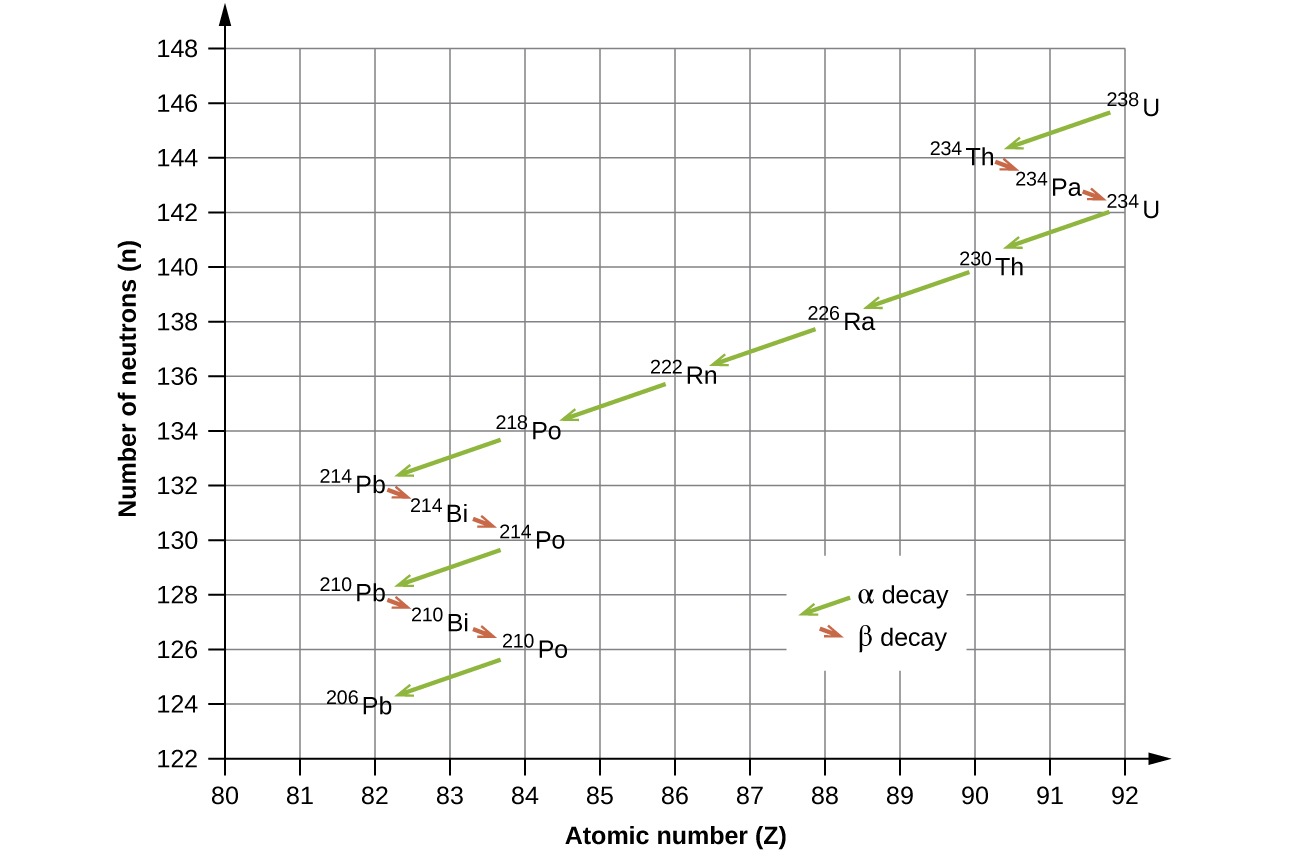
Figure 21.9図 21.9
Uranium-238 undergoes a radioactive decay series consisting of 14 separate steps before producing stable lead-206. This series consists of eight α decays and six β decays.
ウラン238は14段階からなる放射性崩壊系列を経て、安定な鉛206になる。この系列は、8回のα崩壊と6回のβ崩壊からなる。
Radioactive Half-Lives放射性核種の半減期
Radioactive decay follows first-order kinetics. Since first-order reactions have already been covered in detail in the kinetics chapter, we will now apply those concepts to nuclear decay reactions. Each radioactive nuclide has a characteristic, constant half-life (t1/2), the time required for half of the atoms in a sample to decay. An isotope’s half-life allows us to determine how long a sample of a useful isotope will be available, and how long a sample of an undesirable or dangerous isotope must be stored before it decays to a low-enough radiation level that is no longer a problem.
英語のヒント
放射性崩壊は一次反応の速度則に従う。一次反応は反応速度の章で詳しく扱ったので、ここではその考え方を核崩壊に応用する。各放射性核種には、固有で一定の半減期t1/2がある。半減期は、試料中の原子の半分が崩壊するのに必要な時間である。半減期がわかれば、有用な同位体の試料をいつまで使えるか、また不要・危険な同位体を、放射線量が問題にならないほど低くなるまでどれだけ保管する必要があるかを求められる。
For example, cobalt-60, an isotope that emits gamma rays used to treat cancer, has a half-life of 5.27 years (Figure 21.10). In a given cobalt-60 source, since half of the nuclei decay every 5.27 years, both the amount of material and the intensity of the radiation emitted is cut in half every 5.27 years. (Note that for a given substance, the intensity of radiation that it produces is directly proportional to the rate of decay of the substance and the amount of the substance.) This is as expected for a process following first-order kinetics. Thus, a cobalt-60 source that is used for cancer treatment must be replaced regularly to continue to be effective.
たとえば、がん治療に使うγ線を放出する同位体コバルト60の半減期は5.27年である(図21.10)。コバルト60の線源では、5.27年ごとにの核の半分が崩壊する。そのため、物質の量と放出放射線の強さは、どちらも5.27年ごとに半分になる。ある物質が出す放射線の強さは、その物質の崩壊速度と量に正比例する。これは、一次反応の速度則から予想されるとおりである。したがって、がん治療用のコバルト60線源は、有効性を保つために定期的な交換が必要となる。
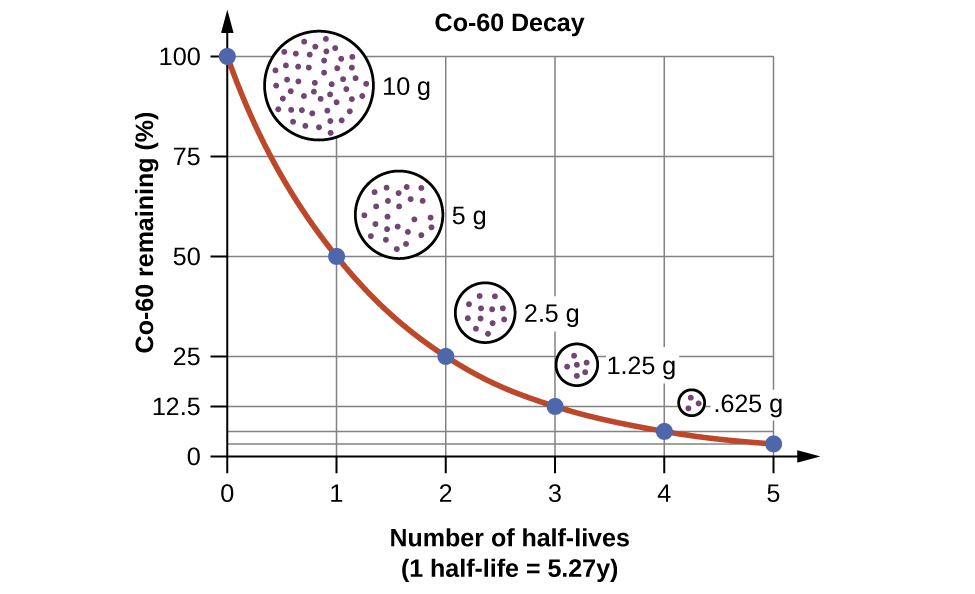


Figure 21.10図 21.10
For cobalt-60, which has a half-life of 5.27 years, 50% remains after 5.27 years (one half-life), 25% remains after 10.54 years (two half-lives), 12.5% remains after 15.81 years (three half-lives), and so on.
半減期5.27年のコバルト60は、5.27年後(半減期1回分)に50%、10.54年後(2回分)に25%、15.81年後(3回分)に12.5%が残り、以後も同じように減っていく。
Since nuclear decay follows first-order kinetics, we can adapt the mathematical relationships used for first-order chemical reactions. We generally substitute the number of nuclei, N, for the concentration. If the rate is stated in nuclear decays per second, we refer to it as the activity of the radioactive sample. The rate for radioactive decay is:
英語のヒント
核崩壊は一次反応の速度則に従うので、一次の化学反応に使った数学的関係を応用できる。一般に、濃度の代わりに原子核の数Nを使う。毎秒の核崩壊の回数で表した速度を、試料の放射能という。放射性崩壊の速度は、
decay rate = λN with λ = the decay constant for the particular radioisotope
崩壊速度 = λN。λは、その放射性同位体の崩壊定数である。
The decay constant, λ, which is the same as a rate constant discussed in the kinetics chapter. It is possible to express the decay constant in terms of the half-life, t1/2:
崩壊定数λは、反応速度の章で扱った速度定数と同じ役割をもつ。崩壊定数は、半減期t1/2を用いて次のように表せる。
The first-order equations relating amount, N, and time are:
量Nと時間を結ぶ一次反応の式は、次のとおりである。
where N0 is the initial number of nuclei or moles of the isotope, and Nt is the number of nuclei/moles remaining at time t. Example 21.5 applies these calculations to find the rates of radioactive decay for specific nuclides.
ここでN0は同位体の初期の原子核数、またはモル数、Ntは時刻tに残る原子核数、またはモル数である。例題21.5では、これらの計算を特定の核種の放射性崩壊速度に適用する。
Example 21.5例題 21.5
Rates of Radioactive Decay放射性崩壊の速度
decays with a half-life of 5.27 years to produce
は半減期5.27年で崩壊し、を生じる。
(a) What is the decay constant for the radioactive disintegration of cobalt-60?
(a) コバルト60の放射性崩壊の崩壊定数はいくらか。
(b) Calculate the fraction of a sample of the isotope that will remain after 15 years.
(b) 同位体の試料が、15年後に残る割合を求めなさい。
(c) How long does it take for a sample of to disintegrate to the extent that only 2.0% of the original amount remains?
(c) の試料が崩壊し、初期量の2.0%だけになるまでに、どれだけ時間がかかるか。
Solution解法
(a) The value of the rate constant is given by:
(a) 速度定数の値は、次の式で与えられる。
(b) The fraction of that is left after time t is given by Rearranging the first-order relationship Nt = N0e–λt to solve for this ratio yields:
(b) 時間tの後に残るの割合は、で表される。この比について解くために、一次反応の関係Nt = N0e–λtを整理すると、
The fraction of that will remain after 15.0 years is 0.138. Or put another way, 13.8% of the originally present will remain after 15 years.
15.0年後に残るの割合は0.138である。言い換えると、初めに存在したの13.8%が、15年後にも残っている。
(c) 2.00% of the original amount of is equal to 0.0200 N0. Substituting this into the equation for time for first-order kinetics, we have:
(c) の初期量の2.00%は、0.0200 N0に等しい。これを一次反応の時間の式へ代入すると、
Check Your Learning理解度を確かめよう
Radon-222, has a half-life of 3.823 days. How long will it take a sample of radon-222 with a mass of 0.750 g to decay into other elements, leaving only 0.100 g of radon-222?
ラドン222 の半減期は3.823日である。質量0.750 gのラドン222試料がほかの元素へ崩壊し、残るラドン222が0.100 gになるまでに、どれだけ時間がかかるか。
Because each nuclide has a specific number of nucleons, a particular balance of repulsion and attraction, and its own degree of stability, the half-lives of radioactive nuclides vary widely. For example: the half-life of is 1.9 1019 years; is 24,000 years; is 3.82 days; and element-111 (Rg for roentgenium) is 1.5 10–3 seconds. The half-lives of a number of radioactive isotopes important to medicine are shown in Table 21.2, and others are listed in Appendix M.
Half-lives of Radioactive Isotopes Important to Medicine 医療で重要な放射性同位体の半減期 |
|||
|---|---|---|---|
Type The “m” in Tc-99m stands for “metastable,” indicating that this is an unstable, high-energy state of Tc-99. Metastable isotopes emit γ radiation to rid themselves of excess energy and become (more) stable. 種類。Tc-99mの「m」は「準安定」を意味し、Tc-99の不安定で高エネルギーの状態を示す。準安定な同位体はγ線を放出して余分なエネルギーを失い、より安定になる。 |
Decay Mode 崩壊形式 |
Half-Life 半減期 |
Uses 用途 |
F-18 |
β+ decay β+崩壊 |
110. minutes 110.分 |
PET scans PET検査 |
Co-60 |
β decay, γ decay β崩壊、γ崩壊 |
5.27 years 5.27年 |
cancer treatment がん治療 |
Tc-99m |
γ decay γ崩壊 |
8.01 hours 8.01時間 |
scans of brain, lung, heart, bone 脳・肺・心臓・骨の検査 |
I-131 |
β decay β崩壊 |
8.02 days 8.02日 |
thyroid scans and treatment 甲状腺の検査と治療 |
Tl-201 |
electron capture 電子捕獲 |
73 hours 73時間 |
heart and arteries scans; cardiac stress tests 心臓・動脈の検査、心臓負荷試験 |