第21章核化学
21.2 Nuclear Equations21.2 核反応式
Learning Objectives学習目標
By the end of this section, you will be able to:
この節を終えると、次のことができるようになる。
- Identify common particles and energies involved in nuclear reactions核反応に関わる代表的な粒子とエネルギーを見分ける
- Write and balance nuclear equations核反応式を書き、つり合いを合わせる
Changes of nuclei that result in changes in their atomic numbers, mass numbers, or energy states are nuclear reactions. To describe a nuclear reaction, we use an equation that identifies the nuclides involved in the reaction, their mass numbers and atomic numbers, and the other particles involved in the reaction.
英語のヒント
原子番号、質量数、またはエネルギー状態の変化を伴う原子核の変化を、核反応という。核反応は、関わる核種、その質量数・原子番号、さらに関わるほかの粒子を示す式で表す。
Types of Particles in Nuclear Reactions核反応に関わる粒子の種類
Many entities can be involved in nuclear reactions. The most common are protons, neutrons, alpha particles, beta particles, positrons, and gamma rays, as shown in Figure 21.4. Protons also represented by the symbol and neutrons are the constituents of atomic nuclei, and have been described previously. Alpha particles also represented by the symbol are high-energy helium nuclei. Beta particles also represented by the symbol are high-energy electrons, and gamma rays are photons of very high-energy electromagnetic radiation. Positrons also represented by the symbol are positively charged electrons (“anti-electrons”). The subscripts and superscripts are necessary for balancing nuclear equations, but are usually optional in other circumstances. For example, an alpha particle is a helium nucleus (He) with a charge of +2 and a mass number of 4, so it is symbolized This works because, in general, the ion charge is not important in the balancing of nuclear equations.
英語のヒント
核反応にはさまざまなものが関わる。図21.4に示すように、特によく現れるのは陽子、中性子、α粒子、β粒子、陽電子、γ線である。陽子は記号でも表し、中性子とともに原子核を構成する。これらはすでに説明した。α粒子は記号でも表す、高エネルギーのヘリウム原子核である。β粒子は記号でも表す、高エネルギーの電子である。γ線は、非常に高いエネルギーの電磁放射の光子である。陽電子は記号でも表す、正電荷をもつ電子、すなわち「反電子」である。下付き・上付きの数字は核反応式のつり合いを合わせるのに必要だが、ほかの場合は通常、省略してもよい。たとえばα粒子は、電荷+2、質量数4のヘリウム原子核Heなので、と表す。一般に核反応式のつり合いではイオンの電荷が重要でないため、この表し方でよい。
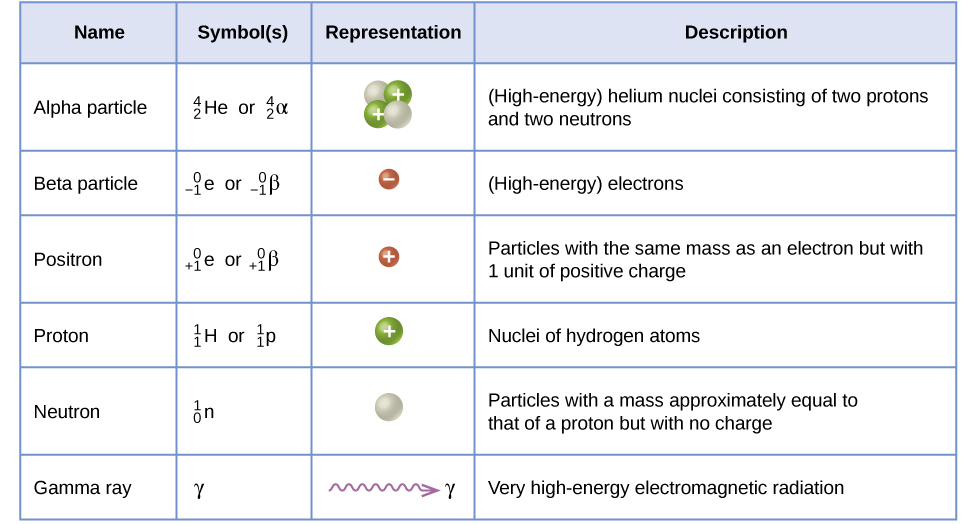

Figure 21.4図 21.4
Although many species are encountered in nuclear reactions, this table summarizes the names, symbols, representations, and descriptions of the most common of these.
核反応には多くの種類の粒子などが現れるが、この表では特によく現れるものの名称、記号、図示、説明をまとめている。
Note that positrons are exactly like electrons, except they have the opposite charge. They are the most common example of antimatter, particles with the same mass but the opposite state of another property (for example, charge) than ordinary matter. When antimatter encounters ordinary matter, both are annihilated and their mass is converted into energy in the form of gamma rays (γ)—and other much smaller subnuclear particles, which are beyond the scope of this chapter—according to the mass-energy equivalence equation E = mc2, seen in the preceding section. For example, when a positron and an electron collide, both are annihilated and two gamma ray photons are created:
英語のヒント
陽電子は、電荷が反対であることを除けば電子とまったく同じである。陽電子は反物質の最も一般的な例である。反物質とは、通常の物質と質量が等しく、電荷など別の性質が反対の状態にある粒子をいう。反物質が通常の物質と出会うと、両者は消滅し、その質量がγ線という形のエネルギーへ変わる。この章の範囲を超える、さらに小さな亜核粒子も生じる。これは、前の節で見た質量とエネルギーの等価式E = mc2に従う。たとえば陽電子と電子が衝突すると、両者は消滅し、2個のγ線光子ができる。
As seen in the chapter discussing light and electromagnetic radiation, gamma rays compose short wavelength, high-energy electromagnetic radiation and are (much) more energetic than better-known X-rays that can behave as particles in the wave-particle duality sense. Gamma rays are a type of high energy electromagnetic radiation produced when a nucleus undergoes a transition from a higher to a lower energy state, similar to how a photon is produced by an electronic transition from a higher to a lower energy level. Due to the much larger energy differences between nuclear energy shells, gamma rays emanating from a nucleus have energies that are typically millions of times larger than electromagnetic radiation emanating from electronic transitions.
英語のヒント
光と電磁放射の章で見たように、γ線は波長が短い高エネルギーの電磁放射であり、よく知られたX線よりもはるかに高いエネルギーをもつ。波動と粒子の二重性の意味で、粒子としても振る舞う。γ線は、原子核が高いエネルギー状態から低い状態へ遷移するときに生じる。これは、電子が高いエネルギー準位から低い準位へ遷移すると光子が生じることに似ている。核のエネルギー殻の間隔ははるかに大きいので、原子核からのγ線のエネルギーは、通常、電子遷移からの電磁放射の数百万倍になる。
Balancing Nuclear Reactions核反応のつり合い
A balanced chemical reaction equation reflects the fact that during a chemical reaction, bonds break and form, and atoms are rearranged, but the total numbers of atoms of each element are conserved and do not change. A balanced nuclear reaction equation indicates that there is a rearrangement during a nuclear reaction, but of nucleons (subatomic particles within the atoms’ nuclei) rather than atoms. Nuclear reactions also follow conservation laws, and they are balanced in two ways:
英語のヒント
つり合いの取れた化学反応式は、反応中に結合が切れたりできたりして原子の並びが変わっても、各元素の原子の総数は保存されるという事実を表す。つり合いの取れた核反応式も組み替えを表すが、組み替わるのは原子ではなく、原子核内の亜原子粒子である核子である。核反応も保存則に従い、次の2点でつり合いを保つ。
- The sum of the mass numbers of the reactants equals the sum of the mass numbers of the products.反応物の質量数の和は、生成物の質量数の和に等しい。
- The sum of the charges of the reactants equals the sum of the charges of the products.反応物の電荷の和は、生成物の電荷の和に等しい。
If the atomic number and the mass number of all but one of the particles in a nuclear reaction are known, we can identify the particle by balancing the reaction. For instance, we could determine that is a product of the nuclear reaction of and if we knew that a proton, was one of the two products. Example 21.4 shows how we can identify a nuclide by balancing the nuclear reaction.
英語のヒント
核反応に現れる粒子のうち、1つを除くすべての原子番号と質量数がわかれば、式のつり合いから未知の粒子を特定できる。たとえば、との核反応で、2つの生成物の1つが陽子だとわかっていれば、もう1つがだと求められる。例題21.4では、核反応のつり合いから核種を特定する方法を示す。
Example 21.4例題 21.4
Balancing Equations for Nuclear Reactions核反応式のつり合いを合わせる
The reaction of an α particle with magnesium-25 produces a proton and a nuclide of another element. Identify the new nuclide produced.
α粒子とマグネシウム25 が反応すると、陽子と別の元素の核種ができる。新たにできた核種を特定しなさい。
Solution解法
The nuclear reaction can be written as:
核反応は次のように書ける。
where A is the mass number and Z is the atomic number of the new nuclide, X. Because the sum of the mass numbers of the reactants must equal the sum of the mass numbers of the products:
ここでAは新たな核種Xの質量数、Zは原子番号である。反応物と生成物の質量数の和は等しくなければならないので、
Similarly, the charges must balance, so:
同様に、電荷もつり合わなければならないので、
Check the periodic table: The element with nuclear charge = +13 is aluminum. Thus, the product is
周期表を確かめると、核電荷+13の元素はアルミニウムである。したがって、生成物はである。
Check Your Learning理解度を確かめよう
The nuclide combines with an electron and produces a new nucleus and no other massive particles. What is the equation for this reaction?
核種が電子1個と結びつき、新しい原子核を生じる。ほかに質量をもつ粒子は生じない。この反応を式で表しなさい。
Following are the equations of several nuclear reactions that have important roles in the history of nuclear chemistry:
以下に、核化学の歴史で重要な役割を果たした核反応の式を示す。
- The first naturally occurring unstable element that was isolated, polonium, was discovered by the Polish scientist Marie Curie and her husband Pierre in 1898. It decays, emitting α particles:自然に存在する不安定な元素として初めて単離されたポロニウムは、ポーランド出身の科学者マリー・キュリーと夫ピエールによって1898年に発見された。α粒子を放出して崩壊する。
- The first nuclide to be prepared by artificial means was an isotope of oxygen, 17O. It was made by Ernest Rutherford in 1919 by bombarding nitrogen atoms with α particles:人工的に初めて作られた核種は、酸素の同位体17Oである。アーネスト・ラザフォードが1919年、窒素原子にα粒子を衝突させて作った。
- James Chadwick discovered the neutron in 1932, as a previously unknown neutral particle produced along with 12C by the nuclear reaction between 9Be and 4He:ジェームズ・チャドウィックは1932年、中性子を発見した。9Beと4Heの核反応で、12Cとともに生じる、それまで知られていなかった中性粒子だった。
- The first element to be prepared that does not occur naturally on the earth, technetium, was created by bombardment of molybdenum by deuterons (heavy hydrogen, , by Emilio Segre and Carlo Perrier in 1937:地球上に自然には存在しない元素として初めて作られたテクネチウムは、1937年にエミリオ・セグレとカルロ・ペリエによって合成された。モリブデンに重陽子(重い水素、)を衝突させて作った。
- The first controlled nuclear chain reaction was carried out in a reactor at the University of Chicago in 1942. One of the many reactions involved was:制御された核連鎖反応が初めて実現したのは、1942年、シカゴ大学の原子炉である。関わる多くの反応の1つを示す。