第21章核化学
21.3 Radioactive Decay21.3 放射性崩壊
Learning Objectives学習目標
By the end of this section, you will be able to:
この節を終えると、次のことができるようになる。
- Recognize common modes of radioactive decay代表的な放射性崩壊の形式を見分ける
- Identify common particles and energies involved in nuclear decay reactions核崩壊反応に関わる代表的な粒子とエネルギーを見分ける
- Write and balance nuclear decay equations核崩壊の反応式を書き、つり合いを合わせる
- Calculate kinetic parameters for decay processes, including half-life半減期など、崩壊過程の速度を表す量を計算する
- Describe common radiometric dating techniques代表的な放射年代測定法を説明する
Following the somewhat serendipitous discovery of radioactivity by Becquerel, many prominent scientists began to investigate this new, intriguing phenomenon. Among them were Marie Curie (the first woman to win a Nobel Prize, and the only person to win two Nobel Prizes in different sciences—chemistry and physics), who was the first to coin the term “radioactivity,” and Ernest Rutherford (of gold foil experiment fame), who investigated and named three of the most common types of radiation. During the beginning of the twentieth century, many radioactive substances were discovered, the properties of radiation were investigated and quantified, and a solid understanding of radiation and nuclear decay was developed.
英語のヒント
ベクレルによる、いくらか偶然に導かれた放射能の発見を受け、多くの著名な科学者がこの新しい興味深い現象を調べ始めた。その中には、初めて「放射能」という語を作ったマリー・キュリーや、金箔実験で知られ、代表的な3種類の放射線を調べて命名したアーネスト・ラザフォードがいた。キュリーは、女性で初めてノーベル賞を受け、化学と物理という異なる科学分野で2度受賞した唯一の人物である。20世紀初頭には、多くの放射性物質が発見され、放射線の性質が調査・定量化され、放射線と核崩壊について確かな理解が築かれた。
The spontaneous change of an unstable nuclide into another is radioactive decay. The unstable nuclide is called the parent nuclide; the nuclide that results from the decay is known as the daughter nuclide. The daughter nuclide may be stable, or it may decay itself. The radiation produced during radioactive decay is such that the daughter nuclide lies closer to the band of stability than the parent nuclide, so the location of a nuclide relative to the band of stability can serve as a guide to the kind of decay it will undergo (Figure 21.5).
英語のヒント
不安定な核種が別の核種へ自発的に変化することを、放射性崩壊という。初めの不安定な核種を親核種、崩壊で生じた核種を娘核種と呼ぶ。娘核種は安定な場合も、さらに崩壊する場合もある。放射性崩壊では、娘核種が親核種より安定帯に近づくような放射線が生じる。そのため、安定帯に対する核種の位置を見れば、どのような崩壊を起こすかを判断する手掛かりになる(図21.5)。
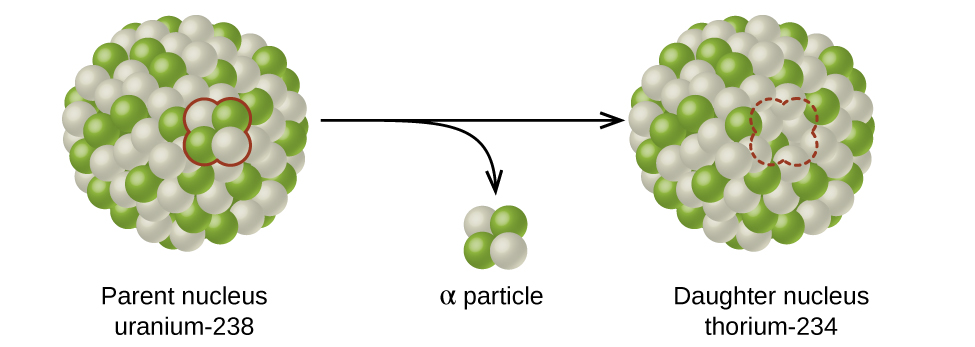
Figure 21.5図 21.5
A nucleus of uranium-238 (the parent nuclide) undergoes α decay to form thorium-234 (the daughter nuclide). The alpha particle removes two protons (green) and two neutrons (gray) from the uranium-238 nucleus.
親核種であるウラン238の原子核がα崩壊し、娘核種のトリウム234となる。α粒子によって、ウラン238の核から陽子2個(緑)と中性子2個(灰色)が取り除かれる。
Types of Radioactive Decay放射性崩壊の種類
Ernest Rutherford’s experiments involving the interaction of radiation with a magnetic or electric field (Figure 21.6) helped him determine that one type of radiation consisted of positively charged and relatively massive α particles; a second type was made up of negatively charged and much less massive β particles; and a third was uncharged electromagnetic waves, γ rays. We now know that α particles are high-energy helium nuclei, β particles are high-energy electrons, and γ radiation compose high-energy electromagnetic radiation. We classify different types of radioactive decay by the radiation produced.
英語のヒント
ラザフォードは、放射線と磁場・電場との相互作用の実験(図21.6)から、3種類の放射線の性質を調べた。1つ目は正電荷をもつ比較的重いα粒子、2つ目は負電荷をもつずっと軽いβ粒子、3つ目は電荷をもたない電磁波のγ線だった。現在では、α粒子は高エネルギーのヘリウム原子核、β粒子は高エネルギーの電子、γ線は高エネルギーの電磁放射であるとわかっている。放射性崩壊は、生じる放射線の種類によって分類する。
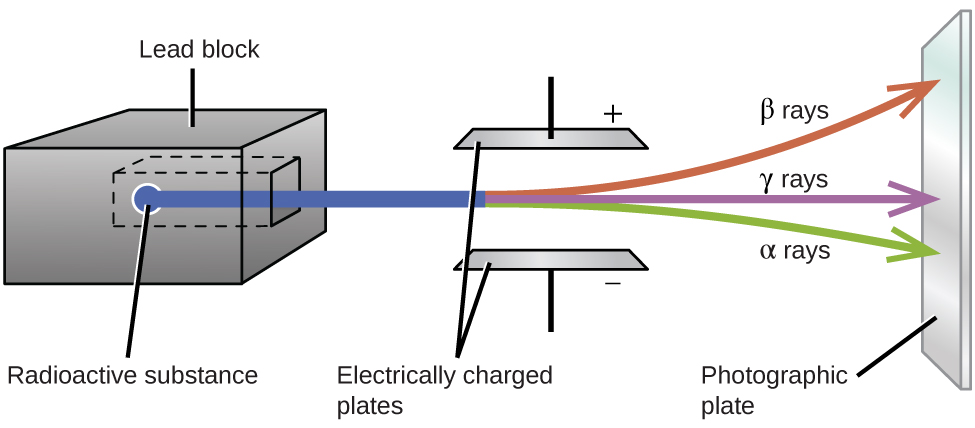
Figure 21.6図 21.6
Alpha particles, which are attracted to the negative plate and deflected by a relatively small amount, must be positively charged and relatively massive. Beta particles, which are attracted to the positive plate and deflected a relatively large amount, must be negatively charged and relatively light. Gamma rays, which are unaffected by the electric field, must be uncharged.
α粒子は負の極板に引かれ、曲がり方が比較的小さいので、正電荷をもち、比較的重いとわかる。β粒子は正の極板に引かれ、大きく曲がるので、負電荷をもち、比較的軽いとわかる。γ線は電場の影響を受けないので、電荷をもたないとわかる。
Alpha (α) decay is the emission of an α particle from the nucleus. For example, polonium-210 undergoes α decay:
α崩壊とは、原子核からα粒子が放出されることである。たとえばポロニウム210は、次のようにα崩壊する。
Alpha decay occurs primarily in heavy nuclei (A > 200, Z > 83). Because the loss of an α particle gives a daughter nuclide with a mass number four units smaller and an atomic number two units smaller than those of the parent nuclide, the daughter nuclide has a larger n:p ratio than the parent nuclide. If the parent nuclide undergoing α decay lies below the band of stability (refer to Figure 21.2), the daughter nuclide will lie closer to the band.
α崩壊は、主に重い原子核(A > 200、Z > 83)で起こる。α粒子を失うと、娘核種の質量数は親核種より4小さく、原子番号は2小さくなる。このため、娘核種のn:p比は親核種より大きくなる。α崩壊する親核種が安定帯の下にある場合(図21.2参照)、娘核種は安定帯へ近づく。
Beta (β) decay is the emission of an electron from a nucleus. Iodine-131 is an example of a nuclide that undergoes β decay:
β崩壊とは、原子核から電子が放出されることである。ヨウ素131は、β崩壊をする核種の一例である。
Beta decay, which can be thought of as the conversion of a neutron into a proton and a β particle, is observed in nuclides with a large n:p ratio. The beta particle (electron) emitted is from the atomic nucleus and is not one of the electrons surrounding the nucleus. Such nuclei lie above the band of stability. Emission of an electron does not change the mass number of the nuclide but does increase the number of its protons and decrease the number of its neutrons. Consequently, the n:p ratio is decreased, and the daughter nuclide lies closer to the band of stability than did the parent nuclide.
英語のヒント
β崩壊は、中性子が陽子とβ粒子へ変わる過程と考えられ、n:p比の大きな核種で観察される。放出されるβ粒子(電子)は原子核から来るもので、原子核の周囲にある電子の1つではない。こうした核種は安定帯の上にある。電子を放出しても核種の質量数は変わらないが、陽子数は増え、中性子数は減る。その結果、n:p比が小さくなり、娘核種は親核種より安定帯へ近づく。
Gamma emission (γ emission) is observed when a nuclide is formed in an excited state and then decays to its ground state with the emission of a γ ray, a quantum of high-energy electromagnetic radiation. The presence of a nucleus in an excited state is often indicated by an asterisk (*). Cobalt-60 emits γ radiation and is used in many applications including cancer treatment:
英語のヒント
γ線放出は、励起状態でできた核種が、高エネルギーの電磁放射の量子であるγ線を出し、基底状態へ移るときに観察される。原子核が励起状態であることは、しばしばアスタリスク*で示す。コバルト60はγ線を放出し、がん治療を含む多くの用途に使われる。
There is no change in mass number or atomic number during the emission of a γ ray unless the γ emission accompanies one of the other modes of decay.
γ線放出がほかの形式の崩壊を伴わない限り、γ線放出では質量数も原子番号も変わらない。
Positron emission (β+ decay) is the emission of a positron from the nucleus. Oxygen-15 is an example of a nuclide that undergoes positron emission:
陽電子放出(β+崩壊)とは、原子核から陽電子が放出されることである。酸素15は、陽電子を放出する核種の一例である。
Positron emission is observed for nuclides in which the n:p ratio is low. These nuclides lie below the band of stability. Positron decay is the conversion of a proton into a neutron with the emission of a positron. The n:p ratio increases, and the daughter nuclide lies closer to the band of stability than did the parent nuclide.
陽電子放出は、n:p比の小さい核種で観察される。これらの核種は安定帯の下にある。陽電子崩壊では、陽子が中性子に変わり、陽電子が放出される。n:p比が大きくなり、娘核種は親核種より安定帯へ近づく。
Electron capture occurs when one of the inner electrons in an atom is captured by the atom’s nucleus. For example, potassium-40 undergoes electron capture:
電子捕獲は、原子の内側の電子の1つが原子核に取り込まれるときに起こる。たとえばカリウム40は、次のように電子捕獲する。
Electron capture occurs when an inner shell electron combines with a proton and is converted into a neutron. The loss of an inner shell electron leaves a vacancy that will be filled by one of the outer electrons. As the outer electron drops into the vacancy, it will emit energy. In most cases, the energy emitted will be in the form of an X-ray. Like positron emission, electron capture occurs for “proton-rich” nuclei that lie below the band of stability. Electron capture has the same effect on the nucleus as does positron emission: The atomic number is decreased by one and the mass number does not change. This increases the n:p ratio, and the daughter nuclide lies closer to the band of stability than did the parent nuclide. Whether electron capture or positron emission occurs is difficult to predict. The choice is primarily due to kinetic factors, with the one requiring the smaller activation energy being the one more likely to occur.
英語のヒント
電子捕獲では、内殻電子が陽子と結びついて中性子になる。内殻電子が失われると空席ができ、外側の電子の1つがそこを埋める。その際にエネルギーを放出し、多くの場合はX線となる。陽電子放出と同じく、電子捕獲は安定帯の下にある、陽子の多い原子核で起こる。核への影響も陽電子放出と同じで、原子番号が1減り、質量数は変わらない。n:p比が増し、娘核種は親核種より安定帯へ近づく。電子捕獲と陽電子放出のどちらが起こるかを予測するのは難しい。主に反応速度に関わる要因で決まり、必要な活性化エネルギーが小さいほうが起こりやすい。
Figure 21.7 summarizes these types of decay, along with their equations and changes in atomic and mass numbers.
図21.7に、これらの崩壊の種類と、それぞれの反応式、原子番号・質量数の変化をまとめる。
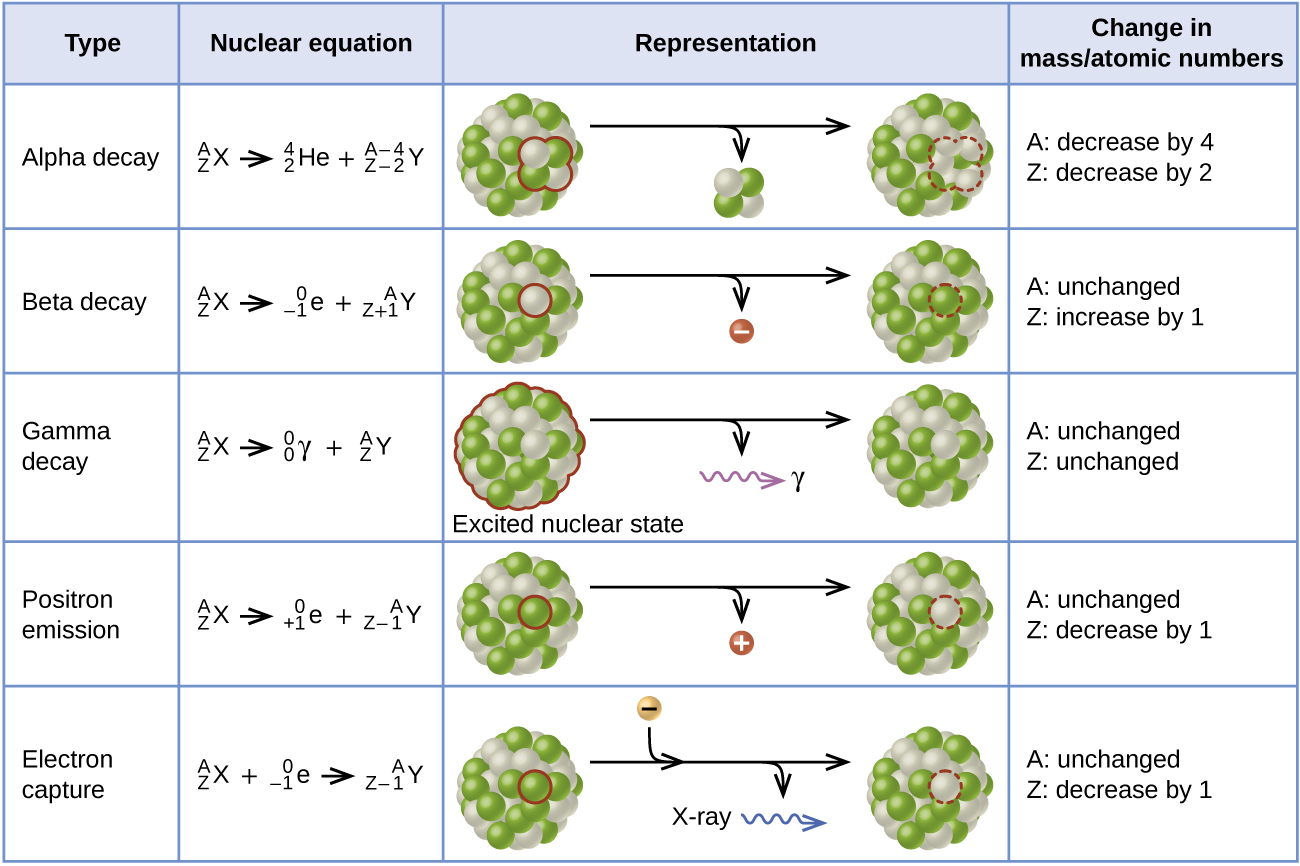


Figure 21.7図 21.7
This table summarizes the type, nuclear equation, representation, and any changes in the mass or atomic numbers for various types of decay.
さまざまな崩壊の種類について、種類、核反応式、図示、質量数・原子番号の変化をまとめた表。