第21章核化学
Measuring Radiation Exposure放射線被ばくの測定
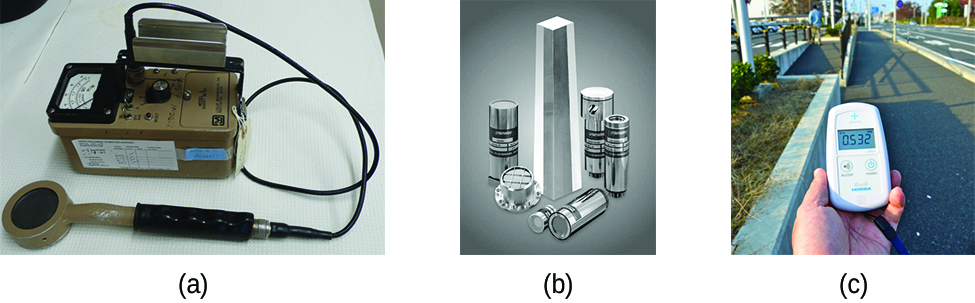
Several different devices are used to detect and measure radiation, including Geiger counters, scintillation counters (scintillators), and radiation dosimeters (Figure 21.35). Probably the best-known radiation instrument, the Geiger counter (also called the Geiger-Müller counter) detects and measures radiation. Radiation causes the ionization of the gas in a Geiger-Müller tube. The rate of ionization is proportional to the amount of radiation. A scintillation counter contains a scintillator—a material that emits light (luminesces) when excited by ionizing radiation—and a sensor that converts the light into an electric signal. Radiation dosimeters also measure ionizing radiation and are often used to determine personal radiation exposure. Commonly used types are electronic, film badge, thermoluminescent, and quartz fiber dosimeters.
英語のヒント
放射線の検出・測定には、ガイガー計数管、シンチレーション計数器(シンチレーター)、線量計などの装置を使う(図21.35)。おそらく最もよく知られるガイガー計数管は、ガイガー・ミュラー計数管とも呼ばれ、放射線を検出・測定する。放射線は管内の気体を電離し、電離の速さは放射線量に比例する。シンチレーション計数器には、電離放射線で励起されると発光する物質「シンチレーター」と、光を電気信号へ変えるセンサーがある。線量計も電離放射線を測定し、個人の被曝量の把握によく使われる。一般的には、電子式、フィルムバッジ、熱蛍光式、石英繊維式がある。
OpenStax, Rice University, Chemistry 2e. Original caption credit: (credit c: modification of work by “osaMu”/Wikimedia commons) Source work: Minamisoma Radiation 2011-11.jpg · CC BY 2.0; OpenStax composition CC BY 4.0 · Source出典
Figure 21.35図 21.35
Devices such as (a) Geiger counters, (b) scintillators, and (c) dosimeters can be used to measure radiation. (credit c: modification of work by “osaMu”/Wikimedia commons)
(a)ガイガー計数管、(b)シンチレーター、(c)線量計などで、放射線を測定できる。(出典:cは「osaMu」/Wikimedia Commonsの作品を改変)
A variety of units are used to measure various aspects of radiation (Figure 21.36). The SI unit for rate of radioactive decay is the becquerel (Bq), with 1 Bq = 1 disintegration per second. The curie (Ci) and millicurie (mCi) are much larger units and are frequently used in medicine (1 curie = 1 Ci = 3.7 1010 disintegrations per second). The SI unit for measuring radiation dose is the gray (Gy), with 1 Gy = 1 J of energy absorbed per kilogram of tissue. In medical applications, the radiation absorbed dose (rad) is more often used (1 rad = 0.01 Gy; 1 rad results in the absorption of 0.01 J/kg of tissue). The SI unit measuring tissue damage caused by radiation is the sievert (Sv). This takes into account both the energy and the biological effects of the type of radiation involved in the radiation dose. The roentgen equivalent for man (rem) is the unit for radiation damage that is used most frequently in medicine (100 rem = 1 Sv). Note that the tissue damage units (rem or Sv) includes the energy of the radiation dose (rad or Gy) along with a biological factor referred to as the RBE (for relative biological effectiveness) that is an approximate measure of the relative damage done by the radiation. These are related by:
英語のヒント
放射線のさまざまな側面を測定するために、いろいろな単位を使う(図21.36)。放射性崩壊の速さのSI単位はベクレル(Bq)で、1 Bqは1秒あたり1回の崩壊である。キュリー(Ci)とミリキュリー(mCi)は、それよりはるかに大きい単位で、医学でよく使う。1キュリー = 1 Ci = 1秒あたり3.7 1010回の崩壊である。放射線量のSI単位はグレイ(Gy)で、1 Gyは組織1 kgあたり1 Jのエネルギー吸収を表す。医療では吸収線量の単位ラド(rad)がより多く使われる。1 rad = 0.01 Gyで、組織1 kgあたり0.01 Jの吸収に相当する。放射線による組織損傷を測るSI単位はシーベルト(Sv)である。線量に含まれるエネルギーと、放射線の種類による生物学的影響の両方を考慮する。レム(rem、人体に対するレントゲン当量)は、医学で最も頻繁に使われる放射線障害の単位で、100 rem = 1 Svである。組織損傷の単位remやSvには、線量のエネルギー(radやGy)に加え、生物学的因子RBE(生物学的効果比)が含まれる。RBEは、放射線による相対的な損傷の程度をおおよそ表す。関係は次の通りである。
with RBE approximately 10 for α radiation, 2(+) for protons and neutrons, and 1 for β and γ radiation.
RBEはおよそ、α線で10、陽子と中性子で2以上、β線とγ線で1である。
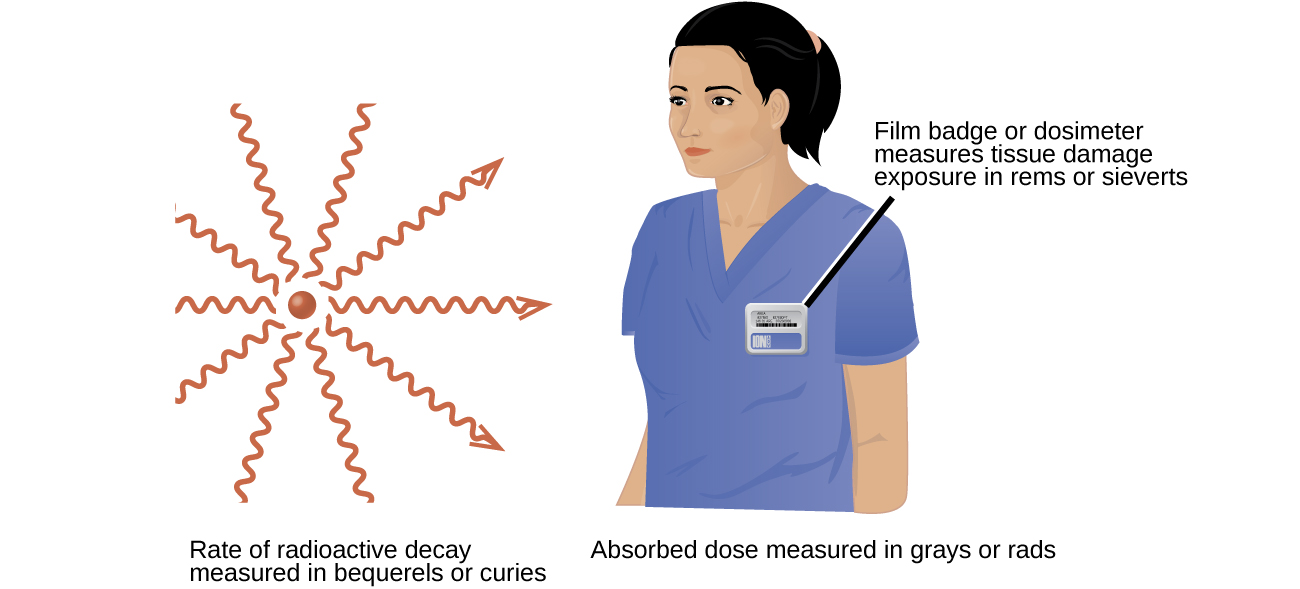


Figure 21.36図 21.36
Different units are used to measure the rate of emission from a radioactive source, the energy that is absorbed from the source, and the amount of damage the absorbed radiation does.
放射線源からの放出の速さ、線源から吸収したエネルギー、吸収した放射線による損傷の大きさは、それぞれ異なる単位で測る。
Units of Radiation Measurement放射線測定の単位
Table 21.4 summarizes the units used for measuring radiation.
放射線の測定に使う単位を、表21.4にまとめる。
Units Used for Measuring Radiation 放射線測定に用いる単位 |
|||
|---|---|---|---|
Measurement Purpose 測定の目的 |
Unit 単位 |
Quantity Measured 測る量 |
Description 説明 |
activity of source 線源の放射能 |
becquerel (Bq) ベクレル(Bq) |
radioactive decays or emissions 放射性崩壊または放射線放出 |
amount of sample that undergoes 1 decay/second 毎秒1回の崩壊を起こす試料の量 |
curie (Ci) キュリー(Ci) |
amount of sample that undergoes 3.7 1010 decays/second 毎秒3.7 1010回の崩壊を起こす試料の量 |
||
absorbed dose 吸収線量 |
gray (Gy) グレイ(Gy) |
energy absorbed per kg of tissue 組織1 kgあたりの吸収エネルギー |
1 Gy = 1 J/kg tissue 1 Gy = 組織1 kgあたり1 J |
radiation absorbed dose (rad) 吸収線量の単位ラド(rad) |
1 rad = 0.01 J/kg tissue 1 rad = 組織1 kgあたり0.01 J |
||
biologically effective dose 生物学的効果を考慮した線量 |
sievert (Sv) シーベルト(Sv) |
tissue damage 組織の損傷 |
Sv = RBE Gy |
roentgen equivalent for man (rem) レム(rem) |
Rem = RBE rad |
||
Example 21.8例題 21.8
Amount of Radiation放射線の量
Cobalt-60 (t1/2 = 5.26 y) is used in cancer therapy since the γ rays it emits can be focused in small areas where the cancer is located. A 5.00-g sample of Co-60 is available for cancer treatment.
コバルト60(t1/2 = 5.26年)は、放出するγ線を、がんのある小さな領域へ集中できるため、がん治療に使われる。治療用に5.00 gのCo-60試料がある。
(a) What is its activity in Bq?
(a) 放射能は何Bqか。
(b) What is its activity in Ci?
(b) 放射能は何Ciか。
Solution解法
The activity is given by:
放射能は次の式で与えられる。
And to convert this to decays per second:
これを1秒あたりの崩壊数に換算すると、次のようになる。
(a) Since 1 Bq = the activity in Becquerel (Bq) is:
(a) 1 Bq = なので、ベクレル(Bq)単位の放射能は次のようになる。
(b) Since 1 Ci = the activity in curie (Ci) is:
(b) 1 Ci = なので、キュリー(Ci)単位の放射能は次のようになる。
Check Your Learning理解度を確かめよう
Tritium is a radioactive isotope of hydrogen (t1/2 = 12.32 y) that has several uses, including self-powered lighting, in which electrons emitted in tritium radioactive decay cause phosphorus to glow. Its nucleus contains one proton and two neutrons, and the atomic mass of tritium is 3.016 amu. What is the activity of a sample containing 1.00mg of tritium (a) in Bq and (b) in Ci?
トリチウムは、水素の放射性同位体(t1/2 = 12.32年)で、いくつかの用途がある。たとえば、トリチウムの放射性崩壊で出る電子がリンを光らせる、自発光照明に使う。原子核には陽子1個と中性子2個があり、原子質量は3.016 amuである。トリチウム1.00 mgを含む試料の放射能を、(a)Bq、(b)Ciで求めなさい。