第5章多項式関数と有理関数Polynomial and Rational Functions
Introduction to Polynomial and Rational Functions多項式関数と有理関数のはじめに
• 5.1 Quadratic Functions • 5.2 Power Functions and Polynomial Functions • 5.3 Graphs of Polynomial Functions • 5.4 Dividing Polynomials • 5.5 Zeros of Polynomial Functions • 5.6 Rational Functions • 5.7 Inverses and Radical Functions • 5.8 Modeling Using Variation
・5.1 二次関数・5.2 累乗関数と多項式関数・5.3 多項式関数のグラフ・5.4 多項式の割り算・5.5 多項式関数の零点・5.6 有理関数・5.7 逆関数と無理関数・5.8 比例による表し方
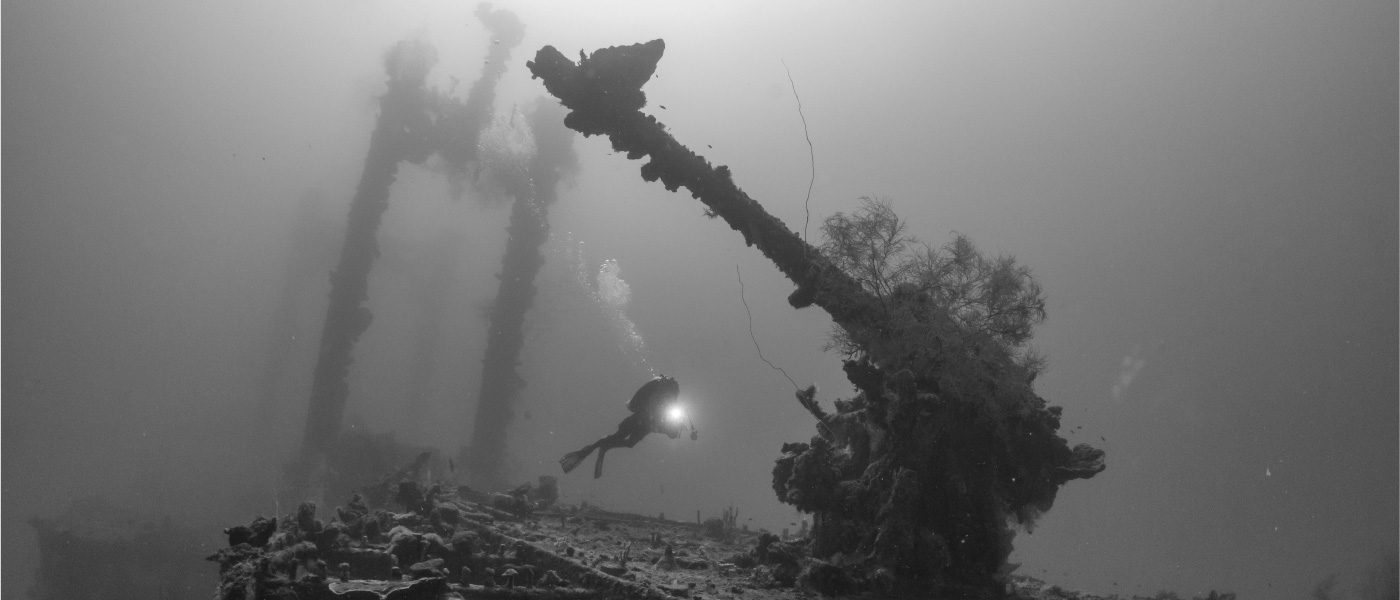
You don't need to dive very deep to feel the effects of pressure. As a person in their neighborhood pool moves eight, ten, twelve feet down, they often feel pain in their ears as a result of water and air pressure differentials. Pressure plays a much greater role at ocean diving depths.
水圧の影響は、深く潜らなくても感じられる。身近なプールでも、水深8フィート、10フィート、12フィートと潜るにつれて、水圧と耳の内部の気圧との差で耳が痛くなることがある。海の深い場所へ潜る場合には、圧力の影響はさらに大きくなる。
Scuba and free divers are constantly negotiating the effects of pressure in order to experience enjoyable, safe, and productive dives. Gases in a person's respiratory system and diving apparatus interact according to certain physical properties, which upon discovery and evaluation are collectively known as the gas laws. Some are conceptually simple, such as the inverse relationship regarding pressure and volume, and others are more complex. While their formulas seem more straightforward than many you will encounter in this chapter, the gas laws are generally polynomial expressions.
スキューバダイビングでも素潜りでも、安全に目的を果たすには、圧力の影響を考える必要がある。呼吸器や潜水装置の中の気体は、一定の物理法則に従って振る舞う。これらをまとめて気体の法則と呼ぶ。圧力と体積の反比例のように基本的な関係もあれば、より複雑な関係もある。こうした法則は、量どうしの関係を式で表す身近な例になる。