プリンピキア

付録A証明、恒等式、基本関数Appendix A Proofs, Identities, and Toolkit Functions

Appendix A Proofs, Identities, and Toolkit Functions付録A 証明・恒等式・基本関数

Important Proofs and Derivations大切な証明と導出

Product Rule

積の規則

log a xy=log a x+log a y

Proof:

証明:

Let m=log a x and n=log a y.

m=log a x かつ n=log a y とする。

Write in exponent form.

指数の形で書く。

x=a m and y=a n .

x=a my=a n

Multiply.

掛ける。

xy=a m a n =a m+n

a m+n = xy log a (xy) = m+n = log a x+log b y

Change of Base Rule

底の変換の規則

log a b=log c b log c a log a b=1 log b a

where x and y are positive, and a>0,a1.

ここで xy は正であり、a>0,a1. である。

Proof:

証明:

Let x=log a b.

x=log a b とする。

Write in exponent form.

指数の形で書く。

a x =b

Take the log c of both sides.

両辺の log c を取る。

log c a x = log c b xlog c a = log c b x = log c b log c a log a b = log c b log c a

When c=b,

c=b のとき

log a b=log b b log b a =1 log b a

Heron’s Formula

ヘロンの公式

A=s( sa )( sb )( sc )

where s=a+b+c 2

ここで s=a+b+c 2 である。

Proof:

証明:

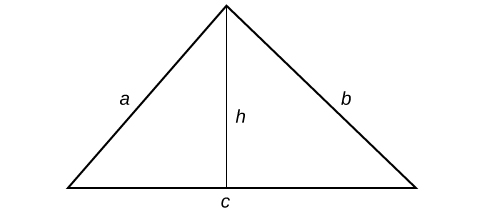
Let a, b, and c be the sides of a triangle, and h be the height.

a b c を三角形の辺、h を高さとする。

A triangle with sides labeled: a, b and c.  A line runs through the center of the triangle, bisecting the top angle; this line is labeled: h.

So s=a+b+c 2.

よって s=a+b+c 2 である。

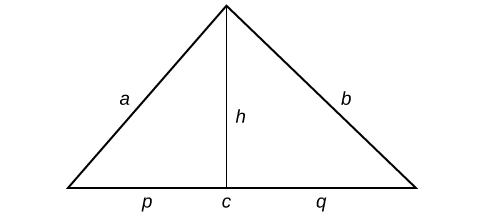
We can further name the parts of the base in each triangle established by the height such that p+q=c.

さらに、高さで分けられた各三角形の底辺の部分に、p+q=c となるよう名を付けられる。

A triangle with sides labeled: a, b, and c.  A line runs through the center of the triangle bisecting the angle at the top; this line is labeled: h. The two new line segments on the base of the triangle are labeled: p and q.

Using the Pythagorean Theorem, h 2 +p 2 =a 2 and h 2 +q 2 =b 2 .

ピタゴラスの定理を使うと、h 2 +p 2 =a 2h 2 +q 2 =b 2 である。

Since q=cp, then q 2 =( cp ) 2 . Expanding, we find that q 2 =c 2 2cp+p 2 .

q=cp なので q 2 =( cp ) 2 である。展開すると q 2 =c 2 2cp+p 2 だと分かる。

We can then add h 2 to each side of the equation to get h 2 +q 2 =h 2 +c 2 2cp+p 2 .

そして式の両辺に h 2 を足せば h 2 +q 2 =h 2 +c 2 2cp+p 2 が得られる。

Substitute this result into the equation h 2 +q 2 =b 2 yields b 2 =h 2 +c 2 2cp+p 2 .

この結果を式 h 2 +q 2 =b 2 に代入すると b 2 =h 2 +c 2 2cp+p 2 が得られる。

Then replacing h 2 +p 2 with a 2 gives b 2 =a 2 2cp+c 2 .

そして h 2 +p 2a 2 に置き換えると b 2 =a 2 2cp+c 2 が得られる。

Solve for p to get

p について解いて次を得る。

p=a 2 b 2 c 2 2c

Since h 2 =a 2 p 2 , we get an expression in terms of a, b, and c.

h 2 =a 2 p 2 なので、a b c で表した式が得られる。

h 2 = a 2 p 2 = (a+p)(ap) = [ a+( a 2 +c 2 b 2 ) 2c ][ a( a 2 +c 2 b 2 ) 2c ] = ( 2ac+a 2 +c 2 b 2 )( 2aca 2 c 2 +b 2 ) 4c 2 = ( (a+c) 2 b 2 )( b 2 (ac) 2 ) 4c 2 = (a+b+c)(a+cb)(b+ac)(ba+c) 4c 2 = (a+b+c)(a+b+c)(ab+c)(a+bc) 4c 2 = 2s(2sa)(2sb)(2sc) 4c 2

Therefore,

したがって、

h 2 = 4s(sa)(sb)(sc) c 2 h = 2s(sa)(sb)(sc) c

And since A=1 2 ch, then

そして A=1 2 ch なので、

A = 1 2 c2s(sa)(sb)(sc) c = s(sa)(sb)(sc)

Properties of the Dot Product

内積の性質

u·v=v·u

Proof:

証明:

u·v =u 1 ,u 2 ,...u n ·v 1 ,v 2 ,...v n =u 1 v 1 +u 2 v 2 +...+u n v n =v 1 u 1 +v 2 u 2 +...+v n u n =v 1 ,v 2 ,...v n ·u 1 ,u 2 ,...u n =v·u

u·( v+w )=u·v+u·w

Proof:

証明:

u·(v+w) =u 1 ,u 2 ,...u n ·( v 1 ,v 2 ,...v n +w 1 ,w 2 ,...w n ) =u 1 ,u 2 ,...u n ·v 1 +w 1 ,v 2 +w 2 ,...v n +w n =u 1 (v 1 +w 1 ),u 2 (v 2 +w 2 ),...u n (v n +w n ) =u 1 v 1 +u 1 w 1 ,u 2 v 2 +u 2 w 2 ,...u n v n +u n w n =u 1 v 1 ,u 2 v 2 ,...,u n v n +u 1 w 1 ,u 2 w 2 ,...,u n w n =u 1 ,u 2 ,...u n ·v 1 ,v 2 ,...v n +u 1 ,u 2 ,...u n ·w 1 ,w 2 ,...w n =u·v+u·w

u·u=| u | 2

Proof:

証明:

u·u =u 1 ,u 2 ,...u n ·u 1 ,u 2 ,...u n =u 1 u 1 +u 2 u 2 +...+u n u n =u 1 2 +u 2 2 +...+u n 2 =|u 1 ,u 2 ,...u n | 2 =u·u

Standard Form of the Ellipse centered at the Origin

原点を中心とする楕円の標準の形

1=x 2 a 2 +y 2 b 2

Derivation

導出

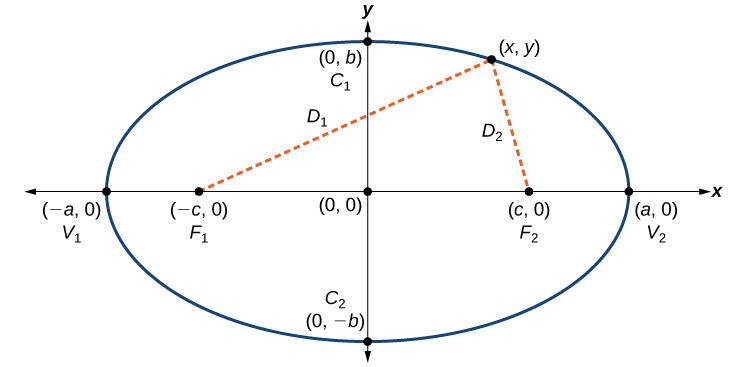
An ellipse consists of all the points for which the sum of distances from two foci is constant:

楕円は、二つの焦点からの距離の和が一定である点すべてからなる。

( x( c ) ) 2 +( y0 ) 2 +( xc ) 2 +( y0 ) 2 =constant

式中の英語:constant:定数

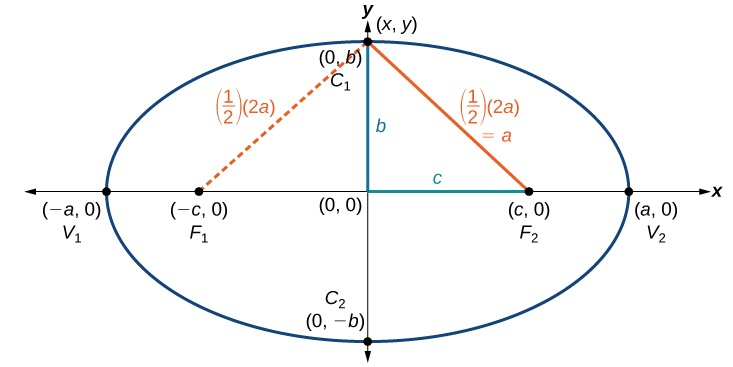
An ellipse centered at the origin on an x, y-coordinate plane.  Points C1 and C2 are plotted at the points (0, b) and (0, -b) respectively; these points appear on the ellipse.  Points V1 and V2 are plotted at the points (-a, 0) and (a, 0) respectively; these points appear on the ellipse.  Points F1 and F2 are plotted at the points (-c, 0) and (c, 0) respectively; these points appear on the x-axis, but not the ellipse. The point (x, y) appears on the ellipse in the first quadrant.  Dotted lines extend from F1 and F2 to the point (x, y).

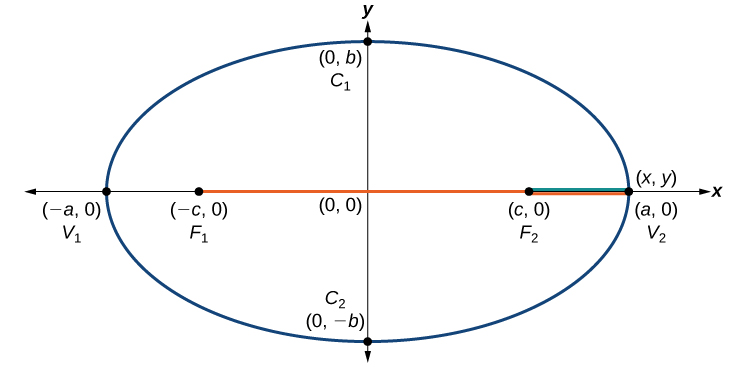
Consider a vertex.

頂点を考えよ。

An ellipse centered at the origin.  The points C1 and C2 are plotted at the points (0, b) and (0, -b) respectively; these points are on the ellipse.  The points V1 and V2 are plotted at the points (-a, 0) and (a, 0) respectively; these points are on the ellipse.  The points F1 and F2 are plotted at the points (-c, 0) and (c, 0) respectively; these points are on the x-axis and not on the ellipse.  A line extends from the point F1 to a point (x, y) which is at the point (a, 0).  A line extends from the point F2 to the point (x, y) as well.

Then, ( x( c ) ) 2 +( y0 ) 2 +( xc ) 2 +( y0 ) 2 =2a

すると ( x( c ) ) 2 +( y0 ) 2 +( xc ) 2 +( y0 ) 2 =2a である。

Consider a covertex.

余頂点を考えよ。

An ellipse centered at the origin.  The points C1 and C2 are plotted at the points (0, b) and (0, -b) respectively; these points are on the ellipse.  The points V1 and V2 are plotted at the points (-a, 0) and (a, 0) respectively; these points are on the ellipse.  The points F1 and F2 are plotted at the points (-c, 0) and (c, 0) respectively; these points are on the x-axis and not on the ellipse.  There is a point (x, y) which is plotted at (0, b). A line extends from the origin to the point (c, 0), this line is labeled: c.  A line extends from the origin to the point (x, y), this line is labeled: b.  A line extends from the point (c, 0) to the point (x, y); this line is labeled: (1/2)(2a)=a.  A dotted line extends from the point (-c, 0) to the point (x, y); this line is labeled: (1/2)(2a)=a.

Then b 2 +c 2 =a 2 .

すると b 2 +c 2 =a 2 である。

(x(c)) 2 +(y0) 2 +(xc) 2 +(y0) 2 = 2a (x+c) 2 +y 2 = 2a(xc) 2 +y 2 (x+c) 2 +y 2 = ( 2a(xc) 2 +y 2 ) 2 x 2 +2cx+c 2 +y 2 = 4a 2 4a(xc) 2 +y 2 +(xc) 2 +y 2 x 2 +2cx+c 2 +y 2 = 4a 2 4a(xc) 2 +y 2 +x 2 2cx+y 2 2cx = 4a 2 4a(xc) 2 +y 2 2cx 4cx4a 2 = 4a(xc) 2 +y 2 1 4a ( 4cx4a 2 ) = (xc) 2 +y 2 ac a x = (xc) 2 +y 2 a 2 2xc+c 2 a 2 x 2 = (xc) 2 +y 2 a 2 2xc+c 2 a 2 x 2 = x 2 2xc+c 2 +y 2 a 2 +c 2 a 2 x 2 = x 2 +c 2 +y 2 a 2 +c 2 a 2 x 2 = x 2 +c 2 +y 2 a 2 c 2 = x 2 c 2 a 2 x 2 +y 2 a 2 c 2 = x 2 ( 1c 2 a 2 )+y 2

Let 1=a 2 a 2 .

1=a 2 a 2 とする。

a 2 c 2 = x 2 ( a 2 c 2 a 2 )+y 2 1 = x 2 a 2 +y 2 a 2 c 2

Because b 2 +c 2 =a 2 , then b 2 =a 2 c 2 .

b 2 +c 2 =a 2 なので b 2 =a 2 c 2 である。

1 = x 2 a 2 +y 2 a 2 c 2 1 = x 2 a 2 +y 2 b 2

Standard Form of the Hyperbola

双曲線の標準の形

1=x 2 a 2 y 2 b 2

Derivation

導出

A hyperbola is the set of all points in a plane such that the absolute value of the difference of the distances between two fixed points is constant.

双曲線とは、平面上の点のうち、二つの定まった点との距離の差の絶対値が一定であるものすべての集合である。

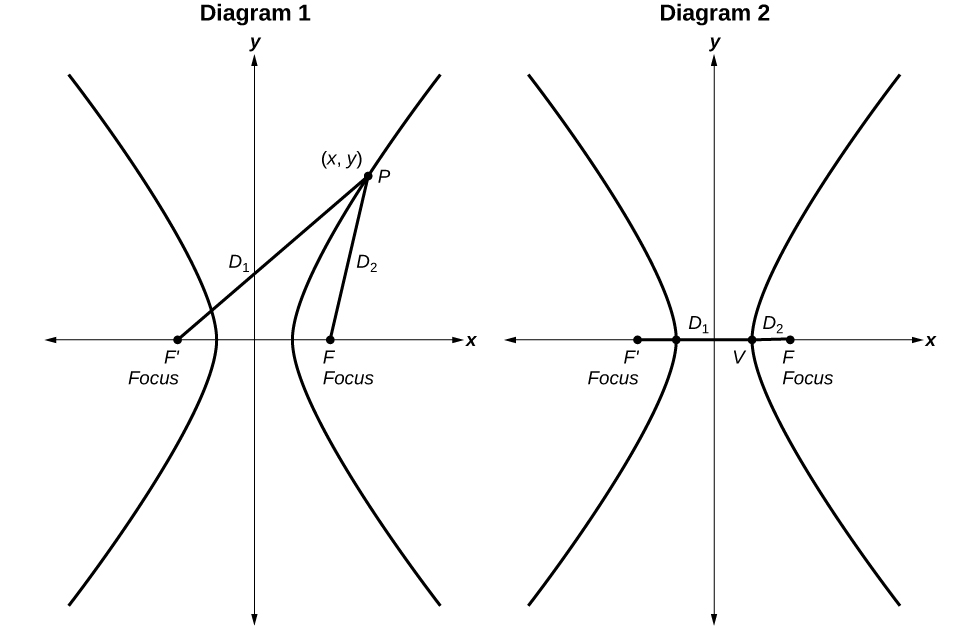
Side-by-side graphs of hyperbole.  In Diagram 1: The foci F’ and F are labeled and can be found a little in front of the opening of the hyperbola.  A point P at (x,y) on the right curve is labeled.  A line extends from the F’ focus to the point P labeled: D1.  A line extends from the F focus to the point P labeled: D2.  In Diagram 2:  The foci F’ and F are labeled and can be found a little in front of the opening of the hyperbola.  A point V is labeled at the vertex of the right hyperbola.  A line extends from the F’ focus to the point V labeled: D1.  A line extends from the F focus to the point V labeled: D2.

Diagram 1: The difference of the distances from Point P to the foci is constant:

図1: 点Pから焦点までの距離の差は一定である。

(x(c)) 2 +(y0) 2 (xc) 2 +(y0) 2 =constant

式中の英語:constant:定数

Diagram 2: When the point is a vertex, the difference is 2a.

図2: 点が頂点のとき、その差は 2a である。

( x( c ) ) 2 +( y0 ) 2 ( xc ) 2 +( y0 ) 2 =2a

(x(c)) 2 +(y0) 2 (xc) 2 +(y0) 2 = 2a (x+c) 2 +y 2 (xc) 2 +y 2 = 2a (x+c) 2 +y 2 = 2a+(xc) 2 +y 2 (x+c) 2 +y 2 = ( 2a+(xc) 2 +y 2 ) x 2 +2cx+c 2 +y 2 = 4a 2 +4a(xc) 2 +y 2 x 2 +2cx+c 2 +y 2 = 4a 2 +4a(xc) 2 +y 2 +x 2 2cx+y 2 2cx = 4a 2 +4a(xc) 2 +y 2 2cx 4cx4a 2 = 4a(xc) 2 +y 2 cxa 2 = a(xc) 2 +y 2 ( cxa 2 ) 2 = a 2 ( (xc) 2 +y 2 ) c 2 x 2 2a 2 c 2 x 2 +a 4 = a 2 x 2 2a 2 c 2 x 2 +a 2 c 2 +a 2 y 2 c 2 x 2 +a 4 = a 2 x 2 +a 2 c 2 +a 2 y 2 a 4 a 2 c 2 = a 2 x 2 c 2 x 2 +a 2 y 2 a 2 ( a 2 c 2 ) = ( a 2 c 2 )x 2 +a 2 y 2 a 2 ( a 2 c 2 ) = ( c 2 a 2 )x 2 a 2 y 2

Define b as a positive number such that b 2 =c 2 a 2 .

b 2 =c 2 a 2 を満たす正の数として b を定める。

a 2 b 2 = b 2 x 2 a 2 y 2 a 2 b 2 a 2 b 2 = b 2 x 2 a 2 b 2 a 2 y 2 a 2 b 2 1 = x 2 a 2 y 2 b 2

Trigonometric Identities三角関数の恒等式

Pythagorean Identitiesピタゴラスの恒等式cos 2 θ+sin 2 θ=1 1+tan 2 θ=sec 2 θ 1+cot 2 θ=csc 2 θ
Even-Odd Identities偶奇の恒等式cos(−θ)=cosθ sec(−θ)=secθ sin(−θ)=sinθ tan(−θ)=tanθ csc(−θ)=cscθ cot(−θ)=cotθ
Cofunction Identities余関数の恒等式cosθ=sin( π 2 θ ) sinθ=cos( π 2 θ ) tanθ=cot( π 2 θ ) cotθ=tan( π 2 θ ) secθ=csc( π 2 θ ) cscθ=sec( π 2 θ )
Fundamental Identities基本の恒等式tanθ=sinθ cosθ secθ=1 cosθ cscθ=1 sinθ cotθ=1 tanθ =cosθ sinθ
Sum and Difference Identities和と差の恒等式cos(α+β)=cosαcosβsinαsinβ cos(αβ)=cosαcosβ+sinαsinβ sin(α+β)=sinαcosβ+cosαsinβ sin(αβ)=sinαcosβcosαsinβ tan(α+β)=tanα+tanβ 1tanαtanβ tan(αβ)=tanαtanβ 1+tanαtanβ
Double-Angle Formulas倍角の公式sin(2θ)=2sinθcosθ cos(2θ)=cos 2 θsin 2 θ cos(2θ)=12sin 2 θ cos(2θ)=2cos 2 θ1 tan(2θ)=2tanθ 1tan 2 θ
Half-Angle Formulas半角の公式sinα 2 =±1cosα 2 cosα 2 =±1+cosα 2 tanα 2 =±1cosα 1+cosα tanα 2 =sinα 1+cosα tanα 2 =1cosα sinα
Reduction Formulas次数を下げる公式sin 2 θ=1cos( 2θ ) 2 cos 2 θ=1+cos( 2θ ) 2 tan 2 θ=1cos( 2θ ) 1+cos( 2θ )
Product-to-Sum Formulas積を和に直す公式cosαcosβ=1 2 [ cos(αβ)+cos(α+β) ] sinαcosβ=1 2 [ sin(α+β)+sin(αβ) ] sinαsinβ=1 2 [ cos(αβ)cos(α+β) ] cosαsinβ=1 2 [ sin(α+β)sin(αβ) ]
Sum-to-Product Formulas和を積に直す公式sinα+sinβ=2sin( α+β 2 )cos( αβ 2 ) sinαsinβ=2sin( αβ 2 )cos( α+β 2 ) cosαcosβ=2sin( α+β 2 )sin( αβ 2 ) cosα+cosβ=2cos( α+β 2 )cos( αβ 2 )
Law of Sines正弦定理sinα a =sinβ b =sinγ c a sinα =b sinβ =c sinγ
Law of Cosines余弦定理a 2 =b 2 +c 2 2bccosα b 2 =a 2 +c 2 2accosβ c 2 =a 2 +b 2 2abcosγ

ToolKit Functions基本関数

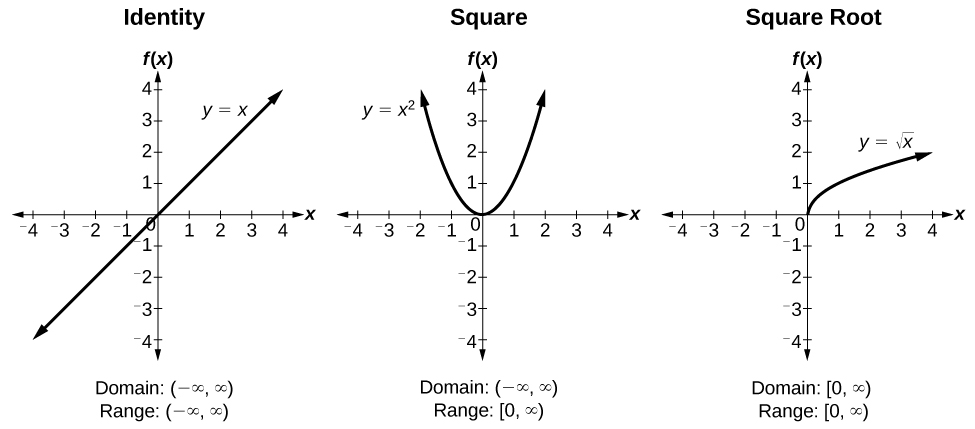
Three graphs side-by-side. From left to right, graph of the identify function, square function, and square root function. All three graphs extend from -4 to 4 on each axis.
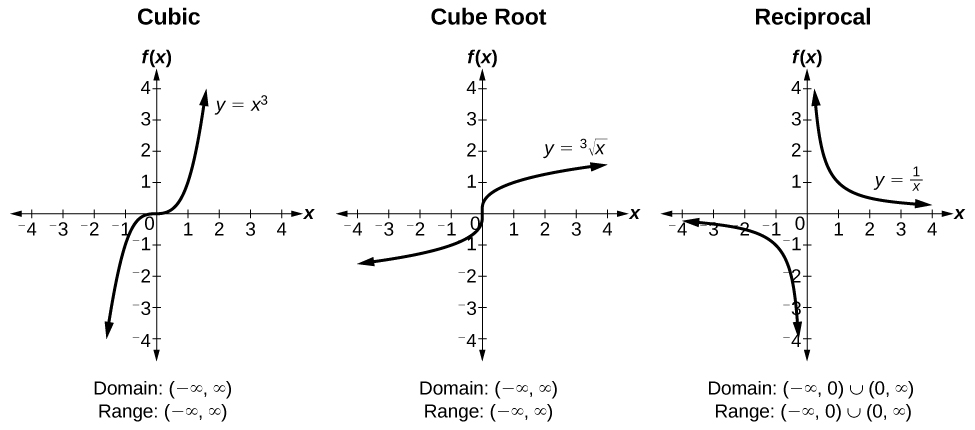
Three graphs side-by-side. From left to right, graph of the cubic function, cube root function, and reciprocal function. All three graphs extend from -4 to 4 on each axis.
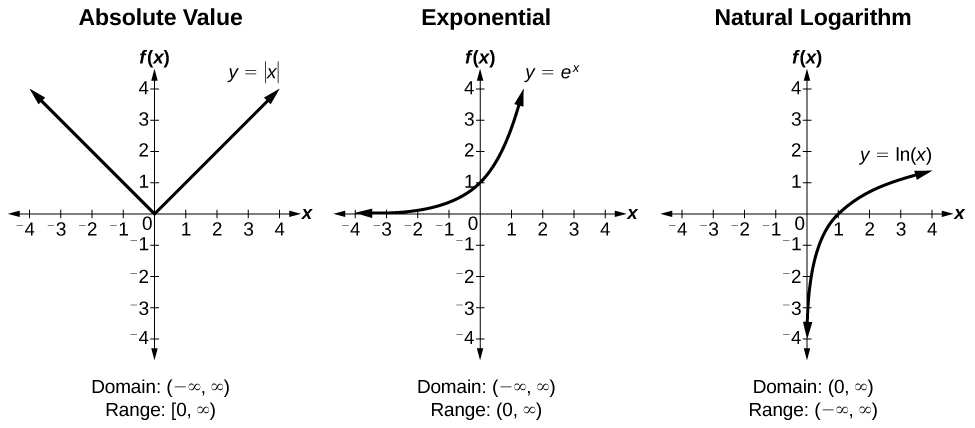
Three graphs side-by-side. From left to right, graph of the absolute value function, exponential function, and natural logarithm function. All three graphs extend from -4 to 4 on each axis.

Trigonometric Functions三角関数

Unit Circle

単位円

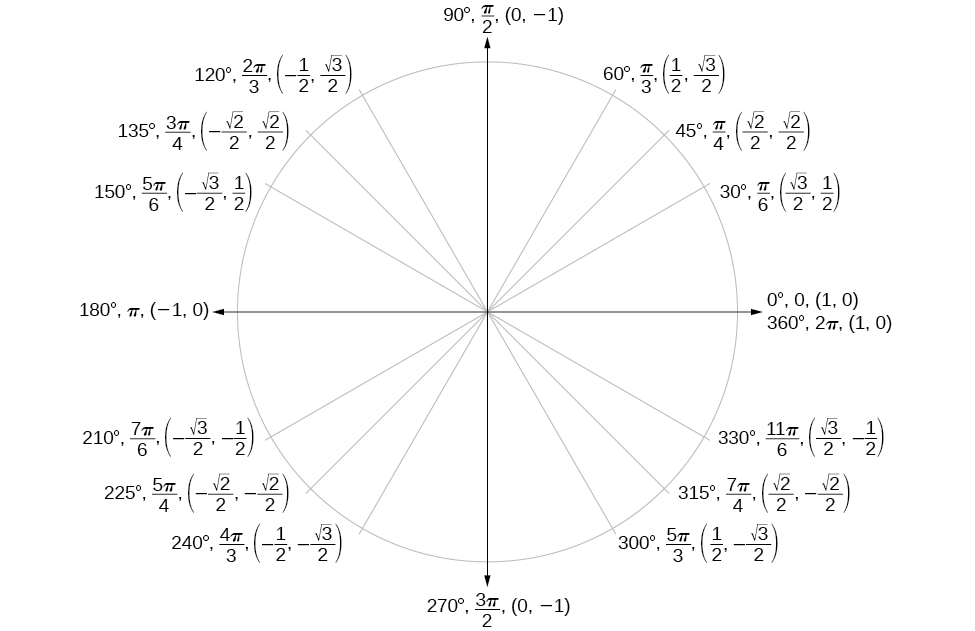
Graph of unit circle with angles in degrees, angles in radians, and points along the circle inscribed.
Angle0π 6 ,or 30°π 4 ,or 45°π 3 ,or 60°π 2 ,or 90°
Cosine余弦13 22 21 20
Sine正弦01 22 23 21
Tangent正接03 313Undefined定められない
Secant正割123 322Undefined定められない
Cosecant余割Undefined定められない2223 31
Cotangent余接Undefined定められない313 30