第13章数列、確率、数え上げSequences, Probability, and Counting Theory
Answer Key解答
13.1 Section Exercises13.1 節末問題
A sequence is an ordered list of numbers that can be either finite or infinite in number. When a finite sequence is defined by a formula, its domain is a subset of the non-negative integers. When an infinite sequence is defined by a formula, its domain is all positive or all non-negative integers.
数列とは、有限にも無限にもなりうる、順序を持つ数の並びである。有限数列が公式で定められるとき、その定義域は非負の整数の部分集合である。無限数列が公式で定められるとき、その定義域は正の整数すべて、または非負の整数すべてである。
Yes, both sets go on indefinitely, so they are both infinite sequences.
そうである。どちらの集合も限りなく続くので、どちらも無限数列である。
A factorial is the product of a positive integer and all the positive integers below it. An exclamation point is used to indicate the operation. Answers may vary. An example of the benefit of using factorial notation is when indicating the product It is much easier to write than it is to write out
階乗とは、ある正の整数と、それより下のすべての正の整数との積である。この演算を示すのに感嘆符を使う。答えはいろいろありうる。階乗の表記の利点の例は、積を示すときである。 と書き出すよりずっと楽に書ける。
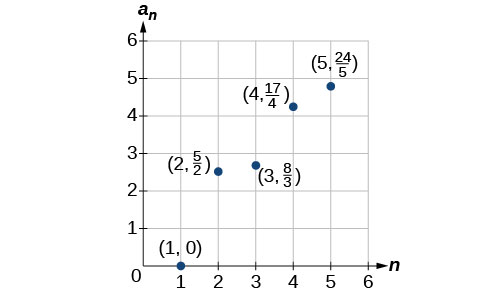
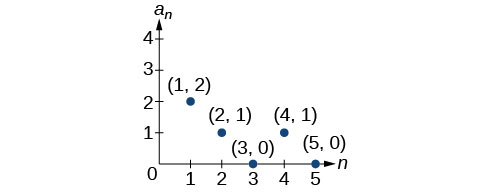
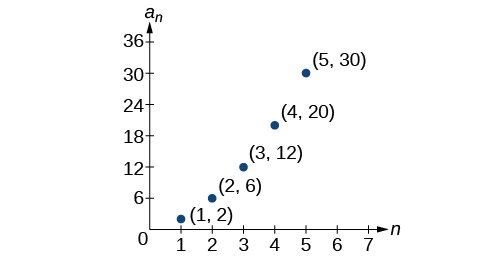
First six terms: 0.042, 0.146, 0.875, 2.385, 4.708
初めの六項: 0.042, 0.146, 0.875, 2.385, 4.708
First four terms: 5.975, 2.765, 185.743, 1057.25, 6023.521
初めの四項: 5.975, 2.765, 185.743, 1057.25, 6023.521
If is a term in the sequence, then solving the equation for will yield a non-negative integer. However, if then so is not a term in the sequence.
がこの数列の項なら、式 を について解くと非負の整数になる。だが なら なので、 はこの数列の項でない。
13.2 Section Exercises13.2 節末問題
A sequence where each successive term of the sequence increases (or decreases) by a constant value.
後に続く各項が一定の値だけ増える(または減る)数列。
We find whether the difference between all consecutive terms is the same. This is the same as saying that the sequence has a common difference.
連続するすべての項の差が同じかどうかを調べる。これは、その数列が公差を持つと言うのと同じである。
Both arithmetic sequences and linear functions have a constant rate of change. They are different because their domains are not the same; linear functions are defined for all real numbers, and arithmetic sequences are defined for natural numbers or a subset of the natural numbers.
等差数列も一次関数も変化の割合が一定である。違うのは定義域が同じでない点である。一次関数はすべての実数について定められ、等差数列は自然数またはその部分集合について定められる。
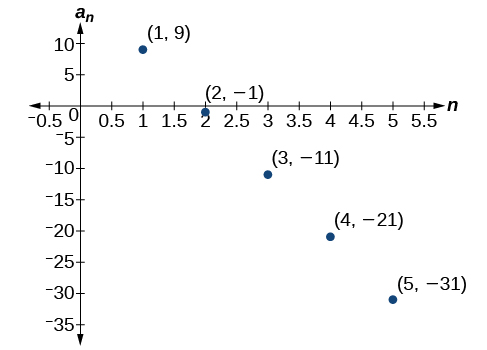
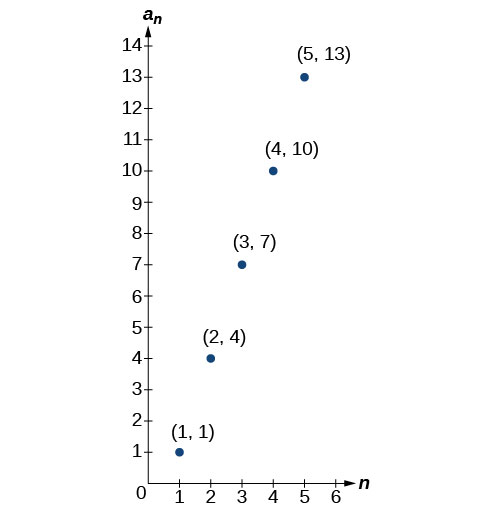
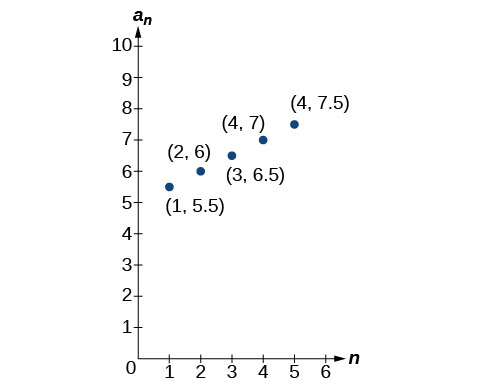
The sequence begins to have negative values at the 13th term,
この数列は第13項 から負の値を持ち始める。
Answers will vary. Check to see that the sequence is arithmetic. Example: Recursive formula: First 4 terms:
答えはいろいろありうる。等差数列になっているか確かめよ。例: 漸化式 初めの4項:
13.3 Section Exercises13.3 節末問題
A sequence in which the ratio between any two consecutive terms is constant.
連続するどの二項の比も一定である数列。
Divide each term in a sequence by the preceding term. If the resulting quotients are equal, then the sequence is geometric.
数列の各項を直前の項で割る。できた商が等しいなら、その数列は等比数列である。
Both geometric sequences and exponential functions have a constant ratio. However, their domains are not the same. Exponential functions are defined for all real numbers, and geometric sequences are defined only for positive integers. Another difference is that the base of a geometric sequence (the common ratio) can be negative, but the base of an exponential function must be positive.
等比数列も指数関数も一定の比を持つ。だが定義域は同じでない。指数関数はすべての実数について定められ、等比数列は正の整数についてだけ定められる。もう一つの違いは、等比数列の底(公比)は負でありうるが、指数関数の底は正でなければならない点である。
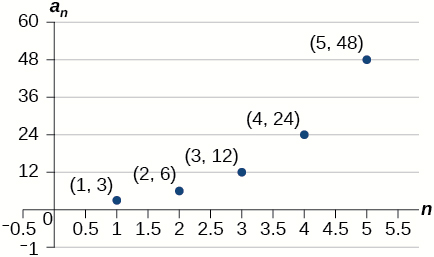
Answers will vary. Example: Explicit formula with a decimal common ratio: First 4 terms:
答えはいろいろありうる。例: 公比が小数の一般項の公式: 初めの4項:
13.4 Section Exercises13.4 節末問題
A geometric series is the sum of the terms in a geometric sequence.
等比級数とは、等比数列の項の和である。
An annuity is a series of regular equal payments that earn a constant compounded interest.
年金とは、一定の複利がつく定期の等しい支払いの連なりである。
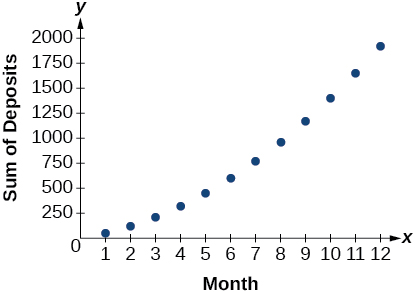
Sample answer: The graph of seems to be approaching 1. This makes sense because is a defined infinite geometric series with
答えの例: のグラフは1に近づいているように見える。 は である定められた無限等比級数なので、これは理にかなう。
13.5 Section Exercises13.5 節末問題
The addition principle is applied when determining the total possible of outcomes of either event occurring. The multiplication principle is applied when determining the total possible outcomes of both events occurring. The word “or” usually implies an addition problem. The word “and” usually implies a multiplication problem.
和の原理は、どちらかの出来事が起こるありうる結果の総数を決めるときに使う。積の原理は、両方の出来事が起こるありうる結果の総数を決めるときに使う。「または」という語はふつう足し算の問題を意味する。「かつ」という語はふつう掛け算の問題を意味する。
13.6 Section Exercises13.6 節末問題
A binomial coefficient is an alternative way of denoting the combination It is defined as
二項係数とは、組合せ を表す別のしかたである。 と定められる。
The Binomial Theorem is defined as and can be used to expand any binomial.
二項定理は と定められ、どの二項式の展開にも使える。
The expression cannot be expanded using the Binomial Theorem because it cannot be rewritten as a binomial.
式 は二項式に書き直せないので、二項定理では展開できない。
13.7 Section Exercises13.7 節末問題
probability; The probability of an event is restricted to values between and inclusive of and
確率。事象の確率は と のあいだ( と を含む)の値に限られる。
The probability of the union of two events occurring is a number that describes the likelihood that at least one of the events from a probability model occurs. In both a union of sets and a union of events the union includes either or both. The difference is that a union of sets results in another set, while the union of events is a probability, so it is always a numerical value between and
二つの事象の和事象が起こる確率とは、確率のモデルの事象の少なくとも一つが起こる起こりやすさを述べる数である。集合の和 でも事象の和 でも、和には のどちらか、または両方が含まれる。違うのは、集合の和は別の集合になるのに対し、事象の和は確率であり、つねに と のあいだの数値になる点である。
| 1 | 2 | 3 | 4 | 5 | 6 | |
| 1 | (1,1) 2 | (1,2) 3 | (1,3) 4 | (1,4) 5 | (1,5) 6 | (1,6) 7 |
| 2 | (2,1) 3 | (2,2) 4 | (2,3) 5 | (2,4) 6 | (2,5) 7 | (2,6) 8 |
| 3 | (3,1) 4 | (3,2) 5 | (3,3) 6 | (3,4) 7 | (3,5) 8 | (3,6) 9 |
| 4 | (4,1) 5 | (4,2) 6 | (4,3) 7 | (4,4) 8 | (4,5) 9 | (4,6) 10 |
| 5 | (5,1) 6 | (5,2) 7 | (5,3) 8 | (5,4) 9 | (5,5) 10 | (5,6) 11 |
| 6 | (6,1) 7 | (6,2) 8 | (6,3) 9 | (6,4) 10 | (6,5) 11 | (6,6) 12 |
Review Exercises復習問題
| 1 | 2 | 3 | 4 | 5 | 6 | |
| 1 | 1,1 | 1,2 | 1,3 | 1,4 | 1,5 | 1,6 |
| 2 | 2,1 | 2,2 | 2,3 | 2,4 | 2,5 | 2,6 |
| 3 | 3,1 | 3,2 | 3,3 | 3,4 | 3,5 | 3,6 |
| 4 | 4,1 | 4,2 | 4,3 | 4,4 | 4,5 | 4,6 |
| 5 | 5,1 | 5,2 | 5,3 | 5,4 | 5,5 | 5,6 |
| 6 | 6,1 | 6,2 | 6,3 | 6,4 | 6,5 | 6,6 |