第13章数列、確率、数え上げSequences, Probability, and Counting Theory
13.2 Arithmetic Sequences13.2 等差数列
Learning Objectives 学習目標
In this section, you will:
この節を終えると、次のことができるようになる。
• Find the common difference for an arithmetic sequence.• Write terms of an arithmetic sequence.• Use a recursive formula for an arithmetic sequence.• Use an explicit formula for an arithmetic sequence.
・等差数列の公差を求める。・等差数列の項を書く。・等差数列の漸化式を使う。・等差数列の一般項の公式を使う。
Companies often make large purchases, such as computers and vehicles, for business use. The book-value of these supplies decreases each year for tax purposes. This decrease in value is called depreciation. One method of calculating depreciation is straight-line depreciation, in which the value of the asset decreases by the same amount each year.
会社はしばしば、商売に使う計算機や車両などを大量に買う。この備品の帳簿上の価値は、税のために毎年下がる。この価値の減りを減価償却という。減価償却を計算する方法の一つが定額法で、資産の価値が毎年同じ額だけ下がる。
As an example, consider a woman who starts a small contracting business. She purchases a new truck for $25,000. After five years, she estimates that she will be able to sell the truck for $8,000. The loss in value of the truck will therefore be $17,000, which is $3,400 per year for five years. The truck will be worth $21,600 after the first year; $18,200 after two years; $14,800 after three years; $11,400 after four years; and $8,000 at the end of five years. In this section, we will consider specific kinds of sequences that will allow us to calculate depreciation, such as the truck’s value.
例として、小さな請負の商売を始めた女性を考えよ。彼女は新しい貨物車を25,000ドルで買う。5年後、彼女はこの貨物車を8,000ドルで売れると見積もる。よって貨物車の価値の減りは17,000ドルであり、5年で毎年3,400ドルである。この貨物車は1年後に21,600ドル、2年後に18,200ドル、3年後に14,800ドル、4年後に11,400ドル、5年の終わりに8,000ドルの価値になる。この節では、この貨物車の価値のような減価償却を計算できるようにする、特定の種類の数列を考える。
Finding Common Differences公差を求める
The values of the truck in the example are said to form an arithmetic sequence because they change by a constant amount each year. Each term increases or decreases by the same constant value called the common difference of the sequence. For this sequence, the common difference is –3,400.
例の貨物車の価値は、毎年一定の額だけ変わるので等差数列をなすという。各項は、この数列の公差という同じ一定の値だけ増えるか減る。この数列では、公差は–3,400である。

The sequence below is another example of an arithmetic sequence. In this case, the constant difference is 3. You can choose any term of the sequence, and add 3 to find the subsequent term.
下の数列も等差数列の例である。この場合、一定の差は3である。この数列のどの項を選んでも、3を足せば次の項が求まる。

Arithmetic Sequence 等差数列
An arithmetic sequence is a sequence that has the property that the difference between any two consecutive terms is a constant. This constant is called the common difference. If is the first term of an arithmetic sequence and is the common difference, the sequence will be:
等差数列とは、連続するどの二項の差も一定であるという性質を持つ数列である。この定数を公差という。 が等差数列の第一項、 が公差なら、この数列は次のようになる。
Example 1例1
Finding Common Differences公差を求める
Is each sequence arithmetic? If so, find the common difference.
各数列は等差数列か。そうなら公差を求めよ。
Solution 解答
Subtract each term from the subsequent term to determine whether a common difference exists.
後の項から各項を引き、公差があるかどうかを決める。
ⓐThe sequence is not arithmetic because there is no common difference.ⓑThe sequence is arithmetic because there is a common difference. The common difference is 4.
ⓐ公差が無いので、この数列は等差数列でない。ⓑ公差があるので、この数列は等差数列である。公差は4である。
Analysis 考察
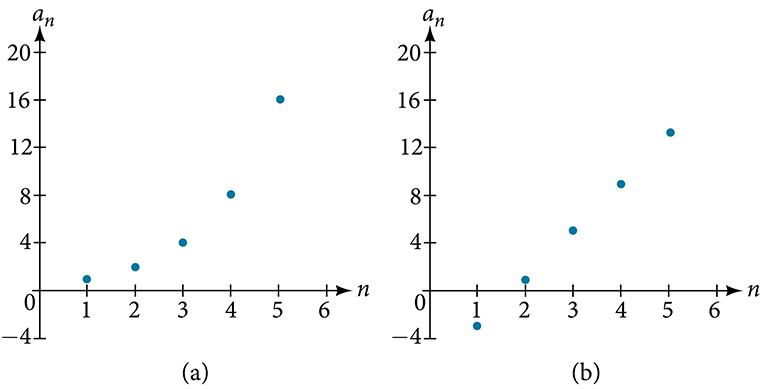
The graph of each of these sequences is shown in Figure 1. We can see from the graphs that, although both sequences show growth, is not linear whereas is linear. Arithmetic sequences have a constant rate of change so their graphs will always be points on a line.
この数列それぞれのグラフを図1に示す。グラフから、どちらの数列も増えてはいるが、 は一次でなく は一次だと分かる。等差数列は変化の割合が一定なので、そのグラフはつねに一直線上の点になる。
Q&A 疑問と答え
If we are told that a sequence is arithmetic, do we have to subtract every term from the following term to find the common difference?
数列が等差数列だと言われたとき、公差を求めるのに、後の項からすべての項を引かねばならないか。
No. If we know that the sequence is arithmetic, we can choose any one term in the sequence, and subtract it from the subsequent term to find the common difference.
そうではない。数列が等差数列だと分かっているなら、この数列のどれか一項を選び、それを後の項から引けば公差が求まる。
Try It #1やってみよう1
Is the given sequence arithmetic? If so, find the common difference.
与えられた数列は等差数列か。そうなら公差を求めよ。
Try It #2やってみよう2
Is the given sequence arithmetic? If so, find the common difference.
与えられた数列は等差数列か。そうなら公差を求めよ。
Writing Terms of Arithmetic Sequences等差数列の項を書く
Now that we can recognize an arithmetic sequence, we will find the terms if we are given the first term and the common difference. The terms can be found by beginning with the first term and adding the common difference repeatedly. In addition, any term can also be found by plugging in the values of and into formula below.
等差数列が見分けられるようになったので、第一項と公差が与えられたときに項を求める。項は、第一項から始めて公差を繰り返し足せば求まる。さらに、下の公式に と の値を入れれば、どの項も求まる。
How To 手順
Given the first term and the common difference of an arithmetic sequence, find the first several terms.
等差数列の第一項と公差が与えられたとき、初めのいくつかの項を求める。
1. Add the common difference to the first term to find the second term.2. Add the common difference to the second term to find the third term.3. Continue until all of the desired terms are identified.4. Write the terms separated by commas within brackets.
1. 第一項に公差を足して第二項を求める。2. 第二項に公差を足して第三項を求める。3. 求めたい項がすべて分かるまで続ける。4. 波括弧の中に、読点で区切って項を書く。
Example 2例2
Writing Terms of Arithmetic Sequences等差数列の項を書く
Write the first five terms of the arithmetic sequence with and .
かつ の等差数列の初めの五項を書け。
Solution 解答
Adding is the same as subtracting 3. Beginning with the first term, subtract 3 from each term to find the next term.
を足すのは3を引くのと同じである。第一項から始めて、各項から3を引けば次の項が求まる。
The first five terms are
初めの五項は である。
Analysis 考察
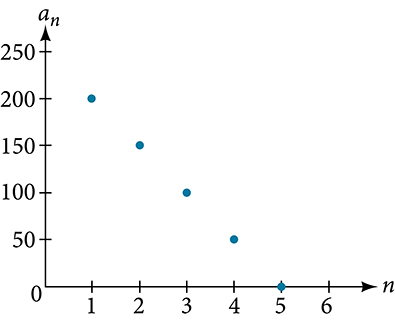
As expected, the graph of the sequence consists of points on a line as shown in Figure 2.
思ったとおり、図2に示すようにこの数列のグラフは一直線上の点からなる。
Try It #3やってみよう3
List the first five terms of the arithmetic sequence with and .
かつ の等差数列の初めの五項を並べよ。
How To 手順
Given any first term and any other term in an arithmetic sequence, find a given term.
等差数列の第一項ともう一つの項が与えられたとき、指定された項を求める。
1. Substitute the values given for into the formula to solve for 2. Find a given term by substituting the appropriate values for and into the formula
1. 公式 に の与えられた値を代入し、 について解く。2. 公式 に と のふさわしい値を代入し、指定された項を求める。
Example 3例3
Writing Terms of Arithmetic Sequences等差数列の項を書く
Given and , find .
かつ のとき、 を求めよ。
Solution 解答
The sequence can be written in terms of the initial term 8 and the common difference .
この数列は、初めの項8と公差 で書ける。
We know the fourth term equals 14; we know the fourth term has the form .
第四項が14に等しいと分かっている。第四項は の形を持つと分かっている。
We can find the common difference .
公差 が求まる。
Find the fifth term by adding the common difference to the fourth term.
第四項に公差を足して第五項を求める。
Analysis 考察
Notice that the common difference is added to the first term once to find the second term, twice to find the third term, three times to find the fourth term, and so on. The tenth term could be found by adding the common difference to the first term nine times or by using the equation
第二項を求めるには公差を第一項に一度足し、第三項には二度、第四項には三度、という具合であることに注意せよ。第十項は、第一項に公差を九回足すか、式 を使えば求まる。
Try It #4やってみよう4
Given and , find .
かつ のとき、 を求めよ。
Using Recursive Formulas for Arithmetic Sequences等差数列の漸化式を使う
Some arithmetic sequences are defined in terms of the previous term using a recursive formula. The formula provides an algebraic rule for determining the terms of the sequence. A recursive formula allows us to find any term of an arithmetic sequence using a function of the preceding term. Each term is the sum of the previous term and the common difference. For example, if the common difference is 5, then each term is the previous term plus 5. As with any recursive formula, the first term must be given.
等差数列の中には、漸化式を使って前の項で定められるものがある。この公式は、数列の項を決める代数の規則を与える。漸化式を使えば、直前の項の関数として等差数列のどの項も求まる。各項は、前の項と公差の和である。たとえば、公差が5なら、各項は前の項に5を足したものである。どの漸化式でもそうだが、第一項が与えられねばならない。
Recursive Formula for an Arithmetic Sequence 等差数列の漸化式
The recursive formula for an arithmetic sequence with common difference is:
公差 の等差数列の漸化式は次である。
How To 手順
Given an arithmetic sequence, write its recursive formula.
等差数列が与えられたとき、その漸化式を書く。
1. Subtract any term from the subsequent term to find the common difference.2. State the initial term and substitute the common difference into the recursive formula for arithmetic sequences.
1. 後の項からどれかの項を引いて公差を求める。2. 初めの項を述べ、等差数列の漸化式に公差を代入する。
Example 4例4
Writing a Recursive Formula for an Arithmetic Sequence等差数列の漸化式を書く
Write a recursive formula for the arithmetic sequence.
この等差数列の漸化式を書け。
Solution 解答
The first term is given as . The common difference can be found by subtracting the first term from the second term.
第一項は と与えられている。公差は、第二項から第一項を引けば求まる。
Substitute the initial term and the common difference into the recursive formula for arithmetic sequences.
等差数列の漸化式に、初めの項と公差を代入する。
Analysis 考察
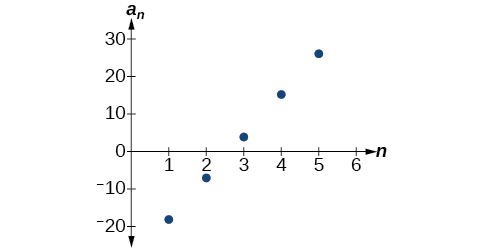
We see that the common difference is the slope of the line formed when we graph the terms of the sequence, as shown in Figure 3. The growth pattern of the sequence shows the constant difference of 11 units.
図3に示すとおり、この数列の項をグラフに描いたときにできる直線の傾きが公差であることが分かる。この数列の増え方の型は、11単位という一定の差を示す。
Q&A 疑問と答え
Do we have to subtract the first term from the second term to find the common difference?
公差を求めるのに、第二項から第一項を引かねばならないか。
No. We can subtract any term in the sequence from the subsequent term. It is, however, most common to subtract the first term from the second term because it is often the easiest method of finding the common difference.
そうではない。この数列のどの項も、後の項から引ける。だが、第二項から第一項を引くのがもっとふつうである。公差を求めるいちばん楽なしかたであることが多いからである。
Try It #5やってみよう5
Write a recursive formula for the arithmetic sequence.
この等差数列の漸化式を書け。
Using Explicit Formulas for Arithmetic Sequences等差数列の一般項の公式を使う
We can think of an arithmetic sequence as a function on the domain of the natural numbers; it is a linear function because it has a constant rate of change. The common difference is the constant rate of change, or the slope of the function. We can construct the linear function if we know the slope and the vertical intercept.
等差数列は、自然数を定義域とする関数と考えられる。変化の割合が一定なので一次関数である。公差が一定の変化の割合、すなわちこの関数の傾きである。傾きと縦の切片が分かっていれば、この一次関数が作れる。
To find the y-intercept of the function, we can subtract the common difference from the first term of the sequence. Consider the following sequence.
この関数の y軸との交点を求めるには、この数列の第一項から公差を引けばよい。次の数列を考えよ。

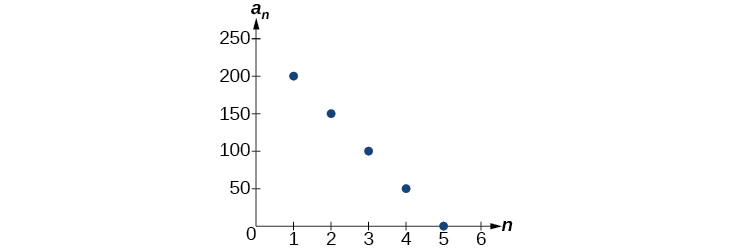
The common difference is , so the sequence represents a linear function with a slope of . To find the -intercept, we subtract from . You can also find the -intercept by graphing the function and determining where a line that connects the points would intersect the vertical axis. The graph is shown in Figure 4.
公差は なので、この数列は傾き の一次関数を表す。軸との交点を求めるには、 から を引く。この関数のグラフを描き、点を結ぶ直線が縦軸と交わるところを決めても 軸との交点は求まる。グラフを図4に示す。
Recall the slope-intercept form of a line is When dealing with sequences, we use in place of and in place of If we know the slope and vertical intercept of the function, we can substitute them for and in the slope-intercept form of a line. Substituting for the slope and for the vertical intercept, we get the following equation:
直線の傾きと切片の形が であったことを思い出せ。数列を扱うときは、 の代わりに を、 の代わりに を使う。この関数の傾きと縦の切片が分かっていれば、直線の傾きと切片の形の と にそれらを代入できる。傾きに 、縦の切片に を代入すると、次の式を得る。
We do not need to find the vertical intercept to write an explicit formula for an arithmetic sequence. Another explicit formula for this sequence is , which simplifies to
等差数列の一般項の公式を書くのに、縦の切片を求める必要は無い。この数列のもう一つの一般項の公式は であり、これは に簡単になる。
Explicit Formula for an Arithmetic Sequence 等差数列の一般項
An explicit formula for the term of an arithmetic sequence is given by
等差数列の第 項の一般項の公式は次で与えられる。
How To 手順
Given the first several terms for an arithmetic sequence, write an explicit formula.
等差数列の初めのいくつかの項が与えられたとき、一般項の公式を書く。
1. Find the common difference, 2. Substitute the common difference and the first term into
1. 公差 を求める。2. に公差と第一項を代入する。
Example 5例5
Writing the nth Term Explicit Formula for an Arithmetic Sequence等差数列の一般項の公式を書く
Write an explicit formula for the arithmetic sequence.
この等差数列の一般項の公式を書け。
Solution 解答
The common difference can be found by subtracting the first term from the second term.
公差は、第二項から第一項を引けば求まる。
The common difference is 10. Substitute the common difference and the first term of the sequence into the formula and simplify.
公差は10である。この数列の公差と第一項を公式に代入し、簡単にする。
Analysis 考察
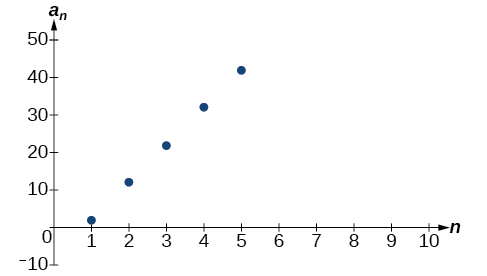
The graph of this sequence, represented in Figure 5, shows a slope of 10 and a vertical intercept of .
図5に表したこの数列のグラフは、傾き10、縦の切片 を示す。
Try It #6やってみよう6
Write an explicit formula for the following arithmetic sequence.
次の等差数列の一般項の公式を書け。
Finding the Number of Terms in a Finite Arithmetic Sequence有限の等差数列の項の数を求める
Explicit formulas can be used to determine the number of terms in a finite arithmetic sequence. We need to find the common difference, and then determine how many times the common difference must be added to the first term to obtain the final term of the sequence.
一般項の公式は、有限の等差数列の項の数を決めるのに使える。公差を求め、そしてこの数列の最後の項を得るには第一項に公差を何回足さねばならないかを決める必要がある。
How To 手順
Given the first three terms and the last term of a finite arithmetic sequence, find the total number of terms.
有限の等差数列の初めの三項と最後の項が与えられたとき、項の総数を求める。
1. Find the common difference 2. Substitute the common difference and the first term into 3. Substitute the last term for and solve for
1. 公差 を求める。2. に公差と第一項を代入する。3. に最後の項を代入し、 について解く。
Example 6例6
Finding the Number of Terms in a Finite Arithmetic Sequence有限の等差数列の項の数を求める
Find the number of terms in the finite arithmetic sequence.
この有限の等差数列の項の数を求めよ。
Solution 解答
The common difference can be found by subtracting the first term from the second term.
公差は、第二項から第一項を引けば求まる。
The common difference is . Substitute the common difference and the initial term of the sequence into the term formula and simplify.
公差は である。この数列の公差と初めの項を第 項の公式に代入し、簡単にする。
Substitute for and solve for
に を代入し、 について解く。
There are eight terms in the sequence.
この数列には八項ある。
Try It #7やってみよう7
Find the number of terms in the finite arithmetic sequence.
この有限の等差数列の項の数を求めよ。
Solving Application Problems with Arithmetic Sequences等差数列で応用問題を解く
In many application problems, it often makes sense to use an initial term of instead of In these problems, we alter the explicit formula slightly to account for the difference in initial terms. We use the following formula:
多くの応用問題では、初めの項を でなく とするほうが理にかなうことが多い。その場合、初めの項の違いを織り込むために一般項の公式を少し変える。次の公式を使う。
Example 7例7
Solving Application Problems with Arithmetic Sequences等差数列で応用問題を解く
A five-year old child receives an allowance of $1 each week. His parents promise him an annual increase of $2 per week.
5歳の子どもが毎週1ドルの小遣いをもらう。親は毎年、週あたり2ドルずつ増やすと約束する。
ⓐWrite a formula for the child’s weekly allowance in a given year.ⓑWhat will the child’s allowance be when he is 16 years old?
ⓐある年のこの子どもの週の小遣いの公式を書け。ⓑこの子どもが16歳のとき、小遣いはいくらになるか。
Solution 解答
ⓐThe situation can be modeled by an arithmetic sequence with an initial term of 1 and a common difference of 2. Let be the amount of the allowance and be the number of years after age 5. Using the altered explicit formula for an arithmetic sequence we get:ⓑWe can find the number of years since age 5 by subtracting. We are looking for the child’s allowance after 11 years. Substitute 11 into the formula to find the child’s allowance at age 16. The child’s allowance at age 16 will be $23 per week.
ⓐこの状況は、初めの項が1、公差が2の等差数列でモデルにできる。 を小遣いの額、 を5歳からの年数とする。等差数列の変えた一般項の公式を使うと次を得る。ⓑ5歳からの年数は引き算で求まる。 11年後の子どもの小遣いを求めたい。公式に11を代入し、16歳のときの子どもの小遣いを求める。 16歳のときの子どもの小遣いは週23ドルになる。
Try It #8やってみよう8
A woman decides to go for a 10-minute run every day this week and plans to increase the time of her daily run by 4 minutes each week. Write a formula for the time of her run after n weeks. How long will her daily run be 8 weeks from today?
ある女性が今週から毎日10分走ることにし、毎日の走りの時間を毎週4分ずつ増やすことにする。n週後の走りの時間の公式を書け。今日から8週後、毎日の走りはどれだけの長さになるか。
Media 教材
Access this online resource for additional instruction and practice with arithmetic sequences.
等差数列についての説明と練習をさらに求めるなら、次のオンライン教材にあたるとよい。
・等差数列
Verbal言葉で答える問題
2. How is the common difference of an arithmetic sequence found?
2. 等差数列の公差はどう求めるか。
4. What are the main differences between using a recursive formula and using an explicit formula to describe an arithmetic sequence?
4. 等差数列を述べるのに、漸化式を使うのと一般項の公式を使うのとの主な違いは何か。
Algebraic代数の問題
For the following exercises, find the common difference for the arithmetic sequence provided.
次の各問について、示された等差数列の公差を求めよ。
For the following exercises, determine whether the sequence is arithmetic. If so find the common difference.
次の各問について、この数列が等差数列かどうかを判定せよ。そうなら公差を求めよ。
For the following exercises, write the first five terms of the arithmetic sequence given the first term and common difference.
次の各問について、第一項と公差が与えられたとき、この等差数列の初めの五項を書け。
For the following exercises, write the first five terms of the arithmetic series given two terms.
次の各問について、二つの項が与えられたとき、この等差数列の初めの五項を書け。
For the following exercises, find the specified term for the arithmetic sequence given the first term and common difference.
次の各問について、第一項と公差が与えられたとき、この等差数列の指定された項を求めよ。
14. First term is 3, common difference is 4, find the 5th term.
14. 第一項が3、公差が4のとき、第5項を求めよ。
16. First term is 5, common difference is 6, find the 8th term.
16. 第一項が5、公差が6のとき、第8項を求めよ。
18. First term is 7, common difference is 8, find the 7th term.
18. 第一項が7、公差が8のとき、第7項を求めよ。
For the following exercises, find the first term given two terms from an arithmetic sequence.
次の各問について、等差数列の二つの項が与えられたとき、第一項を求めよ。
20. Find the first term or of an arithmetic sequence if and
20. かつ のとき、この等差数列の第一項 を求めよ。
22. Find the first term or of an arithmetic sequence if and
22. かつ のとき、この等差数列の第一項 を求めよ。
For the following exercises, find the specified term given two terms from an arithmetic sequence.
次の各問について、等差数列の二つの項が与えられたとき、指定された項を求めよ。
24. and Find
24. かつ 。 を求めよ。
For the following exercises, use the recursive formula to write the first five terms of the arithmetic sequence.
次の各問について、漸化式を使ってこの等差数列の初めの五項を書け。
For the following exercises, write a recursive formula for each arithmetic sequence.
次の各問について、各等差数列の漸化式を書け。
For the following exercises, write a recursive formula for the given arithmetic sequence, and then find the specified term.
次の各問について、与えられた等差数列の漸化式を書き、そして指定された項を求めよ。
38. Find the 17th term.
38. 。第17項を求めよ。
40. Find the 12th term.
40. 。第12項を求めよ。
For the following exercises, use the explicit formula to write the first five terms of the arithmetic sequence.
次の各問について、一般項の公式を使ってこの等差数列の初めの五項を書け。
For the following exercises, write an explicit formula for each arithmetic sequence.
次の各問について、各等差数列の一般項の公式を書け。
For the following exercises, find the number of terms in the given finite arithmetic sequence.
次の各問について、与えられた有限の等差数列の項の数を求めよ。
Graphicalグラフの問題
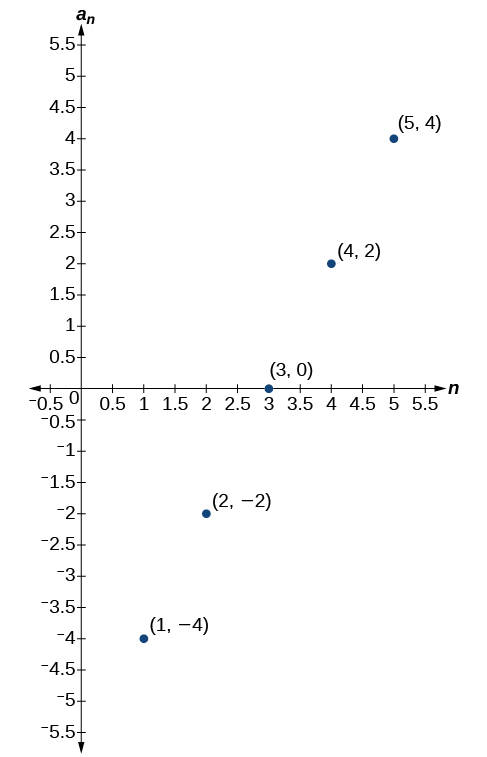
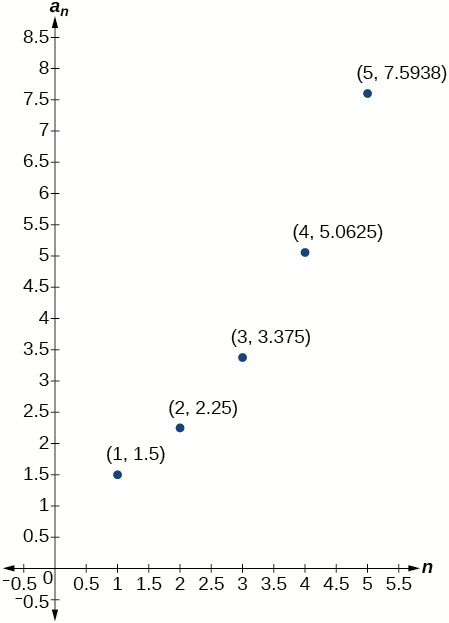
For the following exercises, determine whether the graph shown represents an arithmetic sequence.
次の各問について、示されたグラフが等差数列を表すかどうかを判定せよ。
For the following exercises, use the information provided to graph the first 5 terms of the arithmetic sequence.
次の各問について、与えられた情報を使ってこの等差数列の初めの5項をグラフに描け。
Technology機器を使う問題
For the following exercises, follow the steps to work with the arithmetic sequence using a graphing calculator:
次の各問について、グラフ電卓を使い、次の手順に従って等差数列 を扱え。
• Press [MODE] Select SEQ in the fourth line Select DOT in the fifth line Press [ENTER]• Press [Y=] is the first counting number for the sequence. Set is the pattern for the sequence. Set is the first number in the sequence. Set • Press [2ND] then [WINDOW] to go to TBLSET Set Set Set Indpnt: Auto and Depend: Auto• Press [2ND] then [GRAPH] to go to the TABLE
・[MODE] を押す。4行目で SEQ を選ぶ。5行目で DOT を選ぶ。[ENTER] を押す。・[Y=] を押す。 はこの数列の最初の数え上げの数である。 と設定する。 はこの数列の型である。 と設定する。 はこの数列の最初の数である。 と設定する。・[2ND] のあと [WINDOW] を押して TBLSET へ行く。 と設定する。 と設定する。Indpnt: Auto、Depend: Auto と設定する。・[2ND] のあと [GRAPH] を押して TABLE へ行く。
62. Use the scroll-down arrow to scroll to What value is given for
62. 下向きの矢印で までたどれ。 にはどんな値が示されるか。
For the following exercises, follow the steps given above to work with the arithmetic sequence using a graphing calculator.
次の各問について、グラフ電卓を使い、上に示した手順に従って等差数列 を扱え。
64. What are the first seven terms shown in the column with the heading in the TABLE feature?
64. TABLE の機能で、見出し の列に示される初めの七項は何か。
Extensions発展問題
66. Give two examples of arithmetic sequences whose 4th terms are
66. 第4項が である等差数列の例を二つ挙げよ。
68. Find the 5th term of the arithmetic sequence
68. 等差数列 の第5項を求めよ。
70. At which term does the sequence exceed 151?
70. 数列 は第何項で151を超えるか。
72. For which terms does the finite arithmetic sequence have integer values?
72. 有限の等差数列 は、どの項で整数の値を持つか。
74. Write an arithmetic sequence using an explicit formula. Show the first 4 terms, and then find the 28th term.
74. 一般項の公式を使って等差数列を書け。初めの4項を示し、そして第28項を求めよ。