第11章連立方程式と連立不等式Systems of Equations and Inequalities
Introduction to Systems of Equations and Inequalities連立方程式と連立不等式への導入
• 11.1 Systems of Linear Equations: Two Variables • 11.2 Systems of Linear Equations: Three Variables • 11.3 Systems of Nonlinear Equations and Inequalities: Two Variables • 11.4 Partial Fractions • 11.5 Matrices and Matrix Operations • 11.6 Solving Systems with Gaussian Elimination • 11.7 Solving Systems with Inverses • 11.8 Solving Systems with Cramer's Rule
・11.1 連立一次方程式: 二変数・11.2 連立一次方程式: 三変数・11.3 非線形連立方程式と連立不等式: 二変数・11.4 部分分数・11.5 行列と行列の演算・11.6 ガウスの消去法で連立方程式を解く・11.7 逆行列で連立方程式を解く・11.8 クラメルの公式で連立方程式を解く
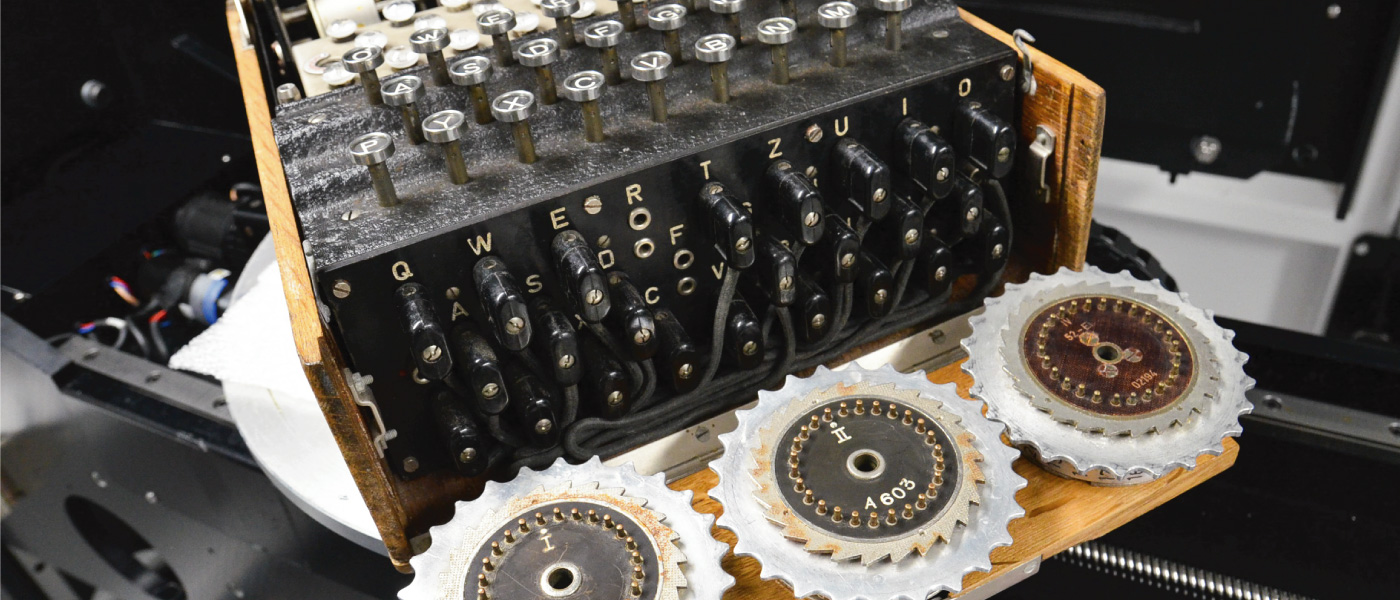
At the start of the Second World War, British military and intelligence officers recognized that defeating Nazi Germany would require the Allies to know what the enemy was planning. This task was complicated by the fact that the German military transmitted all of its communications through a presumably uncrackable code created by a machine called Enigma. The Germans had been encoding their messages with this machine since the early 1930s, and were so confident in its security that they used it for everyday military communications as well as highly important strategic messages. Concerned about the increasing military threat, other European nations began working to decipher the Enigma codes. Poland was the first country to make significant advances when it trained and recruited a new group of codebreakers: math students from Poznań University. With the help of intelligence obtained by French spies, Polish mathematicians, led by Marian Rejewski, were able to decipher initial codes and later to understand the wiring of the machines; eventually they create replicas. However, the German military eventually increased the complexity of the machines by adding additional rotors, requiring a new method of decryption.
第二次世界大戦の初め、英国の軍や情報機関は、ナチス・ドイツに勝つには敵の計画を知る必要があると考えていた。しかしドイツ軍の通信には、「エニグマ」という機械が作り出す、解読不能と思われた暗号が使われていた。ドイツは1930年代初めからエニグマを使用し、その安全性を信頼して、日常の軍事通信にも重要な戦略上の通信にも利用していた。軍事的脅威の高まりを受け、ほかの欧州諸国も解読に取り組んだ。最初に大きな成果を上げたのは、ポズナン大学の数学の学生を育成・採用したポーランドである。フランスの諜報員が得た情報も手掛かりに、マリアン・レイェフスキらは初期の暗号を解読し、機械の配線を突き止め、ついには複製機を作った。その後ドイツ軍がローターを追加して仕組みを複雑にしたため、新たな解読法が必要になった。
The machine attached letters on a keyboard to three, four, or five rotors (depending on the version), each with 26 starting positions that could be set prior to encoding; a decryption code (called a cipher key) essentially conveyed these settings to the message recipient, and allowed people to interpret the message using another Enigma machine. Even with the simpler three-rotor scrambler, there were 17,576 different combinations of starting positions (26 x 26 x 26); plus the machine had numerous other methods of introducing variation. Not long after the war started, the British recruited a team of brilliant codebreakers to crack the Enigma code. The codebreakers, led by Alan Turing, used what they knew about the Enigma machine to build a mechanical computer that could crack the code. And that knowledge of what the Germans were planning proved to be a key part of the ultimate Allied victory of Nazi Germany in 1945.
この機械は、鍵盤の文字を三つ、四つ、または五つ(型による)の回転子につないだ。各回転子には暗号化の前に決められる26の初期位置があった。解読の暗号(暗号鍵という)は、要するにこの設定を受け手に伝え、別のエニグマ機を使って文を読み解けるようにした。より単純な三回転子の攪拌器でさえ、初期位置の組み合わせは17,576通り(26 × 26 × 26)あり、さらにこの機械には変化を持ち込む方法がほかにも数多くあった。戦争が始まってまもなく、英国はエニグマの暗号を破るため、すぐれた暗号解読者の一団を集めた。アラン・チューリング率いる暗号解読者たちは、エニグマ機について知っていることを使って、この暗号を破れる機械式の計算機を作った。そしてドイツの計画を知っていたことは、1945年にナチス・ドイツに対して連合国が最終的に勝利する鍵の一つとなった。
The Enigma is perhaps the most famous cryptographic device ever known. It stands as an example of the pivotal role cryptography has played in society. Now, technology has moved cryptanalysis to the digital world.
エニグマは、史上最もよく知られた暗号装置の1つであり、暗号技術が社会で果たしてきた重要な役割を示している。現在、暗号解読の主な舞台はデジタルの世界へ移っている。
Many ciphers are designed using invertible matrices as the method of message transference, as finding the inverse of a matrix is generally part of the process of decoding. In addition to knowing the matrix and its inverse, the receiver must also know the key that, when used with the matrix inverse, will allow the message to be read.
多くの暗号は、文を伝える方法として逆行列を持つ行列を使って設計されている。行列の逆を求めることが、ふつう解読の過程の一部だからである。行列とその逆を知っているだけでなく、受け手は、逆行列とともに使えば文が読めるようになる鍵も知っていなければならない。
In this chapter, we will investigate matrices and their inverses, and various ways to use matrices to solve systems of equations. First, however, we will study systems of equations on their own: linear and nonlinear, and then partial fractions. We will not be breaking any secret codes here, but we will lay the foundation for future courses.
この章では、行列とその逆、そして行列を使って連立方程式を解くいろいろなしかたを調べる。だがまず、連立方程式そのものを、一次のものと一次でないものについて学び、そして部分分数を学ぶ。ここで秘密の暗号を破ることはないが、この先の講義の土台を築く。