第12章解析幾何Analytic Geometry
Introduction to Analytic Geometry解析幾何への導入
• 12.1 The Ellipse • 12.2 The Hyperbola • 12.3 The Parabola • 12.4 Rotation of Axes • 12.5 Conic Sections in Polar Coordinates
・12.1 楕円・12.2 双曲線・12.3 放物線・12.4 座標軸の回転・12.5 極座標での円錐曲線
The Greek mathematician Menaechmus (c. 380–c. 320 BCE) is generally credited with discovering the shapes formed by the intersection of a plane and a right circular cone. Depending on how he tilted the plane when it intersected the cone, he formed different shapes at the intersection–beautiful shapes with near-perfect symmetry.
平面で直円錐を切ったときに現れる曲線を発見したのは、一般に、古代ギリシャの数学者メナイクモス(紀元前380年ごろ〜320年ごろ)とされる。切断する平面の傾きを変えると、異なる形の曲線が現れる。それらはいずれも、美しい対称性を持っている。
It was also said that Aristotle may have had an intuitive understanding of these shapes, as he observed the orbit of the planet to be circular. He presumed that the planets moved in circular orbits around Earth, and for nearly 2000 years this was the commonly held belief.
アリストテレスも、こうした図形を直感的に捉えていたのかもしれない。彼は、惑星が地球のまわりを円軌道で運動すると考えた。この考え方は、その後およそ2,000年にわたって広く受け入れられていた。
It was not until the Renaissance movement that Johannes Kepler noticed that the orbits of the planet were not circular in nature. His published law of planetary motion in the 1600s changed our view of the solar system forever. He claimed that the sun was at one end of the orbits, and the planets revolved around the sun in an oval-shaped path.
惑星の軌道が円ではないことを明らかにしたのは、近世のヨハネス・ケプラーである。17世紀に発表された惑星運動の法則は、太陽系の見方を大きく変えた。惑星は、太陽を1つの焦点とする楕円軌道を描いて運動する。
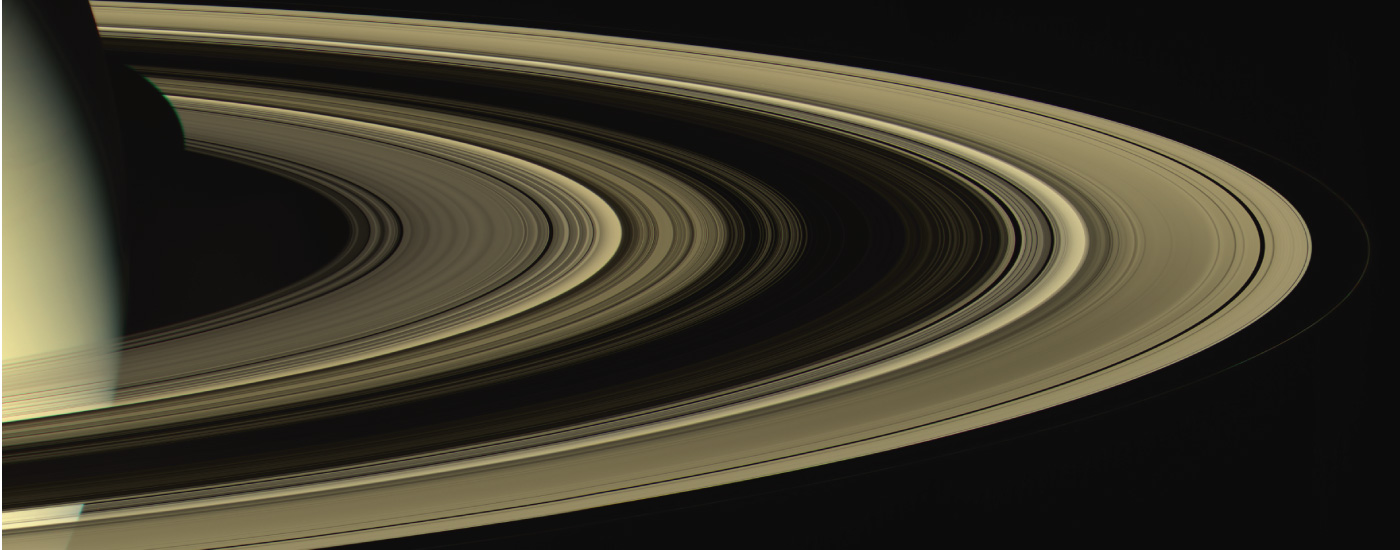
Other objects in the solar system (and perhaps other systems) follow a similar elliptical path, including the spectacular rings of Saturn. Using this understanding as a basis, 19th century mathematicians like James Clerk Maxwell and Sofya Kovalevskaya showed that despite their appearance through the telescopes of the day (and even in current telescopes), the rings are not solid and continuous, but are rather composed of small particles. Even after the Voyager and Cassini missions have provided close-up and detailed data regarding the ring structures, full understanding of their construction relies heavily on mathematical analysis. Of particular interest are the influences of Saturn's moons and moonlets, and the ways they both disrupt and preserve the ring structure.
太陽系(そしておそらく他の系)のほかの物も、土星の壮麗な環をはじめ、似た楕円の道筋をたどる。この理解を土台として、19世紀の数学者ジェイムズ・クラーク・マクスウェルやソフィヤ・コワレフスカヤは、当時の望遠鏡(そして今の望遠鏡でも)ではそう見えるにもかかわらず、環は固く連続したものではなく、小さな粒からできていることを示した。ボイジャーとカッシーニの計画が環の構造について接写と詳しい資料をもたらしたあとも、その成り立ちを十分に理解するには数学の解析に大きく頼っている。とりわけ興味深いのは、土星の衛星と小衛星の影響、そしてそれらが環の構造を乱しもし保ちもするしかたである。
In this chapter, we will investigate the two-dimensional figures that are formed when a right circular cone is intersected by a plane. We will begin by studying each of three figures created in this manner. We will develop defining equations for each figure and then learn how to use these equations to solve a variety of problems.
この章では、直円錐が平面と交わるときにできる二次元の図形を調べる。まず、こうしてできる三つの図形をそれぞれ学ぶ。各図形を定める式を作り、そしてその式を使っていろいろな問題を解くしかたを学ぶ。