第12章解析幾何Analytic Geometry
12.5 Conic Sections in Polar Coordinates12.5 極座標での円錐曲線
Learning Objectives 学習目標
In this section, you will:
この節を終えると、次のことができるようになる。
• Identify a conic in polar form.• Graph the polar equations of conics.• Define conics in terms of a focus and a directrix.
・極形式で円錐曲線を見分ける。・円錐曲線の極方程式のグラフを描く。・円錐曲線を焦点と準線で定める。
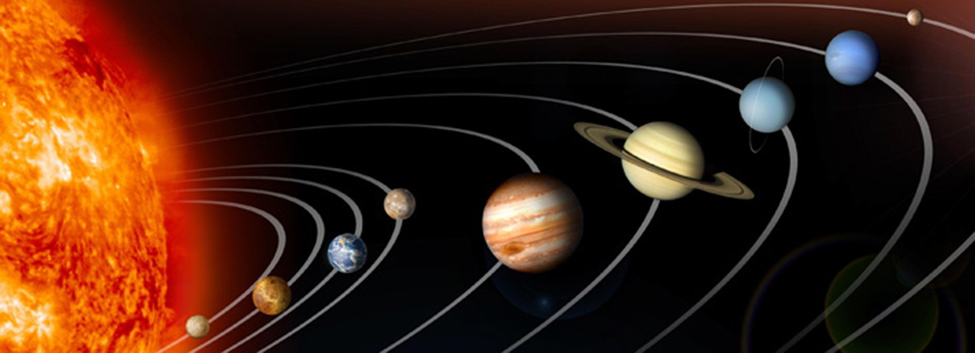
Most of us are familiar with orbital motion, such as the motion of a planet around the sun or an electron around an atomic nucleus. Within the planetary system, orbits of planets, asteroids, and comets around a larger celestial body are often elliptical. Comets, however, may take on a parabolic or hyperbolic orbit instead. And, in reality, the characteristics of the planets’ orbits may vary over time. Each orbit is tied to the location of the celestial body being orbited and the distance and direction of the planet or other object from that body. As a result, we tend to use polar coordinates to represent these orbits.
太陽のまわりの惑星の運動や、原子核のまわりの電子の運動のような軌道の運動は、たいていの人がよく知っている。惑星の系では、より大きな天体のまわりを回る惑星、小惑星、彗星の軌道はしばしば楕円である。だが彗星は、代わりに放物線や双曲線の軌道をとることもある。そして実際には、惑星の軌道の性質は時とともに変わりうる。どの軌道も、回られている天体の位置と、その天体からの惑星その他の物の距離と向きに結び付いている。そのため、この軌道を表すのには極座標を使うことが多い。
In an elliptical orbit, the periapsis is the point at which the two objects are closest, and the apoapsis is the point at which they are farthest apart. Generally, the velocity of the orbiting body tends to increase as it approaches the periapsis and decrease as it approaches the apoapsis. Some objects reach an escape velocity, which results in an infinite orbit. These bodies exhibit either a parabolic or a hyperbolic orbit about a body; the orbiting body breaks free of the celestial body’s gravitational pull and fires off into space. Each of these orbits can be modeled by a conic section in the polar coordinate system.
楕円の軌道では、近点は二つの物がもっとも近づく点、遠点はもっとも離れる点である。ふつう、回る物の速さは近点に近づくにつれて増し、遠点に近づくにつれて減る。脱出速度に達する物もあり、その場合は無限に続く軌道になる。この天体は、ある天体のまわりを放物線か双曲線の軌道で動く。回る物はその天体の重力の引きから逃れ、宇宙へ飛び去る。この軌道はどれも、極座標系の円錐曲線でモデルにできる。
Identifying a Conic in Polar Form極形式で円錐曲線を見分ける
Any conic may be determined by three characteristics: a single focus, a fixed line called the directrix, and the ratio of the distances of each to a point on the graph. Consider the parabola shown in Figure 2.
どの円錐曲線も、三つの性質で定まる。一つの焦点、準線という定まった直線、そしてグラフ上の点からその二つまでの距離の比である。図2に示す放物線 を考えよ。
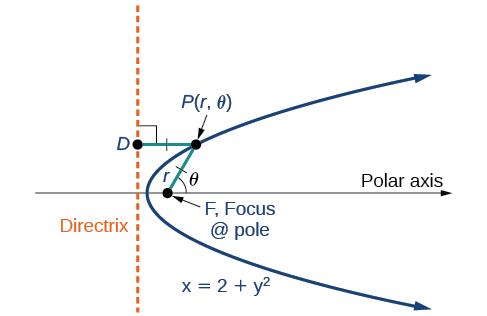
In The Parabola, we learned how a parabola is defined by the focus (a fixed point) and the directrix (a fixed line). In this section, we will learn how to define any conic in the polar coordinate system in terms of a fixed point, the focus at the pole, and a line, the directrix, which is perpendicular to the polar axis.
「放物線」の節で、放物線が焦点(定まった点)と準線(定まった直線)で定められることを学んだ。この節では、極座標系でどの円錐曲線も、定まった点である極の焦点 と、極軸に垂直な直線である準線で定めるしかたを学ぶ。
If is a fixed point, the focus, and is a fixed line, the directrix, then we can let be a fixed positive number, called the eccentricity, which we can define as the ratio of the distances from a point on the graph to the focus and the point on the graph to the directrix. Then the set of all points such that is a conic. In other words, we can define a conic as the set of all points with the property that the ratio of the distance from to to the distance from to is equal to the constant
を焦点である定まった点、 を準線である定まった直線とすると、離心率という定まった正の数 をとれる。これは、グラフ上の点から焦点までの距離と、グラフ上の点から準線までの距離の比として定められる。すると、 を満たす点 すべての集合が円錐曲線である。言い換えれば、円錐曲線とは、 から までの距離と から までの距離の比が定数 に等しいという性質を持つ点 すべての集合として定められる。
For a conic with eccentricity
離心率 の円錐曲線について、
• if the conic is an ellipse• if the conic is a parabola• if the conic is an hyperbola
・ なら円錐曲線は楕円・ なら円錐曲線は放物線・ なら円錐曲線は双曲線
With this definition, we may now define a conic in terms of the directrix, the eccentricity and the angle Thus, each conic may be written as a polar equation, an equation written in terms of and
この定めにより、円錐曲線を準線 、離心率 、角 で定められるようになった。よって、どの円錐曲線も極方程式、すなわち と で書かれた式として書ける。
The Polar Equation for a Conic 円錐曲線の極方程式
For a conic with a focus at the origin, if the directrix is where is a positive real number, and the eccentricity is a positive real number the conic has a polar equation
原点に焦点を持つ円錐曲線について、準線が ( は正の実数)で、離心率が正の実数 のとき、この円錐曲線は次の極方程式を持つ。
For a conic with a focus at the origin, if the directrix is where is a positive real number, and the eccentricity is a positive real number the conic has a polar equation
原点に焦点を持つ円錐曲線について、準線が ( は正の実数)で、離心率が正の実数 のとき、この円錐曲線は次の極方程式を持つ。
How To 手順
Given the polar equation for a conic, identify the type of conic, the directrix, and the eccentricity.
円錐曲線の極方程式が与えられたとき、円錐曲線の種類、準線、離心率を見分ける。
1. Multiply the numerator and denominator by the reciprocal of the constant in the denominator to rewrite the equation in standard form.2. Identify the eccentricity as the coefficient of the trigonometric function in the denominator.3. Compare with 1 to determine the shape of the conic.4. Determine the directrix as if cosine is in the denominator and if sine is in the denominator. Set equal to the numerator in standard form to solve for or
1. 分母の定数の逆数を分子と分母に掛け、式を標準の形に書き直す。2. 分母の三角関数の係数として離心率 を見分ける。3. を1と比べ、円錐曲線の形を決める。4. 分母に余弦があるなら準線を 、分母に正弦があるなら と決める。 を標準の形の分子に等しいと置き、 か について解く。
Example 1例1
Identifying a Conic Given the Polar Form極形式が与えられたときに円錐曲線を見分ける
For each of the following equations, identify the conic with focus at the origin, the directrix, and the eccentricity.
次の各式について、原点に焦点を持つ円錐曲線、準線、離心率を見分けよ。
Solution 解答
For each of the three conics, we will rewrite the equation in standard form. Standard form has a 1 as the constant in the denominator. Therefore, in all three parts, the first step will be to multiply the numerator and denominator by the reciprocal of the constant of the original equation, where is that constant.
三つの円錐曲線それぞれについて、式を標準の形に書き直す。標準の形は分母の定数が1である。したがって、三つすべてで最初の一歩は、元の式の定数の逆数 ( がその定数)を分子と分母に掛けることである。
a. Multiply the numerator and denominator by Because is in the denominator, the directrix is Comparing to standard form, note that Therefore, from the numerator, Since the conic is an ellipse. The eccentricity is and the directrix is b. Multiply the numerator and denominator by Because is in the denominator, the directrix is Comparing to standard form, Therefore, from the numerator, Since the conic is a hyperbola. The eccentricity is and the directrix is c. Multiply the numerator and denominator by Because sine is in the denominator, the directrix is Comparing to standard form, Therefore, from the numerator, Because the conic is a parabola. The eccentricity is and the directrix is
a. 分子と分母に を掛ける。 分母に があるので、準線は である。標準の形と比べると に注意せよ。したがって、分子から である。 なので、この円錐曲線は楕円である。離心率は 、準線は である。b. 分子と分母に を掛ける。 分母に があるので、準線は である。標準の形と比べると である。したがって、分子から である。 なので、この円錐曲線は双曲線である。離心率は 、準線は である。c. 分子と分母に を掛ける。 分母に正弦があるので、準線は である。標準の形と比べると である。したがって、分子から である。 なので、この円錐曲線は放物線である。離心率は 、準線は である。
Try It #1やってみよう1
Identify the conic with focus at the origin, the directrix, and the eccentricity for
について、原点に焦点を持つ円錐曲線、準線、離心率を見分けよ。
Graphing the Polar Equations of Conics円錐曲線の極方程式のグラフを描く
When graphing in Cartesian coordinates, each conic section has a unique equation. This is not the case when graphing in polar coordinates. We must use the eccentricity of a conic section to determine which type of curve to graph, and then determine its specific characteristics. The first step is to rewrite the conic in standard form as we have done in the previous example. In other words, we need to rewrite the equation so that the denominator begins with 1. This enables us to determine and, therefore, the shape of the curve. The next step is to substitute values for and solve for to plot a few key points. Setting equal to and provides the vertices so we can create a rough sketch of the graph.
デカルト座標でグラフを描くとき、各円錐曲線はそれぞれ固有の式を持つ。極座標でグラフを描くときはそうならない。円錐曲線の離心率を使って、どの種類の曲線を描くかを決め、そしてその具体的な性質を決めねばならない。最初の一歩は、前の例でしたように円錐曲線を標準の形に書き直すことである。言い換えれば、分母が1から始まるように式を書き直す必要がある。そうすれば が決まり、したがって曲線の形が決まる。次の一歩は、 に値を代入して について解き、要となる点をいくつか打つことである。 を と に等しいと置けば頂点が得られるので、グラフのおおまかな概形が描ける。
Example 2例2
Graphing a Parabola in Polar Form極形式で放物線のグラフを描く
Graph
のグラフを描け。
Solution 解答
First, we rewrite the conic in standard form by multiplying the numerator and denominator by the reciprocal of 3, which is
まず、3の逆数である を分子と分母に掛け、この円錐曲線を標準の形に書き直す。
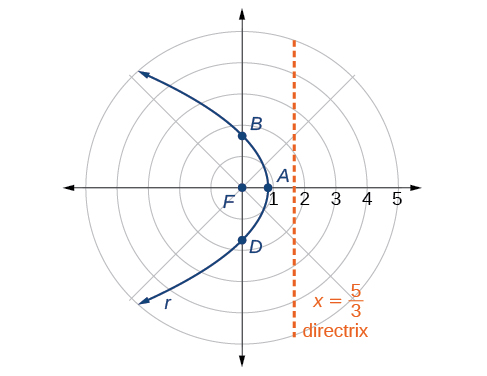
Because we will graph a parabola with a focus at the origin. The function has a and there is an addition sign in the denominator, so the directrix is
なので、原点に焦点を持つ放物線を描くことになる。この関数は を持ち、分母に足し算の記号があるので、準線は である。
The directrix is
準線は である。
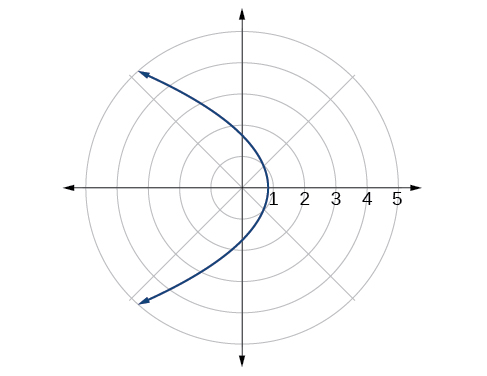
Plotting a few key points as in Table 1 will enable us to see the vertices. See Figure 3.
表1のように要となる点をいくつか打てば、頂点が見える。図3を見よ。
| A | B | C | D | |
|---|---|---|---|---|
| undefined定められない |
Example 3例3
Graphing a Hyperbola in Polar Form極形式で双曲線のグラフを描く
Graph
のグラフを描け。
Solution 解答
First, we rewrite the conic in standard form by multiplying the numerator and denominator by the reciprocal of 2, which is
まず、2の逆数である を分子と分母に掛け、この円錐曲線を標準の形に書き直す。
Because so we will graph a hyperbola with a focus at the origin. The function has a term and there is a subtraction sign in the denominator, so the directrix is
なので、原点に焦点を持つ双曲線を描くことになる。この関数は の項を持ち、分母に引き算の記号があるので、準線は である。
The directrix is
準線は である。
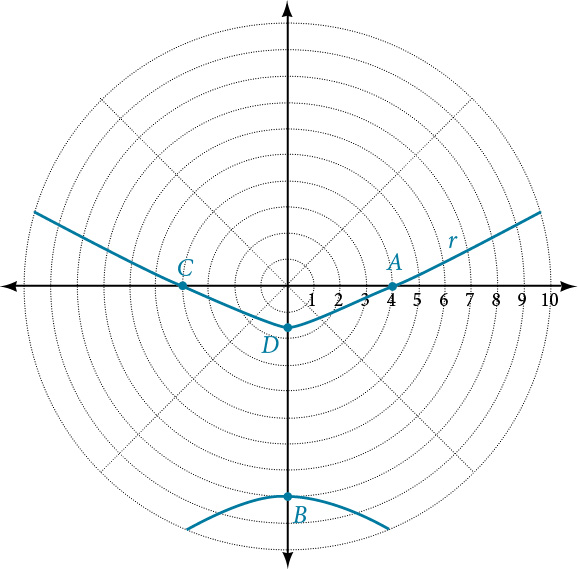
Plotting a few key points as in Table 2 will enable us to see the vertices. See Figure 5.
表2のように要となる点をいくつか打てば、頂点が見える。図5を見よ。
| A | B | C | D | |
|---|---|---|---|---|
Example 4例4
Graphing an Ellipse in Polar Form極形式で楕円のグラフを描く
Graph
のグラフを描け。
Solution 解答
First, we rewrite the conic in standard form by multiplying the numerator and denominator by the reciprocal of 5, which is
まず、5の逆数である を分子と分母に掛け、この円錐曲線を標準の形に書き直す。
Because so we will graph an ellipse with a focus at the origin. The function has a and there is a subtraction sign in the denominator, so the directrix is
なので、原点に焦点を持つ楕円を描くことになる。この関数は を持ち、分母に引き算の記号があるので、準線は である。
The directrix is
準線は である。
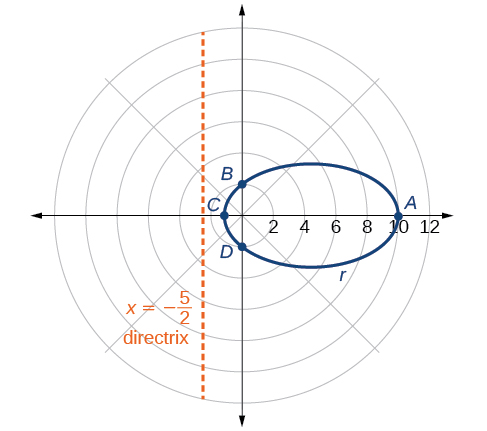
Plotting a few key points as in Table 3 will enable us to see the vertices. See Figure 6.
表3のように要となる点をいくつか打てば、頂点が見える。図6を見よ。
| A | B | C | D | |
|---|---|---|---|---|
Analysis 考察
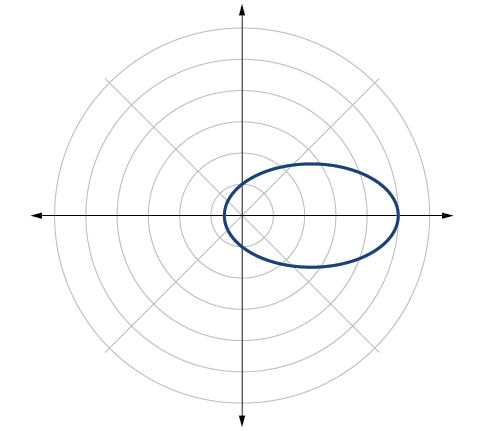
We can check our result using a graphing utility. See Figure 7.
グラフを描く道具で結果を確かめられる。図7を見よ。
Try It #2やってみよう2
Graph
のグラフを描け。
Defining Conics in Terms of a Focus and a Directrix円錐曲線を焦点と準線で定める
So far we have been using polar equations of conics to describe and graph the curve. Now we will work in reverse; we will use information about the origin, eccentricity, and directrix to determine the polar equation.
ここまでは、円錐曲線の極方程式を使って曲線を述べ、グラフを描いてきた。ここでは逆をする。原点、離心率、準線についての情報を使って極方程式を決める。
How To 手順
Given the focus, eccentricity, and directrix of a conic, determine the polar equation.
円錐曲線の焦点、離心率、準線が与えられたとき、極方程式を決める。
1. Determine whether the directrix is horizontal or vertical. If the directrix is given in terms of we use the general polar form in terms of sine. If the directrix is given in terms of we use the general polar form in terms of cosine.2. Determine the sign in the denominator. If use subtraction. If use addition.3. Write the coefficient of the trigonometric function as the given eccentricity.4. Write the absolute value of in the numerator, and simplify the equation.
1. 準線が横か縦かを決める。準線が で与えられているなら、正弦による一般の極の形を使う。準線が で与えられているなら、余弦による一般の極の形を使う。2. 分母の符号を決める。 なら引き算を使う。 なら足し算を使う。3. 三角関数の係数を、与えられた離心率として書く。4. 分子に の絶対値を書き、式を簡単にする。
Example 5例5
Finding the Polar Form of a Vertical Conic Given a Focus at the Origin and the Eccentricity and Directrix原点の焦点、離心率、準線が与えられたときに縦の円錐曲線の極形式を求める
Find the polar form of the conic given a focus at the origin, and directrix
原点に焦点があり、、準線 が与えられたとき、この円錐曲線の極形式を求めよ。
Solution 解答
The directrix is so we know the trigonometric function in the denominator is sine.
準線が なので、分母の三角関数は正弦だと分かる。
Because so we know there is a subtraction sign in the denominator. We use the standard form of
なので、分母には引き算の記号があると分かる。次の標準の形を使う。
and and
そして かつ である。
Therefore,
したがって、
Example 6例6
Finding the Polar Form of a Horizontal Conic Given a Focus at the Origin and the Eccentricity and Directrix原点の焦点、離心率、準線が与えられたときに横の円錐曲線の極形式を求める
Find the polar form of a conic given a focus at the origin, and directrix
原点に焦点があり、、準線 が与えられたとき、この円錐曲線の極形式を求めよ。
Solution 解答
Because the directrix is we know the function in the denominator is cosine. Because so we know there is an addition sign in the denominator. We use the standard form of
準線が なので、分母の関数は余弦だと分かる。 なので、分母には足し算の記号があると分かる。次の標準の形を使う。
and and
そして かつ である。
Therefore,
したがって、
Try It #3やってみよう3
Find the polar form of the conic given a focus at the origin, and directrix
原点に焦点があり、、準線 が与えられたとき、この円錐曲線の極形式を求めよ。
Example 7例7
Converting a Conic in Polar Form to Rectangular Form極形式の円錐曲線を直交形式に換える
Convert the conic to rectangular form.
円錐曲線 を直交形式に換えよ。
Solution 解答
We will rearrange the formula to use the identities
恒等式 を使えるように公式を組み替える。
Try It #4やってみよう4
Convert the conic to rectangular form.
円錐曲線 を直交形式に換えよ。
Media 教材
Access these online resources for additional instruction and practice with conics in polar coordinates.
極座標での円錐曲線についての説明と練習をさらに求めるなら、次のオンライン教材にあたるとよい。
• Polar Equations of Conic Sections• Graphing Polar Equations of Conics - 1• Graphing Polar Equations of Conics - 2
・円錐曲線の極方程式・円錐曲線の極方程式のグラフを描く - 1・円錐曲線の極方程式のグラフを描く - 2
Verbal言葉で答える問題
2. If a conic section is written as a polar equation, what must be true of the denominator?
2. 円錐曲線が極方程式として書かれているとき、分母について何が成り立たねばならないか。
4. If the directrix of a conic section is perpendicular to the polar axis, what do we know about the equation of the graph?
4. 円錐曲線の準線が極軸に垂直のとき、そのグラフの式について何が分かるか。
Algebraic代数の問題
For the following exercises, identify the conic with a focus at the origin, and then give the directrix and eccentricity.
次の各問について、原点に焦点を持つ円錐曲線を見分け、そして準線と離心率を示せ。
For the following exercises, convert the polar equation of a conic section to a rectangular equation.
次の各問について、円錐曲線の極方程式を直交座標での方程式に換えよ。
For the following exercises, graph the given conic section. If it is a parabola, label the vertex, focus, and directrix. If it is an ellipse, label the vertices and foci. If it is a hyperbola, label the vertices and foci.
次の各問について、与えられた円錐曲線のグラフを描け。放物線なら頂点、焦点、準線に印を付けよ。楕円なら頂点と焦点に印を付けよ。双曲線なら頂点と焦点に印を付けよ。
For the following exercises, find the polar equation of the conic with focus at the origin and the given eccentricity and directrix.
次の各問について、原点に焦点を持ち、与えられた離心率と準線を持つ円錐曲線の極方程式を求めよ。
44. Directrix:
44. 準線:
46. Directrix:
46. 準線:
48. Directrix:
48. 準線:
50. Directrix:
50. 準線:
52. Directrix:
52. 準線:
54. Directrix:
54. 準線:
Extensions発展問題
Recall from Rotation of Axes that equations of conics with an term have rotated graphs. For the following exercises, express each equation in polar form with as a function of
「座標軸の回転」で学んだとおり、 の項を持つ円錐曲線の式は回転したグラフを持つ。次の各問について、各式を の関数としての という極形式で表せ。
Key Terms重要語
angle of rotation an acute angle formed by a set of axes rotated from the Cartesian plane where, if then is between if then is between and if then
回転角 デカルト平面から回した座標軸の組が作る鋭角。 なら は のあいだにあり、 なら は のあいだにあり、 なら である
center of a hyperbola the midpoint of both the transverse and conjugate axes of a hyperbola
双曲線の中心 双曲線の主軸と共役軸の両方の中点
center of an ellipse the midpoint of both the major and minor axes
楕円の中心 長軸と短軸の両方の中点
conic section any shape resulting from the intersection of a right circular cone with a plane
円錐曲線 直円錐と平面の交わりでできる形すべて
conjugate axis the axis of a hyperbola that is perpendicular to the transverse axis and has the co-vertices as its endpoints
共役軸 双曲線の軸のうち、主軸に垂直で余頂点を端点とするもの
degenerate conic sections any of the possible shapes formed when a plane intersects a double cone through the apex. Types of degenerate conic sections include a point, a line, and intersecting lines.
退化した円錐曲線 平面が二重円錐をその頂で切るときにできうる形すべて。退化した円錐曲線の種類には、点、直線、交わる二直線がある。
directrix a line perpendicular to the axis of symmetry of a parabola; a line such that the ratio of the distance between the points on the conic and the focus to the distance to the directrix is constant
準線 放物線の対称軸に垂直な直線。円錐曲線上の点から焦点までの距離と準線までの距離の比が一定になるような直線
eccentricity the ratio of the distances from a point on the graph to the focus and to the directrix represented by where is a positive real number
離心率 グラフ上の点 から焦点 までの距離と、準線 までの距離との比。 で表し、 は正の実数である
ellipse the set of all points in a plane such that the sum of their distances from two fixed points is a constant
楕円 平面上の点 のうち、二つの定まった点からの距離の和が一定であるものすべての集合
foci plural of focus
焦点(複数) 焦点の複数形
focus (of a parabola) a fixed point in the interior of a parabola that lies on the axis of symmetry
焦点(放物線の) 放物線の内側にあり、対称軸上にある定まった点
focus (of an ellipse) one of the two fixed points on the major axis of an ellipse such that the sum of the distances from these points to any point on the ellipse is a constant
焦点(楕円の) 楕円の長軸上にある二つの定まった点の一つ。この点から楕円上のどの点 までの距離の和も一定になる
hyperbola the set of all points in a plane such that the difference of the distances between and the foci is a positive constant
双曲線 平面上の点 のうち、 と焦点との距離の差が正の定数であるものすべての集合
latus rectum the line segment that passes through the focus of a parabola parallel to the directrix, with endpoints on the parabola
通径 放物線の焦点を通り準線に平行な線分。端点は放物線上にある
major axis the longer of the two axes of an ellipse
長軸 楕円の二つの軸のうち長いほう
minor axis the shorter of the two axes of an ellipse
短軸 楕円の二つの軸のうち短いほう
nondegenerate conic section a shape formed by the intersection of a plane with a double right cone such that the plane does not pass through the apex; nondegenerate conics include circles, ellipses, hyperbolas, and parabolas
退化していない円錐曲線 平面が二重直円錐と、その頂を通らずに交わってできる形。退化していない円錐曲線には円、楕円、双曲線、放物線がある
parabola the set of all points in a plane that are the same distance from a fixed line, called the directrix, and a fixed point (the focus) not on the directrix
放物線 平面上の点 のうち、準線という定まった直線と、その準線上にない定まった点(焦点)から等しい距離にあるものすべての集合
polar equation an equation of a curve in polar coordinates and
極方程式 極座標 と による曲線の式
transverse axis the axis of a hyperbola that includes the foci and has the vertices as its endpoints
主軸 双曲線の軸のうち、焦点を含み頂点を端点とするもの