第12章解析幾何Analytic Geometry
12.3 The Parabola12.3 放物線
Learning Objectives 学習目標
In this section, you will:
この節を終えると、次のことができるようになる。
• Graph parabolas with vertices at the origin.• Write equations of parabolas in standard form.• Graph parabolas with vertices not at the origin.• Solve applied problems involving parabolas.
・原点を頂点とする放物線のグラフを描く。・放物線の式を標準の形で書く。・原点を頂点としない放物線のグラフを描く。・放物線にかかわる応用問題を解く。
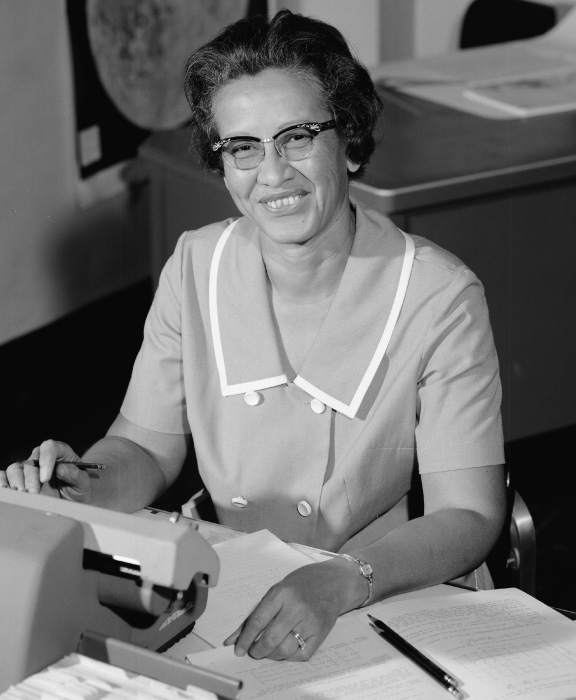
Katherine Johnson is the pioneering NASA mathematician who was integral to the successful and safe flight and return of many human missions as well as satellites. Prior to the work featured in the movie Hidden Figures, she had already made major contributions to the space program. She provided trajectory analysis for the Mercury mission, in which Alan Shepard became the first American to reach space, and she and engineer Ted Sopinski authored a monumental paper regarding placing an object in a precise orbital position and having it return safely to Earth. Many of the orbits she determined were made up of parabolas, and her ability to combine different types of math enabled an unprecedented level of precision. Johnson said, "You tell me when you want it and where you want it to land, and I'll do it backwards and tell you when to take off."
キャサリン・ジョンソンは、多くの有人の任務と人工衛星の飛行と帰還を成功させ安全にするのに欠かせなかった、先駆的なNASAの数学者である。映画『ドリーム』で取り上げられた仕事より前に、彼女はすでに宇宙計画に大きく寄与していた。彼女はマーキュリー計画の軌道の解析を担い、この計画でアラン・シェパードが宇宙に達した最初のアメリカ人になった。また彼女は技術者テッド・ソピンスキとともに、物を正確な軌道の位置に置き、それを安全に地球へ戻すことについての記念碑的な論文を書いた。彼女が決めた軌道の多くは放物線からなり、異なる種類の数学を組み合わせる彼女の力が、前例のない精度を可能にした。ジョンソンはこう言った。「いつ、どこに着地させたいかを言ってくれれば、逆にたどって、いつ飛び立てばいいか教えます。」
Johnson's work on parabolic orbits and other complex mathematics resulted in successful orbits, Moon landings, and the development of the Space Shuttle program. Applications of parabolas are also critical to other areas of science. Parabolic mirrors (or reflectors) are able to capture energy and focus it to a single point. The advantages of this property are evidenced by the vast list of parabolic objects we use every day: satellite dishes, suspension bridges, telescopes, microphones, spotlights, and car headlights, to name a few. Parabolic reflectors are also used in alternative energy devices, such as solar cookers and water heaters, because they are inexpensive to manufacture and need little maintenance. In this section we will explore the parabola and its uses, including low-cost, energy-efficient solar designs.
放物線の軌道その他の複雑な数学についてのジョンソンの仕事は、軌道飛行の成功、月着陸、スペースシャトル計画の発展をもたらした。放物線の応用は、科学のほかの分野でも決定的である。放物線の鏡(反射面)は、エネルギーを捉えて一点に集められる。この性質の利点は、日々使う放物線の物の長い一覧が示している。衛星放送の皿型受信器、吊り橋、望遠鏡、集音器、投光器、車の前照灯などである。放物線の反射面は、太陽熱調理器や湯沸かし器のような代替エネルギーの機器にも使われる。作るのが安く、手入れがほとんど要らないからである。この節では、放物線とその使い道を、安価で省エネな太陽熱の設計も含めて調べる。
Graphing Parabolas with Vertices at the Origin原点を頂点とする放物線のグラフを描く
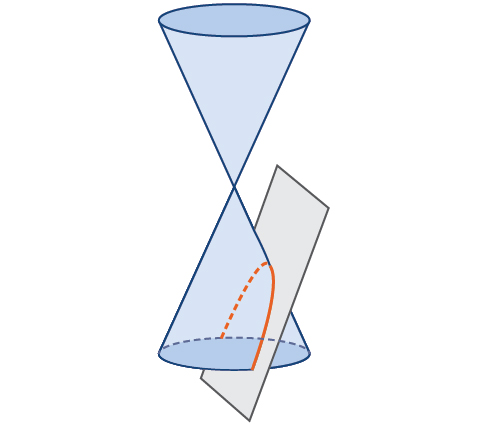
In The Ellipse, we saw that an ellipse is formed when a plane cuts through a right circular cone. If the plane is parallel to the edge of the cone, an unbounded curve is formed. This curve is a parabola. See Figure 2.
「楕円」の節で、平面が直円錐を切ると楕円ができるのを見た。平面が円錐の母線に平行なら、限りなく続く曲線ができる。この曲線が放物線である。図2を見よ。
Like the ellipse and hyperbola, the parabola can also be defined by a set of points in the coordinate plane. A parabola is the set of all points in a plane that are the same distance from a fixed line, called the directrix, and a fixed point (the focus) not on the directrix.
楕円や双曲線と同じく、放物線も座標平面の点の集合として定められる。放物線とは、平面上の点 のうち、準線という定まった直線と、その準線上にない定まった点(焦点)から等しい距離にあるものすべての集合である。
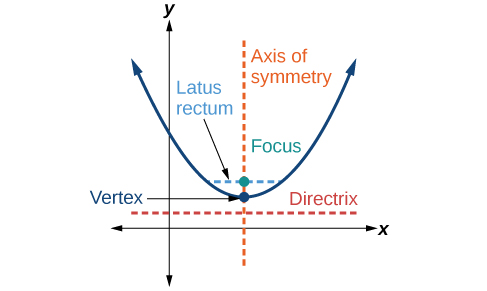
In Quadratic Functions, we learned about a parabola’s vertex and axis of symmetry. Now we extend the discussion to include other key features of the parabola. See Figure 3. Notice that the axis of symmetry passes through the focus and vertex and is perpendicular to the directrix. The vertex is the midpoint between the directrix and the focus.
「二次関数」で、放物線の頂点と対称軸を学んだ。ここでは話を広げ、放物線のほかの要となる特徴も含める。図3を見よ。対称軸が焦点と頂点を通り、準線に垂直であることに注意せよ。頂点は準線と焦点の中点である。
The line segment that passes through the focus and is parallel to the directrix is called the latus rectum. The endpoints of the latus rectum lie on the curve. By definition, the distance from the focus to any point on the parabola is equal to the distance from to the directrix.
焦点を通り準線に平行な線分を通径という。通径の端点は曲線上にある。定めにより、焦点から放物線上のどの点 までの距離 も、 から準線までの距離に等しい。
To work with parabolas in the coordinate plane, we consider two cases: those with a vertex at the origin and those with a vertex at a point other than the origin. We begin with the former.
座標平面で放物線を扱うため、二つの場合を考える。原点を頂点とするものと、原点以外の点を頂点とするものである。まず前者から始める。
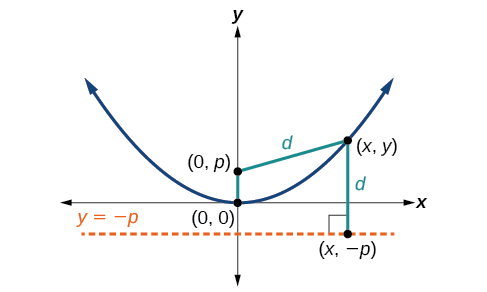
Let be a point on the parabola with vertex focus and directrix as shown in Figure 4. The distance from point to point on the directrix is the difference of the y-values: The distance from the focus to the point is also equal to and can be expressed using the distance formula.
図4に示すとおり、 を、頂点 、焦点 、準線 の放物線上の点とする。点 から準線上の点 までの距離 は、y の値の差 である。焦点 から点 までの距離も に等しく、距離の公式で表せる。
Set the two expressions for equal to each other and solve for to derive the equation of the parabola. We do this because the distance from to equals the distance from to
を表す二つの式を等しいと置き、 について解いて放物線の式を導く。こうするのは、 から までの距離が から までの距離に等しいからである。
We then square both sides of the equation, expand the squared terms, and simplify by combining like terms.
そして式の両辺を平方し、平方の項を展開し、同類項をまとめて簡単にする。
The equations of parabolas with vertex are when the x-axis is the axis of symmetry and when the y-axis is the axis of symmetry. These standard forms are given below, along with their general graphs and key features.
頂点 の放物線の式は、x軸が対称軸のときは 、y軸が対称軸のときは である。この標準の形を、一般のグラフと要となる特徴とともに下に示す。
Standard Forms of Parabolas with Vertex (0, 0) 原点を頂点とする放物線の標準形
Table 1 and Figure 5 summarize the standard features of parabolas with a vertex at the origin.
表1と図5に、原点を頂点とする放物線の標準の特徴をまとめる。
| Axis of Symmetry対称軸 | Equation式 | Focus焦点 | Directrix準線 | Endpoints of Latus Rectum通径の端点 |
| x-axisx軸 | ||||
| y-axisy軸 |
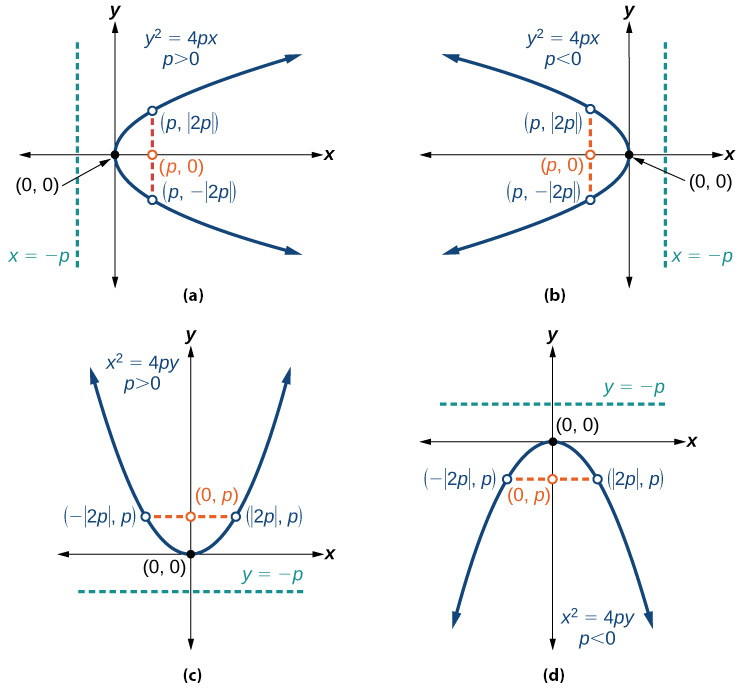
The key features of a parabola are its vertex, axis of symmetry, focus, directrix, and latus rectum. See Figure 5. When given a standard equation for a parabola centered at the origin, we can easily identify the key features to graph the parabola.
放物線の要となる特徴は、頂点、対称軸、焦点、準線、通径である。図5を見よ。原点を中心とする放物線の標準の式が与えられれば、放物線のグラフを描くための要となる特徴が容易に見分けられる。
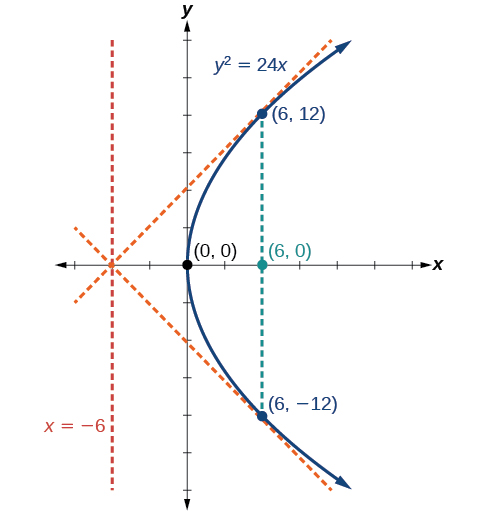
A line is said to be tangent to a curve if it intersects the curve at exactly one point. If we sketch lines tangent to the parabola at the endpoints of the latus rectum, these lines intersect on the axis of symmetry, as shown in Figure 6.
直線が曲線とちょうど一点で交わるとき、その直線はその曲線に接するという。通径の端点で放物線に接する直線の概形を描くと、図6に示すとおり、その直線は対称軸上で交わる。
How To 手順
Given a standard form equation for a parabola centered at (0, 0), sketch the graph.
(0, 0) を中心とする放物線の式が標準の形で与えられたとき、グラフの概形を描く。
1. Determine which of the standard forms applies to the given equation: or 2. Use the standard form identified in Step 1 to determine the axis of symmetry, focus, equation of the directrix, and endpoints of the latus rectum. If the equation is in the form then the axis of symmetry is the x-axis, set equal to the coefficient of x in the given equation to solve for If the parabola opens right. If the parabola opens left. use to find the coordinates of the focus, use to find the equation of the directrix, use to find the endpoints of the latus rectum, Alternately, substitute into the original equation. If the equation is in the form then the axis of symmetry is the y-axis, set equal to the coefficient of y in the given equation to solve for If the parabola opens up. If the parabola opens down. use to find the coordinates of the focus, use to find equation of the directrix, use to find the endpoints of the latus rectum, 3. Plot the focus, directrix, and latus rectum, and draw a smooth curve to form the parabola.
1. 与えられた式にどちらの標準の形が当てはまるかを決める。 か かである。2. 第1歩で見分けた標準の形を使って、対称軸、焦点、準線の式、通径の端点を決める。式が の形なら、対称軸は x軸 である。与えられた式の x の係数を と等しいと置いて について解く。 なら放物線は右に開く。 なら左に開く。 を使って焦点の座標 を求める。 を使って準線の式 を求める。 を使って通径の端点 を求める。あるいは、元の式に を代入する。式が の形なら、対称軸は y軸 である。与えられた式の y の係数を と等しいと置いて について解く。 なら放物線は上に開く。 なら下に開く。 を使って焦点の座標 を求める。 を使って準線の式 を求める。 を使って通径の端点 を求める。3. 焦点、準線、通径を打ち、なめらかな曲線を描いて放物線を作る。
Example 1例1
Graphing a Parabola with Vertex (0, 0) and the x-axis as the Axis of Symmetry頂点 (0, 0)、対称軸が x軸の放物線のグラフを描く
Graph Identify and label the focus, directrix, and endpoints of the latus rectum.
のグラフを描け。焦点、準線、通径の端点を見分けて印を付けよ。
Solution 解答
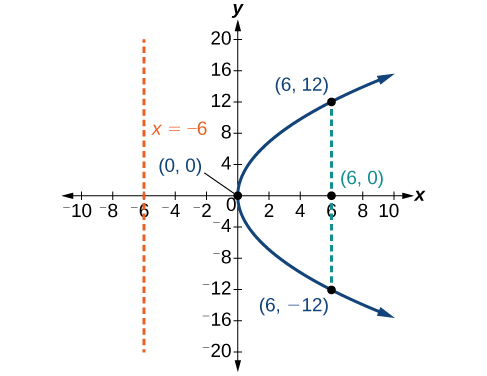
The standard form that applies to the given equation is Thus, the axis of symmetry is the x-axis. It follows that:
与えられた式に当てはまる標準の形は である。よって対称軸は x軸である。したがって次が分かる。
• so Since the parabola opens right• the coordinates of the focus are • the equation of the directrix is • the endpoints of the latus rectum have the same x-coordinate at the focus. To find the endpoints, substitute into the original equation:
・ なので である。 なので放物線は右に開く・焦点の座標は ・準線の式は ・通径の端点は焦点と同じ x座標を持つ。端点を求めるには、元の式に を代入する。
Next we plot the focus, directrix, and latus rectum, and draw a smooth curve to form the parabola. Figure 7
次に、焦点、準線、通径を打ち、なめらかな曲線を描いて放物線を作る。図7
Try It #1やってみよう1
Graph Identify and label the focus, directrix, and endpoints of the latus rectum.
のグラフを描け。焦点、準線、通径の端点を見分けて印を付けよ。
Example 2例2
Graphing a Parabola with Vertex (0, 0) and the y-axis as the Axis of Symmetry頂点 (0, 0)、対称軸が y軸の放物線のグラフを描く
Graph Identify and label the focus, directrix, and endpoints of the latus rectum.
のグラフを描け。焦点、準線、通径の端点を見分けて印を付けよ。
Solution 解答
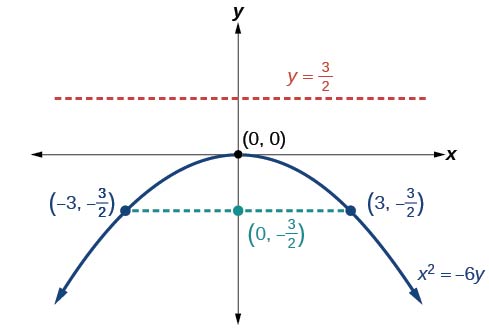
The standard form that applies to the given equation is Thus, the axis of symmetry is the y-axis. It follows that:
与えられた式に当てはまる標準の形は である。よって対称軸は y軸である。したがって次が分かる。
• so Since the parabola opens down.• the coordinates of the focus are • the equation of the directrix is • the endpoints of the latus rectum can be found by substituting into the original equation,
・ なので である。 なので放物線は下に開く。・焦点の座標は ・準線の式は ・通径の端点は、元の式 に を代入すれば求まる。
Next we plot the focus, directrix, and latus rectum, and draw a smooth curve to form the parabola.
次に、焦点、準線、通径を打ち、なめらかな曲線を描いて放物線を作る。
Try It #2やってみよう2
Graph Identify and label the focus, directrix, and endpoints of the latus rectum.
のグラフを描け。焦点、準線、通径の端点を見分けて印を付けよ。
Writing Equations of Parabolas in Standard Form放物線の式を標準の形で書く
In the previous examples, we used the standard form equation of a parabola to calculate the locations of its key features. We can also use the calculations in reverse to write an equation for a parabola when given its key features.
前の例では、放物線の標準の形の式を使って、要となる特徴の位置を計算した。この計算を逆にたどれば、要となる特徴が与えられたときに放物線の式も書ける。
How To 手順
Given its focus and directrix, write the equation for a parabola in standard form.
焦点と準線が与えられたとき、放物線の式を標準の形で書く。
1. Determine whether the axis of symmetry is the x- or y-axis. If the given coordinates of the focus have the form then the axis of symmetry is the x-axis. Use the standard form If the given coordinates of the focus have the form then the axis of symmetry is the y-axis. Use the standard form 2. Multiply 3. Substitute the value from Step 2 into the equation determined in Step 1.
1. 対称軸が x軸か y軸かを決める。与えられた焦点の座標が の形なら、対称軸は x軸である。標準の形 を使う。与えられた焦点の座標が の形なら、対称軸は y軸である。標準の形 を使う。2. を掛ける。3. 第2歩の値を、第1歩で決めた式に代入する。
Example 3例3
Writing the Equation of a Parabola in Standard Form Given its Focus and Directrix焦点と準線が与えられたときに放物線の式を標準の形で書く
What is the equation for the parabola with focus and directrix
焦点 、準線 の放物線の式はどれか。
Solution 解答
The focus has the form so the equation will have the form
焦点は の形なので、式は の形になる。
• Multiplying we have • Substituting for we have
・ を掛けると、 を得る。・ に代入すると、 を得る。
Therefore, the equation for the parabola is
したがって、この放物線の式は である。
Try It #3やってみよう3
What is the equation for the parabola with focus and directrix
焦点 、準線 の放物線の式はどれか。
Graphing Parabolas with Vertices Not at the Origin原点を頂点としない放物線のグラフを描く
Like other graphs we’ve worked with, the graph of a parabola can be translated. If a parabola is translated units horizontally and units vertically, the vertex will be This translation results in the standard form of the equation we saw previously with replaced by and replaced by
これまで扱ったほかのグラフと同じく、放物線のグラフも平行移動できる。放物線を水平に 、鉛直に だけ移すと、頂点は になる。この平行移動により、先に見た式の標準の形で が に、 が に置き換わったものが得られる。
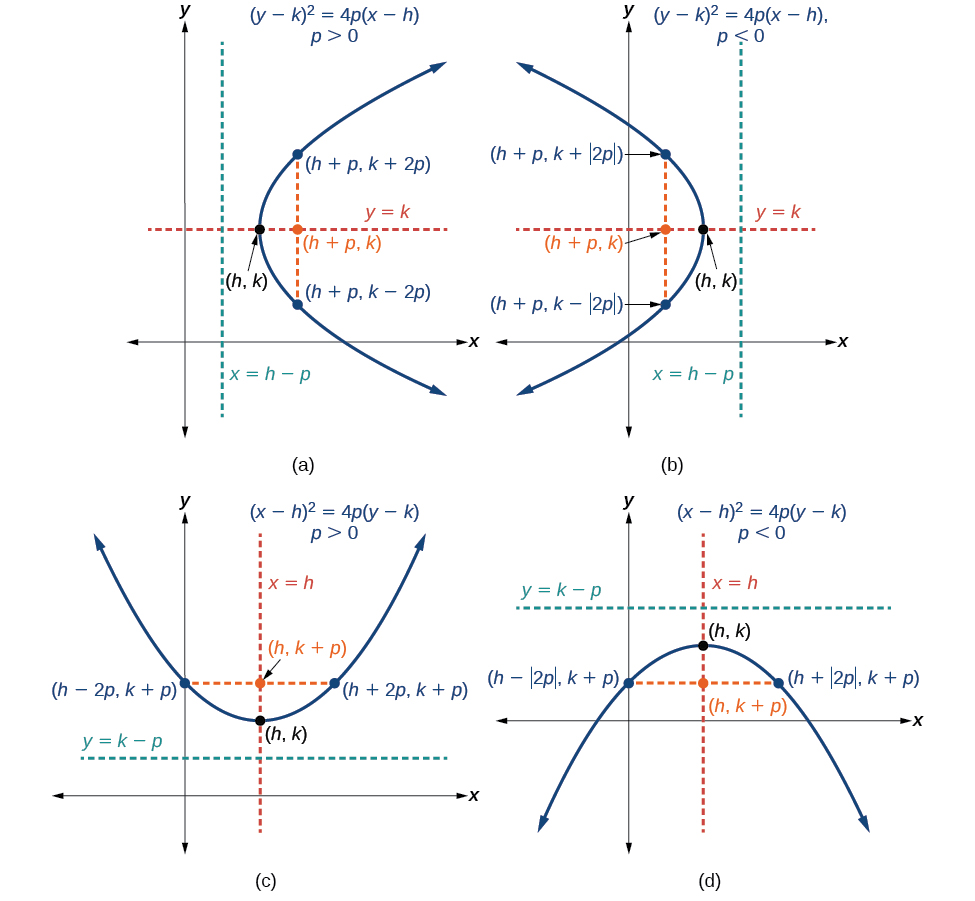
To graph parabolas with a vertex other than the origin, we use the standard form for parabolas that have an axis of symmetry parallel to the x-axis, and for parabolas that have an axis of symmetry parallel to the y-axis. These standard forms are given below, along with their general graphs and key features.
原点以外の頂点 を持つ放物線のグラフを描くには、対称軸が x軸に平行な放物線には標準の形 、対称軸が y軸に平行な放物線には を使う。この標準の形を、一般のグラフと要となる特徴とともに下に示す。
Standard Forms of Parabolas with Vertex ( 放物線の方程式の標準形(頂点:
Standard Forms of Parabolas with Vertex (h, k)頂点 (h, k) の放物線の標準の形
Table 2 and Figure 9 summarize the standard features of parabolas with a vertex at a point
表2と図9に、点 を頂点とする放物線の標準の特徴をまとめる。
| Axis of Symmetry対称軸 | Equation式 | Focus焦点 | Directrix準線 | Endpoints of Latus Rectum通径の端点 |
How To 手順
Given a standard form equation for a parabola centered at (h, k), sketch the graph.
(h, k) を中心とする放物線の式が標準の形で与えられたとき、グラフの概形を描く。
1. Determine which of the standard forms applies to the given equation: or 2. Use the standard form identified in Step 1 to determine the vertex, axis of symmetry, focus, equation of the directrix, and endpoints of the latus rectum. If the equation is in the form then: use the given equation to identify and for the vertex, use the value of to determine the axis of symmetry, set equal to the coefficient of in the given equation to solve for If the parabola opens right. If the parabola opens left. use and to find the coordinates of the focus, use and to find the equation of the directrix, use and to find the endpoints of the latus rectum, If the equation is in the form then: use the given equation to identify and for the vertex, use the value of to determine the axis of symmetry, set equal to the coefficient of in the given equation to solve for If the parabola opens up. If the parabola opens down. use and to find the coordinates of the focus, use and to find the equation of the directrix, use and to find the endpoints of the latus rectum, 3. Plot the vertex, axis of symmetry, focus, directrix, and latus rectum, and draw a smooth curve to form the parabola.
1. 与えられた式にどちらの標準の形が当てはまるかを決める。 か かである。2. 第1歩で見分けた標準の形を使って、頂点、対称軸、焦点、準線の式、通径の端点を決める。式が の形なら、与えられた式から頂点の と すなわち を見分ける。 の値を使って対称軸 を決める。与えられた式の の係数を と等しいと置いて について解く。 なら放物線は右に開く。 なら左に開く。 と を使って焦点の座標 を求める。 と を使って準線の式 を求める。 と を使って通径の端点 を求める。式が の形なら、与えられた式から頂点の と すなわち を見分ける。 の値を使って対称軸 を決める。与えられた式の の係数を と等しいと置いて について解く。 なら放物線は上に開く。 なら下に開く。 と を使って焦点の座標 を求める。 と を使って準線の式 を求める。 と を使って通径の端点 を求める。3. 頂点、対称軸、焦点、準線、通径を打ち、なめらかな曲線を描いて放物線を作る。
Example 4例4
Graphing a Parabola with Vertex (h, k) and Axis of Symmetry Parallel to the x-axis頂点 (h, k)、対称軸が x軸に平行な放物線のグラフを描く
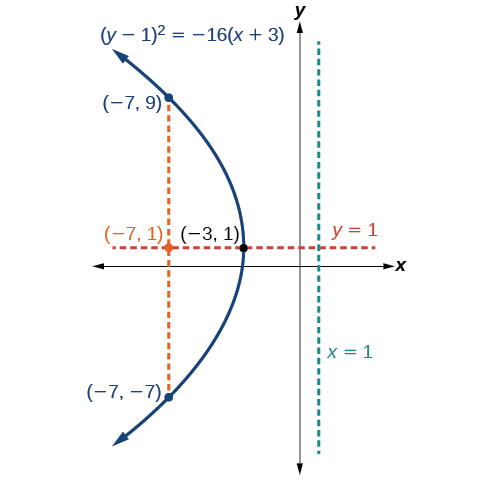
Graph Identify and label the vertex, axis of symmetry, focus, directrix, and endpoints of the latus rectum.
のグラフを描け。頂点、対称軸、焦点、準線、通径の端点を見分けて印を付けよ。
Solution 解答
The standard form that applies to the given equation is Thus, the axis of symmetry is parallel to the x-axis. It follows that:
与えられた式に当てはまる標準の形は である。よって対称軸は x軸に平行である。したがって次が分かる。
• the vertex is • the axis of symmetry is • so Since the parabola opens left.• the coordinates of the focus are • the equation of the directrix is • the endpoints of the latus rectum are or and
・頂点は ・対称軸は ・ なので である。 なので放物線は左に開く。・焦点の座標は ・準線の式は ・通径の端点は 、すなわち と
Next we plot the vertex, axis of symmetry, focus, directrix, and latus rectum, and draw a smooth curve to form the parabola. See Figure 10.
次に、頂点、対称軸、焦点、準線、通径を打ち、なめらかな曲線を描いて放物線を作る。図10を見よ。
Try It #4やってみよう4
Graph Identify and label the vertex, axis of symmetry, focus, directrix, and endpoints of the latus rectum.
のグラフを描け。頂点、対称軸、焦点、準線、通径の端点を見分けて印を付けよ。
Example 5例5
Graphing a Parabola from an Equation Given in General Form一般の形で与えられた式から放物線のグラフを描く
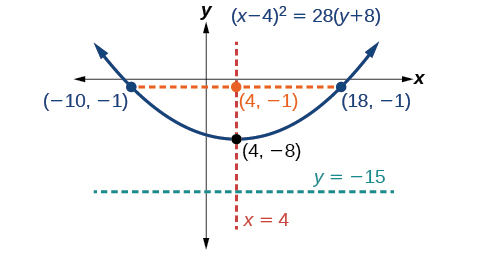
Graph Identify and label the vertex, axis of symmetry, focus, directrix, and endpoints of the latus rectum.
のグラフを描け。頂点、対称軸、焦点、準線、通径の端点を見分けて印を付けよ。
Solution 解答
Start by writing the equation of the parabola in standard form. The standard form that applies to the given equation is Thus, the axis of symmetry is parallel to the y-axis. To express the equation of the parabola in this form, we begin by isolating the terms that contain the variable in order to complete the square.
まず、この放物線の式を標準の形で書くことから始める。与えられた式に当てはまる標準の形は である。よって対称軸は y軸に平行である。この放物線の式をこの形で表すため、平方完成するのに変数 を含む項を取り出すことから始める。
It follows that:
したがって次が分かる。
• the vertex is • the axis of symmetry is • since and so the parabola opens up• the coordinates of the focus are • the equation of the directrix is • the endpoints of the latus rectum are or and
・頂点は ・対称軸は ・ なので、放物線は上に開く・焦点の座標は ・準線の式は ・通径の端点は 、すなわち と
Next we plot the vertex, axis of symmetry, focus, directrix, and latus rectum, and draw a smooth curve to form the parabola. See Figure 11.
次に、頂点、対称軸、焦点、準線、通径を打ち、なめらかな曲線を描いて放物線を作る。図11を見よ。
Try It #5やってみよう5
Graph Identify and label the vertex, axis of symmetry, focus, directrix, and endpoints of the latus rectum.
のグラフを描け。頂点、対称軸、焦点、準線、通径の端点を見分けて印を付けよ。
Solving Applied Problems Involving Parabolas放物線にかかわる応用問題を解く
As we mentioned at the beginning of the section, parabolas are used to design many objects we use every day, such as telescopes, suspension bridges, microphones, and radar equipment. Parabolic mirrors, such as the one used to light the Olympic torch, have a very unique reflecting property. When rays of light parallel to the parabola’s axis of symmetry are directed toward any surface of the mirror, the light is reflected directly to the focus. See Figure 12. This is why the Olympic torch is ignited when it is held at the focus of the parabolic mirror.
この節の初めに述べたとおり、放物線は、望遠鏡、吊り橋、集音器、電波探知の機器など、日々使う多くの物の設計に使われている。オリンピックの聖火を灯すのに使うような放物線の鏡は、たいへん独特な反射の性質を持つ。放物線の対称軸に平行な光線が鏡のどの面へ向けられても、光はまっすぐ焦点へ反射する。図12を見よ。オリンピックの聖火が、放物線の鏡の焦点に置かれると点くのはこのためである。
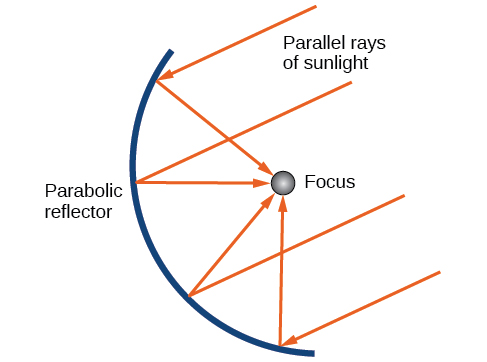
Parabolic mirrors have the ability to focus the sun’s energy to a single point, raising the temperature hundreds of degrees in a matter of seconds. Thus, parabolic mirrors are featured in many low-cost, energy efficient solar products, such as solar cookers, solar heaters, and even travel-sized fire starters.
放物線の鏡は太陽のエネルギーを一点に集められ、数秒で温度を数百度上げる。よって、放物線の鏡は、太陽熱調理器、太陽熱の暖房、旅行用の大きさの着火具など、多くの安価で省エネな太陽熱の製品に使われている。
Example 6例6
Solving Applied Problems Involving Parabolas放物線にかかわる応用問題を解く
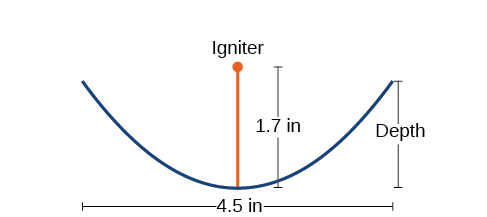
A cross-section of a design for a travel-sized solar fire starter is shown in Figure 13. The sun’s rays reflect off the parabolic mirror toward an object attached to the igniter. Because the igniter is located at the focus of the parabola, the reflected rays cause the object to burn in just seconds.
旅行用の大きさの太陽熱着火具の設計の断面を図13に示す。太陽の光線が放物線の鏡で反射し、点火装置に取り付けた物へ向かう。点火装置が放物線の焦点にあるので、反射した光線がわずか数秒でその物を燃やす。
ⓐFind the equation of the parabola that models the fire starter. Assume that the vertex of the parabolic mirror is the origin of the coordinate plane.ⓑ Use the equation found in part ⓐ to find the depth of the fire starter.
ⓐこの着火具のモデルとなる放物線の式を求めよ。放物線の鏡の頂点を座標平面の原点とせよ。ⓑ ⓐで求めた式を使って、この着火具の深さを求めよ。
Solution 解答
ⓐThe vertex of the dish is the origin of the coordinate plane, so the parabola will take the standard form where The igniter, which is the focus, is 1.7 inches above the vertex of the dish. Thus we have ⓑThe dish extends inches on either side of the origin. We can substitute 2.25 for in the equation from part (a) to find the depth of the dish. The dish is about 0.74 inches deep.
ⓐ皿の頂点が座標平面の原点なので、この放物線は である標準の形 をとる。焦点である点火装置は、皿の頂点の1.7インチ上にある。よって である。ⓑ皿は原点の両側へ インチ広がっている。(a)の式の に2.25を代入すれば、皿の深さが求まる。 皿の深さはおよそ0.74インチである。
Try It #6やってみよう6
Balcony-sized solar cookers have been designed for families living in India. The top of a dish has a diameter of 1600 mm. The sun’s rays reflect off the parabolic mirror toward the “cooker,” which is placed 320 mm from the base.
インドに住む家族のために、バルコニーの大きさの太陽熱調理器が設計されている。皿の上部の直径は1600mmである。太陽の光線が放物線の鏡で反射し、底から320mmのところに置かれた「調理部」へ向かう。
ⓐFind an equation that models a cross-section of the solar cooker. Assume that the vertex of the parabolic mirror is the origin of the coordinate plane, and that the parabola opens to the right (i.e., has the x-axis as its axis of symmetry).
ⓐこの太陽熱調理器の断面のモデルとなる式を求めよ。放物線の鏡の頂点を座標平面の原点とし、放物線は右に開く(すなわち x軸を対称軸とする)とせよ。
ⓑ Use the equation found in part ⓐ to find the depth of the cooker.
ⓑ ⓐで求めた式を使って、この調理器の深さを求めよ。
Media 教材
Access these online resources for additional instruction and practice with parabolas.
放物線についての説明と練習をさらに求めるなら、次のオンライン教材にあたるとよい。
• Conic Sections: The Parabola Part 1 of 2• Conic Sections: The Parabola Part 2 of 2• Parabola with Vertical Axis• Parabola with Horizontal Axis
・円錐曲線: 放物線 その1・円錐曲線: 放物線 その2・軸が縦の放物線・軸が横の放物線
Verbal言葉で答える問題
2. If the equation of a parabola is written in standard form and is positive and the directrix is a vertical line, then what can we conclude about its graph?
2. 放物線の式が標準の形で書かれ、 が正で準線が縦の直線のとき、そのグラフについて何が結論できるか。
4. What is the effect on the graph of a parabola if its equation in standard form has increasing values of
4. 標準の形の式で の値が増えると、放物線のグラフにどんな効きが現れるか。
Algebraic代数の問題
For the following exercises, determine whether the given equation is a parabola. If so, rewrite the equation in standard form.
次の各問について、与えられた式が放物線かどうかを判定せよ。そうなら、その式を標準の形に書き直せ。
For the following exercises, rewrite the given equation in standard form, and then determine the vertex focus and directrix of the parabola.
次の各問について、与えられた式を標準の形に書き直し、そしてこの放物線の頂点 、焦点 、準線 を決めよ。
Graphicalグラフの問題
For the following exercises, graph the parabola, labeling the focus and the directrix.
次の各問について、放物線のグラフを描き、焦点と準線に印を付けよ。
For the following exercises, find the equation of the parabola given information about its graph.
次の各問について、放物線のグラフについての情報が与えられたとき、その式を求めよ。
46. Vertex is directrix is focus is
46. 頂点 、準線 、焦点
48. Vertex is directrix is focus is
48. 頂点 、準線 、焦点
50. Vertex is directrix is focus is
50. 頂点 、準線 、焦点
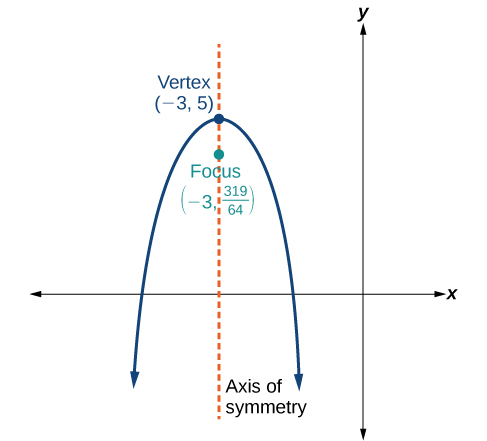
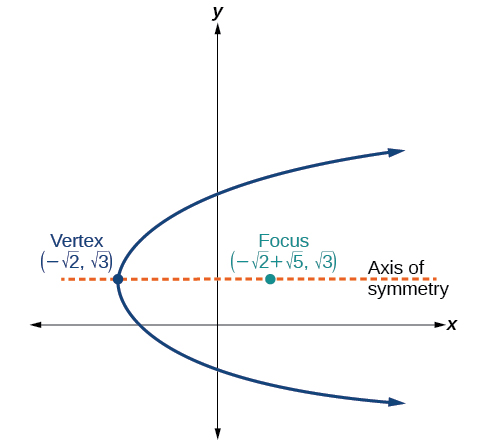
For the following exercises, determine the equation for the parabola from its graph.
次の各問について、放物線のグラフからその式を決めよ。
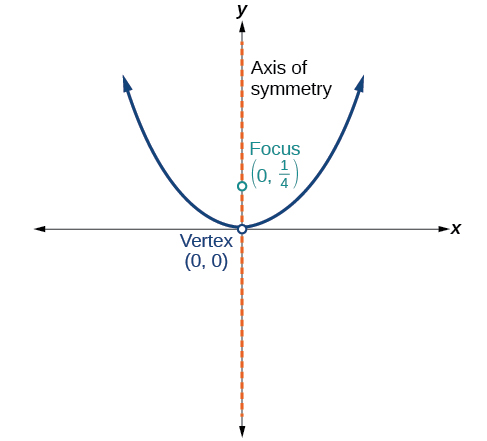
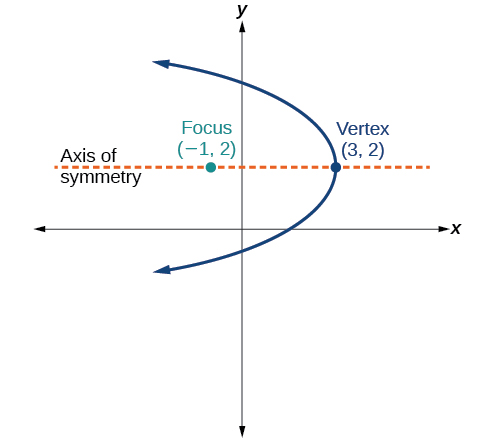
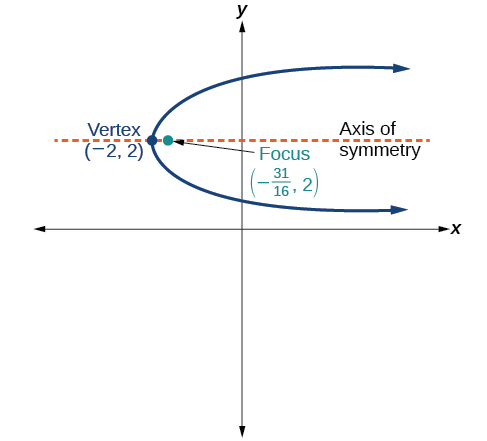
Extensions発展問題
Real-World Applications現実世界への応用
62. If we want to construct the mirror from the previous exercise such that the focus is located at what should the equation of the parabola be?
62. 前の問いの鏡を、焦点が にあるように作りたいとき、この放物線の式はどうなるべきか。
63. A satellite dish is shaped like a paraboloid of revolution. This means that it can be formed by rotating a parabola around its axis of symmetry. The receiver is to be located at the focus. If the dish is 12 feet across at its opening and 4 feet deep at its center, where should the receiver be placed?
63. 衛星放送の皿型受信器は回転放物面の形をしている。これは、放物線をその対称軸のまわりに回せば作れるということである。受信部は焦点に置くことになっている。この皿が開口部で差し渡し12フィート、中心で深さ4フィートなら、受信部はどこに置くべきか。
64. Consider the satellite dish from the previous exercise. If the dish is 8 feet across at the opening and 2 feet deep, where should we place the receiver?
64. 前の問いの皿型受信器を考えよ。この皿が開口部で差し渡し8フィート、深さ2フィートなら、受信部はどこに置くべきか。
65. The reflector in a searchlight is shaped like a paraboloid of revolution. A light source is located 1 foot from the base along the axis of symmetry. If the opening of the searchlight is 3 feet across, find the depth.
65. 探照灯の反射面は回転放物面の形をしている。光源は対称軸に沿って底から1フィートのところにある。この探照灯の開口部が差し渡し3フィートなら、深さを求めよ。
66. If the reflector in the searchlight from the previous exercise has the light source located 6 inches from the base along the axis of symmetry and the opening is 4 feet, find the depth.
66. 前の問いの探照灯の反射面で、光源が対称軸に沿って底から6インチのところにあり、開口部が4フィートなら、深さを求めよ。
68. If the arch from the previous exercise has a span of 160 feet and a maximum height of 40 feet, find the equation of the parabola, and determine the distance from the center at which the height is 20 feet.
68. 前の問いのアーチが幅160フィート、最大の高さ40フィートなら、この放物線の式を求め、高さが20フィートになる中心からの距離を決めよ。
70. For the object from the previous exercise, assume the path followed is given by Determine how far along the horizontal the object traveled to reach maximum height.
70. 前の問いの物について、たどる道筋が で与えられるとする。この物が最大の高さに達するまでに水平にどれだけ進んだかを決めよ。